He once advised the French president, now he's entering Binance with stablecoin Usual
TechFlow Selected TechFlow Selected
He once advised the French president, now he's entering Binance with stablecoin Usual
The earlier you participate in the distribution, the more tokens you will receive.
 Navigating Web3 tides with focused insights
Author: Chain Master
More than a month later, Binance has finally launched its latest Launchpool. However, unlike many people expected, the recent new token offering Usual wasn't particularly popular—many seasoned veterans, including the author, missed out on it.
The reason? Usual focuses on stablecoin issuance, which immediately reminds many experienced investors of algorithmic stablecoins that boomed during the last bull market—often associated with blowups and collapses. To this day, I still remember rushing into algorithmic stablecoins while burning hundreds of dollars in gas fees—then nothing more came of it.
In fact, Usual is fundamentally different from what most people imagine as algorithmic stablecoins. Their stablecoin is backed 1:1 by real-world assets (RWA), fully compliant and regulated—features entirely distinct from traditional algorithmic stablecoins.
According to the official description, Usual is a multi-chain infrastructure that integrates an expanding ecosystem of tokenized real-world assets (RWA) from institutions like BlackRock, Ondo, Mountain Protocol, M0, Hashnote, transforming them into permissionless, on-chain verifiable, and composable stablecoins called USD0.
In April this year, Usual announced a $7 million funding round led by IOSG and Kraken Ventures, with participation from GSR, Mantle, Starkware, Flowdesk, Avid 3, Bing Ventures, Breed, Hypersphere, Kima Ventures, Psalion, Public Works, and X Ventures.
Seven months later, Usual announced another $1.5 million in funding, with participants including Comfy Capital, early crypto investor echo, and Jed Breed, founder of Breed VC. Specific valuation details were not disclosed.
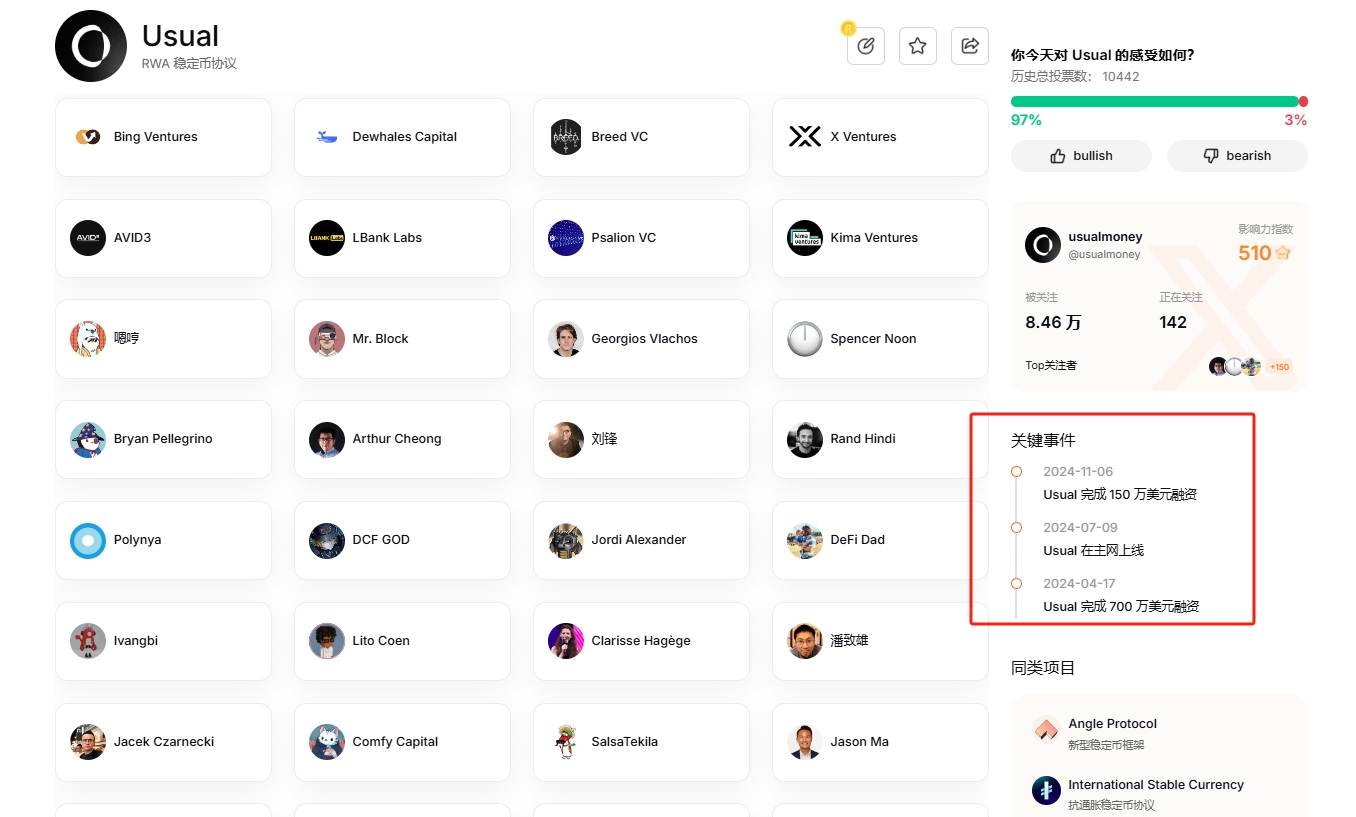
This means Usual has publicly disclosed only $8.5 million in total funding—a far cry from projects raising tens or even hundreds of millions. Yet while most users chase after so-called "blue-chip" projects, Usual made it straight onto Binance. Those who missed the initial opportunity can still participate via Launchpool mining.
Missed it? Yes. But we shouldn't skip researching Usual—it's listed on the "Universe Exchange," after all, meaning it must have something going for it.
1. Founder: Former Political Advisor to the French President
Usual CEO Pierre Person was formerly a French Member of Parliament focusing on monetary policy and served as a political advisor to French President Emmanuel Macron.
In 2022, he founded Usual with the goal of rebuilding a stable feedback mechanism through decentralized data, enabling users to gain greater ownership over their data.
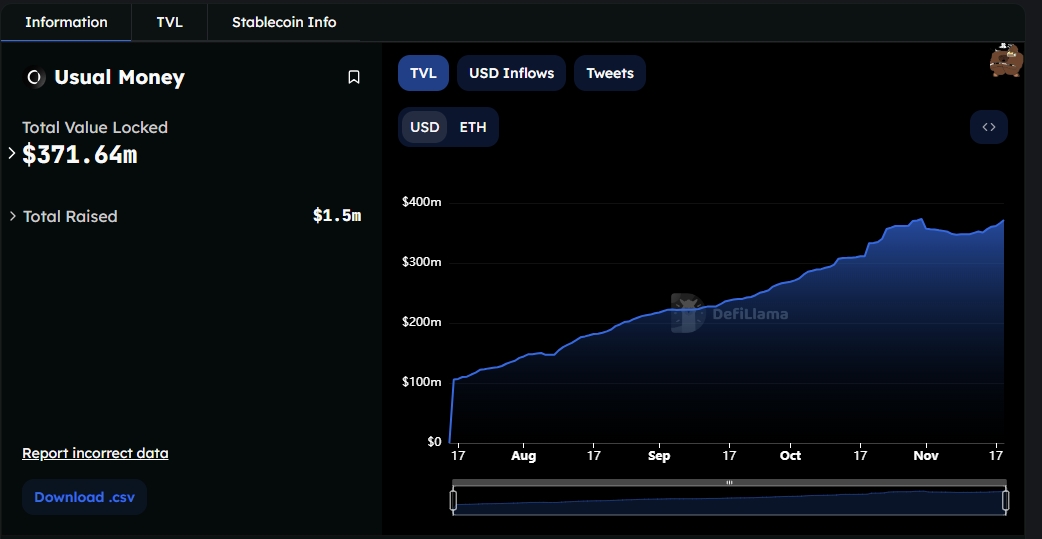
To date, the Usual platform has surpassed $370 million in total value locked (TVL).
2. USD0: The First Liquid Deposit Token
USD0 is Usual’s first Liquid Deposit Token (LDT), 1:1 backed by ultra-short-term real-world assets (RWA), ensuring stability and security. As an RWA-backed stablecoin aggregating various U.S. Treasury token offerings, USD0 can be minted in two ways:
① Direct RWA Deposit: Users deposit eligible RWAs into the protocol and receive an equivalent amount of USD0 at a 1:1 ratio.
② Indirect USDC/USDT Deposit: Users deposit USDC or USDT into the protocol and receive USD0 at a 1:1 rate. This indirect method involves third-party collateral providers who supply the required RWA-backed collateral.
3. $USUAL: 90% of Supply Allocated to Community
The total supply of $USUAL is 4 billion tokens, with an initial circulation of 12.37%, of which 7.5% is allocated to Binance Launchpool.
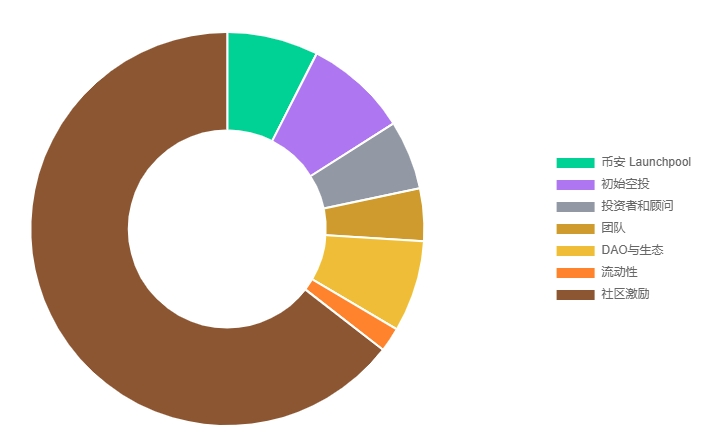
The official documentation emphasizes that 90% of the total token supply will be distributed to the community, while only 10% goes to insiders (team, advisors, investors), ensuring fair distribution and genuine user participation.
As the official governance token, $USUAL holders will have access to the platform's actual protocol revenue, future income streams, and infrastructure ownership rights.
Notably, USUAL is deflationary—similar to Bitcoin’s halving mechanism—meaning earlier participants receive larger token allocations.
For more project information, refer to the Binance Research report:
Join TechFlow official community to stay tuned
Telegram:https://t.me/TechFlowDaily
X (Twitter):https://x.com/TechFlowPost
X (Twitter) EN:https://x.com/BlockFlow_News