After SUI and Aptos, the next standout Move-based public blockchain
TechFlow Selected TechFlow Selected
After SUI and Aptos, the next standout Move-based public blockchain
Movement surpasses Libra vision, mainnet launch imminent.
 Navigating Web3 tides with focused insights
Author: Fishery, Core Contributor at Biteye
Introduction
Five years ago, Facebook's Libra/Diem project emerged unexpectedly and captured global attention. However, this ambitious initiative quietly ended in 2022, leaving behind an unfinished legacy. Yet, Libra’s technological inheritance—Move language—is being revitalized through its "successors."
As widely known, Aptos and Sui carry forward this technical heritage.
Now, the emergence of Movement Network reveals possibilities beyond Libra's original vision. Through its modular design and emphasis on ecosystem interoperability, it charts a far more expansive roadmap for Move than what was initially conceived with Libra/Diem.
The Evolution of Smart Contract Blockchains
Ethereum became the most popular blockchain after Bitcoin thanks to its EVM smart contract functionality, which also led to the widespread adoption of Solidity, the programming language for EVM.
After Ethereum, many emerging blockchains attempted alternative approaches, creating their own smart contract languages in hopes of replicating Ethereum's success. For example, NEO experimented with C# and JavaScript, Waves introduced Ride, and Cardano adopted Haskell. Despite their technically innovative beginnings, most failed to gain significant market share and ultimately could not challenge Solidity’s dominance.
During recent years of DeFi development, Solidity's drawbacks have become increasingly apparent: complex syntax, vulnerability-prone design, and cumbersome development processes have left growing numbers of teams and users fatigued.
The demand for a simpler, safer next-generation smart contract language has grown stronger.
Move language fits this need perfectly, emphasizing security and uniqueness of data resources—a reflection of deep understanding in financial safety and resource management. This design philosophy aligns closely with the core needs of blockchain asset management and is more readily accepted by communities that prioritize security and stability.
In this market cycle, the Move ecosystem has steadily advanced, with developers and users progressively voting with their feet by migrating to Move-based blockchains. Unlike previous waves of speculative "me-too" smart contract languages, Move’s popularity stems from its ability to genuinely address real developer and market demands.
Observing the development trajectory of the Move ecosystem reveals a growth path fundamentally different from Ethereum's—and distinct from early smart contract platforms that rapidly expanded during market booms. The Move ecosystem has chosen a more pragmatic strategy focused on solving practical problems and meeting actual market needs.
Comparing the Move and Ethereum Ecosystems
There are numerous technical comparisons between Move and Ethereum in existing literature. This section instead focuses on their respective paths to rise.
The biggest difference lies in the much closer relationship between infrastructure teams and ecosystem projects in the Move ecosystem.
In Ethereum’s development, core developer teams maintained relatively distant relationships with ecosystem projects, offering little explicit support. When ETH dropped from $1,400 to $80 in 2018, there were almost no applications running on the chain. Many readers know the rest: grassroots DeFi teams and miners saved Ethereum.
The Ethereum Foundation did not particularly acknowledge or support these contributions, instead focusing solely on advancing Layer 2 and PoS upgrades. While this ensured continuity in the technical roadmap, it also somewhat constrained the diversification of ecosystem infrastructure.
In a sense, Ethereum’s success originated from both the smart contract capabilities developed by its core team and the pioneering efforts of grassroots DeFi teams—neither could have succeeded alone.
In contrast, during its early stages, Move’s infrastructure teams actively supported various applications and developers within the community, especially in areas such as development tools, funding, and resource sharing—demonstrating a more collaborative and mutually beneficial relationship. This synergy strengthened community cohesion and laid a solid foundation for the prosperity of the Move ecosystem.
Moreover, the Move ecosystem demonstrates stronger market orientation. Of particular note is the Movement project—the only solution in the Move ecosystem comparable to Ethereum Layer 2—which exemplifies Move’s keen responsiveness to market demands.
Unlike Ethereum, which vacillated between Beam and Layer 2 solutions, Movement is not bound by centralized organizational decisions. Instead, it delivers Move-based infrastructure products aligned with market feedback.
In the long run, this market-driven technological development path may be more conducive to fostering a vibrant innovation environment.
It allows technology upgrades to respond directly to user and developer needs, rather than being constrained by predetermined plans from a centralized entity. This characteristic enables the Move ecosystem to demonstrate greater adaptability and growth potential in the fast-changing blockchain landscape.
The Evolution of Move
The development of Move's infrastructure ecosystem can be divided into three phases.
Phase One (2019): Facebook (now Meta) launched the Libra/Diem project aiming to create a global digital currency and introduced a new programming language called Move to ensure smart contract security. Due to U.S. regulatory pressures, the project was terminated in 2022, halting Move’s first commercial application.
Phase Two: Following Diem’s termination, two Move-based Layer 1 blockchains—Aptos and Sui—emerged, founded by former members of the Libra/Diem team, seeking to advance and commercialize the project’s innovative ideas.
Aptos was co-founded by Mo Shaikh and Avery Ching, former Diem executives, launching its mainnet in October 2022. Targeting high performance and low latency, Aptos leverages the Move language and a unique consensus protocol, attracting developer interest and quickly securing substantial capital investment.
Sui, on the other hand, was created by another group of ex-Diem engineers from Mysten Labs. It launched its mainnet in May 2023, positioning itself as a modular and highly scalable high-performance blockchain.
Also built on Move, Sui extended the language further, enhancing concurrency handling and developing richer developer tools to improve development experience and efficiency.
Both projects inherited the technical foundations of Libra/Diem and established new ecosystems in the blockchain space through distinctive technologies and market strategies. Their rise signifies the revival of Libra/Diem’s legacy in a new generation of public chains, continuing the mission of advancing blockchain technology.
The birth of Aptos and Sui represents not only the continuation of unfinished work from the original project but also the resurgence of Move as a next-generation smart contract language, showcasing advantages in security and developer-friendliness. Institutional investments in these projects reflect strong market confidence in the Move ecosystem and the future potential of the language.
Phase Three: Building upon Libra/Diem’s vision, Movement Labs introduced Movement Network—an advanced, modular Move blockchain infrastructure featuring high TPS and fast finality.
The timing of Movement’s launch is noteworthy. After the initial hype around Aptos and Sui faded, the Move ecosystem entered a downturn. Both Sui and Aptos hit periodic lows, and the outlook for the Move sector appeared uncertain.
Precisely at this moment, in September 2023, Movement Labs announced a $3.4 million Pre-Seed round. The participation of these investors not only signaled institutional confidence in the Move ecosystem but also served as a strong endorsement of Movement’s team capability.
Movement gained further momentum, securing a $38 million funding round led by Polychain in April this year, followed by investment from Binance Labs in May, making it one of the hottest projects in the space.
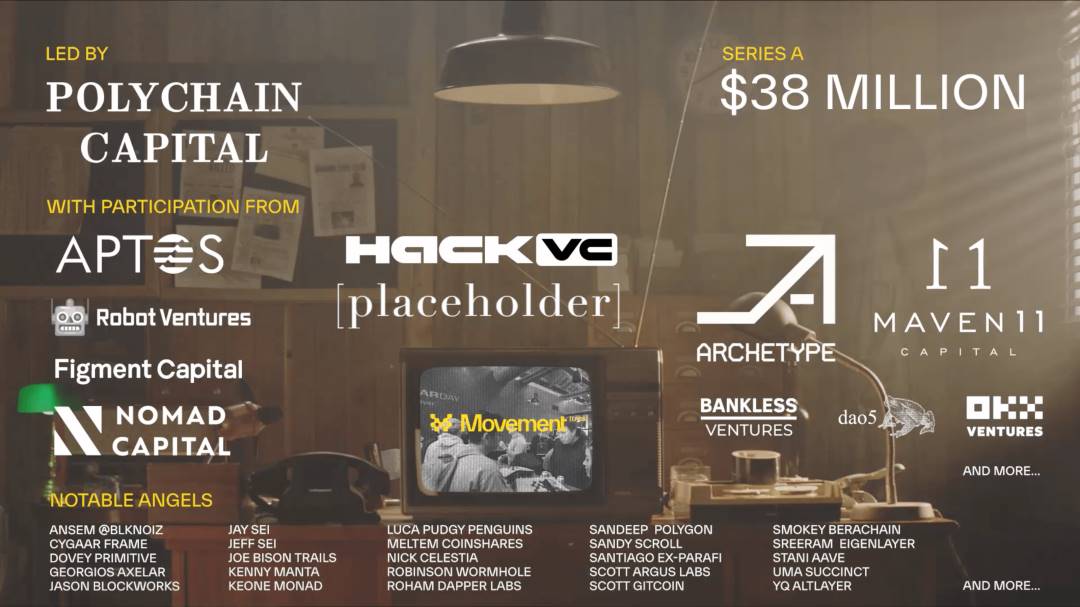
From Move’s evolution, it’s clear that unlike the Ethereum Foundation’s early indifference toward DeFi pioneers and miners, Move’s infrastructure teams have actively supported innovation and developers.
Through funding, technical tools, and community building, they’ve cultivated a tightly-knit developer ecosystem. This comprehensive support has enabled the Move ecosystem to rapidly accumulate developers and users, gradually becoming the new favorite for smart contract development.
Movement Network: A Rising Star in the Move Ecosystem
Within the Move ecosystem, Movement Network holds significant strategic value. Unlike Layer 1 blockchains such as Aptos and Sui, Movement does not compete with them; instead, it plays a pivotal bridging role through its unique modular architecture.
As a rising star in Move-based infrastructure, Movement Network is injecting fresh vitality into the ecosystem with its innovative technical architecture.
The network consists of three core components: the Move Executor, Fast Finality Settlement Module, and Decentralized Shared Sequencer—collectively forming a high-performance, secure, and interoperable infrastructure platform.
Technically, Movement’s key innovation lies in successfully achieving deep integration between the Move language and the EVM ecosystem.
The Move Executor, a core component of the Movement-SDK, supports both MoveVM and EVM bytecode.
This dual compatibility allows developers to leverage the advanced features of Move while maintaining interoperability with existing Ethereum applications. By integrating MoveVM’s parallel execution capability with established EVM interpreters, the Move Executor achieves a balanced trade-off between compatibility and scalability.
Developers can benefit from Move’s advantages while retaining Ethereum-level settlement. Notably, Movement supports executing Move code from both Aptos and Sui simultaneously—an innovative architecture known as "Move-EVM" (MEVM)—offering unprecedented flexibility for developers.
For transaction settlement, the Fast Finality Settlement Module employs an innovative staking-based validation mechanism.
Compared to traditional zk-rollups and optimistic rollups, Movement Network achieves second-level transaction finality without requiring expensive proof-generation hardware, significantly reducing latency and improving user experience. The module ensures network security through validator staking, enhancing transaction processing efficiency while maintaining cryptographic economic security.
These technological innovations position Movement as a highly promising infrastructure project within the Move ecosystem, providing robust technical support for the broader adoption and expansion of the Move language.
The current macro environment further strengthens Movement’s narrative. As the U.S. regulatory stance toward crypto becomes more favorable, we can expect more enterprises, like during the last bull market, to enter the Web3 space.
Given that Move was originally designed by Facebook as an enterprise-grade programming language, it is likely to become the preferred choice for these companies. Considering enterprises’ strict requirements for system sovereignty, public chains like Aptos/Sui cannot fully meet their sovereignty needs. As the only modular solution currently available in the Move ecosystem, Movement’s strategic value becomes increasingly prominent.
Through the open-source Movement SDK, enterprises can deploy their own rollups—retaining full control over their systems while benefiting from the infrastructure advantages of both the Ethereum ecosystem and the Move language.
Conclusion
Looking back at the evolution of Web2, we see a direct positive correlation between development convenience and application quality. Aptos, Sui, and Movement are bringing this lesson into Web3, driving the prosperity of the Move ecosystem through diverse technical approaches and innovative solutions.
TechFlow
Join TechFlow official community to stay tuned
Telegram:https://t.me/TechFlowDaily
X (Twitter):https://x.com/TechFlowPost
X (Twitter) EN:https://x.com/BlockFlow_News
 @BiteyeCN