








NFT's Breakthrough and Rebirth: Finding Innovative Paths and Growth Potential Amid Turmoil
TechFlow Selected TechFlow Selected
NFT's Breakthrough and Rebirth: Finding Innovative Paths and Growth Potential Amid Turmoil
This report provides an in-depth analysis of the current state of NFT market development and explores potential pathways for the sustainable growth of NFTs.
 Navigating Web3 tides with focused insights
Author: Nancy, PANews
Over the past few years, the NFT market has experienced dramatic fluctuations, from initial explosive growth to a sharp decline today. Amid this market storm, most NFT projects have failed to withstand the severe test, casting serious doubts on the long-term viability of NFTs as a crypto asset class.
At "NFTCON 2024," the first global NFT developer summit co-hosted by PANews and NFTScan, PANews released its latest industry report. This report provides an in-depth analysis of the current state of the NFT market and explores potential paths toward sustainable development, helping readers better understand the complexity of the NFT ecosystem and identify future innovation trajectories.
Multipronged Challenges and Market Shifts
Since the beginning of 2024, the overall NFT market continues to face numerous challenges and uncertainties. While several key indicators suggest a gradual stabilization, the NFT landscape has shifted due to changes in demand, platform competition, and evolving narratives, with its value system urgently requiring new forms of empowerment.
Sales Decline but Profits Rebound: Growing Latent Demand
According to the latest data from CryptoSlam, as of November 6, annual NFT sales are approaching $7.43 billion—down approximately 14.8% compared to the beginning of the year. In terms of average sale price, the figure stands at $119 in 2024, slightly higher than last year but still only about one-quarter of historical peaks.
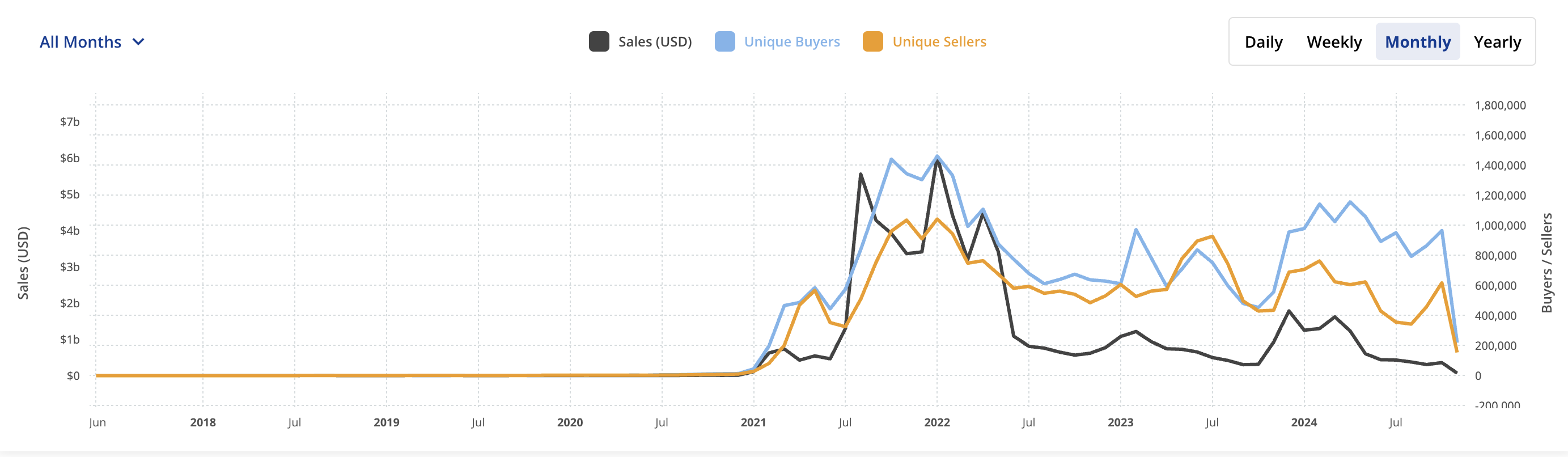
Despite the overall decline in sales volume, market profits show signs of recovery. To date, NFT trading profits in 2024 have exceeded $33.3 million, a stark contrast to the nearly $250 million in negative returns recorded in 2023. Additionally, wash trading within the NFT market has significantly decreased. This year’s wash trading volume amounts to just $2.32 billion—only about 8.5% of the total wash trading volume seen in 2022.
From a buyer-seller dynamics perspective, latent demand in the NFT market continues to grow. The number of unique NFT buyers reached 6.878 million this year—a record high—and substantially exceeds the number of independent sellers, which stands at 3.611 million.
Decline of Legacy Projects and Narrative Challenges
In contrast to previous years, no breakout NFT projects have emerged in 2024 to lead the market. More critically, once-popular legacy NFT projects are now collectively facing a cold spell. Many former star NFTs are suffering devaluation, with waning market enthusiasm and eroding confidence.

Data from Dune earlier this month shows that most NFT projects have seen significant drops in both floor prices and trading volumes. Even leading projects such as CryptoPunks, Bored Ape Yacht Club (BAYC), and Azuki were not spared, with their prices hitting multi-year lows. Moreover, the number of projects achieving monthly trading volumes exceeding one million dollars remains extremely limited, further highlighting the severe challenges and adjustment pressures currently facing the NFT market.
Meanwhile, previously popular NFT narratives—such as collecting, art, metaverse, and gaming—are increasingly being questioned. Issues like low-quality imitations, overvaluation bubbles, and insufficient market liquidity have begun to undermine the perceived value of these narratives.
Shifting Dominance Among Major Blockchains: Bitcoin Surges, Ethereum Cools
In 2024, NFT sales were primarily concentrated on three major blockchains: Bitcoin, Ethereum, and Solana. Together, they accounted for $6.53 billion in sales—representing 87.9% of the total market. Among them, Bitcoin stood out with $2.77 billion in sales, marking a 1.53x increase from last year. Although Ethereum still maintains dominance in the NFT space with over $2.44 billion in transaction volume, its performance has notably declined compared to previous years—amounting to only about one-tenth of its 2022 peak. Solana remained relatively stable, recording $1.32 billion in sales and achieving modest year-over-year growth.
Marketplace Landscape: Magic Eden Gains Momentum
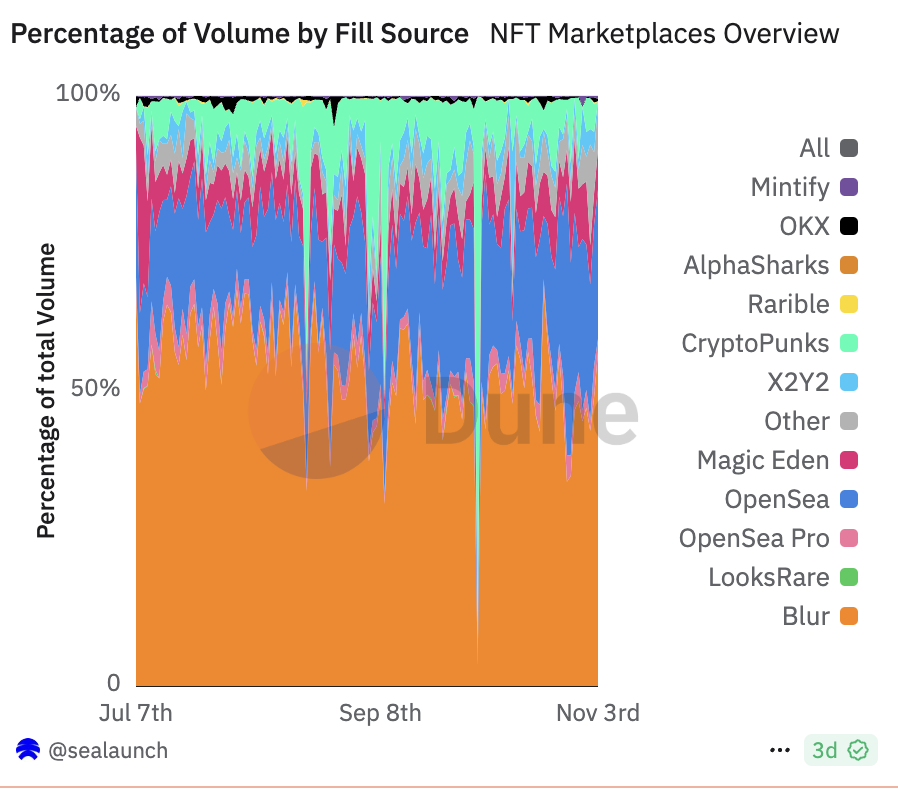
In the trading arena, Blur, OpenSea, and Magic Eden remain the dominant platforms. According to Dune data as of November 4, Blur leads with 49% market share, followed by OpenSea at 29.2%, while Magic Eden holds 5.4%. Notably, amid an overall cooling market, both Blur and OpenSea saw declines in their market shares, whereas Magic Eden demonstrated strong growth and particularly impressive performance.
Regulatory Complexity and Uncertainty
The development of NFTs faces significant regulatory uncertainty, with varying definitions, classifications, and policies across different jurisdictions. The lack of a unified legal framework—especially regarding intellectual property protection, consumer rights, and anti-money laundering guidelines—poses substantial challenges for market participants.
Innovation Pathways Toward Sustainable NFT Development
Sustainable NFT development requires more than innovation in traditional digital collectibles. It also demands integration across multiple domains—including DeFi, RWA, consumer applications, and public blockchains—to explore new ways of enhancing asset liquidity and value conversion. Below are several promising directions:
DeFi
NFTfi represents the deep convergence of NFTs and DeFi financial models, offering NFT holders expanded financial tools and value-creation opportunities such as lending, staking, derivatives trading, yield farming, and liquidity pools. These innovations broaden NFT use cases, significantly enhance liquidity and price discovery, and elevate overall asset value.
For example, in financial derivatives and lending, NFTs can serve as collateral for loans or be used to create various financial instruments and investment strategies based on NFT valuations. In GameFi, in-game items such as characters, skins, and equipment can be tokenized as NFTs, providing players with additional income streams and improving asset liquidity and valuation. Artistic or knowledge-based NFTs can be integrated with DeFi through staking and financing mechanisms to improve holder liquidity. DeFi can also combine with NFT insurance to offer risk protection services for NFT assets.
RWA
The integration of NFTs with RWAs (real-world assets) breaks down geographical and time barriers inherent in traditional finance, enabling real-world assets to be represented and traded digitally and efficiently on blockchain. Through NFT tokenization, transparency and efficiency in asset transactions are significantly improved, greatly enhancing liquidity. Investors gain easier access to buying and selling opportunities. Furthermore, the competitive and transparent nature of NFT markets supports more rational price discovery, allowing asset values to reflect their true worth more accurately and creating a fairer, more open trading environment.
For instance, real estate ownership or usage rights can be converted into NFTs, enabling seamless peer-to-peer transactions via blockchain platforms. This approach improves liquidity while reducing transaction costs and intermediary fees. Digital ownership or fractional rights of artworks can be tokenized and transferred via NFT marketplaces, introducing new investment and trading models while addressing trust issues and geographic limitations in traditional art markets. In supply chain management, tracking luxury goods or agricultural products by embedding production stages and supplier information into NFTs ensures product authenticity and quality traceability. Financial instruments such as bonds, equities, and fund shares can be tokenized as NFTs to streamline trading processes and enhance liquidity and transparency. In insurance, converting contracts or policies into NFTs allows customers to manage, trade, or transfer coverage rights more easily, increasing contract transparency.
However, while NFT applications in RWA face risks related to regulation, market adoption, and technical security, they offer innovative solutions for managing, trading, and financing real-world assets.
Consumer Applications
With rising consumer demand for personalization, uniqueness, and virtual identity, NFTs demonstrate immense potential in consumer applications. They can fundamentally redefine interactions and value exchange between brands and consumers, effectively drive fan economy growth, and accelerate NFT adoption in consumer sectors. Consumer-focused NFTs extend beyond digital art or rare collectibles to include digital identity, brand loyalty programs, membership benefits, gaming, and virtual goods.
For example, Web2 brands like Nike and Adidas can issue NFTs as digital membership cards or loyalty points. Consumers can redeem exclusive discounts, event access, and services using these NFTs, and even resell them on secondary markets. Platforms like Decentraland and The Sandbox allow users to purchase virtual land NFTs and then build, develop, lease, or sell digital assets such as virtual stores, entertainment venues, and museums within immersive worlds. Music platforms like Audius and Royal enable artists to tokenize music and creative works as NFTs, providing direct monetization while allowing fans to own unique versions and receive future royalty distributions. NFTs can also function as digital tickets for concerts, sports events, and art exhibitions, granting entry rights while improving anti-counterfeiting measures, transparency, and interactive experiences. Fashion brands including Gucci, Balenciaga, and Rtfkt are experimenting with NFTs in virtual fashion and digital wearables, allowing consumers to purchase limited-edition digital clothing, shoes, and accessories to express individuality and identity in virtual environments.
Social Networks
NFTs hold transformative potential for reshaping social media and online interaction models—particularly in building personalized identities and virtual personas. For example, NFTs can symbolize individual identity, reflecting users’ unique achievements, preferences, and status. Social platforms integrating NFT marketplaces can enable users to buy and sell digital goods, artworks, or other NFT assets, enriching in-platform engagement and social experiences. NFTs also lay the foundation for decentralized social networks by enabling disintermediation and decentralized governance, empowering users to truly own and control their content creation and sharing while directly earning economic rewards from platform activities.
Public Blockchains
Given the current state of NFT development on major public blockchains like Ethereum and Bitcoin, high gas fees, strict block size limits, slow confirmation times, and scalability bottlenecks present significant constraints on broader NFT adoption. To address these challenges, some projects are exploring innovative approaches such as cross-chain interoperability and Layer 2 (L2) solutions.
For example, the rise of multi-chain ecosystems frees NFTs from reliance on any single blockchain. By breaking down inter-chain silos, more efficient asset transfers and trading environments become possible, injecting new vitality into NFT liquidity and accessibility. L2 solutions play a crucial role in scaling transaction throughput and lowering prohibitively high fees, making NFT trading and creation more affordable for a wider user base. Additionally, emerging blockchains like Polygon and Solana, leveraging advanced architecture and innovative consensus mechanisms, continue to optimize NFT transaction speed and security, delivering smoother, safer, and more efficient user experiences.
Conclusion
For NFTs to evolve from simple digital collectibles into a more diverse, liquid, and market-viable asset class, it is essential to fully preserve and strengthen their unique cultural significance and personalized social identity attributes. At the same time, the NFT market must actively pursue integration with broader asset categories and real-world applications. Such convergence will not only enhance the utility and investment value of NFTs but also promote wider recognition and adoption across diverse use cases, ultimately unlocking new avenues for growth.
Join TechFlow official community to stay tuned
Telegram:https://t.me/TechFlowDaily
X (Twitter):https://x.com/TechFlowPost
X (Twitter) EN:https://x.com/BlockFlow_News
 PANews






