Trump Predestined? How Trading Markets View the Election Outlook
TechFlow Selected TechFlow Selected
Trump Predestined? How Trading Markets View the Election Outlook
Derivatives traders appear to be preparing for a bullish Bitcoin move in the days following the U.S. election on November 5.
 Navigating Web3 tides with focused insights
Author: Chandler, Foresight News
On November 5, the 2024 U.S. presidential election will conclude, with the race between Kamala Harris and Donald Trump remaining fiercely contested and the outcome still uncertain.
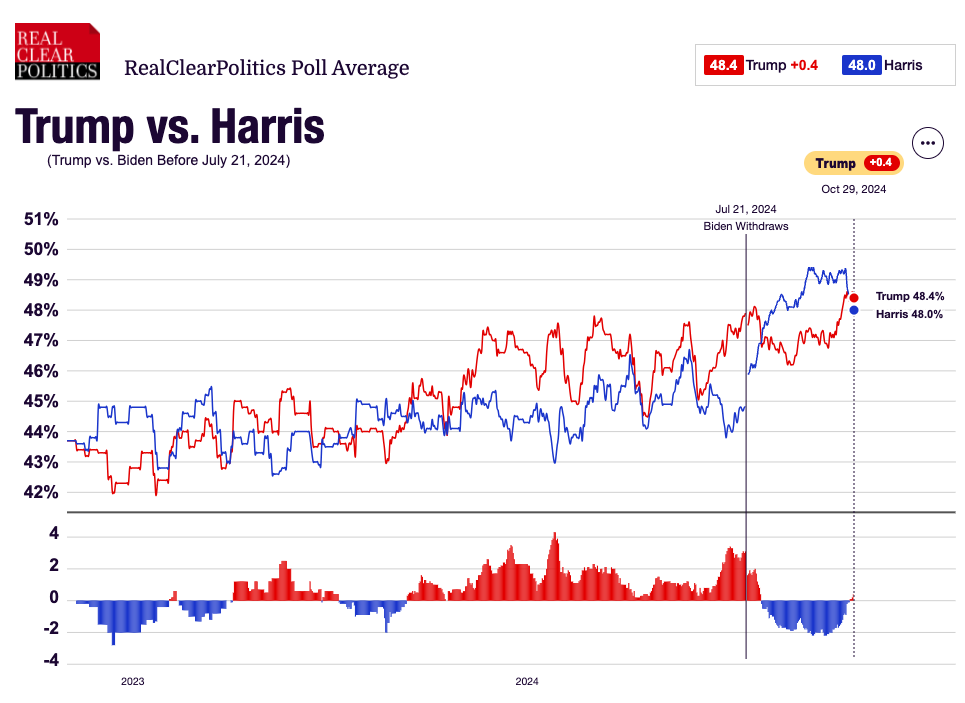
Historically, opinion polls have served as an indicator for election results. According to RealClearPolitics (RCP), a U.S. political forecasting website, if voting were held today based on current state-level polling averages, Trump and Harris would secure 219 and 215 electoral votes respectively within their own camps.
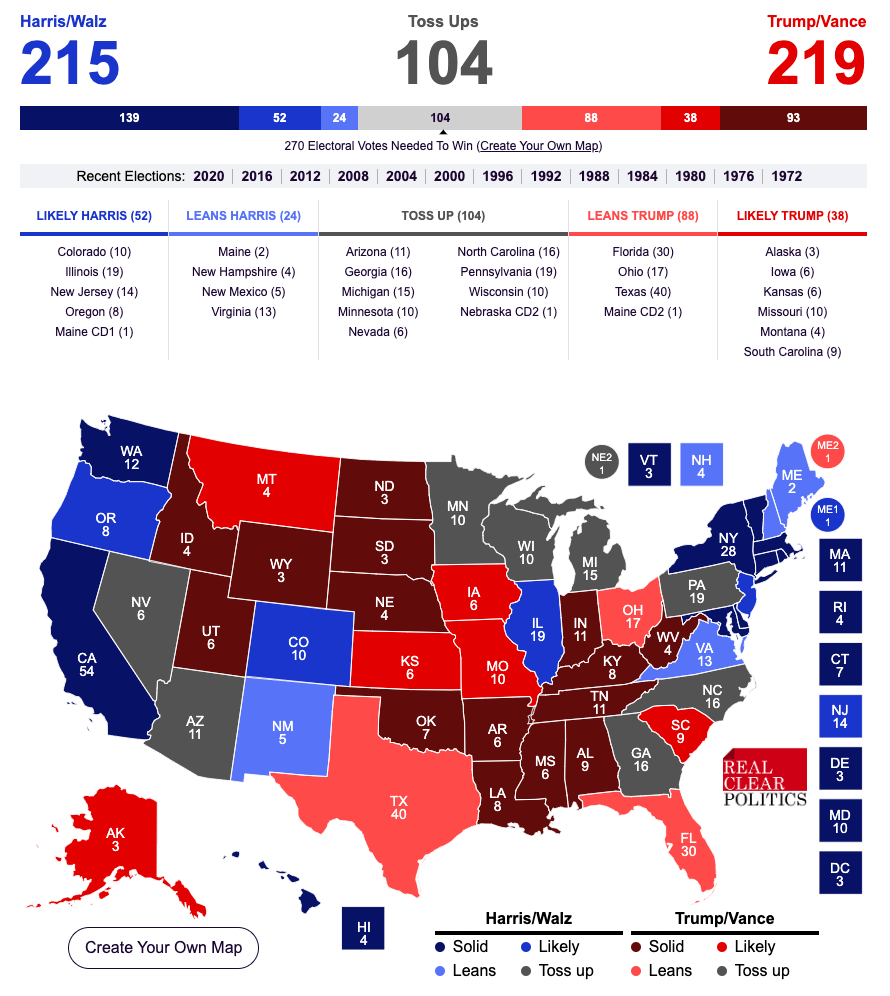
Based on average polling data, Trump has now overtaken Harris in support by 0.4 percentage points.
In addition, on Polymarket—a prediction market built on Polygon—the probability of Trump winning has risen to 67%, while Harris’s chances have dropped to 33.1%, giving Trump a lead of 33.9 percentage points. According to Lookonchain, during October, ten whale addresses collectively spent $70.6 million betting on Trump's victory in the U.S. election on Polymarket.
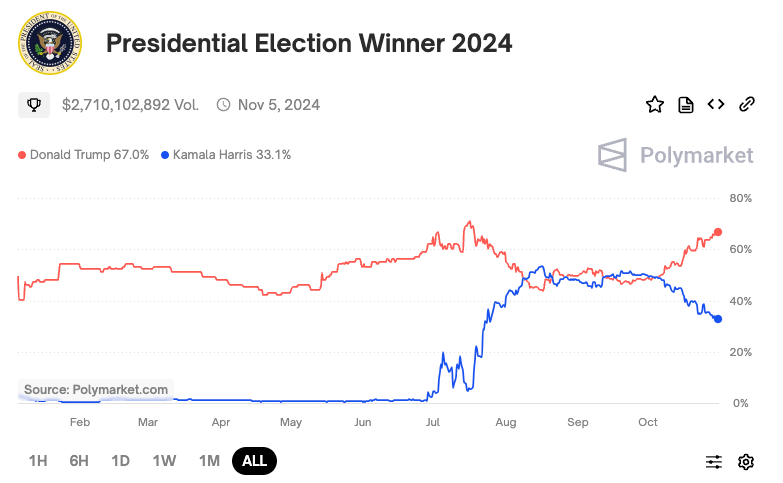
However, Polymarket’s current odds may not fully reflect actual voter sentiment.
As reported by Bloomberg, Polymarket confirmed that FREDI9999, one of the major buyers backing Trump’s victory, is a French trader. By October 24, four accounts—FREDI9999, Theo4, PrincessCaro, and Michie—had placed significant bets on Trump’s win, with potential payouts totaling approximately $46 million.
Polymarket stated it had conducted an investigation and concluded that the trader acted based on "personal views about the election," finding no evidence that the user manipulated or attempted to manipulate the market.
Additionally, Fortune magazine recently reported that analysts from blockchain firms Chaos Labs and Inca Digital discovered rampant wash trading on Polymarket. They identified signs of artificial activity where buy and sell orders were repeatedly executed simultaneously to create a false impression of volume and liquidity. Chaos Labs found that fake trades accounted for about one-third of the trading volume in Polymarket’s U.S. presidential election market, while Inca Digital estimated that “a large portion” of the market’s volume could be attributed to potentially fraudulent transactions.
Inca stated the actual trading value in the presidential election prediction market was around $1.75 billion, compared to Polymarket’s reported figure of $2.7 billion. Chaos Labs attributed this discrepancy to Polymarket conflating stock trades with dollar-denominated transactions.
It is also important to note that under the U.S. Electoral College system, the national popular vote does not determine the final result—polls in key swing states are far more critical. A candidate can win the popular vote nationwide but still lose the election if they fail to secure enough electoral votes from pivotal states. Therefore, voter intentions in swing states are more decisive than national polling averages, as these states often determine the ultimate outcome.
How Traditional Financial Markets View the Election
On October 29, the U.S. Nasdaq Composite Index rose 0.78% to close at 18,712.75, setting a new all-time high. On October 30, U.S. equities saw slight declines, with the Nasdaq ending its four-day winning streak by falling 0.56%. From the perspective of traders and investors, with just one week left before the U.S. presidential election, markets appear to be pricing in the possibility of Trump returning to the White House. Phillip Wool, Head of Portfolio Management at Rayliant Global Advisors, said Trump’s odds of winning are increasing, which is seen as positive for U.S. stocks in the short term. He noted that fiscal deficits are likely to expand, inflation could rebound, and this might slow down the Federal Reserve’s pace of rate cuts—all of which would put upward pressure on the U.S. dollar.
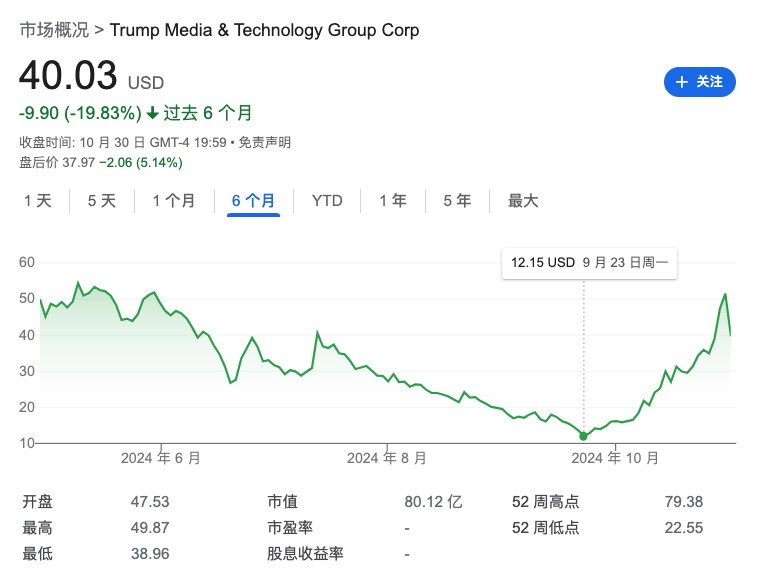
Meanwhile, Truth Social, the social media platform owned by Trump, has reached a valuation exceeding that of X, Elon Musk’s social media platform. As of the close on October 29, shares of Trump Media & Technology Group, parent company of Truth Social, had surged 324% from their recent low set on September 24, pushing its market capitalization to $10.3 billion. However, it pulled back slightly on the 30th, with the market cap returning to around $8 billion.
The yield on the U.S. 10-year Treasury note briefly rose to 4.34% early on the 29th, the highest level since early July, and closed at 4.28% on the 30th. Spot gold prices hit $2,798 per ounce, reaching another record high.
Bitcoin surged to $73,600—the highest level since March—before pulling back slightly, currently settling around $72,500, near its all-time peak.
Yet on another front, the outcome remains far from certain. According to analysis by Shenwan Hongyuan, in the short term, if Trump wins, previous market positioning may continue only modestly, whereas if Harris prevails, earlier trades could reverse sharply. Historically, gambling markets have not been reliable predictors of election outcomes—out of 22 U.S. presidential elections since 1936, five were incorrectly forecasted. Polling data also carries inherent flaws.
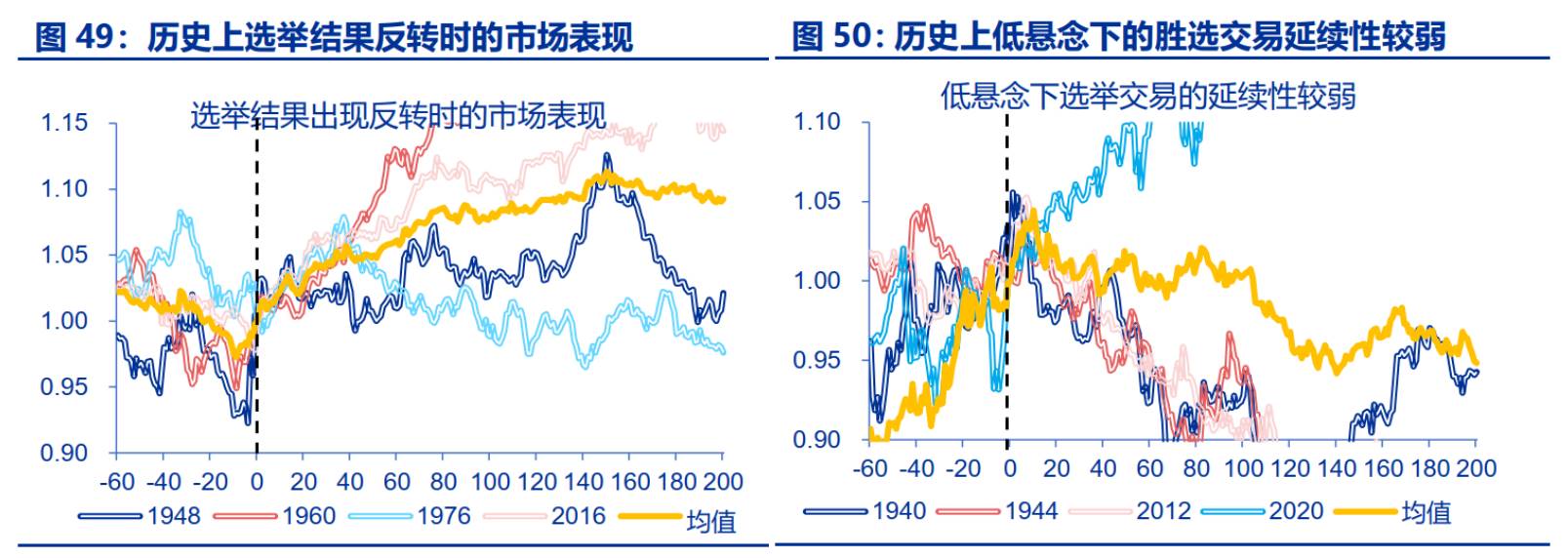
This year, factors such as continued mail-in voting, post-pandemic urban-rural population shifts, and new biases introduced into polling models after adjustments for Trump may all contribute to uncertainty. Yet market positioning has clearly tilted toward Trump. This implies that if Trump wins smoothly, market movements may resemble those seen in 2020 or 2012, with minor continuation of prior trends. But should Harris win, markets could experience a dramatic reversal similar to what occurred in 2016.
Crypto Market: High Open Interest Ahead of Breakout
Currently, open interest in the crypto market has risen significantly, especially in Bitcoin options and futures, reflecting strong investor anticipation of the upcoming U.S. election and subsequent market volatility. Luuk Strijers, CEO of Deribit, noted that derivatives traders are preparing for a bullish move in Bitcoin following the U.S. election on November 5.
Strijers said: "For options expiring on November 8, the open interest exceeds $2 billion, with primary strike prices at $70,000, $75,000, and $80,000. The put/call ratio stands at 0.55, indicating that outstanding call options outnumber puts by nearly two times. Forward IV shows a clear increase compared to Mark IV, particularly during the election period, signaling that traders expect higher volatility. The forward implied volatility is 72.29%, suggesting a potential price fluctuation of about 3.78% in the days following the presidential election."
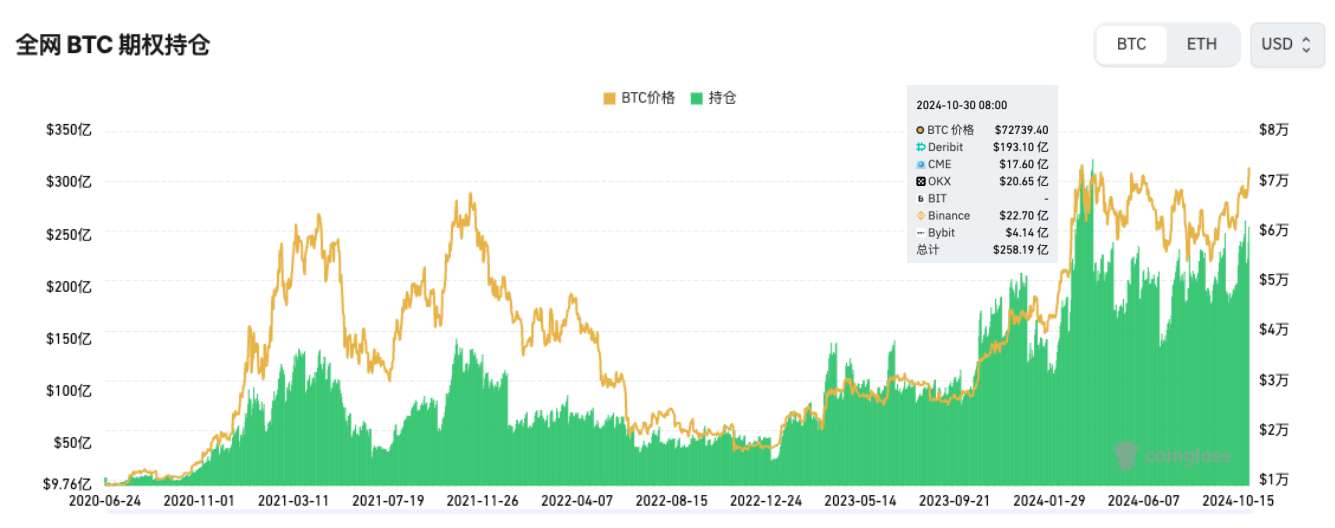
Bitcoin options open interest has reached a six-month high
Data source: Coinglass
Strijers added that the spike in implied volatility is temporary, suggesting the market does not anticipate prolonged uncertainty. The 25 Delta Skew (put-call skew) is negative across the board, indicating greater expectations for upside movement and strengthening bullish sentiment. Demand for calls is strong relative to puts, showing investors are less concerned about hedging downside risk.
Looking at spot Bitcoin ETF data, net inflows totaled $870 million on October 29—the third-highest single-day net inflow in history. The top two were $1.05 billion on March 12 and $887 million on June 4.
As of publication, the total net asset value of spot Bitcoin ETFs reached $72.545 billion, and the ETF net asset ratio (market cap relative to total Bitcoin market cap) hit 5.07%, surpassing 5% for the first time in history.
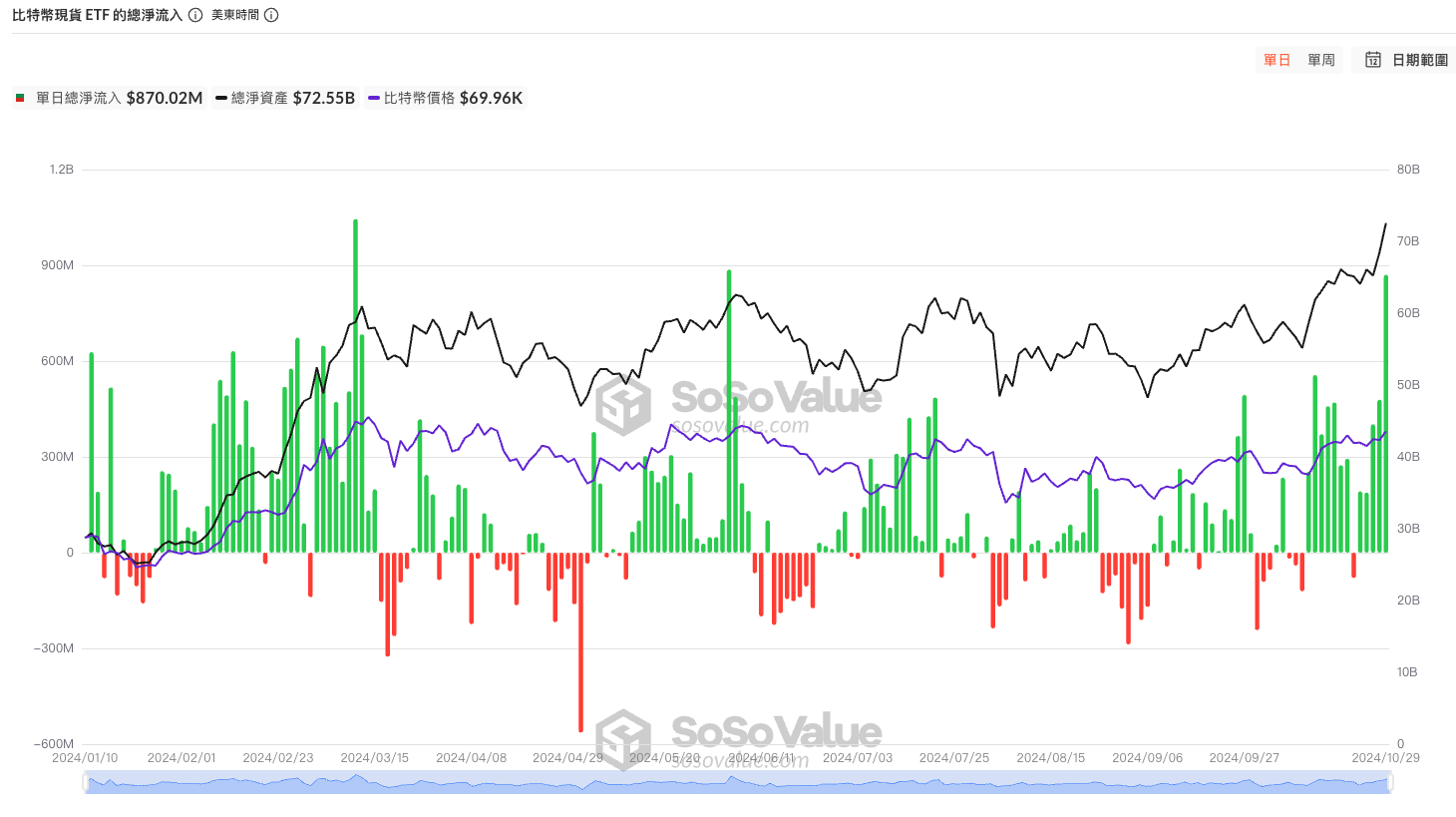
October 29 saw the third-largest daily net inflow into spot Bitcoin ETFs in history
Data source: SoSoValue
In addition, Bitcoin futures open interest hit a new all-time high in dollar terms on October 29. BTC futures OI recorded its largest single-day increase since June 3, rising by over 20,000 BTC in one day.
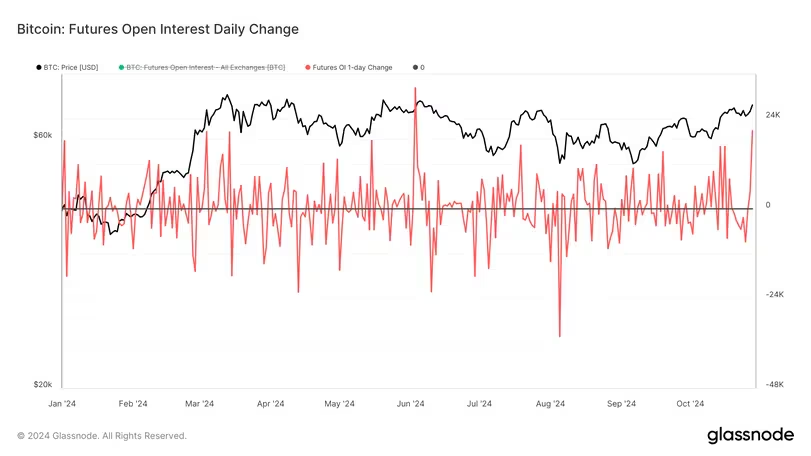
Daily change in futures open interest
Data source: Glassnode
Open Interest (OI) refers to the total number of outstanding derivative contracts (such as futures or options) that have not yet been settled within a specific timeframe. A high OI generally indicates heightened market attention toward a particular asset. When OI increases alongside rising prices, it suggests new capital is entering the market, typically interpreted as a sign of strengthening trend momentum—as observed in recent trading sessions.
At the time of writing, total Bitcoin open interest reached $43.468 billion. Within the past two days, CME’s open interest surpassed 170,000 BTC, worth over $12.549 billion, giving it approximately 30% dominance in the futures market. Binance’s Bitcoin futures position exceeded 127,100 BTC, valued at over $9.2 billion, capturing more than 20% of the market share.
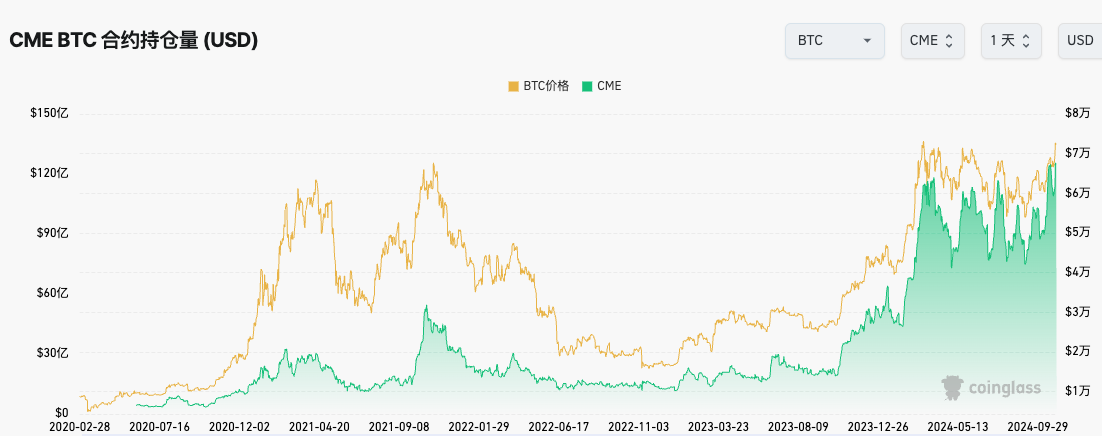
CME BTC contract open interest nearing historical highs
Data source: Coinglass
Overall, both traditional and crypto markets are displaying signs of optimism, with some traders seemingly positioning again for a “Trump trade.” In the short term, political uncertainty surrounding the election tends to trigger significant price volatility. These fluctuations stem not only from shifting expectations about candidates’ policies but also from market reactions to economic fundamentals. Over the long term, however, asset valuations remain primarily driven by fundamental factors, with elections influencing markets largely through their impact on these underlying conditions.
Join TechFlow official community to stay tuned
Telegram:https://t.me/TechFlowDaily
X (Twitter):https://x.com/TechFlowPost
X (Twitter) EN:https://x.com/BlockFlow_News
 Foresight News