OKG Research: Challenges and Breakthroughs – The Current State of Ethereum L2 and the Rise of New L1s
TechFlow Selected TechFlow Selected
OKG Research: Challenges and Breakthroughs – The Current State of Ethereum L2 and the Rise of New L1s
In the long term, the trend of multi-chain integration will promote technological advancement and application expansion in the blockchain industry, and drive the development of an open, collaborative ecosystem.
 Navigating Web3 tides with focused insights
Author: Samuel QIN, OKG Research
"What's happening with Ethereum?" This topic has been frequently raised at recent industry events, with no shortage of bearish sentiment in the market. From being the breeding ground for crypto innovation to seemingly turning into barren land, Ethereum appears to be drifting away from current industry trends and its former value proposition. Once the star of DeFi Summer, Ethereum has long struggled with scalability issues—soaring transaction fees and network congestion have become increasingly apparent, creating urgent demand for improvements in blockchain scalability.
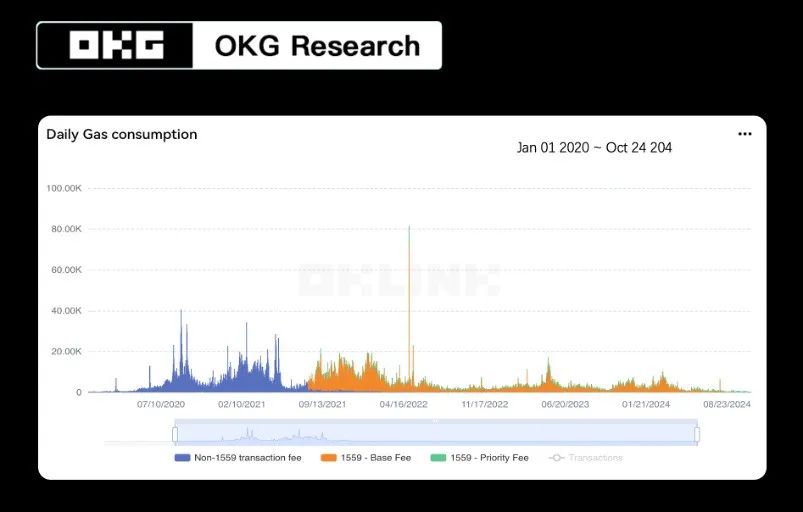
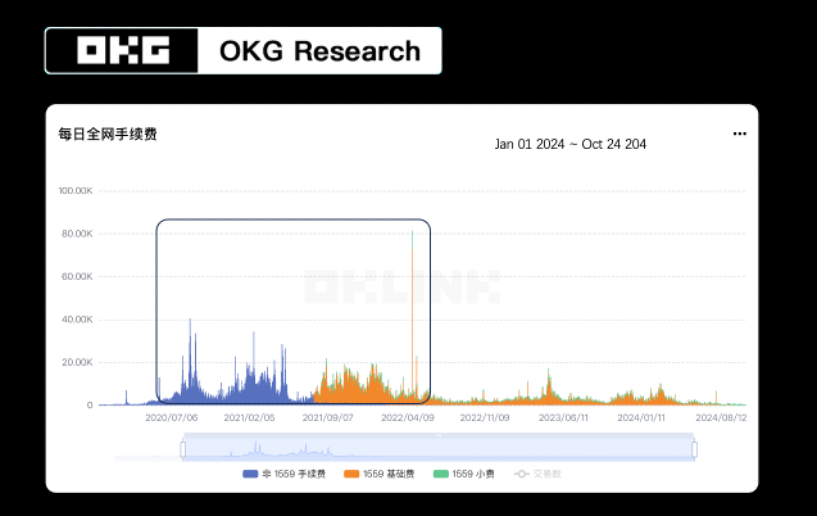
*OKG Research, Data source: Ethereum Gas Consumption from 200101~241024 from https://www.oklink.com/data/
With the emergence of two major Ethereum scaling approaches—Optimistic Rollups (OP) and Zero-Knowledge Rollups (ZK)—both leveraging Ethereum’s mainnet for security, key Layer2 metrics show clear progress: TPS has improved significantly and L2 transaction costs have dropped notably.
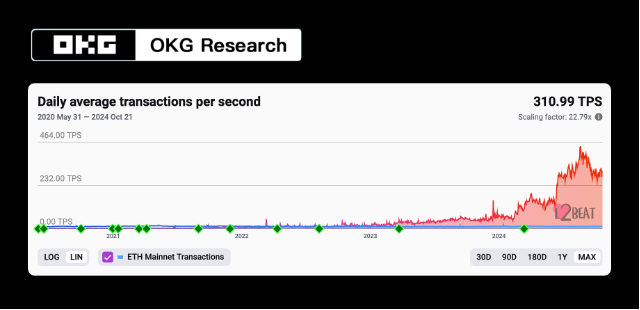
*OKG Research, Data Source: https://l2beat.com/scaling/activity
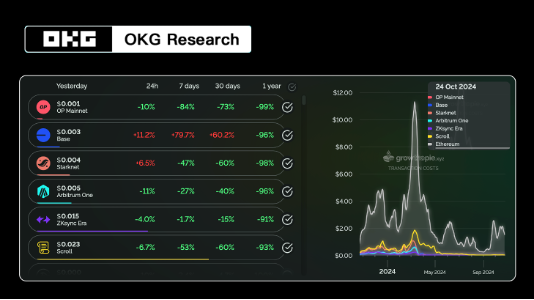
*OKG Research, Graph Source: https://www.growthepie.xyz/fundamentals/transaction-costs
However, despite these technical advances, neither scaling path has driven significant growth in Ethereum’s user base. Daily active users have remained relatively flat from 2021 to 2024. On the contrary, reliance on L2s has intensified liquidity fragmentation, further fragmenting Ethereum’s ecosystem. Certain L2s, bolstered by niche-specific applications, have attracted substantial user bases, intensifying competition with Ethereum’s mainnet.
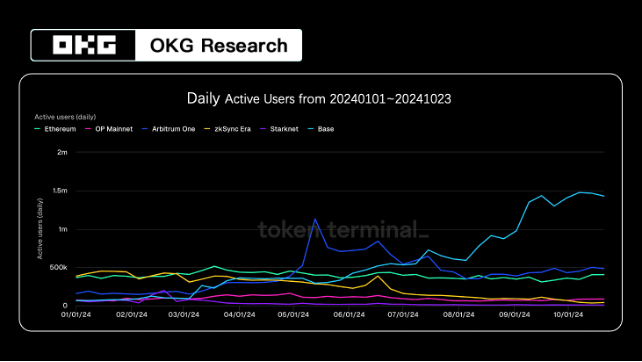
OKG Research, Data Source: https://tokenterminal.com/ Active Users from 240101~241031
This competition has exacerbated the misalignment between L2s and the Ethereum mainnet. Prior to EIP-4844 deployment, L2s had to submit transaction data permanently to Ethereum as call data, requiring them to pay high gas fees—accounting for roughly 70–80% of total L2 transaction costs. With EIP-4844, transaction data is now stored temporarily in block-carried blobs and automatically deleted after a verification period, dramatically reducing storage costs.
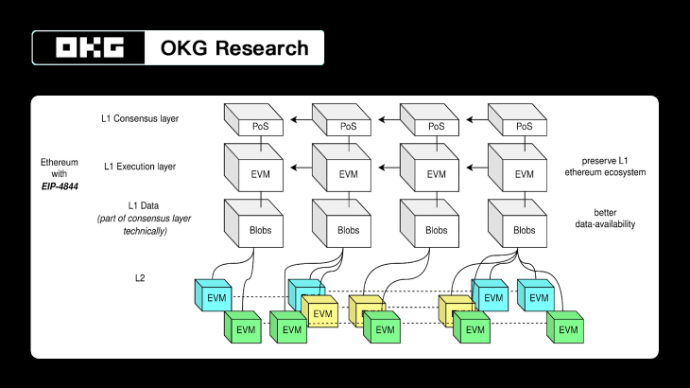
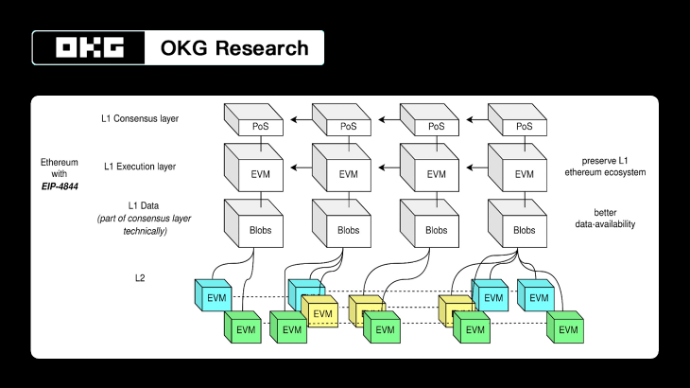
*OKG Research, Graph from https://hackmd.io/@luozhu/SyleCcpti
The "Rent Paid to L1" chart clearly shows a pronounced decline in fees that L2s must pay to Ethereum. Additionally, since L2s handle transaction execution, MEV revenue is no longer passed back to the mainnet. As a result, stakers under Ethereum’s PoS model inevitably face reduced income due to lower fee inflows.
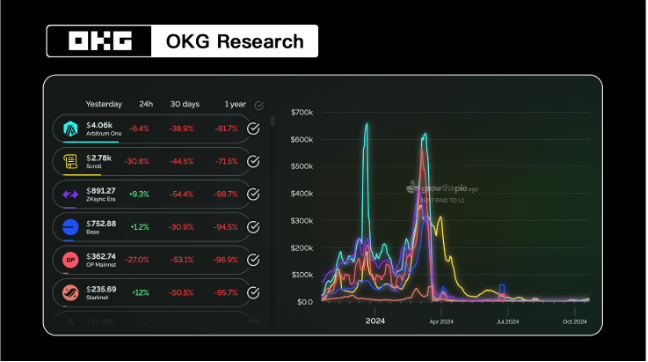
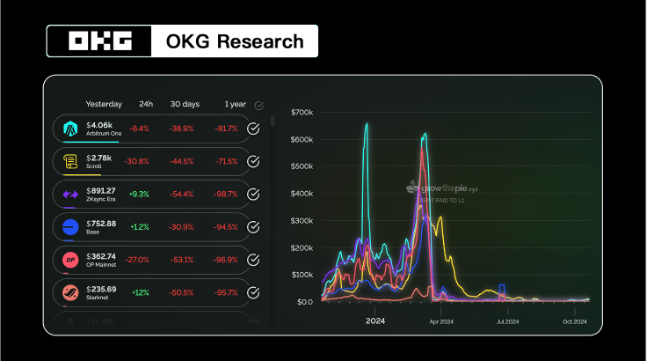
*OKG Research, Data Source: http://growthepie.xyz Rent Paid to L1
Moreover, when measuring transaction finality, interoperability between different types of L2s remains weak. Cross-L2 interactions often still require routing through the Ethereum mainnet, resulting in persistently high friction costs and suboptimal user experience.
This undermines the original vision of using L2s to achieve seamless Ethereum scaling. Instead, it reinforces fragmentation among L2s. Despite notable improvements in scalability and transaction fees, liquidity across L2 networks is splintered into multiple siloed subnetworks. The cost of moving funds between L2s remains high. Most L2s merely replicate existing narratives and applications from Ethereum without introducing truly breakout innovations, limiting their ability to attract entirely new user demographics through distinctive use cases.
In contrast, new Layer 1 blockchains can architecturally avoid such pitfalls. Compared to current L2 solutions, next-generation L1s like Aptos and Sui leverage novel consensus mechanisms, modular designs, and enhanced user experiences to better address performance bottlenecks facing public blockchains today.
These Layer 1 blockchains employ unique consensus algorithms and high-performance node networks, delivering superior scalability, significantly cheaper on-chain interactions, and strong cross-chain compatibility. They aim to draw users dispersed across various blockchain ecosystems and support broader application scenarios—particularly consumer-facing applications beyond just financial use cases. These features help drive blockchain adoption and encourage participation across diverse industries.
Nonetheless, new L1s face challenges in rapidly building developer communities and user bases, which typically requires extensive marketing and incentive programs, increasing initial costs. They also face pressure to balance performance, decentralization, and security—engineering hurdles such as downtime or halted block production remain real risks during stress testing.
As L2s and new L1s race forward, the expansion of the multi-chain ecosystem accelerates. Users urgently need a unified "gateway" to easily access the Web3 world. However, as discussed earlier, different chains employ divergent technical architectures, necessitating robust technical expertise to provide cross-chain parsing and access services.
In the future, cross-chain migration and aggregation will become standard in the blockchain industry, enabling users to enjoy better interaction experiences and enhanced transaction security across a wider range of choices.
In this data-driven on-chain world, multi-chain explorers are essential tools for industry participants seeking insight into the blockchain landscape. These tools must serve various stakeholders—including projects, developers, and end-users. However, most ecosystem explorers have limited monetization options and often rely on funding from ecosystem foundations. Their ecosystem-specific orientation usually results in single-chain offerings. While they allow deep vertical exploration within one chain, as the number of public chains grows, the lack of platforms capable of horizontally aggregating multi-chain data clearly fails to meet evolving user needs.
Current multi-chain explorers mostly present data in isolated formats. Users cannot simply input an address to intelligently locate which specific public chain it belongs to. This leads to fragmented on-chain data, preventing unified aggregation of related information. The friction of switching also forces users to manually manage accounts across multiple platforms, making it difficult to accurately consolidate scattered on-chain data.
Furthermore, customized, highly modular technical architectures tailored for major public chain ecosystems (EVM-compatible chains, Cosmos ecosystem chains, UTXO models, etc.) are needed. In response to user demands and market trends, customized heterogeneous chain integration has become increasingly critical. Yet, considering the technical complexity of integrating different chains, certain chains and data naturally take precedence over others.
Poly-chain explorers represented by OKX Web3 Explorer are attempting to aggregate multi-chain information. With an open and neutral approach to connecting all types of public chains, aligned with co-development across industry ecosystems, users can access data across 50+ public chains through a single account and interface—greatly reducing the burden of multi-chain data aggregation.
A consolidated entry point is also the most effective way to reach active users. By providing basic information across chains, such platforms can spark user curiosity, encouraging exploration of diverse blockchain ecosystems and promoting liquidity flow and application convergence across different ecosystems.
In the long term, the trend toward multi-chain integration will drive technological advancement and application expansion in the blockchain industry, fostering the development of an open and collaborative ecosystem. This not only facilitates user exploration in Web3 but also lays a solid foundation for a more open and inclusive on-chain world.
Join TechFlow official community to stay tuned
Telegram:https://t.me/TechFlowDaily
X (Twitter):https://x.com/TechFlowPost
X (Twitter) EN:https://x.com/BlockFlow_News
 @OKGResearch