








BOB: Hybrid L2 Under the Powerful Alliance of BTC and ETH
TechFlow Selected TechFlow Selected
BOB: Hybrid L2 Under the Powerful Alliance of BTC and ETH
BOB is secured by BTC L1—the most secure Layer 1—and leverages this security to create trustless bridges connecting BTC, ETH, and other Layer 1 blockchains.
 Navigating Web3 tides with focused insights
By: IOSG Ventures
Abstract
BOB belongs to a new type of L2: Hybrid L2. Secured by BTC L1—the most secure L1—BOB leverages this security to create trustless bridges connecting BTC, ETH, and other L1 blockchains. As such, Hybrid L2 achieves interoperability without relying on third-party bridging solutions and resolves the issue of fragmented multi-chain BTC liquidity.
1. Introduction
BTC was created as a decentralized, transparent, and censorship-resistant payment system. A decade later, smart contract chains have driven the creation of DeFi applications and other innovative products such as NFTs, tokenized social media and gaming, DAOs, and other trustless governance structures. In this landscape, while BTC L1 remains central to global cryptocurrency adoption, it has lagged behind in innovation and developer activity.
Despite its slow evolution and lack of flexibility, BTC L1 still surpasses all other cryptocurrencies combined in market capitalization, trading volume, and number of active users. As of October 2024, BTC has 300 million users globally, a $1 trillion market cap, and unmatched brand recognition and dominance. However, BTC L1’s DeFi activity is the lowest among all cryptocurrencies: Ethereum’s DeFi TVL-to-market-cap ratio is 30%, whereas BTC’s is only 0.1%—a 300-fold difference.
In recent years, multiple attempts have been made to introduce smart contracts and DeFi to BTC L1 through protocol changes and forks, but all have failed. BTC L1 resists any protocol upgrades that could significantly alter its functionality or increase complexity. Therefore, BTC L1 will not achieve native programmability comparable to Ethereum for the foreseeable future, making BTC L2 the optimal solution for DeFi within the BTC ecosystem.
1.1 Hybrid L2
Hybrid L2 is a BTC L2 solution designed to address the primary challenges of scaling DeFi on BTC L1. Such an L2 typically exhibits three key attributes:
-
BTC L1 Security: Utilizes OP verification and fraud proofs on BTC L1 via BitVM2.
-
Trustless BTC Bridging: Employs an enhanced BitVM bridge design where users can deposit and withdraw BTC as long as BTC L1 is secure and at least one honest node exists on the network to execute on-chain disputes. This novel security model, known as "existential honesty" (1-of-n), relies on minimal assumptions and offers far superior security compared to existing multi-sig BTC bridges.
-
Trustless Ethereum Bridging: BOB leverages BTC L1 security combined with Ethereum L1/L2 OP rollup bridge designs, encoding L2 withdrawals as part of an L1 smart contract to ensure withdrawal correctness. This design can be extended to most smart contract-enabled L1 chains.
As the first Hybrid L2, BOB delivers a practical, trustless cross-chain interoperability solution: First, BTC L1—the most secure decentralized network—secures both the L2 and all cross-chain bridges. On top of this, BOB solves the fragmentation of cross-chain BTC liquidity—users can deposit assets across various chains using native BTC liquidity and BTC L1-secured withdrawal mechanisms via the BOB network. Ultimately, BOB sustains BTC L1’s security and viability by paying fees to it.
2. The State of BTC L2: Blessings and Challenges
BTC L2 holds the potential to bring innovation to BTC L1 while preserving its core principles. It opens up DeFi use cases, enabling trading, lending, and staking without reliance on centralized exchanges. This represents a massive opportunity to unlock BTC’s trillion-dollar market. Currently, dozens of chains claim to be “BTC L2s.”
However, building a BTC L2 is extremely challenging, and past attempts have failed to achieve the success seen on Ethereum. We believe launching a successful BTC L2 faces three major hurdles:
-
BTC Security and Trustless BTC Bridging: This is the defining feature that sets BTC L2 apart from all other chains. BTC L1’s security enables users to deposit and withdraw BTC without relying on third parties. To date, nearly all BTC bridges rely on multi-signature schemes. BOB is the first team in history to implement this vision via BitVM2.
-
Building a Competitive Ecosystem: An L2 succeeds only if its dApp ecosystem thrives. Success hinges on offering top-tier development tools and DeFi infrastructure—wallets, institutional custody, oracles—and keeping pace with performance demands like millisecond transaction speeds and gas fee abstraction. Without a competitive developer environment, BTC L1 applications will struggle to compete with those on Ethereum and other networks.
-
Attracting Blue-Chip Liquidity (Cold Start Problem): In DeFi ecosystems, integrating stablecoins, fiat on/off ramps, and inter-network bridges is crucial. Network effects determine the success of new products, so developing on isolated chains poses significant challenges.
3. BOB's Foundation: Bridges, Light Clients, and BitVM
BOB’s innovation centers on three core technical concepts: cross-chain bridges, light clients, and BitVM. These technologies collectively form BOB’s value proposition, warranting deeper exploration.
3.1 Light Clients
The “Simplified Payment Verification” (SPV) light client protocol on BTC L1 allows nodes to verify payments without downloading the full blockchain. It requires only verifying consensus finality through block headers and validating selected transactions.
BTC L1’s light clients offer provable security and can be verified by other blockchains with smart contract capabilities. For example, Threshold has operated such light clients on Ethereum for years. In contrast, Ethereum lacks a secure light client due to the need to store and track over a million validators’ public keys, increasing system complexity.
3.2 Cross-Chain Bridges
We have established two essential properties for “bridging” or “wrapping” assets across blockchains:
a) Both chains must operate correctly simultaneously;
b) Achieving this without trusted third parties is difficult.
In practice, we can reduce reliance on third parties by allowing any network participant to assume validation duties. Through so-called “light client bridges,” Chain A and Chain B can verify each other’s consensus protocols via smart contracts. When asset a is deposited into the bridge on Chain A, Chain B’s smart contract verifies that consensus has been achieved on Chain A before minting wrapped token b(a). Conversely, when b(a) is burned on Chain B, the transaction must first be verified as finalized on Chain A. Due to the complexity of light clients, few such designs have been successfully implemented.
3.3 BitVM
BitVM is a mechanism for executing arbitration programs on BTC L1 in an optimistic (OP) manner. Execution occurs off-chain, with disputes resolved on-chain upon failure. Its two main use cases are OP rollups on BTC L1 (similar to Arbitrum) and trustless bridging. In both cases, BitVM allows users to deposit and withdraw BTC from the L2—deposits cannot be stolen as long as at least one honest node exists on the network.
The current standard is BitVM2, whose design summary is as follows:
-
Compress the program into a SNARK verifier implemented within BTC L1 scripts.
-
Split the verifier into subprogram blocks under 4MB to execute within BTC L1 transactions.
-
During setup, BitVM2 operators commit the program via Taproot trees and pre-sign transactions.
-
Users deposit funds into BitVM2 (e.g., bridge deposits).
-
When attempting to withdraw funds from BitVM2, anyone can challenge the operator.
-
If challenged, the operator must reveal all intermediate subprogram results and the final computation.
-
If the operator cheats, some revealed subprogram outputs will be incorrect, and anyone can prove cheating by executing the relevant subprogram.
-
A cheating operator is ejected and loses access to deposits.
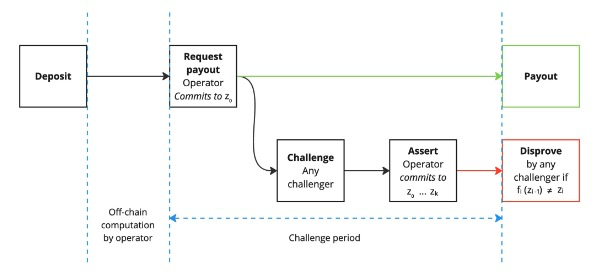
Source: bitvm.org
A detailed overview of BitVM2 is available in our latest paper.
4. BOB Hybrid L2
BOB’s Hybrid L2 design innovatively builds on BTC L1 as a decentralized network’s source of trust and its simplicity in consensus verification.
4.1 BTC L1 Security
BOB’s Hybrid L2 uses BTC L1 for settlement and security. The ideal BTC L2 design widely recognized today is zk-rollups: all state changes are computed off-chain and then verified and recorded on-chain via zk proofs. However, BTC L1 currently cannot support zk-rollups because implementing a zk prover in BTC L1 scripts requires additional opcodes to prevent consensus forgery. Therefore, BOB achieves security via BitVM2-based OP verification. This method generates validity proofs for each state transition, publishing them along with state differences to BTC L1. Paired with BitVM2, any network participant can initiate a challenge via fraud proofs within a 7-day window to overturn invalid operations and ensure security.
This means any node in the network can participate in fraud proof challenges when errors are detected. The design makes security nearly equivalent to BTC L1 itself: as long as one honest and online node exists, fraud proofs can be triggered.
4.2 Trust-Minimized BTC L1 Bridging
BitVM2 fraud proofs also enable BOB to build a trust-minimized BTC L1 bridge. Specifically, this is a light client bridge where BTC L1 supports BOB by running a light client within BitVM2. The bridge allows users to securely deposit BTC into the BOB network and withdraw back to BTC L1 when needed. This new design relies on the “existential honesty” security model, requiring only a 1-of-n honesty assumption to guarantee correct operation—significantly stricter than existing multi-sig bridge schemes.
Most existing BTC bridges rely on multi-signature setups requiring a majority of signers to be honest. In contrast, BitVM2 ensures funds cannot be stolen even if all bridge operators are dishonest—as long as one online participant exists. This eliminates vulnerabilities inherent in multi-sig schemes and constitutes the most secure BTC bridge design in history.
4.3 Trust-Minimized Ethereum Bridging
BOB’s Hybrid design also supports secure deposits and withdrawals of ETH and ERC20 tokens, similar to Optimism. When users wish to withdraw assets from the L2 to Ethereum, they must wait a 7-day challenge period to ensure no fraud proofs are submitted. This mechanism secures asset bridging between Ethereum and BTC L1, mitigating inherent cross-chain bridge risks.
In BOB’s Hybrid L2 design, the ETH bridge smart contract waits for final confirmation of BOB on the BTC L1 network, ensuring all proofs are valid. This functionality, part of the bridge smart contract, verifies the BTC L1 blockchain via a BTC L1 light client. Thus, any user depositing ETH and ERC20 tokens into BOB can retrieve these assets on Ethereum as long as BTC L1 remains secure and at least one online node can trigger a fraud proof.
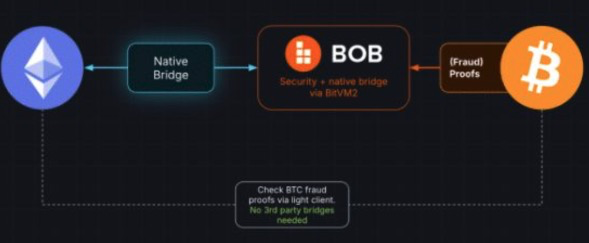
Source: BOB
5. Outlook: BOB as the Center of DeFi
The uniqueness of Hybrid L2 positions BOB at the heart of the largest DeFi ecosystems. BOB currently leverages the network effects of both BTC L1 and Ethereum and plans to expand to other chains in the future.
5.1 Self-Sufficiency Through Ethereum
dApps built on BOB benefit from Ethereum’s best-in-class infrastructure and development tools, gain access to core DeFi user groups, and establish connections with all exchanges and institutional players. Notably, nearly all Ethereum users hold BTC, and most BTC users engage with ETH DeFi.
5.2 Growth Driven by BTC L1
Over time, the added security and BTC access provided by trust-minimized BitVM2 bridging will unlock vast untapped BTC liquidity pools, enabling dApps on BOB not only to match but surpass their Ethereum counterparts. This effect is amplified by BTC L1’s global adoption and diverse user base: while ETH L2s compete for the same users, BOB’s dApps can tap into BTC’s 300+ million users and thousands of real-world businesses.
5.3 BTC L1 as the Hub of Multi-Chain DeFi
BTC L1, ETH, and stablecoins dominate 90% of the market. Yet, like traditional banks, we believe hundreds of chains will emerge focusing on specific applications or geographies. All these chains will require secure access to BTC L1 and ways to exchange assets among themselves.
Currently, centralized exchanges fulfill this role—they connect all chains, allow users to deposit and withdraw assets, and facilitate conversions to respective L1s. However, CEXs have caused major issues in the past and will continue to do so until we fully transition to DeFi.
In contrast, BOB aims to position BTC L1 as the foundation of a secure and transparent DeFi ecosystem. As a Hybrid L2, BOB enables secure bridging of assets from BTC L1 to any smart contract chain capable of verifying BTC L1’s blockchain. This means 90% of modern L1 and L2 chains—including Solana, Tron, Sui, Aptos, Monad, Avalanche, Cosmos, Polkadot, etc.—can securely deposit and withdraw assets via BOB. All operations are trust-minimized through BTC L1, eliminating dependence on third-party bridges.
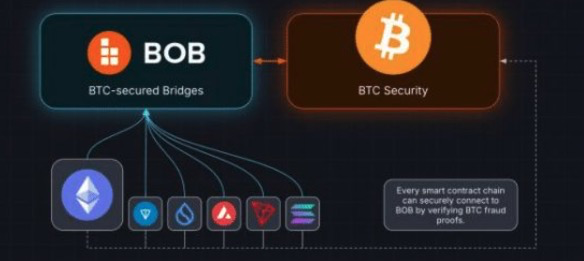
Source: BOB
Leveraging BTC L1 as a trust anchor to build an interoperable DeFi ecosystem is the core advantage of the Hybrid L2 design. Rather than fragmenting BTC liquidity across dozens of chains, BOB consolidates liquidity around BTC, offering a viable alternative to centralized exchanges and placing BTC at the center of DeFi.
6. Conclusion
BOB Hybrid L2 addresses some of the most pressing challenges in building a decentralized financial system atop BTC L1. By creating infrastructure that inherits BTC L1’s security and maintains trust-minimized BTC bridging, it enables broad user participation in BTC L1 without reliance on centralized services. Simultaneously, BOB prevents BTC liquidity fragmentation through trust-minimized bridges to Ethereum and other smart contract L1s, offering a practical, BTC L1-security-based solution to long-standing cross-chain interoperability issues—positioning BTC at the heart of DeFi.
Join TechFlow official community to stay tuned
Telegram:https://t.me/TechFlowDaily
X (Twitter):https://x.com/TechFlowPost
X (Twitter) EN:https://x.com/BlockFlow_News
 IOSG Ventures






