








AC's L1 Blueprint: A Litepaper Overview of Sonic, Centered on "Developers and Users"
TechFlow Selected TechFlow Selected
AC's L1 Blueprint: A Litepaper Overview of Sonic, Centered on "Developers and Users"
Can Sonic become the next-generation L1 and validate AC's previous sharp critique that "L2s as app chains are illogical for developers"?
 Navigating Web3 tides with focused insights
Author: Sonic Labs
Translation: Yangz, Techub News
Translator's Note: While Layer 2 (L2) ecosystems are bustling, Layer 1 (L1) networks appear deserted. It has been a year since the Fantom Foundation announced the Sonic upgrade in October last year. Last week, Sonic Labs released its Litepaper, systematically unveiling Andre Cronje—the so-called "King of DeFi"'s vision for a new L1. With only about two months left until Sonic’s anticipated mainnet launch, can Sonic become the next-generation L1 and validate AC’s sharp critique that “L2s as app chains are illogical for developers”? Let’s wait and see!
Below is the full translation of the Sonic Litepaper.
Abstract
In the evolving blockchain ecosystem, what truly sets a network apart? For Sonic, the key lies in delivering unique products and features that empower developers to build applications more competitively than on any other chain. Our focus is on providing tangible value to developers—increasing their revenue, enabling control over fee pricing, simplifying user payments—all achievable within seconds.
Many existing platforms inadequately address developer-centric needs. Ethereum focuses on scalability via optimistic and zero-knowledge rollups, with L2 total value locked (TVL) now exceeding $34 billion. This shift toward L2 solutions has inadvertently emphasized value capture through centralized sequencers charging fees, rather than fostering high-quality application development. The incentive structures designed to boost valuations and fees via rollup deployments have led to excessive commoditization of L2s, prioritizing sequencer revenue over security and decentralization. This trend creates an imbalance where sequencers benefit disproportionately while developers remain undercompensated. As a result, adoption of innovative consumer-facing applications stalls, limiting their potential market impact.
Sonic emerges from this recognition of systemic challenges—an L1 redefining developer incentives. Sonic’s Fee Monetization (FeeM) program allows developers to earn up to 90% of fees generated by their applications. Through dynamic fee customization, fee subsidies, and native account abstraction, Sonic provides flexible tools to enhance user experience and drive adoption.
Traditional L1s face a stark choice: evolve or become obsolete. Sonic leads this transformation by offering unprecedented scalability, decentralization, and near-instant speed. Combining strengths of both L1 and L2, Sonic delivers 10,000 transactions per second (TPS), sub-second finality, and a natively decentralized bridge connecting to Ethereum to enhance liquidity and security.
By merging cutting-edge technology with a revolutionary, developer-first model, Sonic aims to redefine the blockchain industry, refocusing attention on productive, consumer-facing applications and empowering builders to create profitable on-chain businesses.
Business Case and Initial Objectives
As a decentralized L1, Sonic primarily offers fee-supported distributed computing capacity. Current industry incentive structures paradoxically marginalize fundamental productive applications and network revenues, shifting focus toward short-term parasitic and extractive monetization models, ultimately slowing growth and momentum. We measure success simply: whether network revenue exceeds the total cost of incentivizing validators.
We generate demand for these transactions by supporting developers and enterprises building consumer or B2B applications that require writing data to the network and charging fees. Sonic aims to maximize demand without disruption, utilizing the full transaction throughput the network can effectively support, while collecting sufficient fees per transaction to cover operational costs.
Sonic can easily process up to 900 million transactions daily, with sub-second time-to-finality (TTF). This supply far exceeds current demand. Currently, all L2s combined handle around 12 million transactions per day, peaking at approximately 17 million. Solana recently peaked at 40 million daily transactions. Even combining these peaks yields roughly 57 million daily transactions—only a fraction of our capacity threshold.
With abundant block space and transaction capacity, our focus shifts to scaling demand. Achieving greater demand than the entire industry currently handles requires bold initiatives such as:
-
Fee Monetization (FeeM): Rewarding builders with up to 90% of application fees
-
Sonic Gateway: Enabling users and builders to access Ethereum liquidity securely via a native cross-chain bridge
-
Hosting one of the largest airdrops in history to kickstart network flywheels with new users and protocols
-
Dynamic fee functionality allowing developers to customize gas costs for interactions with their contracts, fostering an on-chain creator economy
-
Innovator Fund: Allocating up to 200 million S tokens from the Sonic Labs treasury to acquire infrastructure and strategic partners, promoting long-term network development
-
Sonic & Sodas: Funding community-driven, developer-focused events worldwide sponsored by Sonic Labs
All of this will occur alongside deployment of Tier-1 infrastructure partners including Chainlink, Pyth, Dune, Alchemy, and Safe.
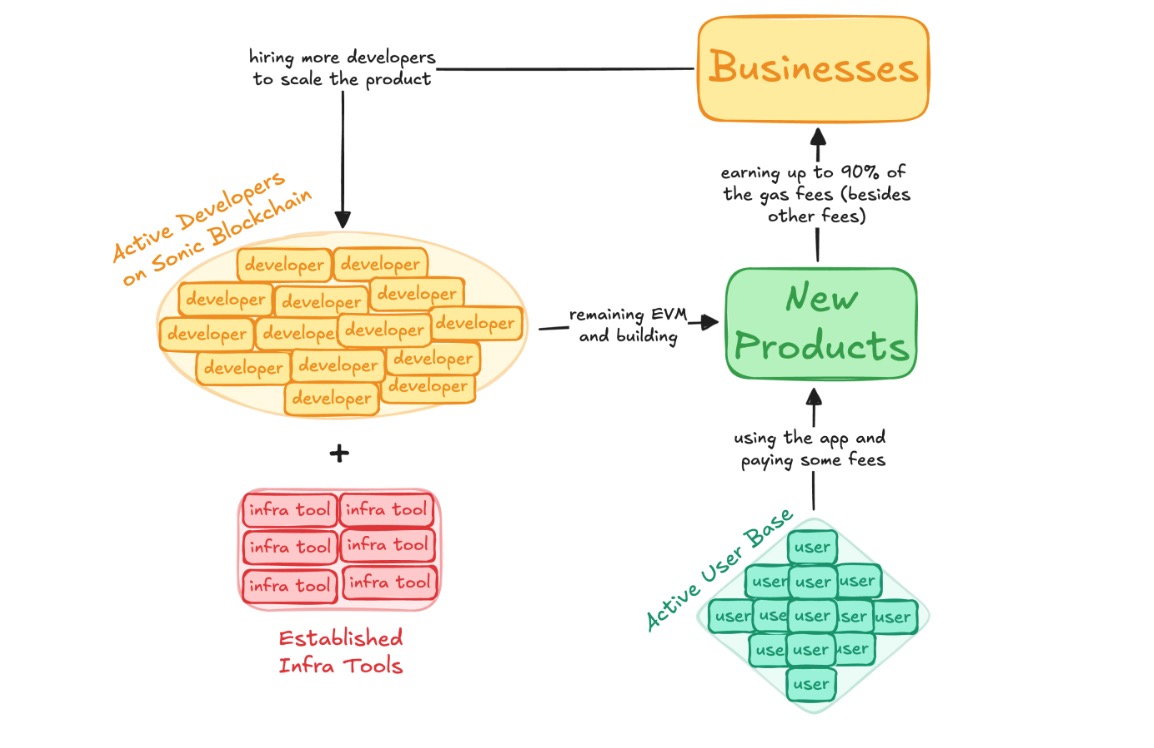
Incentive Mechanisms
Peter Thiel heavily invested in user acquisition during PayPal’s early days, paying $10 to every user who signed up and referred friends. Similarly, the Sonic Labs treasury will allocate up to 200 million S tokens to programs like the Innovator Program, accelerating immediate adoption of Sonic-based applications and supporting emerging innovators. Additionally, a 190.5 million S token airdrop will give Sonic developers opportunities to attract more users by incentivizing application usage. Furthermore, Sonic is rapidly streamlining its liquid staking token (LST) market, offering dedicated token holders greater flexibility.
A cohort of mature developers is already prepared to migrate from Fantom Opera to Sonic, but achieving broader goals requires millions of users and thousands of developers.
Sonic Labs Innovator Fund
Funded directly from the Sonic Labs treasury, the Sonic Labs Innovator Fund consists of up to 200 million S tokens. This fund is currently being used to ensure Sonic’s integration with top-tier infrastructure, guaranteeing builders access to best-in-class tools even in today’s challenging market environment.
Sonic is actively collaborating with dozens of applications and leading infrastructure providers across domains including on-chain analytics tools, compliance, native assets, real-world assets (RWA), bridge integrations, custody solutions, institutional adoption, exchange-traded products, wallets, subgraphs, and strategic Web2 partnerships. To date, publicly confirmed secure infrastructure integrations include Chainlink, Dune, Safe, Pyth, Alchemy, Redstone, and Tenderly.
Airdrop Program
We plan to distribute 190.5 million S tokens via airdrop to incentivize user and developer activity on both Opera and the new Sonic chain.
The first major component of the airdrop is Sonic Boom, which will award Sonic Gems (points within the airdrop system) to up to 30 winning projects as prizes for developing innovative applications. This initiative helps establish a DeFi ecosystem on Sonic and jumpstarts adoption flywheels. Projects can redistribute these points as rewards to users interacting with their apps, helping maintain user engagement through usage incentives.
Sonic aims to identify promising teams and equip them with the tools needed to build successful applications in DeFi, gaming, AI, and beyond. The airdrop’s core objective is to grow the developer community to critical mass, enabling us to continue supporting their growth as they scale.
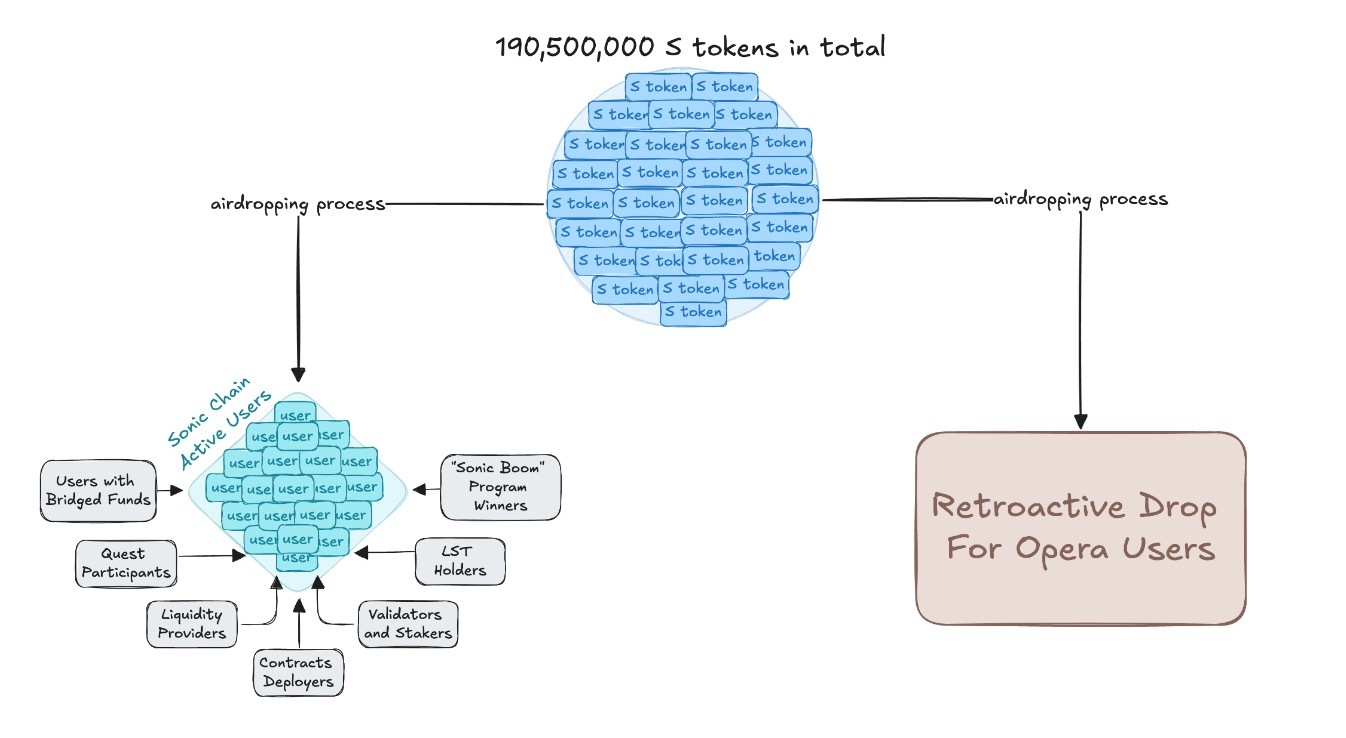
Airdrop Design
Sonic employs a deflationary airdrop system using a unique linear decay mechanism, incorporating game theory to address the challenge of maintaining active on-chain participation post-airdrop. Specifically, such systems must minimize sudden misalignment of circulating supply shortly after distribution, which linear decay and token burn mechanisms help resolve.
The burn mechanism encourages recipients to increase on-chain activity while waiting for optimal exit timing. Recipients may either wait for full vesting of their airdropped position or redeem early—at a cost. Those who do neither will see their unclaimed allocation go to speculative buyers.
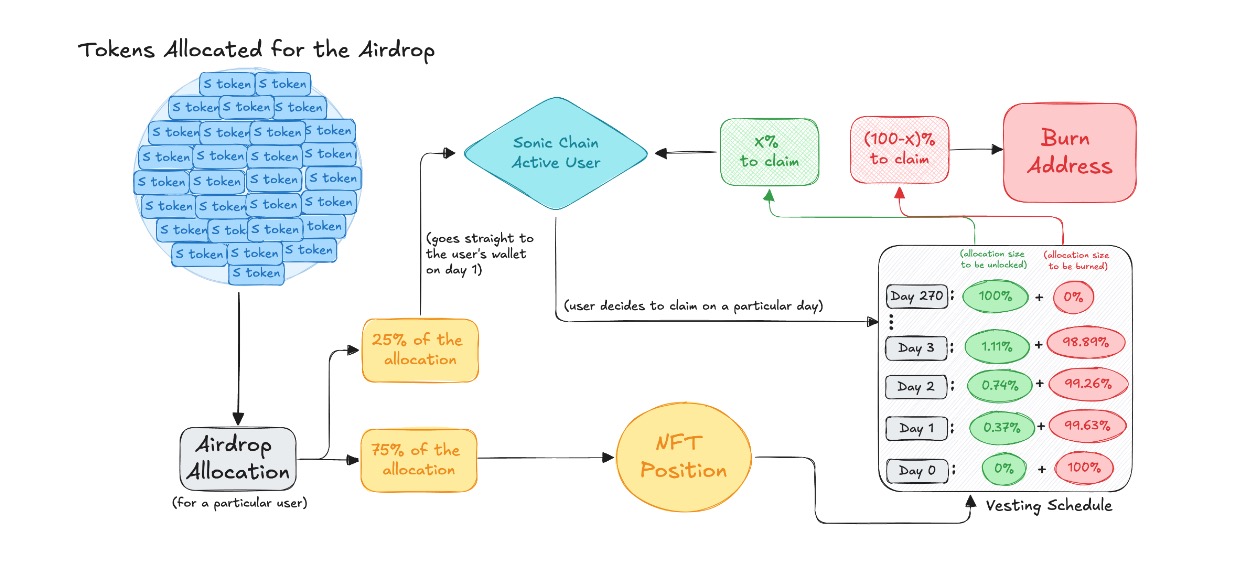
On Day One of the airdrop, 25% of the user’s allocation becomes liquid, while the remaining 75% vests over 9 months (270 days) as an ERC-1155 NFT position. Sonic users can claim the initial 25% immediately and retain flexibility in deciding when to claim the remainder according to the applicable burn rate.
Users who choose to hold the NFT but wish to trade it on secondary markets are free to do so, creating a speculative market for individual airdrop allocations while simultaneously exerting deflationary pressure on the overall airdrop. The chart below illustrates how many S tokens would be burned if a user claims before the full 270-day unlock period.
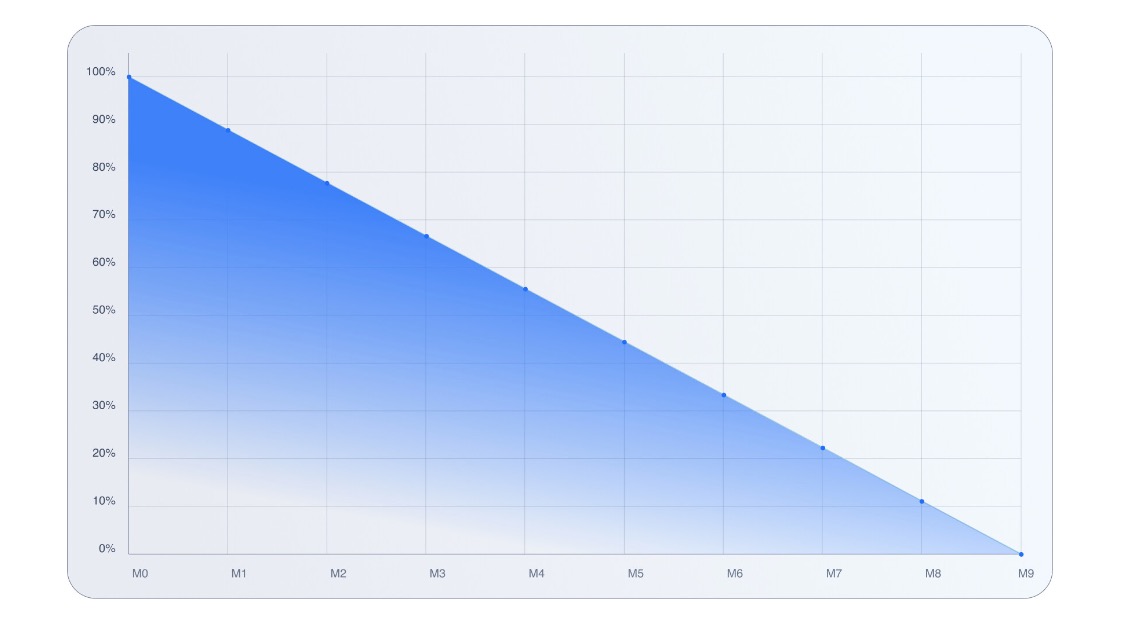
Fee Monetization
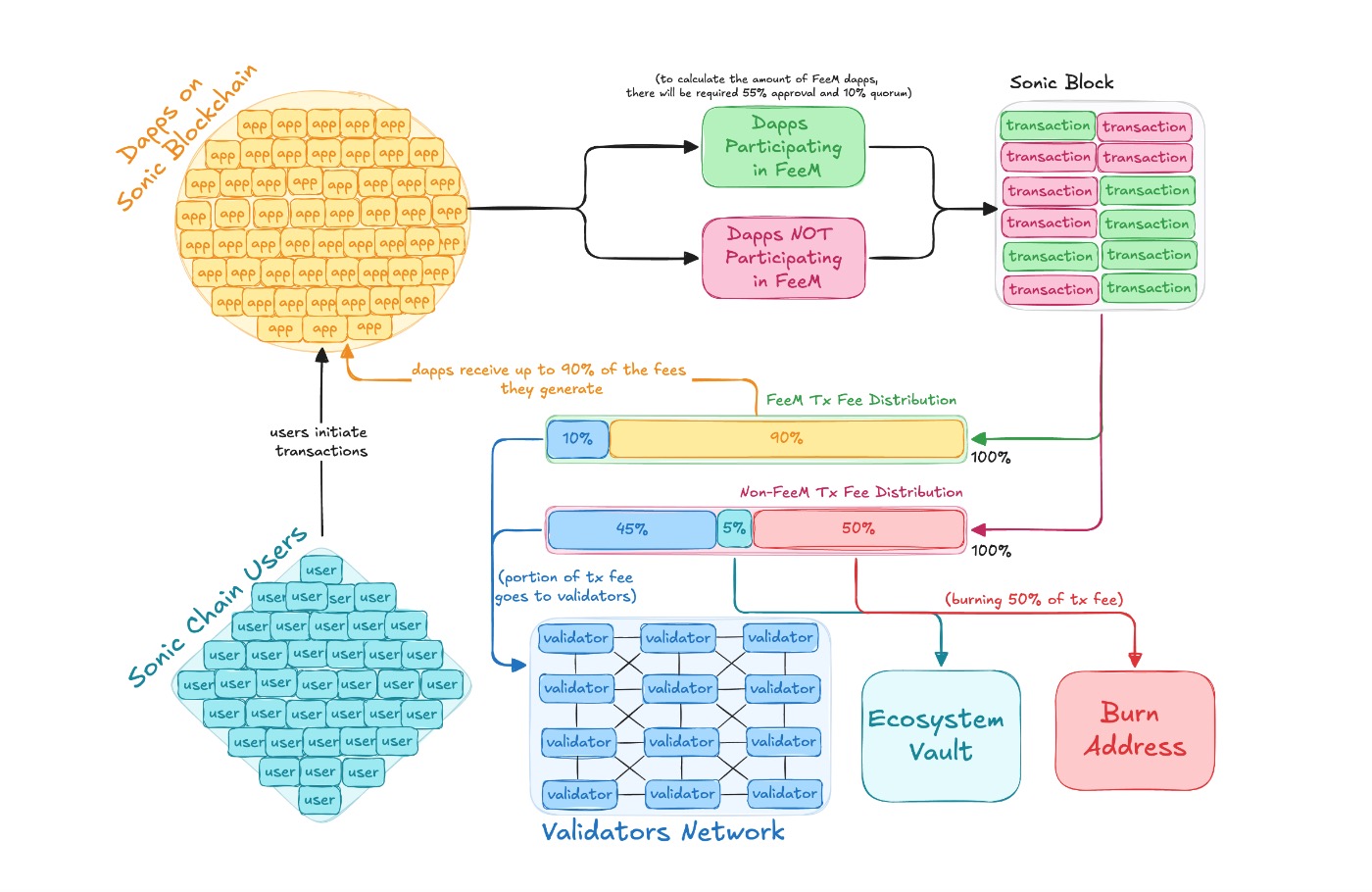
Sonic’s Fee Monetization program (formerly Gas Monetization) enables developers to earn up to 90% of fees generated by their applications, providing sustainable revenue to retain top creators and support network infrastructure.
Through FeeM, Sonic aims to cultivate a thriving ecosystem analogous to ad-revenue models on traditional web platforms. Below is a breakdown of transaction fees, including the innovative burn mechanism:
-
Transactions on non-FeeM applications
If a user submits a transaction on a non-FeeM application, 50% of the transaction fee is burned, with the remainder distributed to validators and the ecosystem treasury.
-
Transactions on FeeM-enabled applications
If a user submits a transaction on a FeeM-enabled application, 90% of the transaction fee goes to the application’s developer, with the rest going to validators.
Fee Structure
Sonic proposes a target block reward rate of 3.5% to ensure ongoing network sustainability. The table below outlines differences in fee distribution between non-FeeM and FeeM-enabled applications.
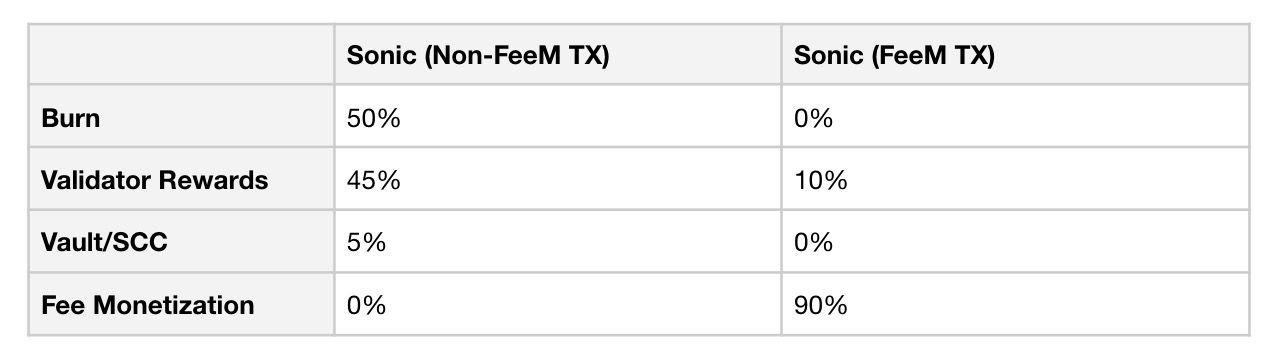
If a FeeM-enabled application earns less than the 90% cap, the residual transaction fees are sent to validators.
Burn and FeeM Mechanism Example
-
Scenario: 50% of transactions come from FeeM-enabled apps, the other 50% from non-FeeM transactions
-
Average target cost: $0.01 per transaction
-
Network capacity: Over 900 million transactions per day
-
Projection: Achieving 10 million daily transactions results in:
-
~$100,000 inflow per day
-
~$36.5 million annual inflow
-
$9.125 million burned annually
-
$10.0375 million paid to validators annually
-
$16.425 million paid to Sonic developers annually
Sonic Liquid Staking Token (LST)
During Fantom’s operation, staked nodes consistently exceeded 40%, compared to Ethereum’s ~30%. However, complex staking mechanics hindered LST market growth, limiting millions in capital flow into DeFi.
Sonic’s new staking mechanism introduces a 14-day lock-up period and a 7-day withdrawal window, creating an ideal structure to unlock an estimated LST market exceeding $500 million.
Technical Architecture
Sonic delivers exceptional scalability and storage capabilities while ensuring fast, seamless user experiences. Sonic supports up to 10,000 ERC-20 transfer transactions per second with sub-second finality, enabling instant, irreversible transactions, and leverages advanced storage systems for efficient data management.
Unlike L2s and Ethereum, true finality on Sonic is achieved in just one block (no longest-chain rule), without needing to batch and write data back to Ethereum.
Sonic Gateway
In the evolving blockchain landscape, a native, decentralized cross-chain bridge is essential for a healthy ecosystem, enabling strong interoperability and preventing network silos. Yet, current L1 and L2 solutions often force users to compromise on security, speed, or decentralization. Cross-chain bridge hacks have already caused losses exceeding $2.5 billion.
Recognizing these systemic threats, Sonic’s bridge adheres to three simple objectives:
-
Security: Built-in fail-safe mechanisms to ensure safety
-
Speed: Smooth user experience enabling effortless asset transfers
-
Decentralization: Eliminates single points of control; only users access their funds
Sonic Gateway is a trustless cross-chain bridge enabling ERC-20 token transfers between Ethereum and Sonic while achieving all three goals. By leveraging Sonic’s own validator network—with validators operating nodes on both chains—it establishes a secure, decentralized channel between platforms.
With built-in fail-safe mechanisms, Sonic Gateway safeguards assets, protecting user funds under all circumstances. Crucially, only users can access funds transferred via Sonic Gateway; no centralized entity can override user control or access funds via master keys.
Additionally, Sonic Gateway is optimized for efficiency. Transfers from Ethereum to Sonic take a maximum of 10 minutes, while transfers from Sonic to Ethereum take up to 1 hour (these intervals are called “heartbeats”). Although Sonic is not an L2, it remains an active participant in the Ethereum ecosystem, spending ETH via Sonic Gateway to write transactions onto the chain.
Fast-Lane Transactions
Users may opt for “Fast-Lane Transactions” to execute transfers immediately. By paying a premium to bypass standard “heartbeat” delays—which normally delay fund availability on the destination chain—users gain instant access to funds.
Fast-Lane Transactions propagate full state to the target chain, just like regular heartbeat transactions, benefiting all users—not just the submitter. In essence, they are equivalent to heartbeat transactions, merely submitted earlier. Importantly, Fast-Lane Transactions are optional enhancements that do not alter standard heartbeat timing.
For example, if the standard Ethereum-to-Sonic heartbeat interval is 10 minutes, submitting a Fast-Lane Transaction 5 minutes before the next scheduled heartbeat allows all users transferring from Ethereum to Sonic to access their funds immediately, while the next standard heartbeat still occurs in 5 minutes.
Gateway Fail-Safe Mechanism
Sonic Gateway includes a built-in fail-safe mechanism allowing users to reclaim their bridged assets on the original chain in case of failure of Sonic or its gateway.
This mechanism activates if the gateway fails continuously for 14 days, safeguarding users transferring assets from Ethereum to Sonic. As an insurance measure, the 14-day fail-safe period is immutable—once deployed, neither Sonic Labs nor any third party can modify it.
Importantly, this period is not a race condition but a fundamental feature ensuring users retain custody of their bridged assets on the source chain.
How the Fail-Safe Mechanism Works
Sonic Gateway transmits “heartbeats” between chains, containing each blockchain’s Merkle root and block height. If heartbeats stop for 14 consecutive days, it signals gateway failure, triggering fund unlocking on Ethereum.
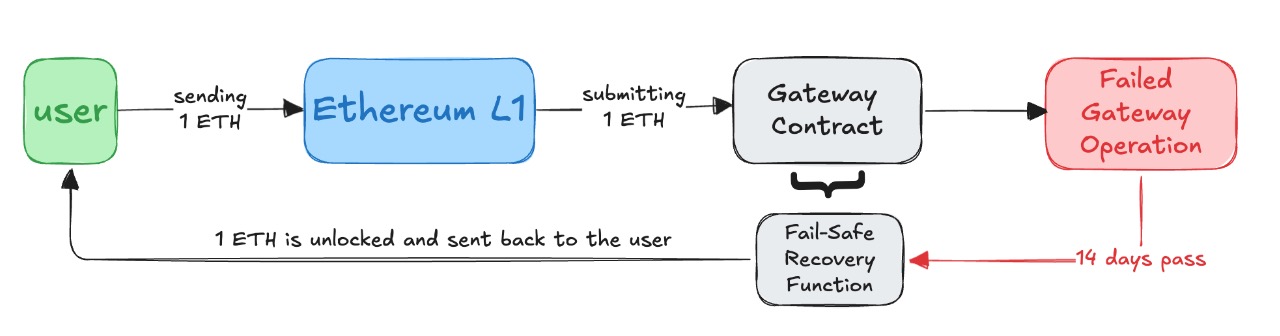
Only assets transferred via Sonic Gateway are recoverable. The 14-day duration serves as a buffer period, allowing time to resolve issues before the gateway is deemed unavailable.
Sonic vs. L2
Most L2s are optimistic rollups, operating under the assumption that all withdrawals are valid unless challenged (hence “optimistic”). To ensure security, these L2s enforce a 7-day challenge period, during which anyone can verify and dispute withdrawal claims on Ethereum. For instance, if you attempt to withdraw 2 ETH from Optimism to another platform, those assets won’t be released on Ethereum until the 7-day challenge window closes. So why does withdrawing from platforms like Arbitrum or Optimism to exchanges like Binance appear to take only minutes?
In reality, deposits from optimistic rollups to exchanges may seem fast, but the exchange assumes the risk of the challenge period—because Binance trusts most L2s. However, technically, the funds credited to your account aren’t secure until the 7-day window closes, meaning the exchange bears interim risk.
In contrast, as an L1 with its own secure validators, Sonic can offer exchanges instant (single-block) settlements with no associated risk, as these transactions aren’t subject to challenge periods—even if USDC (and other ERC-20 tokens) become native on Sonic. Moreover, assets bridged from Ethereum via Sonic Gateway settle within one hour, a faster and safer alternative compared to the 7-day dispute windows required by most L2 solutions.
Sonic Database
Sonic uses a database to store its world state, including account information, VM bytecode, smart contract storage, and more. This database features “live pruning,” automatically removing historical data to reduce storage demands on validators.
Previously, pruning required validator nodes to go offline, posing financial and operational risks. Now, validators can perform live pruning—continuously discarding historical data while maintaining uninterrupted operation, saving disk space and costs.
Live pruning works by splitting the database into two types: LiveDB and ArchiveDB. LiveDB contains only the current block’s world state, while ArchiveDB holds world state from all historical blocks. Validators use only LiveDB, while archival nodes maintain both LiveDB and ArchiveDB to serve historical data requests via RPC interfaces.
Sonic’s database employs an efficient tree-like or hierarchical structure, simplifying data retrieval. Critically, it still provides cryptographic signatures for the world state and offers archiving via an incremental prefix algorithm. It also uses native disk formats instead of indirect storage via key-value stores like LevelDB or PebbleDB.
Sonic Virtual Machine
The Sonic Virtual Machine (VM) replaces the EVM, enhancing execution speed on Sonic. Fully compatible with Solidity and Vyper, the Sonic VM allows ecosystem developers to continue using familiar development tools. Additionally, Sonic will support Geth 1.4.
The Sonic VM uses dynamic translation—converting code into more efficient instruction formats within clients—to execute smart contracts more efficiently. This is achieved through advanced execution techniques and “super-instructions,” which represent common code patterns in highly optimized forms.
Tokenomics
Sonic’s native token is S, serving multiple functions:
-
Paying transaction fees
-
Securing the chain via staking (minimum 1 S)
-
Running validators to secure the chain (minimum 50,000 S)
Governance Participation
At mainnet launch, S will have a total supply of 3.175 billion, matching FTM’s total supply. Circulating supply will correspond to FTM’s circulating supply at that time. FTM holders can exchange their tokens for S at a 1:1 ratio. Based on decisions from multiple governance proposals, the following additions will gradually be integrated into S’s tokenomics.
Airdrop Program
Six months after Sonic’s launch, 6% of the 3.175 billion S tokens will be minted for the airdrop program, rewarding users and builders on both Fantom Opera and Sonic. The airdrop features an innovative burn mechanism that rewards active participants and gradually reduces the total S supply.
Ongoing Grants
Six months after launch, additional S tokens will be minted to boost S adoption and global reach; expand team size and operations; implement robust marketing campaigns and DeFi initiatives; and launch programs like Sonic Spark and Sonic University to fuel future growth.
To fund this, starting six months after mainnet launch, 1.5% of the initial S supply (47.625 million tokens) will be minted annually for six years. However, to prevent inflation, any newly minted tokens not used in a given year will be burned, ensuring 100% of newly minted tokens are used exclusively for network growth rather than held in reserve. For example, if Sonic Labs uses only 5 million tokens in Year 1, the remaining 42.625 million will be destroyed.
Block Rewards
We are transitioning validator rewards from Fantom Opera to Sonic. In the initial years, Opera validators will continue receiving rewards. However, as validators and stakers migrate to Sonic, their block rewards will be reduced. Savings from these reductions will be reallocated to reward Sonic validators. Meanwhile, the Sonic Foundation will continue maintaining Opera validators for the foreseeable future.
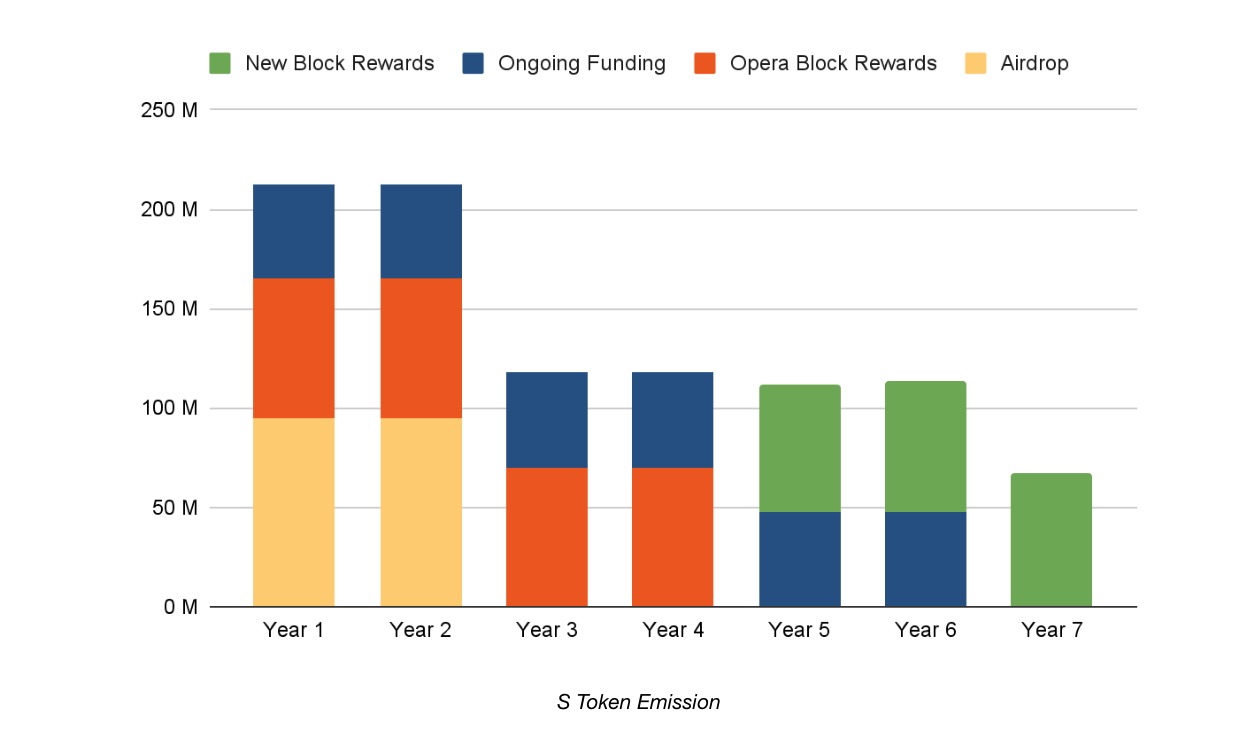
Sonic targets a 3.5% annual percentage rate (APR). To maintain this yield without inflation during the first four years, we will redirect remaining FTM block rewards from Opera to Sonic as rewards for validators and stakers. These rewards are already included in the initial 3.175 billion S supply.
Although the initial total supply of S is technically 3.175 billion—matching FTM’s supply—the circulating supply at launch will be approximately 2,883,358,939 tokens. The difference (~70,067,224 tokens per year) will be distributed to validators over Sonic’s first four years. During this period, no new S tokens need to be minted for block rewards.
Due to these changes, Opera’s APR will drop to zero after Sonic’s launch. Additionally, to preserve value for all FTM and S holders and eliminate the need for new inflationary rewards at launch, no new tokens will be minted for validator security during Sonic’s first four years. After four years, S block rewards will resume at an annual issuance rate of 1.75% to reward validators.
The chart below shows the total issuance of S tokens over the first seven years.
Token Burn Mechanisms
Sonic implements three burn mechanisms to reduce net S token issuance:
-
Fee Monetization Burn: 50% of transaction fees on non-FeeM applications are burned
-
Airdrop Burn: Users who do not wait for the full 270-day vesting period lose part of their airdropped S, which is then burned
-
Ongoing Grant Burn: Of the 47.625 million S tokens minted annually during the first six years for growth funding, any unused portion is burned
The chart below forecasts S’s circulating supply from launch through Year 7. The blue line represents circulating supply without burns; the red line includes burns.
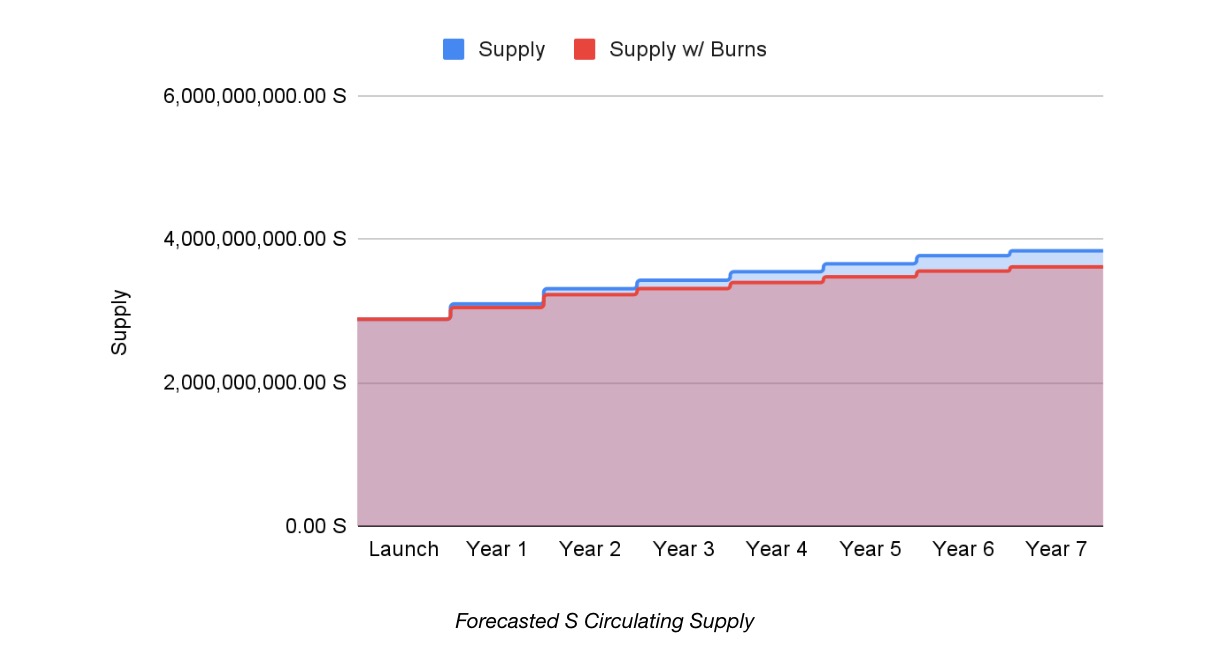
To illustrate potential burn volumes in the chart above, we assume 50% of tokens from ongoing grants will be burned. We also assume 10 million daily transactions on Sonic at ~$0.01 average fee, with half occurring on non-FeeM apps (where 50% of fees are burned). Finally, we assume users on average claim 20% of their airdrop early, resulting in partial burns.
Note: All provided tokenomic calculations assume a December 2024 launch. Adjustments will be made if the launch date changes.
From Fantom to Sonic
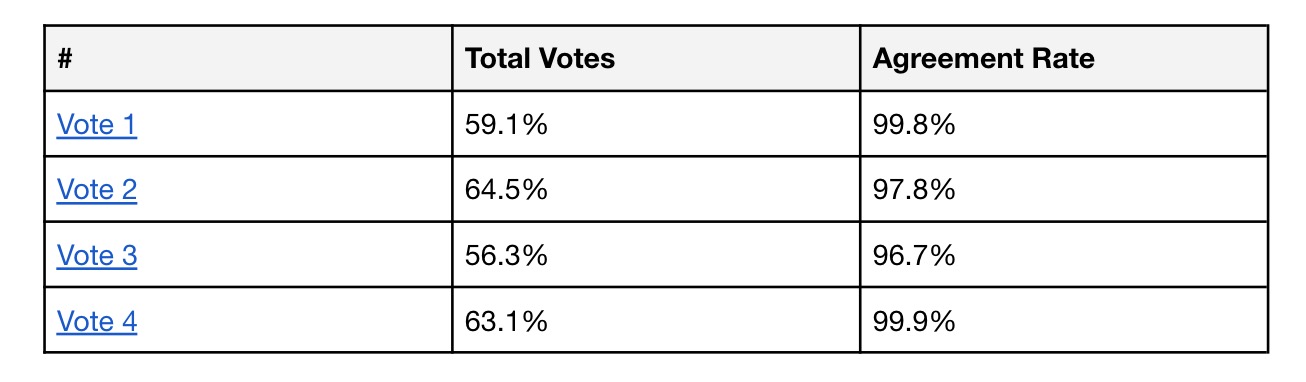
Following extensive discussion within the Fantom community and approval via four governance votes (results shown below), Sonic will launch as a new chain, continuing Fantom’s legacy.
FTM holders can exchange for S in one of two ways:
-
CeFi route: Sonic is partnering with most exchanges currently listing FTM to coordinate automatic swaps
-
Self-custody / DeFi route: Sonic Labs will deploy a simple bridge enabling 1:1 FTM-to-S conversion. Bidirectional swapping will be supported during the first 90 days after Sonic mainnet launch. Starting at 4 PM GMT on Day 91, only one-way FTM-to-S conversions will be allowed.
Conclusion
Sonic aims to revolutionize the blockchain industry by delivering a next-generation L1 that combines speed, scalability, and security. With innovative features such as fee monetization, a secure Ethereum-connected cross-chain bridge, and streamlined staking mechanisms, Sonic positions itself as a developer-friendly platform that prioritizes builders and users alike.
Join TechFlow official community to stay tuned
Telegram:https://t.me/TechFlowDaily
X (Twitter):https://x.com/TechFlowPost
X (Twitter) EN:https://x.com/BlockFlow_News






