Industry's Largest Acquisition: The Underlying Logic Behind Stripe's $1.1 Billion Purchase of Bridge
TechFlow Selected TechFlow Selected
Industry's Largest Acquisition: The Underlying Logic Behind Stripe's $1.1 Billion Purchase of Bridge
Future M&A deals will become even more intense.
 Navigating Web3 tides with focused insights
By Will Wang
For some, Stripe’s $1.1 billion acquisition of Bridge, a stablecoin API provider, may seem unexpected. But the truth is, stablecoins are sweeping the globe—posting over 50% year-over-year growth—and already processing more than twice the global transaction volume of Visa.
As the saying goes, “When the spring river warms, ducks know first.” Stripe, one of America’s three major payment giants, after aggressively experimenting with Pay with Crypto this year, has now made a bold move: acquiring Bridge.xyz, a stablecoin API company founded just two years ago, for $1.1 billion—the largest acquisition deal in the crypto industry to date.
This article will explore Bridge's business model through the lens of stablecoins, and then analyze Stripe’s strategic rationale behind the acquisition.
1. The Rise of Stablecoins
A16z Crypto’s recently released State of Crypto Report 2024 clearly states that stablecoins have become one of Web3’s most prominent “killer applications.” Thanks to the widespread adoption of smartphones and the real-world implementation of blockchain technology, stablecoins could represent the greatest financial empowerment movement in human history.
Stablecoins have simplified value transfer. Their quarterly transaction volume is already more than double that of Visa’s $3.9 trillion—settling trillions of dollars in assets annually, demonstrating their immense practicality. Additionally, measured by daily active addresses, stablecoins account for nearly one-third (32%) of daily cryptocurrency usage, second only to decentralized finance (DeFi) at 34%.
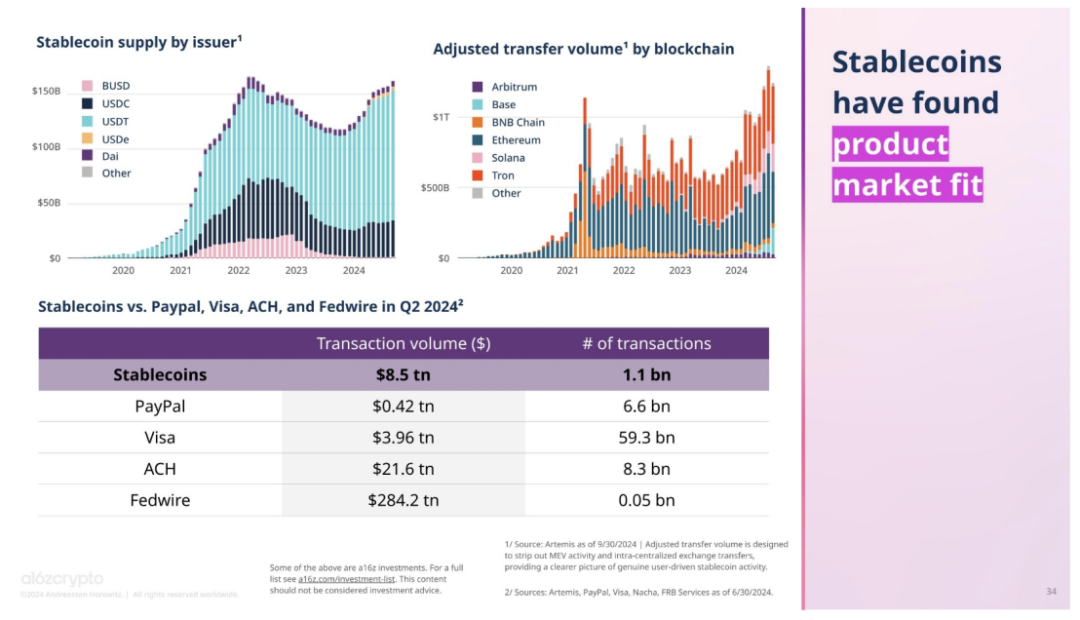
(State of Crypto Report 2024: New data on swing states, stablecoins, AI, builder energy, and more)
According to Visa’s own stablecoin report, the total supply of stablecoins is approximately $170 billion. They settle trillions of dollars in assets each year. Around 20 million blockchain addresses conduct stablecoin transactions monthly, and over 120 million addresses hold non-zero stablecoin balances. These figures indicate that stablecoins operate as a parallel monetary system to traditional financial infrastructure—something that was virtually nonexistent just five years ago.
Here are some staggering stablecoin statistics:
-
Stablecoins are now the sixth-largest purchaser of U.S. Treasuries;
-
30% of cross-border remittances are conducted via stablecoins;
-
Major companies such as Visa, PayPal, Square, and Mastercard all have stablecoin initiatives;
-
SWIFT and several sovereign nations are exploring the utility of stablecoin payments;
-
The use of stablecoins for non-crypto purposes is growing rapidly—such as remittances, cross-border payments, payroll, trade settlements, and merchant payments.
2. What Is Bridge?
Founded by entrepreneurs Sean Yu and Zach Abrams, Bridge is a stablecoin API engine offering software tools that enable companies to accept stablecoin payments. The founders previously sold Evenly—a Venmo competitor—to Block in 2013; Abrams also served as a senior executive at Coinbase.
Bridge’s Orchestration API integrates stablecoin payments into existing Web2 business operations, handling all compliance, regulatory, and technical complexities.
The Issuance API enables users to issue their own stablecoins and offers investment options in U.S. Treasuries yielding around 5%, improving capital efficiency.
These APIs, combined with Bridge’s proprietary capabilities—1) cross-chain stablecoin transactions, 2) fiat-to-crypto on/off ramps, and 3) virtual bank accounts provided through Lead Bank—enable Web2 users to adopt stablecoin payments seamlessly and effortlessly.
Bridge claims its API allows funds to be transferred globally within minutes, enabling smooth stablecoin payments, converting local fiat currencies into stablecoins, and providing dollar and euro accounts for consumers and businesses worldwide—allowing users to save and spend in USD and EUR.
While not fundamentally revolutionary, Bridge stands out by streamlining the user experience for Web2 audiences.
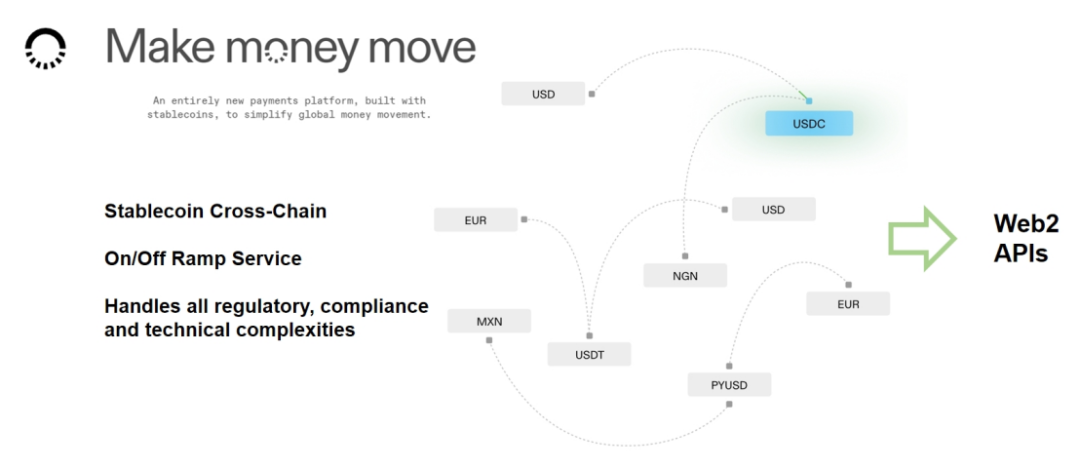
(https://www.bridge.xyz/#secSolution)
According to Foresight News’ article, “What Exactly Is Bridge, the Company Stripe Just Acquired for $1.1 Billion?”: Bridge has attracted numerous high-profile clients, including SpaceX. As reported by Fortune magazine, SpaceX uses Bridge to collect payments in different currencies across jurisdictions and transfer them via stablecoins into its global treasury.
Bridge has also partnered with crypto firms such as the Stellar blockchain network and Bitcoin payment app Strike, providing infrastructure for their own stablecoin payment features. Additionally, Coinbase has adopted Bridge’s services to support transfers between Tether on Tron and USDC on Base. To date, Bridge has processed over $5 billion in annual payments.
As Forbes reported, Bridge had previously raised $58 million from investors, including a $40 million Series A round valuing the company at $200 million. Investors included Sequoia Capital, Ribbit Capital, Index Ventures, Haun Ventures, and 1confirmation. This $1.1 billion acquisition represents a 5.5x premium and marks Stripe’s largest-ever acquisition—as well as the biggest deal in crypto industry history.
The $1.1 billion price tag isn’t excessive—especially when compared to multi-billion-dollar valuations of crypto protocols whose only exit liquidity comes from selling useless governance tokens to the market.
3. The Stripe-Bridge Partnership
The collaboration between Stripe and Bridge is essentially a continuation of the stablecoin rise story. Their integration will further accelerate the execution of Stripe’s Pay With Crypto strategy, enabling Stripe to handle stablecoins more easily, making transactions more transparent and secure.

(x.com/Stablecoin/status/1848390039975469094)
Let’s look at Bridge’s latest official announcement:
“Bridge and Stripe will join forces to accelerate the adoption and utility of tokenized dollars, making it easier for everyone around the world to transfer, store, and spend money.
When we launched our API 18 months ago, the world was very different. Many questioned the practicality of digital assets altogether, and stablecoins were no exception. Regulators, banks, and fintech companies were unable or unwilling to engage deeply with this new medium of exchange.
Since then, some of the world’s largest financial institutions—including Visa and SWIFT—have begun natively supporting stablecoins. Policymakers globally are working to provide clarity and support for stablecoin infrastructure, recognizing the strategic importance of this technology to the current financial system.
Behind the scenes, stablecoin adoption and usage are accelerating rapidly.
Shortly after launch, several cross-border payment companies integrated our API, proving stablecoins can make global money flows faster and cheaper. Then, we worked with government agencies to disburse aid, supporting thousands of frontline workers in Latin America. Later, we built Virtual Accounts, enabling fintechs like Dolar App and Chipper Cash to let global consumers and enterprises hold and spend U.S. dollars.
With every use case, we’ve proven—not just to ourselves but to external stakeholders—that stablecoins can become core global financial infrastructure. Stablecoins represent a new payment platform—not because consumers or businesses inherently want ‘crypto,’ but because they solve critical financial problems. They make money easier to move, cheaper to hold, and less expensive to send.
Stripe and Bridge share a common vision: our increasingly globalized world needs better money. We need currency that can move across borders freely, accessible to anyone anywhere, and nearly free to send.
And crucially, we both believe transformative change in financial services doesn’t happen overnight. It takes years of accumulation—continuous product and platform improvements, and building trust with customers, regulators, and partners.”
4. Stripe’s Crypto Strategy
Prior to the acquisition, on October 10, Stripe announced the relaunch of its crypto payment gateway (Pay With Crypto) for U.S. businesses, enabling American merchants to:
1. Accept USDC and USDP from over 150 countries via Ethereum, Solana, and Polygon (Crypto Payin);
2. Receive payouts in U.S. dollars (Crypto Payouts);
3. Integrate with checkout solutions, Elements payment components, and Payment Intent APIs—with plans to extend to subscription services soon.
In 2014, Stripe became the first major payment company to offer Bitcoin payments. However, due to long confirmation times, high fees, and price volatility leading to declining demand, the service was gradually phased out by 2018.
Yet this isn’t Stripe’s first recent foray into crypto services. In July, Stripe’s EU entity enabled users to purchase cryptocurrencies such as BTC, ETH, and SOL.
In June, Stripe partnered with Coinbase: Stripe incorporated Coinbase’s Base Layer 2 into its crypto payment offerings, while Coinbase integrated Stripe’s fiat-to-crypto onramp, allowing users to buy crypto directly into their Coinbase wallets.
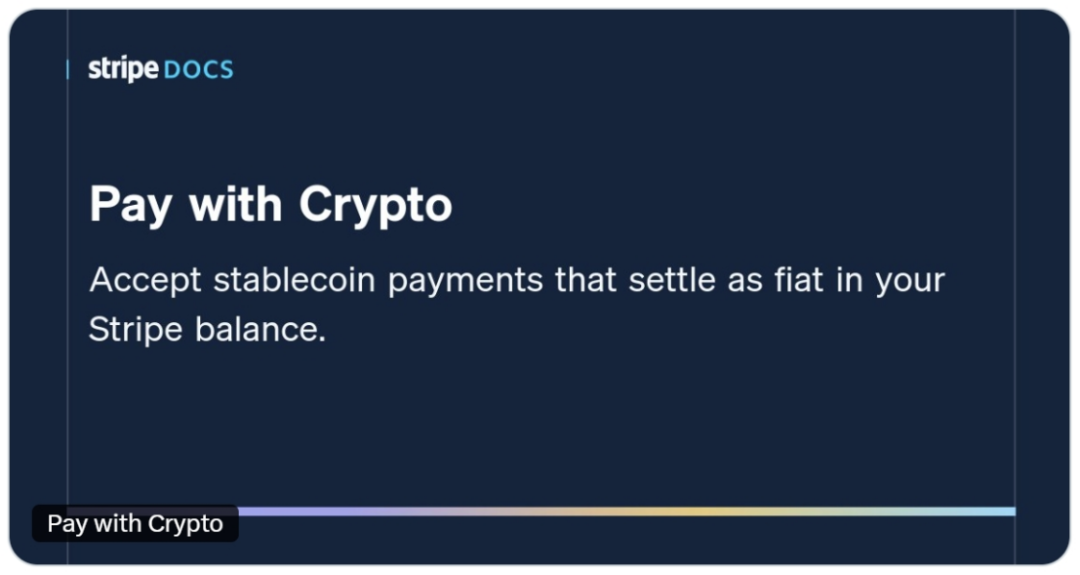
(docs.stripe.com/crypto/pay-with-crypto)
The essence of Stripe’s crypto-related activities—whether payment processing or transfers—is twofold: 1) On/Off ramps; 2) Cross-chain settlement of crypto/stablecoins.
Therefore, the acquisition of Bridge:
-
Quickly fills functional gaps in this business area;
-
Better serves Stripe’s existing customer base;
-
Expands beyond Stripe’s ecosystem. Notably, Bridge’s marquee client is the U.S. government. Yes, you read that right—Uncle Sam has joined the stablecoin party.
5. Responding to PayPal’s PYUSD
Last October, when writing "Web3 Payments Deep Dive: Industry Giants Enter the Arena, Poised to Reshape the Crypto Landscape," I was still evaluating the practical utility and adoption of stablecoin payments. Now, major payment players have fully entered the space.
After launching its stablecoin PYUSD on Ethereum last August, PayPal introduced PYUSD on Solana this June. Beyond its own ecosystem, PayPal is actively fostering a developer ecosystem around PYUSD.
According to DeFiLlama data, in August, PYUSD on Solana captured 64% of the market share, compared to 36% on Ethereum. PYUSD’s overall market cap reached $1 billion in August.
PayPal previously outlined its roadmap for stablecoin payments toward mass adoption:
-
Awareness through Introduction
-
Utility through Integration
-
Ubiquity through Assimilation
Clearly, the industry is currently in the second phase, moving steadily toward the third.
 (Understanding PayPal’s Stablecoin Payment Logic and Its Path to Mass Adoption)
Another payment giant, Block (formerly Square), led by Jack Dorsey, remains a staunch believer in Bitcoin—holding 8,027 BTC—and has extensive investments across the crypto landscape.
6. Final Thoughts
As Anna @gizmothegizzer once said, “In the country of the blind, the one-eyed man is king.” In crypto, the company with the most obscure APIs and the best connections might just be emperor. My first thought is Tether—but Bridge might be among them too.
We are just getting started.
Future M&A deals will be even more dramatic.
Join TechFlow official community to stay tuned
Telegram:https://t.me/TechFlowDaily
X (Twitter):https://x.com/TechFlowPost
X (Twitter) EN:https://x.com/BlockFlow_News
 0xWillmfer