








Crypto airdrops are dead, having killed themselves in the pursuit of profit
TechFlow Selected TechFlow Selected
Crypto airdrops are dead, having killed themselves in the pursuit of profit
Killing yourself on the mad, profit-driven path.
 Navigating Web3 tides with focused insights
Author: Johnnatan Messias, Aviv Yaish, Benjamin Livshits
Translation: Block unicorn

Airdrops are a commonly used strategy among blockchain protocols to attract and expand early user bases. Typically, protocols distribute tokens to specific users as "rewards" for participating in the protocol, aiming to cultivate long-term community loyalty and sustained economic activity. Despite the widespread use of airdrops, there is limited deep understanding of the key factors behind successful ones. This article outlines the design space of airdrops and proposes critical outcomes for effective strategies. We evaluate their success by analyzing on-chain data from six large-scale airdrops and find that a significant portion of tokens are often quickly sold off by so-called "airdrop farmers." Based on this analysis, we summarize common pitfalls and provide guidelines for improving airdrop designs.
Blockchain protocols often design reward programs to attract new users and strengthen existing user loyalty. In recent years, distributing platform-issued tokens—commonly known as "airdrops"—has become widely popular. For instance, in 2023 alone, users received a total value of $4.56 billion in airdropped tokens across various protocols. Although airdrops are extensively used in the blockchain space, our preliminary research indicates no significant correlation between airdrops and a platform’s popularity relative to existing alternatives. Intuitively, this outcome is suboptimal and could lead to funds being wasted that might otherwise have been used to improve platform quality of service (QoS).
While the basic concept of an airdrop is relatively simple, the design space for such reward schemes is broad and implementation details can vary significantly based on platform characteristics. For example, some airdrop mechanisms focus on “core users,” granting them substantial rewards with the expectation that these users will stimulate valuable economic activity and thereby attract more participants. However, this approach may introduce potential issues: when tokens grant users voting power in decentralized governance proposals to change the protocol—typically following a “one token, one vote” model—and individual users may control multiple voting tokens, it raises concerns about centralization of voting power, where a small number of users hold majority decision-making authority.
To understand why previous airdrops have not always achieved their intended goals and to quantify their success, we first define a set of reasonable expected outcomes for airdrops. Then, we review past airdrops, assess their performance, and reveal interesting insights by comparing them against these baseline expectations. Specifically, we analyze data from five popular airdrops (ENS, dYdX, 1inch, Arbitrum, Uniswap) and one fake airdrop conducted by Sybil (aka "Sybil") farmers (Gemstone). Our findings show that a large majority of tokens (up to 95%) were quickly sold through exchanges after the airdrop, indicating that these airdrops failed to meet their intended objectives, with primary beneficiaries being "airdrop farmers"—highly specialized users who employ complex strategies to maximize their share of distributed tokens. Additionally, we describe common challenges faced by past airdrops. Given that the phenomenon of airdrops is relatively new, theoretical and practical understanding remains in its infancy; thus, prior airdrops may not have fully succeeded over the long term. Finally, based on our analysis, we propose recommendations for improving airdrop mechanisms to create fairer systems for genuine users.
Block Unicorn Note: The term "airdrop farmers" in this article refers to users who either use automated scripts or manually operate dozens of accounts—all categorized as "airdrop farmers."
Our contributions are summarized as follows:
▶ Arbitrum Study
We conduct a comprehensive case study of the Arbitrum airdrop by measuring transaction volume, token distribution structure, and token value before and after the airdrop. We observe a significant increase in daily fees during the airdrop event. However, the number of transactions per address on Arbitrum declined after the airdrop. In contrast, other protocols without airdrops performed better than Arbitrum.
▶ Quantitative Analysis
We perform quantitative analysis on ENS, dYdX, 1inch, Arbitrum, Uniswap, and a fake airdrop called Gemstone. Results show that most funds obtained via these airdrops were sold on exchanges rather than used to build dApps or engage with the platforms. Specifically, 36.62% of ENS tokens were sold, 35.45% for dYdX, and 54.05% for 1inch. Tokens were typically sold within an average of 1 to 2.34 transfers after receipt, with a median of two transfers.
▶ Qualitative Analysis
We conduct a qualitative analysis of past airdrops and propose guidelines for future airdrop design to address the issues we identified. We focus particularly on airdrop farming behavior and the distribution of governance tokens through airdrops. To mitigate these problems, we recommend alternative incentives such as offering fee discounts for subsequent interactions on blockchain protocols.
▶ Multi-chain Empirical Data
We collected data from two major Ethereum Rollup networks—Arbitrum and ZKsync Era—that are less studied in literature, along with curated datasets from major airdrops. We plan to share our dataset and scripts in a publicly accessible repository.
Goals of Airdrops
Airdrops are powerful tools for promoting protocols, acquiring users, attracting newcomers, and incentivizing existing users to participate in these protocols and applications. They are widely used for these purposes, with many documented cases in literature (see Table 1). Protocols can create tokens and distribute them to users via airdrops. For example, blockchain Rollup solutions like Arbitrum, Optimism, and ZKsync Era, as well as DeFi applications such as Uniswap, 1inch, dYdX, and ENS, have all utilized airdrops.
Airdrops can take various forms, most commonly single-round and multi-round distributions. In a single-round airdrop, tokens are distributed once to users, whereas multi-round airdrops distribute tokens over several rounds using different strategies each time. This allows earlier rounds’ insights to inform later ones, helping address encountered challenges—for instance, observing past user behavior patterns to mitigate potential Sybil attacks (i.e., multiple accounts controlled by a single entity). The choice between single- and multi-round airdrops depends on the protocol's goals and community dynamics.
Additionally, the timing of an airdrop significantly impacts the number of eligible recipients. Compared to newer projects conducting early airdrops, mature protocols delaying their airdrops may have a larger user base. This difference in user base scale introduces complexity when performing Sybil attack detection, as more accounts need to be evaluated and potentially filtered out. If detection is inadequate, it may negatively affect community sentiment, with the protocol inadvertently rewarding accounts associated with industrial farming—a scenario often viewed unfavorably by the community. To mitigate this issue, LayerZero Labs implemented a self-reporting mechanism. Under this system, Sybil attackers can choose to self-report and receive 15% of their entitled token allocation.
Table 1: This table shows the start date, end date, blockchain, type of airdrop, and project category for six airdrop projects.
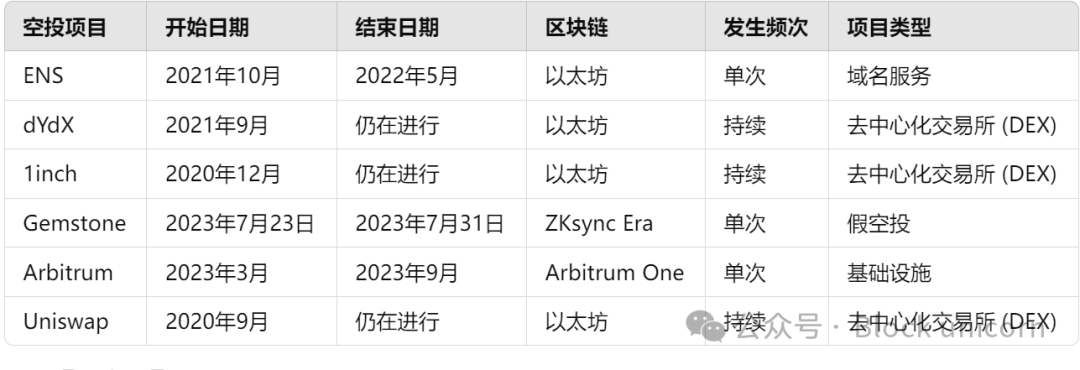
Next, we break down the high-level goal of airdrops—launching a user community—into several sub-goals. These sub-goals are not mutually exclusive, and other worthy goals may exist; we focus on these because they highlight interesting challenges inherent in common airdrop mechanisms.
Short-term user attraction.
Historically, emerging blockchain protocols have used airdrops to establish initial user bases and provide an initial liquidity boost to the underlying chain and its protocols. Particularly for decentralized platforms, increasing economic activity tends to make them more attractive and valuable to users, fostering long-term engagement.
Establishing an initial user base is important but insufficient to sustain high levels of economic activity over the long term. Ideally, users should become regular active participants on the platform. This can be achieved by issuing rewards usable only within the blockchain protocol or application, similar to airline frequent flyer points. For example, on Layer-2 blockchains, fee discounts could be offered for future transactions. Other potentially helpful measures include multi-round airdrops and rewarding users who complete specific "quests" that deepen their familiarity with the protocol’s features. For instance, Linea’s quest-based airdrop gave users hands-on experience with its functionalities and use cases.
Target users who create value for the platform.
Airdrops should focus on users who contribute most to the platform's long-term sustainability. In protocols relying on user-provided liquidity, this might mean rewarding users who supply the most liquidity to lending pools or decentralized exchanges, or those interacting across multiple tokens. On Rollups, especially valuable users might be "creators" deploying popular and useful smart contracts or users bridging tokens onto the Rollup. Such users add additional use cases to the platform, thereby attracting more users.
Post-Market Transaction Analysis
The motivation for our quantitative analysis stems from the observation that airdrop recipients often rapidly sell their tokens and exit shortly thereafter—clearly contradicting the original intent of airdrops. Analyses of decentralized exchange (DEX) airdrops indicate that recipients sometimes sell all their tokens soon after receipt. For example, after the ParaSwap airdrop, 61% of tokens were quickly sold.
In both cases, most recipients stop using the associated blockchain protocol within months. This pattern suggests that airdrops are ineffective at sustaining long-term recipient engagement, or that recipients include a large number of Sybil accounts. Moreover, rapid selling behavior can disrupt markets, especially if perceived as a signal of declining confidence in the protocol’s future prospects. Here, we analyze data related to six airdrops (see Table 1), sourced from node archival records on Ethereum, Arbitrum, and ZKsync Era (for detailed information on data collection, see Appendix 0.A). To identify exchanges, we used a list of 620 exchange account addresses obtained from Dune and Etherscan.
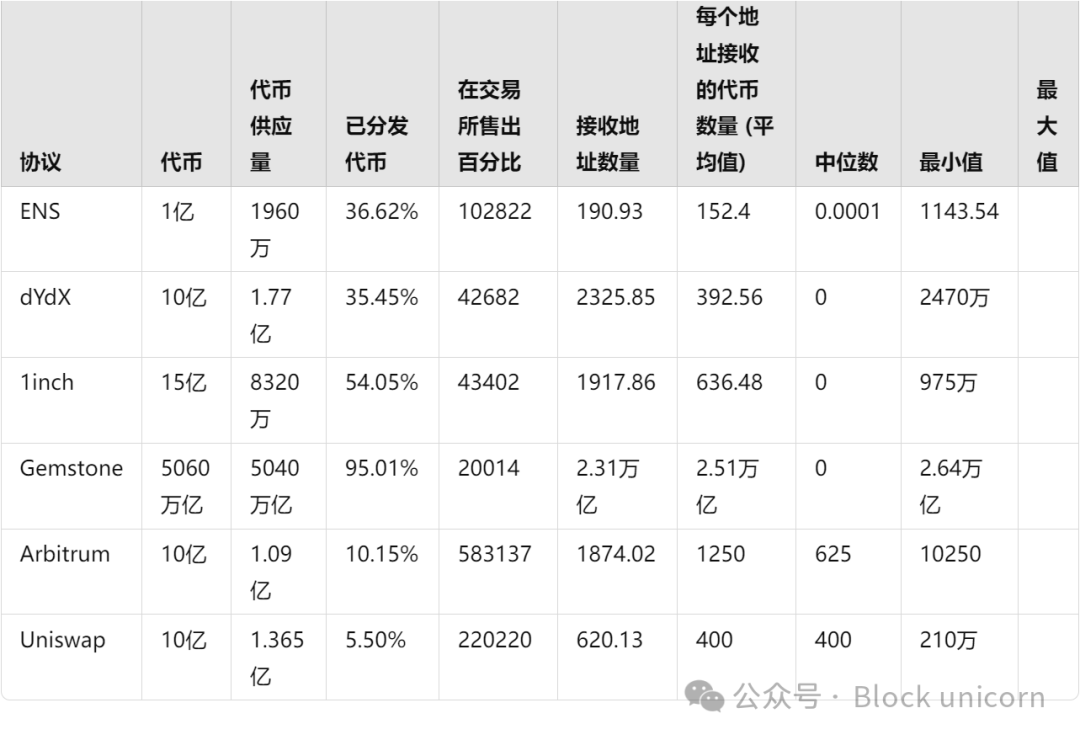
Table 2: Distribution statistics for six airdrops. Note that protocols often send large portions of airdropped tokens to addresses under their control. For details on top recipients, refer to Table 4 in Appendix 0.D.
Timing of Token Distribution
Table 2 provides quantitative insights into how airdropped tokens are allocated across user groups. Our analysis reveals a large number of recipients in each airdrop, suggesting the presence of airdrop farmers (see Column 5 of Table 2). Furthermore, data show frequent trading of tokens on exchanges, supported by the observation that recipients’ first transfer post-airdrop is often a sale to an exchange (see Column 4 of Table 2). The Gemstone case stands out particularly, with 95% of its tokens sold on exchanges. In this case, the airdrop was initiated by a non-open-source decentralized exchange created by airdrop farmers.
Moreover, the Gemstone airdrop vastly exceeded others in the quantity of distributed tokens. This massive distribution also resulted in a much higher median allocation per recipient compared to other airdrops (see Table 2). Notably, Gemstone distributed 99.53% of its total token supply during its airdrop. It must be emphasized that Gemstone primarily functioned as a Sybil attack rather than a legitimate airdrop.
Figure 1: Comparison of post-airdrop token claiming and transfer patterns: (a) Daily token claim counts; (b) Time to reach exchanges.
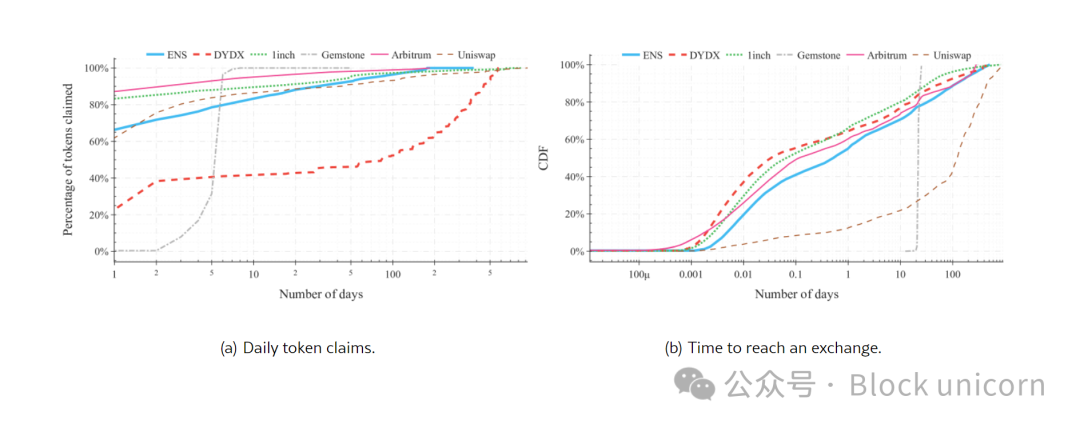
Among all airdrops analyzed in this study, the Arbitrum airdrop exhibited the fastest user token claiming speed. Figure 1(a) displays the distribution of accounts claiming tokens daily. Arbitrum conducted a large-scale airdrop, distributing 1,162,166,000 ARB tokens to 625,143 selected accounts. Of these, 583,137 accounts (93.28%) successfully claimed 94.03% of the ARB allocation. Remarkably, 72.45% of accounts claimed tokens on the first day, another 14.41% on the second day. Cumulatively, nearly 87% of accounts claimed Arbitrum tokens within the first day of the airdrop announcement, indicating that most participants were highly engaged and acted swiftly.
Table 3: Gemstone and 1inch are exceptions, with a median of 1 hop to exchanges, while other protocols show a median of 2 hops connecting airdrop recipients to exchanges.
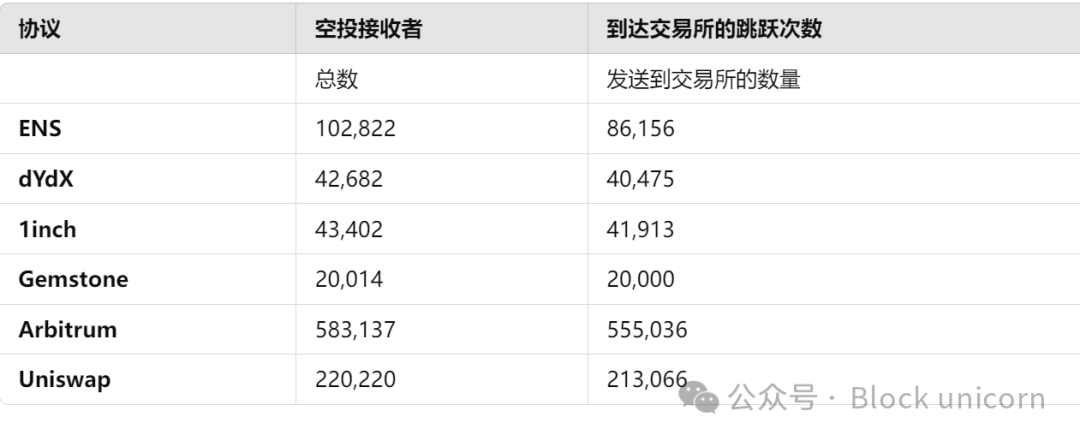
Users typically interact with exchanges to swap one token for another or to sell them. To assess how frequently airdrop recipients profit by selling tokens through exchanges after receipt, we analyzed user interaction with exchanges post-airdrop. Table 3 shows that most airdrop recipients traded with exchanges, ranging from a low of 83.79% for ENS to a high of 99.93% for Gemstone.
Additionally, Table 3 presents the shortest path from each airdrop recipient address to any exchange address in our dataset. We found that token transfers to exchanges usually involve only a few steps, indicating that airdrop recipients did not make significant efforts to obscure their activities. Gemstone is a notable exception, with all tokens sold in a single hop. Surprisingly, most accounts reached exchanges through relatively few intermediate steps—typically two hops. This observation underscores the pivotal role of exchanges in the cryptocurrency ecosystem.
Most accounts exchanged their tokens within approximately one million blocks after the airdrop. Due to delays introduced by developers, Gemstone had significantly higher block numbers than other projects. Given differing block times between Ethereum (a new block every 15 seconds) and ZKsync, we normalized block time into days. As shown in Figure 1(b), within one day, 66.09% of 1inch accounts interacted with exchanges. In contrast, ENS had an interaction rate of 55.15%, dYdX 64.26%, Arbitrum 60.34%, and Uniswap 12.39%. This rapid trading behavior contradicts one of the main goals of conducting an airdrop—to promote sustained user engagement—since quick token conversion suggests users likely leave the protocol shortly after receiving the airdrop.
Token Transfer Graphs
To better understand the transfer structures occurring after each address receives airdropped tokens, we analyzed the transfer network, represented as G(V, E), where each node (V) represents an address and an edge (E) is formed when tokens move from one address to another. Specifically, the ENS network contains 184,585 nodes and 608,462 edges; the dYdX network has 112,853 nodes and 406,027 edges; the Gemstone network includes 20,014 nodes and 240,113 edges; the 1inch network comprises 308,329 nodes and 1,400,913 edges. Arbitrum includes 2,025,898 nodes and 27,438,608 edges, while the Uniswap network consists of 118,0830 user addresses and 3,762,613 token transfer records.
To make these graphs more visually readable, we limited the number of hops in the data to one hop from any address receiving protocol airdrop tokens and plotted their largest connected components within the first few hours post-airdrop (results available in Figure 7 in Appendix 0.B). We manually labeled high-in-degree nodes using labels provided by Etherscan, a popular blockchain explorer. Results show that except for Gemstone, the decentralized exchange receiving the most transfers in all other protocols (measured by in-degree) was Uniswap, followed by SushiSwap.
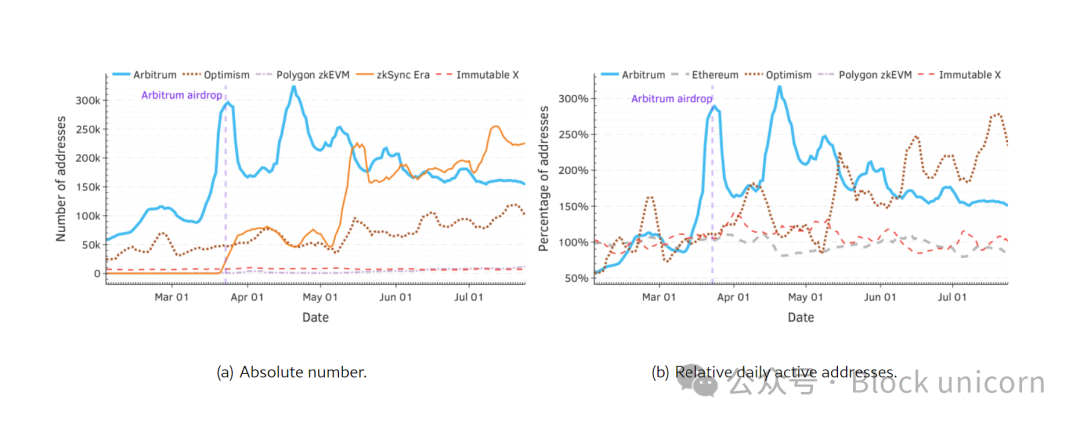
Figure 2: Daily number of unique active addresses per protocol: (a) directly showing how many distinct users each platform has per day; (b) compares daily active user counts of each platform to the average before the Arbitrum airdrop, providing a clearer view of the impact of the airdrop on user activity.
For Gemstone, all tokens were sent in one hop to address 0x7aa⋯49ad. In contrast, the dYdX airdrop used a more diverse set of exchange addresses. Notably, as shown in Table 3, some airdrop recipients chose to sell their tokens on exchanges. We observed common exchanges such as Uniswap, Wintermute, and SushiSwap.
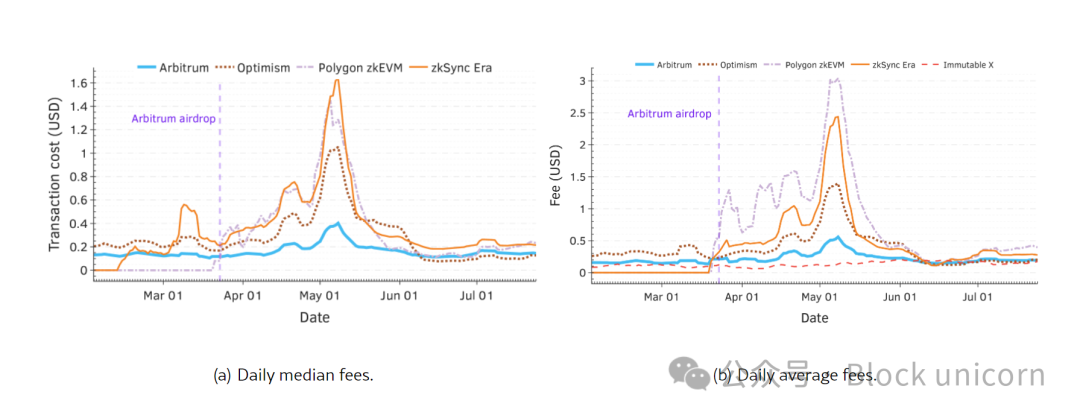
Figure 3: Daily transaction fees (USD): (a) average fee per transaction.
Measuring Airdrop Lift
Empirical studies suggest that some airdrops succeed in attracting users in the short term—at least superficially. While preliminary data indicate poor performance in achieving other goals, substantive research on this topic remains insufficient. In this section, we examine the performance of the Arbitrum airdrop using relevant metrics such as daily transaction volume, daily active unique addresses, median transaction fees, total value locked (TVL), user-paid fees, and stablecoin market capitalization. Our data sources include Growthepie. See the appendix for further details on this data.
Unique Active Addresses
Many protocols perform equally or better without airdrops. Although Arbitrum saw an increase in unique addresses after its airdrop and maintained levels above 50% of pre-airdrop figures, other protocols achieved similar growth without airdrops. For example, Optimism experienced greater address growth in May 2023, possibly linked to the launch of Bedrock. Similarly, ZKsync Era surpassed Arbitrum in address count within two months after its own airdrop.
Fees may partially explain the narrowing gap between Arbitrum and Optimism. Arbitrum consistently leads Optimism in daily active addresses. However, data show this gap is closing. Before the airdrop, Arbitrum had 2.6 times more active addresses than Optimism, but over the past 50 days, this ratio dropped to 1.83. Optimism’s lower median transaction fees since June may partly explain this trend (see Figure 3(a)).
Unique address counts fluctuate over time. Unique address counts exhibit volatile behavior—rising rapidly, peaking, then declining. Notably, Optimism and Arbitrum show opposite phases in relative address numbers, possibly due to users switching between protocols when fees rise. However, no such pattern appears in median transaction fees, with Arbitrum maintaining consistently lower fees around mid-May 2023. Still, the unique address metric may be manipulated. According to our analysis, the Arbitrum airdrop did not result in long-term user engagement, as the unique address metric is vulnerable to manipulation. Users can create multiple addresses to exploit airdrop limits. This makes the metric unreliable for measuring real activity, as large fluctuations may stem from such behaviors. Moreover, the easy availability of airdrop software facilitates automated execution of such activities. Therefore, more Sybil-resistant metrics should be considered to assess genuine user participation, such as combining graph network analysis with machine learning techniques.
Transaction-Related Metrics
Transaction-related metrics offer useful alternatives for measuring "real" economic activity, as users must pay fees to send transactions, excluding scenarios involving retroactive rebates or loss-leading protocols.
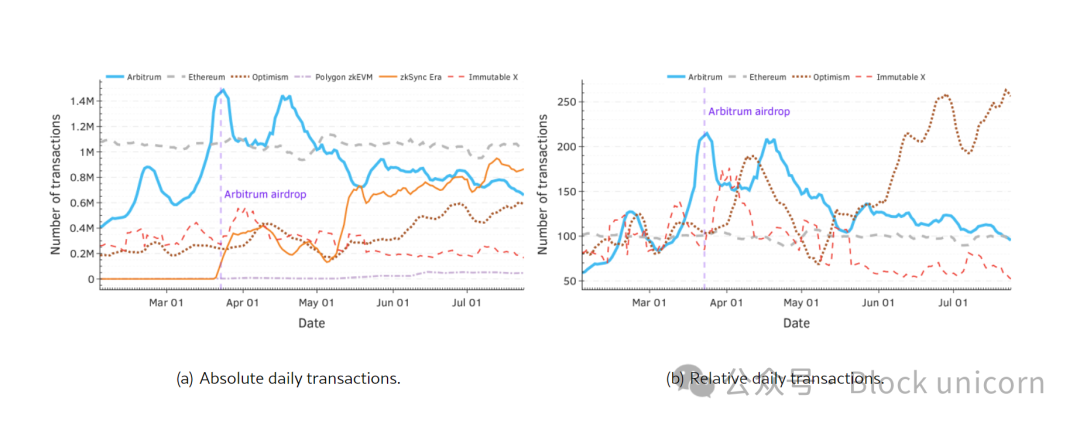
When considering transactions, the gap between Arbitrum and Optimism narrows. Notably, by late July, the difference in transaction counts between Arbitrum and Optimism nearly disappeared. Additionally, Immutable X’s daily transaction count has almost halved since Arbitrum’s airdrop, while its unique address count remains relatively stable (see Figure 4(b)). This suggests that despite stable address numbers, user engagement with Immutable X has declined.
Figure 4: (a) Directly shows the number of daily transactions per platform; (b) compares daily transaction counts of each platform to the average before the Arbitrum airdrop, providing a clearer visualization of the airdrop’s impact on transaction volume.
Arbitrum’s per-address transaction volume decreased after the airdrop. To assess the impact of Arbitrum’s airdrop on user engagement across other protocols, Figure 5(a) shows the relative average daily transaction volume per unique address. Since the airdrop, Arbitrum’s per-user transaction volume has fallen below 75% of pre-airdrop levels. However, transaction volume can be misleading without considering fees—high transaction volume alone does not necessarily reflect authentic user engagement. Some protocols require users to conduct multiple transactions to qualify for airdrops, leading to inflated activity during periods of low fees. This aligns with Goodhart’s Law, which states that “when a measure becomes a target, it ceases to be a good measure.”
Figure 5: (a) Daily number of transactions; (b) Daily average transaction fee
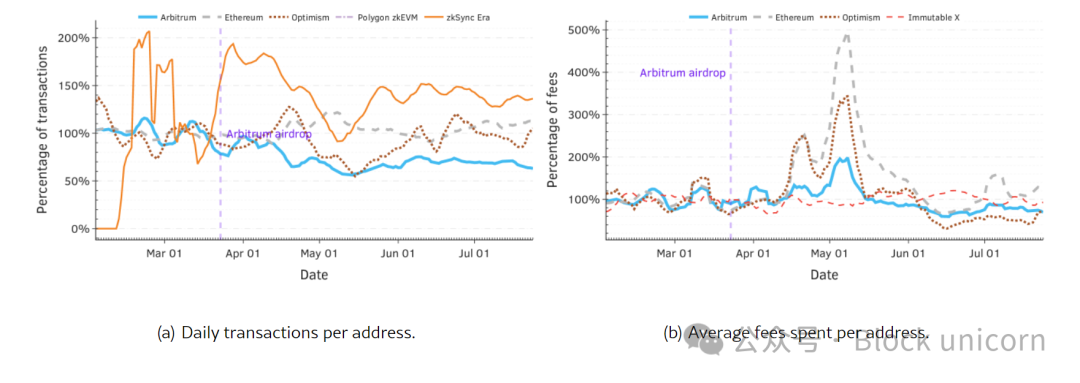
Since June, average transaction fees across all protocols have been similar. A good metric should reflect user commitment, and transaction fees can serve as a proxy, measuring what users are willing to pay to interact with the protocol. Since June, average fees per transaction and per unique address have been similar across protocols. Comparing average and median fees (see Figure 3) shows that median fees may be more informative in understanding shifts in user behavior. Another useful metric is the relative average fee per address compared to the 50 days before the Arbitrum airdrop, shown in Figure 5(b). This indicates that Arbitrum’s user engagement was not significantly affected by the airdrop and generally follows patterns seen in other protocols.
Arbitrum’s daily total fees spiked during the airdrop period, but the airdrop did not confer a clear long-term advantage in transaction fees, as shown in Figure 9. Although Arbitrum experienced a fee peak on the day of the airdrop, this surge was temporary. Indeed, as shown in Figure 6(a), Arbitrum averaged 1.96 times higher daily transaction fees than other protocols in the 50 days before the airdrop, but this ratio narrowed to 1.74 in the last 50 days of the dataset.
Figure 6: (a) Ratio of daily transaction fees between Arbitrum and Optimism; (b) TVL growth relative to the average in the 50 days before the Arbitrum airdrop.
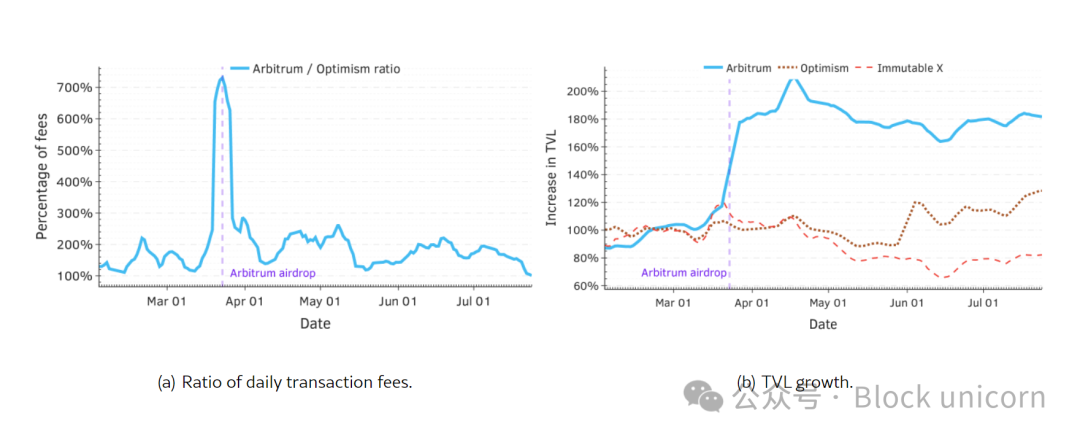
Total Value Locked (TVL), a protocol’s TVL measures the total value of all assets stored within the protocol.
The Arbitrum airdrop had a lasting impact on its TVL—it is the only metric among those examined that showed sustained improvement after the airdrop: Arbitrum’s TVL increased by over 50% immediately after the airdrop and has not significantly declined since, as shown in Figure 6(b). This may be surprising, given that Arbitrum’s airdrop distribution strategy only considered user activity prior to February 6, 2023.
Common Airdrop Design Challenges
Airdrops resemble traditional loyalty programs—such as sign-up bonuses offered by banks and credit card companies—and face several shared design challenges. However, the unique context of blockchain technology and the specific mechanisms adopted by most airdrops may exacerbate these challenges or even introduce new ones. In this section, we explore three such challenges.
Airdrop Farmers
These are users who employ complex strategies to maximize the number of airdropped tokens they receive. Blockchain protocols have adopted various measures to reduce manipulation by airdrop farmers, with a common method being to limit the amount of reward a single user can obtain.
As a result, protocols have turned to Proof-of-Humanity (PoH) services such as Gitcoin Passport. These services typically assign a numerical score to users based on certain metrics, with higher scores indicating a greater likelihood of being a real person. Gitcoin Passport metrics are based on a series of tasks, such as linking social media accounts or holding a certain amount of ETH. These methods can be enhanced by analyzing on-chain data to detect and exclude Sybil attackers, though this risks false negatives.
Other mitigation techniques include requiring users to complete tasks—from sending specific types of transactions to sharing posts on social media. These tasks can seem arbitrary, frustrating users, and are easily automated and cheaply gamed, especially when protocols offer transaction fee rebates. Furthermore, many protocols' reliance on a limited number of PoH services means that a single investment by a farmer could yield substantial profits across multiple airdrops—even biometric identity verification cannot guarantee full Sybil resistance.
Another approach adopted by protocols is to announce airdrops retrospectively, rewarding users who were active before the announcement. However, farmers can prepare in advance, interacting with these protocols even in the absence of formal airdrop announcements, as demonstrated by the dYdX airdrop.
Reward farming is not limited to crypto-related airdrops; similar phenomena occur in "traditional" loyalty programs. Credit card churning, for example—where users apply for credit cards solely to collect new-user rewards and cancel them afterward—is prevalent. Given that similar problems exist even in traditional environments where users can be easily identified and penalized, the challenge of rewarding airdrop users appears far from solved.
Threats to Decentralized Governance
Some protocols distribute governance tokens via airdrops to decentralize their governance processes. However, distributing governance tokens carries risks. These tokens enable holders to participate in protocol governance and vote on key decisions. Often, these tokens can also be exchanged for other tokens, giving them monetary value, which may attract more farmers seeking to acquire them.
Empirical evidence suggests that airdropped governance tokens may outperform non-governance tokens. Recent analyses show that airdropped governance tokens achieve up to 14.99% higher market cap growth rates compared to non-airdropped governance tokens. However, the authors note that this effect is not statistically significant when using common benchmarks.
Despite these potential benefits, improperly handled, airdropping governance tokens poses significant risks. It may concentrate excessive power in the hands of a few users, leading to unfair distribution of decision-making authority within the system. Moreover, some recipients may not act in the best interest of the protocol and may vote to alter the protocol for personal gain, potentially harming its long-term success.
Insider Trading
This issue arises when individuals use privileged information for economic gain at the expense of other protocol users. This practice is widely recognized as a violation of securities laws in traditional financial markets and often provokes negative reactions within blockchain communities.
When insiders leverage privileged information to increase their profits, it may provoke community backlash. Insiders may have early knowledge of eligibility criteria and reward metrics for each address and could exploit this information. For example, it was claimed that AltLayer’s Head of Growth may have profited $200,000 from the airdrop using insider information, though this was later deemed coincidental. Nevertheless, such incidents may erode user trust in these protocols.
This issue also raises fairness concerns, as certain users possess superior and more accurate information than others. Identifying insider traders is a challenging task, so protocols need to provide thorough disclosures to their users. Additionally, incentivizing blockchain data analytics firms and research groups to conduct post-airdrop data audits—by analyzing address details and transfer patterns—can help identify insider traders. For this, data availability is crucial. Therefore, protocols should ensure transparency and encourage in-depth analysis to uphold integrity and fairness in the blockchain community.
Design Guidelines
The aforementioned design challenges, while concerning, can offer insights for future airdrop designers and guide paths toward potential success.
Alternative Incentives for Sustained User Engagement
The long-term benefits of airdrops for protocols may be difficult to quantify, as potential advantages could be indirect and hard to measure, while costs are often immediate and irreversible. Moreover, certain costs and impacts—such as those arising from distributing governance tokens—may be unpredictable. Thus, communities might consider adopting alternative measures to achieve a more predictable cost-benefit relationship instead of relying on airdrops. A simple alternative is a community-voted program that systematically rewards loyal users with discounts on future interactions. In the context of Layer-2 (L2) solutions, these discounts could apply to transaction fees. This approach encourages users to re-engage with the protocol to benefit from the incentive, thereby promoting sustained user participation. Additionally, this incentive mechanism is relatively resistant to airdrop farmers, as discounts have no intrinsic value outside the protocol, and protocol costs are incurred only by actively using users.
However, discount mechanism design must be careful, including defining eligibility criteria and setting appropriate discount levels. Moreover, it remains unclear whether discounts can attract users as effectively as the immediate and tangible rewards provided by airdrops. Another option is conducting multiple airdrops over an extended period rather than a one-time event. While this method may still face some pitfalls of standard one-time airdrops, it can help ensure long-term community engagement and prevent the drop in user adoption seen by some protocols immediately after a one-off airdrop. Blast took a more innovative approach by launching a points-based reward program. Under this program, users accumulate points through various activities to earn rewards—such as bridging tokens to the protocol (i.e., transferring funds from another protocol) and participating in referral programs that reward users for bringing in more participants. Notably, Blast received $1.1 billion in deposits before its official launch. This method provides measurable indicators of user contribution to the protocol, structured around a referral program model.
Furthermore, innovative allocation mechanisms play a crucial role in mitigating the presence of Sybil attacks among whitelisted addresses. For example, Celestia proposed a unique design using GitHub commits as a proxy for assessing users’ contributions to the blockchain ecosystem. However, a concern may arise that users or farmers could generate fake activity on GitHub to exploit other protocols’ airdrops using similar strategies. Hence, farmers may anticipate that new protocols will use selection criteria similar to past airdrops. To counter this, protocols can focus on metrics resistant to programmable manipulation, increasing the difficulty or cost of creating automated user accounts.
Target Well-Known and Reputable Entities
Protocols can target developers and projects building relevant applications instead of rewarding anonymous users. For example, in Arbitrum’s airdrop, 1.13% of distributed tokens were allocated to DAO projects. Arbitrum also offered additional incentives beyond the airdrop for specific groups, such as university students and technical community members interested in researching and developing tools related to the protocol.
Optimism implemented another approach, allocating part of its revenue to fund successful projects retroactively—essentially introducing the concept of venture funding into the blockchain world. Prioritizing established and reputable entities—including projects built on the protocol, research groups, technical communities, and students—can foster sustained engagement. By funding these entities, protocols may attract value-driven users and promote long-term participation.
Active Monitoring and Community Participation
Ongoing monitoring and analysis of protocol data during the airdrop process are crucial to prevent malicious exploitation. For example, the Linea team discovered a vulnerability allowing users to manipulate the incentive mechanism. Timely detection prevented cheaters from claiming over one-third of the NFTs allocated as incentives.
Besides technical monitoring, protocols should encourage disclosure of vulnerabilities—whether exploited or not—by maintaining open communication channels and offering bug bounties. For example, a community member from AzukiDAO disclosed a vulnerability, enabling the protocol to respond promptly. Monitoring should extend beyond on-chain data. Social media is frequently exploited by scammers promoting fake airdrops, tricking users into connecting wallets to fraudulent websites and stealing funds. Even protocols with no planned airdrops can become targets of such scams.
Active community participation in technical discussions also enhances security. For instance, cygaar conducted a retrospective analysis of ZKsync Era’s NFT airdrop, identifying potential cost-saving improvements. Maintaining transparency and providing insights into internal protocol operations helps build trust. When technical issues arise, well-informed users are more likely to respond with understanding.
Rewards Should Be Linked to Costs Incurred
The effects of Goodhart’s Law are evident in many past airdrops. For example, airdrops often explicitly announce rewards for users who actively participate in interactions (these are projects you probably shouldn't join—or KOLs urging everyone to join). However, these methods can be abused, with users fulfilling requirements through meaningless, fake transactions, rendering the metric ineffective at reflecting genuine user engagement.
The problem also lies in operational metrics used to determine eligibility, which often fail to account for the actual cost users incur per operation. For example, when transaction count is the primary metric, low transaction fees allow airdrop farmers to meet volume requirements at minimal cost. A potential solution is adopting reputation-based mechanisms to suppress artificial inflation of transaction volume. However, protocols must carefully define "user reputation" and appropriate evaluation metrics.
Conversely, high transaction fees may diminish the perceived value of rewards, reducing the appeal of airdrops. To address these issues, rewards should be adjusted according to the actual costs borne by users, ensuring a fairer and more effective distribution of incentives.
Related Work
Recent research on airdrops has mainly focused on post-hoc analysis and guidelines for designing effective airdrop campaigns.
Airdrop Research by Yaish and Livshits proposed a theoretical model of airdrops, considering two groups: honest users and "airdrop farmers," the latter having lower qualification costs and lower intrinsic utility from using the platform issuing the airdrop. Their analysis shows that when issuers pay a non-zero fixed cost per recipient, the threat of fake identity attacks by farmers can lead to infinite issuance costs. However, they also noted that capping the total number of airdropped tokens and distributing them evenly among all recipients can limit losses from farmers. Moreover, by properly designing the airdrop mechanism, farmers can be leveraged to generate network effects, attracting honest users who might otherwise choose competing platforms.
Makridis et al. explored the impact of governance token airdrops on the growth of decentralized exchanges (DEXs). By analyzing 51 exchanges, they found that such airdrops significantly increased market capitalization and trading volume. Lommers et al. provided a comprehensive overview of various airdrop types (e.g., foundational airdrops, holder airdrops, and value-based airdrop models). Their study highlighted how eligibility criteria, signaling, and implementation strategies influence airdrop success and offered practical optimization advice. Fan et al. conducted a case study on the ParaSwap DEX, proposing a taxonomy of user roles based on behavior and airdrop effectiveness. Their research showed that users receiving higher rewards were more likely to make positive contributions to the community. They also identified arbitrage patterns and pointed out limitations in current methods for detecting airdrop hunters. Meanwhile, graph network analysis and machine learning methods have been proposed as Sybil attack detection techniques to address these issues.
Allen conducted nine airdrop case studies (including Optimism, Arbitrum, Blur) and provided insights into task-driven claim designs. The study emphasized the need for dynamic design and feedback loops and noted that due to the complexity and cost of advanced mechanisms, some projects may revert to simpler designs. Allen et al. investigated motivations behind token airdrops, particularly focusing on marketing and decentralization. While airdrops are often seen as marketing tools, the authors argue this rationale is weak due to limited evidence of marketing-driven airdrop success. Instead, decentralization and community building are emphasized as the primary motivations for airdrops.
Technical Aspects of Airdrops Frowis et al. identified operational challenges and costs associated with large-scale Ethereum airdrops. They suggested that optimizing through specific smart contracts could save up to 50% in costs, while extraction-based methods could shift costs to recipients. Overall, however, total cost remains proportional to the number of recipients.
Wahby et al. addressed privacy issues in current airdrop mechanisms, which leak recipient information. They proposed a private airdrop scheme based on zero-knowledge proofs using RSA credentials, achieving privacy protection while maintaining computational efficiency. Their implementation significantly improved signature generation and verification speeds.
Conclusion
This study identifies common issues in airdrops and proposes guidelines to improve their effectiveness. Our analysis of six major airdrop projects reveals widespread instances of recipients quickly selling their tokens—36.62%, 35.45%, and 54.05% of ENS, dYdX, and 1inch tokens were traded shortly after distribution, with a median of just two transactions. This indicates that airdrops fail to sustain long-term user engagement or attract valuable contributors.
For Arbitrum, we observed a spike in daily fees during the airdrop, followed by a decline in transactions per address. Other protocols without airdrops outperformed Arbitrum, and since June 2023, transaction fees across protocols have converged, suggesting that airdrops are not the primary driver of user growth.
Finally, we discussed challenges including airdrop farming, governance token distribution, and insider trading, offering insights for future airdrop strategies.
Join TechFlow official community to stay tuned
Telegram:https://t.me/TechFlowDaily
X (Twitter):https://x.com/TechFlowPost
X (Twitter) EN:https://x.com/BlockFlow_News
 @BlockUnicorn






