Rune Frenzy Returns: Can the Bitcoin Ecosystem Recover?
TechFlow Selected TechFlow Selected
Rune Frenzy Returns: Can the Bitcoin Ecosystem Recover?
The Bitcoin ecosystem is stirring with activity.
 Navigating Web3 tides with focused insights
Author: Chandler, Foresight News
As Bitcoin's nearly six-month consolidation phase may be coming to an end, activity within the Bitcoin ecosystem is beginning to stir.
As of October 17, Magic Eden market data shows a broad uptick across the Runes category. DOG·GO·TO·THE·MOON rose 10.1% over 24 hours, with its current price at 8.7 satoshis; PUPS·WORLD·PEACE increased by 10.75%, now priced at 234 satoshis; BILLION·DOLLAR·CAT saw the largest gain, surging 47.67%, currently trading at 155 satoshis.
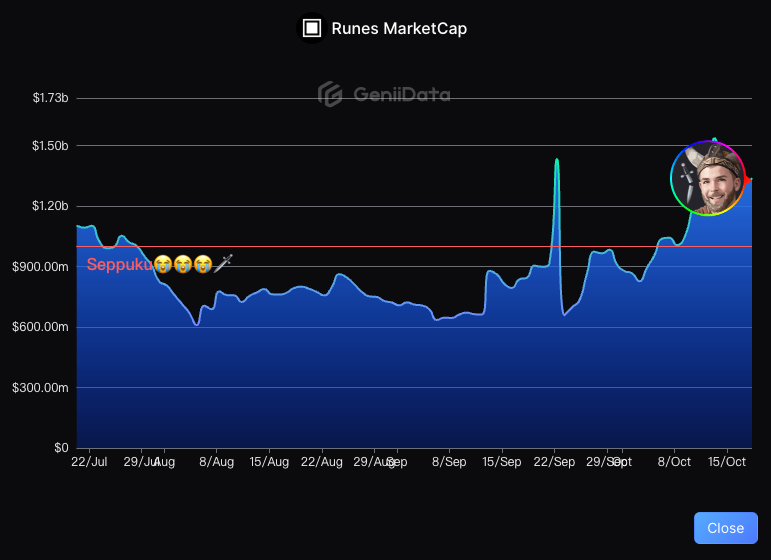
According to GeniiData, the total market capitalization of the Runes protocol has recovered to $1.34 billion.
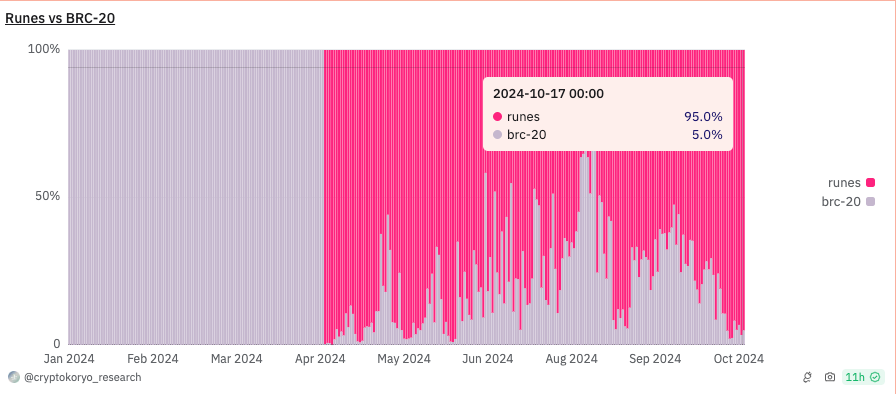
Data shared by Dune user @cryptokoryo_research reveals that the Runes protocol is gradually becoming a significant force within the Bitcoin ecosystem. Currently, Rune transactions account for approximately 10% of total activity on the Bitcoin network. This figure initially spiked dramatically upon the protocol’s launch, peaking at 81.3%. That surge was largely driven by intense FOMO sentiment, which has since cooled as market enthusiasm returns to more rational levels.
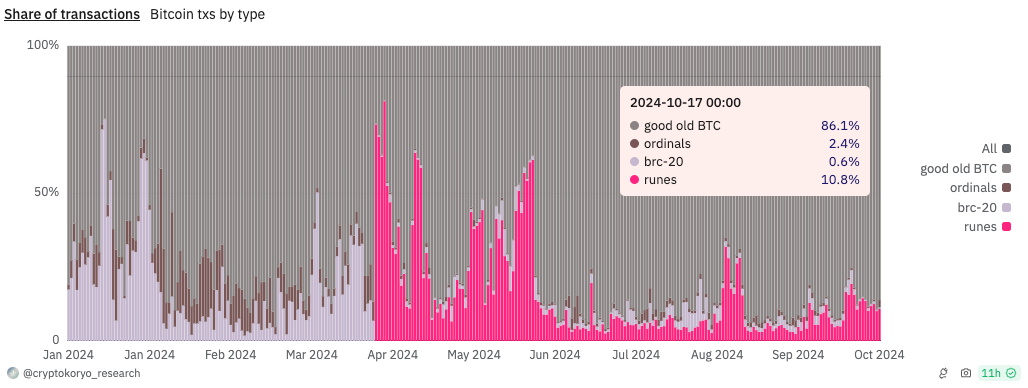
During this process, Runes rapidly evolved from an emerging asset into one of the mainstream forces in the Bitcoin ecosystem, surpassing BRC-20 tokens in transactional activity. On-chain data indicates that current Rune transaction volume stands at roughly a 95:5 ratio compared to BRC-20, highlighting its growing competitiveness and positioning it as one of the most active L1 assets.
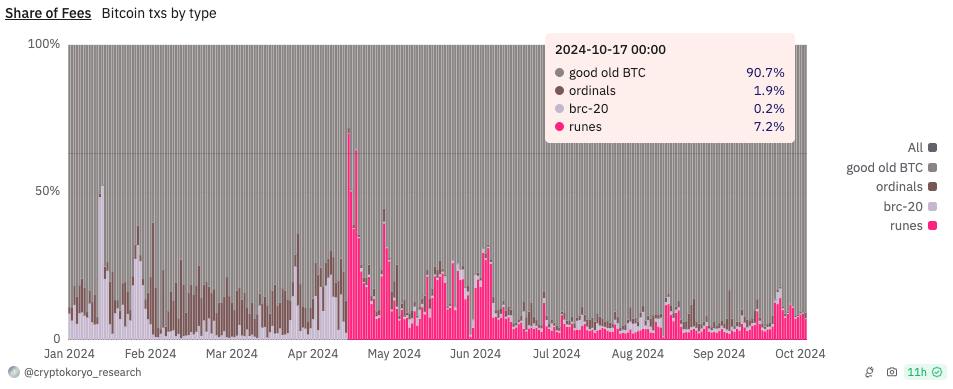
From a fee perspective, native Bitcoin transaction fees still dominate, accounting for about 90% of total fees. However, fees generated by the Runes protocol now fluctuate around the 10% mark. In contrast, combined fees from BRC-20 and Ordinals protocols make up only 2–3%, underscoring the rising importance of Runes in contributing to miner revenue.
The resurgence of the Runes protocol has prompted deeper reflection on the future development of the Bitcoin ecosystem: Can this revival drive a broader recovery across Bitcoin’s ecosystem?
What Is the Runes Protocol?
Launched in 2023 by Bitcoin developer Casey Rodarmor, the Runes protocol is a new token standard designed to enable fungible token (FT) issuance on the Bitcoin blockchain. Leveraging Bitcoin’s UTXO model and the OP_RETURN field, Runes allows for efficient creation and management of tokens while maintaining high compatibility and scalability. It seamlessly integrates with other Bitcoin-layer technologies such as the RGB protocol and Lightning Network, extending Bitcoin’s use cases without compromising its core security and decentralization.
The key innovation of the Runes protocol lies in its efficient and low-bloat approach to token management. Unlike inscription-based protocols, Runes stores token data via the OP_RETURN opcode, minimizing on-chain storage usage while enabling complex transaction logic. This mechanism effectively reduces blockchain bloat and creates additional fee income opportunities for miners. From an economic standpoint, Runes introduces a new revenue stream for Bitcoin miners, helping alleviate financial pressure following block reward halvings.
Technically, being a UTXO-based protocol allows Runes to fully leverage Bitcoin’s foundational architecture, ensuring highly secure token issuance and transfers. Furthermore, its scalable design enables strong compatibility with Layer 2 solutions—particularly RGB and the Lightning Network—opening up broad application prospects including cross-chain transactions and decentralized finance platforms.
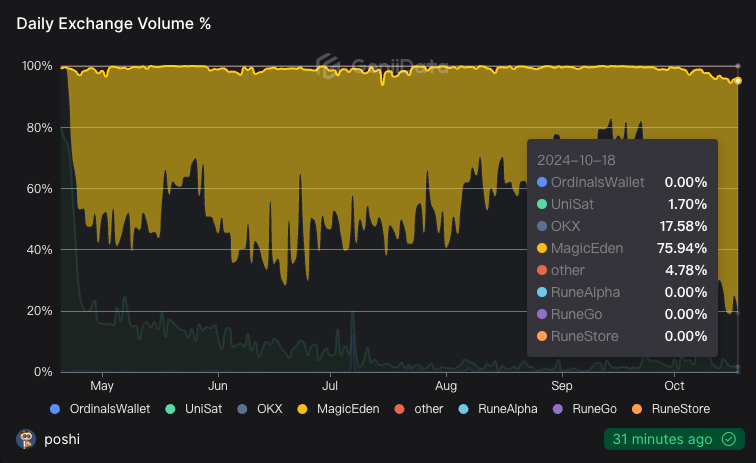
Overall, liquidity for Runes remains relatively concentrated. Currently, Magic Eden dominates Rune trading with approximately 75.94% market share, making it the most active Rune trading platform. OKX follows as the second-largest exchange with 17.58% of trading volume, demonstrating notable liquidity. UniSat ranks third with 1.70%, while other platforms like OrdinalsWallet and RuneAlpha show minimal trading activity.
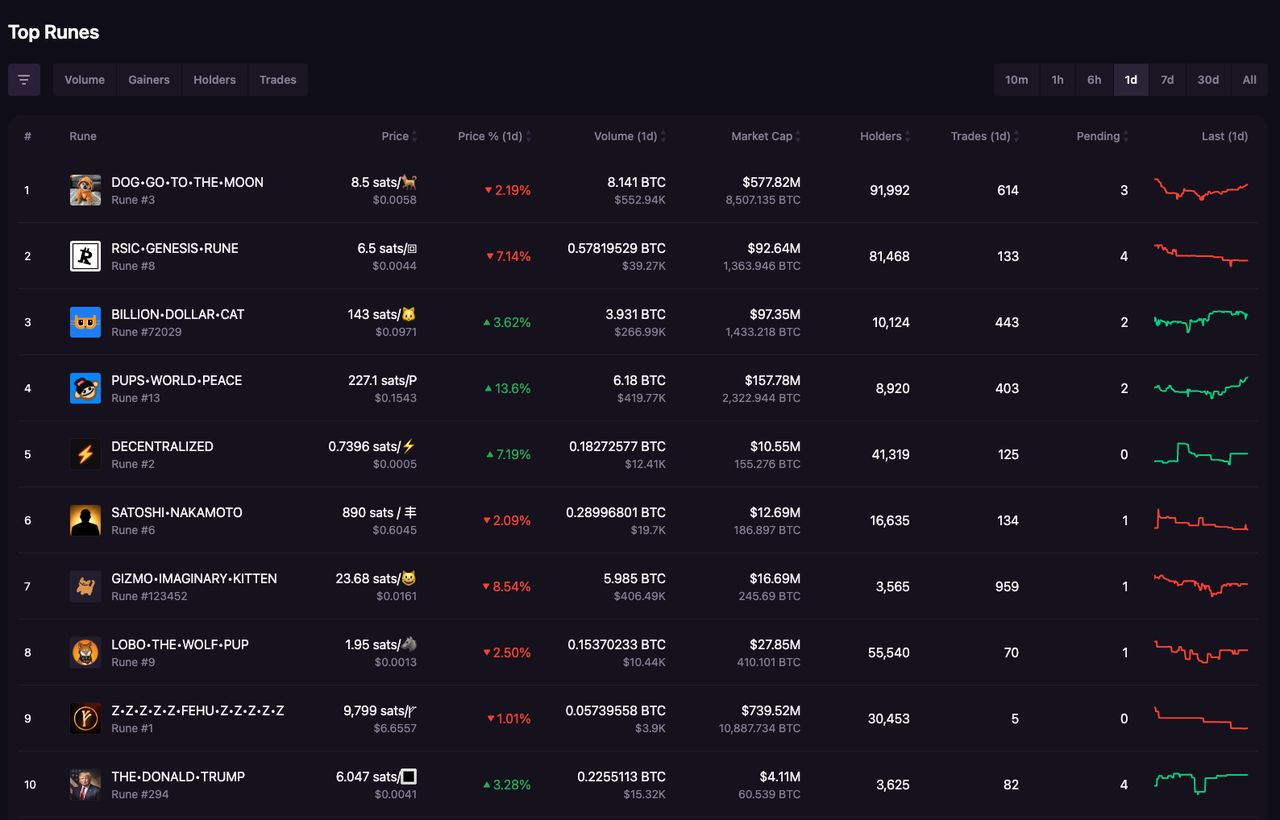
Within Magic Eden, the Rune market exhibits a strong head concentration effect. DOG·GO·TO·THE·MOON maintains its leading position due to high market cap and deep liquidity. Other Rune projects vary significantly in terms of liquidity and holder distribution, with overall market liquidity still heavily concentrated among a few top assets—especially in trading volume and market capitalization. DOG is clearly the market leader, boasting a market cap of $577 million and a 24-hour trading volume of 8.141 BTC. With nearly 92,000 holders, it reflects widespread community recognition and consensus.
In comparison, other Rune projects lag behind. RSIC·GENESIS·RUNE has a market cap of $92 million but a daily trading volume of only 0.578 BTC, indicating clear liquidity constraints. While RUNEs like BILLION·DOLLAR·CAT and PUPS·WORLD·PEACE show some level of activity, with daily volumes of 3.931 BTC and 6.18 BTC respectively, they still fall far short of DOG’s performance.
Current Drivers Behind the Rune Boom
The dynamics of Runes resemble those of meme tokens—traffic, symbolic meaning, liquidity, and market consensus can all rapidly amplify their popularity. First, traffic often stems from support by well-known KOLs, artists, or major projects. Rapid social media amplification draws intense investor attention. Within elite ecosystems like Bitcoin, endorsement from influential figures can significantly accelerate a Rune’s rise. For instance, GIZMO·IMAGINARY·KITTEN, promoted on X by Bitcoin Puppets artist @lepuppeteerfou, experienced a sharp price increase. Although lepuppeteerfou later denied any association with the project, the narrative spread widely through social channels, driving its market cap to tens of millions of dollars.
Symbolism also plays a crucial role. The cultural and symbolic weight carried by certain Runes often exceeds their technical utility. Take “Satoshi Nakamoto” Runes, for example—they represent not just digital assets but also embody the history and ethos of the Bitcoin community. Such symbolic narratives resonate emotionally with investors, boosting trust and enthusiasm.
Liquidity forms the foundation of a healthy Rune market. Sufficient liquidity enhances trading volume and ensures participants can enter or exit positions smoothly. DOG, thanks to its robust liquidity and market depth, has attracted a large number of investors and become one of the most liquid Rune projects. Conversely, illiquid Runes struggle to maintain momentum, often leading to loss of investor confidence.
Market consensus serves as the core driver behind the Rune frenzy. Meme culture and collective belief create a self-reinforcing cycle. In many cases, participants are not motivated by technological innovation or fundamental value, but rather by group sentiment and shared narratives. This collective psychology fuels sustained price increases.
These four factors—traffic, symbolism, liquidity, and consensus—interact synergistically, resulting in extreme volatility and emotion-driven behavior in the Rune market. Influencer-driven traffic triggers symbolic effects, which foster market consensus, further enhancing liquidity. This feedback loop accelerates market expansion while simultaneously amplifying potential risks.
The long-term potential of the Rune phenomenon depends on whether these drivers can persist and whether the market can transition from emotional speculation toward real-world applications. At present, the Rune market resembles an evolution of meme tokens, capturing investor attention through cultural storytelling. However, without substantive utility or technical underpinning, its high volatility poses a major risk that could lead to rapid erosion of market confidence.
Notably, Ord.io, the Bitcoin Ordinals browser, reported rumors suggesting insiders at Coinbase have indicated the exchange is conducting internal security audits and regulatory compliance reviews for the Runes protocol. If Runes passes these evaluations and gets listed on major exchanges, it would greatly enhance market credibility and potentially bring in broader user adoption and capital inflows. However, this information has not yet been officially confirmed.
Challenges and Opportunities for Bitcoin Ecosystem Recovery
By leveraging Bitcoin’s UTXO model, Runes突破es limitations in scalability and functionality, enabling tokenized asset issuance and circulation at minimal on-chain data cost. This innovation significantly expands Bitcoin’s application scope, unlocking potential in DeFi, NFTs, and on-chain asset management. Increased Rune usage boosts on-chain activity, adding diverse transaction types atop protocols like Ordinals, thereby increasing network engagement and attracting more developers and users. Its market performance already demonstrates considerable potential and a solid user base.
The rise of Runes may signal the first sign of recovery for the Bitcoin ecosystem, yet numerous challenges remain. Technological bottlenecks persist. While Runes introduce new use cases through tokenization, Bitcoin’s inherent scalability constraints continue to limit full-scale ecosystem growth. Additionally, market sentiment and investor confidence will directly impact Rune sustainability. Despite strong current performance, long-term success hinges on continuous capital inflow and user growth. Liquidity remains the key determinant of whether Runes can sustain momentum. Without consistent demand and liquidity, they risk collapsing into short-term speculative bubbles.
Moreover, existing Layer 2 solutions have yet to achieve broad market acceptance. Their coverage and user engagement remain limited, constraining the scalability of Runes and other decentralized applications. True ecosystem breakthroughs require coordinated advancement across technology, developer participation, and user adoption. Only through technological maturity and wider participation can the necessary infrastructure emerge to propel the Bitcoin ecosystem into its next stage of comprehensive prosperity.
Join TechFlow official community to stay tuned
Telegram:https://t.me/TechFlowDaily
X (Twitter):https://x.com/TechFlowPost
X (Twitter) EN:https://x.com/BlockFlow_News
 Foresight News