Exploring the Launch of the Runes Protocol: Why Bearish in the Short Term, Bullish in the Long Term?
TechFlow Selected TechFlow Selected
Exploring the Launch of the Runes Protocol: Why Bearish in the Short Term, Bullish in the Long Term?
Narratives based on technological innovation have a stronger chance of recovery after the first wave of hype cools down.
 Navigating Web3 tides with focused insights
Author: IGNAS | DEFI RESEARCH
Translation: Baihua Blockchain
Bitcoin halving is 3 days away, and the Runes protocol will launch at the same block height as the halving! I’m sure you’ve heard of Runes by now, but I’d like to share my perspective—why I’m bearish in the short term but bullish long-term, how to prepare, and which protocols/tools to use to avoid missing out.
1. Bearish on Runes (Short Term)
I expect the market to stay hot ahead of the Runes launch. Assets like Runestone, RSIC, and PUPS have surged significantly, and holders will receive Rune token airdrops. New Rune tokens may perform strongly initially.
But the market will cool down, much like after NFT reveals. Here’s why:
Bitcoin transaction fees will become too expensive for small traders to actively trade Runes (which in turn will fuel the Bitcoin Layer-2 narrative).
Runes may not significantly improve the BRC20 trading experience since UTXO-based BRC20 transactions are similar to NFTs.
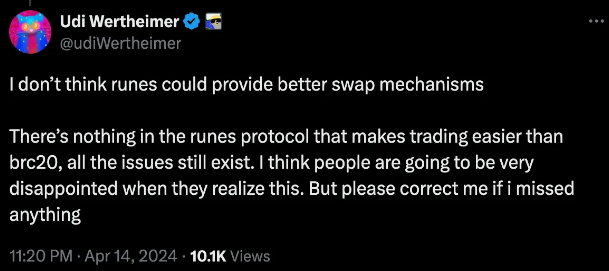
Early UniSat and Ordinal Wallet interfaces for trading are identical to BRC20, involving two aspects during trades: 1) the number of tokens traded per transaction, and 2) the price per bundle.
The number of newly issued Rune tokens will be staggering: dozens or even hundreds of new tokens minted daily (under high gas fees), diluting traders’ attention and capital inflows per token.
From a utility standpoint, Runes are meme coins just like BRC20—at least initially. So the “novelty” will fade, especially if no Rune token sustains upward momentum and speculators start losing money.
Additionally, Casey Rodarmor’s personally created Rune 0 (UNCOMMON•GOODS) will be hard to hype because it 1) can be minted for free for four years, and 2) only allows one unit to be minted per transaction.
2. Why I’m Bullish on Runes Long-Term
If I’m right, the Runes hype will cool shortly after launch, and the best opportunities will emerge after the sell-off.
Here’s why:
Narrative-driven speculation happens in waves.
The first wave is driven by excitement over something new—usually either innovative technology or simple meme potential. Meme tokens are somewhat like gambling: most that spike rarely see a second wave.
However, narratives based on technological innovation have stronger recovery potential once initial hype fades.
Ordinal Inscriptions launched in December 2022, but the first major surge came in May 2023 with BRC20. Freely mintable BRC20 tokens exploded quickly, but second and third waves arrived by late 2023 as developers continued building.
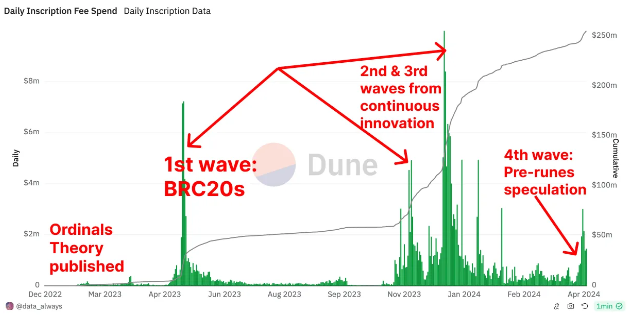
Now we’re in the pre-Runes fourth wave of narrative speculation.
While many narratives die after the first wave (see ERC404 trading), I believe Runes will see fifth, sixth, and more waves.
Here’s why:
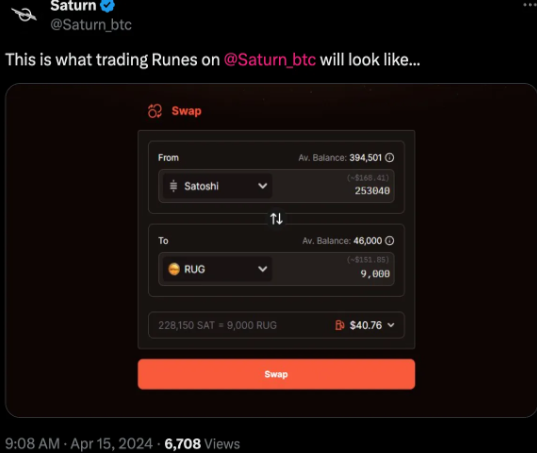
Multiple protocols are building infrastructure for Rune tokens. But developing new DEXs/markets takes time. For example, Saturn is building a familiar DEX for Runes, but it will take time to achieve smooth UX. I’ll share more protocols to watch below.
The Runes protocol aims to unify BTCFi under a single development standard. Imagine Ethereum without a unified ERC20 standard—tokens couldn’t be swapped between Aave and Uniswap. That’s Bitcoin today. Before Runes, we had BRC20, CBRC-20, ARC-20, BRC-420, etc.—a complete mess.
I’m also bullish on Runes long-term because it taps into three pillars driving growth in crypto ecosystems—the framework I use for this bull market.
In my view, any crypto ecosystem’s success is driven by three key elements: technological innovation, token issuance opportunities, and compelling narratives. How does Runes fit?
1) Technological Innovation: We were told NFTs and tokens were impossible on Bitcoin. Yet in this cycle, Bitcoin NFTs outperformed Ethereum NFTs. ORDI, the first BRC-20 on Bitcoin, reached $1 billion in trading volume on Binance.
The magic lies in turning fungible satoshis into non-fungible ones. When inscribed, one satoshi is no longer equal to another.
This is one of the most exciting zero-to-one innovations of the cycle. If you want to understand how we got here, check my previous blog post on BTCFi.
2) Token Issuance: This is partly why we have crypto cycles. In every bull run, new tokens sprout up and receive wild valuations. Just as central banks overprint fiat, we tend to overissue tokens to match increased capital and attention flowing into crypto—leading to eventual market collapse.
This cycle is no different. I wrote extensively about how this unfolds before this bull market began.
However, token issuance has historically been limited to smart contract blockchains like Ethereum/Solana—until Ordinals accidentally enabled BRC20.
I’m concerned about BTCFi due to unrestricted token issuance. BRC20 (and Runes) can be minted easily without real value accrual, since there are no smart contracts on Bitcoin.
Yet the Ordinals community found Schelling points by assigning intrinsic value to early Ordinal NFTs and airdropping tokens to those collections.
Moreover, without direct value accrual, all BRC20 tokens are essentially memes. Only ORDI gained traction as the first BRC20, but now PUPS might cross the Yellow River to become Bitcoin’s true meme coin. The higher PUPS goes, the more confidence it builds among speculators.
Finally, the BTCFi ecosystem is growing native tokens that counterbalance memes and theorize BRC20/Runes as value-accruing assets. More on that later.
3) Compelling Narrative: Narratives breathe life into technical features and tokenomics, transforming them into something relatable, trustworthy, and worth joining.
For instance, Bitcoin Ordinals exist as immutable NFTs on the most secure and decentralized blockchain—a captivating story. Plus, meme coins on Bitcoin? Come on, that’s way cooler than meme coins on Solana or Ethereum.
Crypto Twitter is catching up with Ordinals/Runes technological innovation, and the narrative is red-hot.
This short-term bearish but long-term bullish scenario might be ideal—especially if you’re late to pre-Runes tokens. Once the hype cools, you’ll have time to learn and prepare for the next wave of Rune mania.
The best time to learn was yesterday; the second-best time is today. So here’s a quick intro to Runes.
3. What You Need to Know About the Runes Protocol
Runes was developed by Casey Rodarmor, creator of the Ordinals theory, as a response to BRC20. Casey dislikes BRC20, so expect him to do for fungible tokens what he did for NFTs.
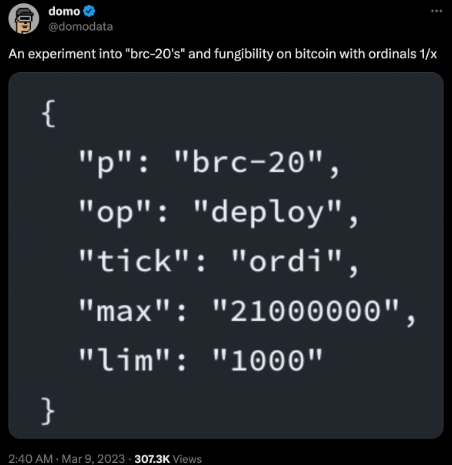
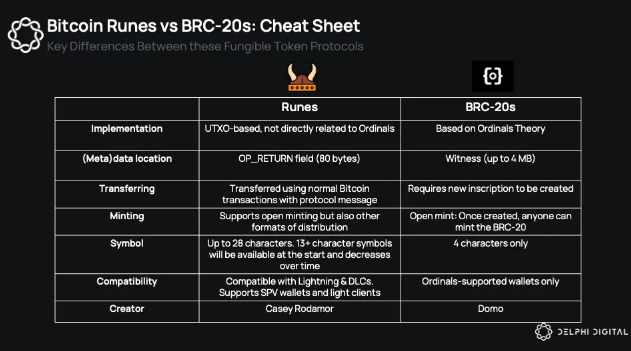
You know BRC-20 tokens use JSON data (text-based format) inscribed on sats. They trade more like NFTs than fungible tokens—for example, you must "inscribe" (via an on-chain Bitcoin transaction) before selling or transferring them.
Also, BRC-20 creates “junk” or “dust” transactions, causing network congestion.
In contrast, Runes uses the UTXO model, which confuses everyone. Here’s my explanation: Ethereum uses an account-based model, while Bitcoin uses UTXO (Unspent Transaction Outputs) to track user balances and states.
For example, if you have a 1 BTC UTXO and want to send 0.3 BTC, the transaction uses the entire 1 BTC UTXO as input. It then creates two outputs: one sending 0.3 BTC to the recipient, and another returning the remaining 0.7 BTC (minus fees) as two new UTXOs to your address.
So technically, when you say “I have 1 BTC,” you should say “I have some UTXOs allowing me to spend 1 BTC.”
In the above example, when you use the 1 BTC UTXO as input, that UTXO is “destroyed,” and two new UTXOs are minted: 0.3 UTXO to the recipient and 0.7 UTXO (minus fees) back to you. As you can see, these UTXOs are like NFTs!
But unlike inscriptions (like BRC20), each rune unit is identical—they’re fungible tokens. You can transfer runes just like regular BTC without needing to inscribe BRC20 every time.
With Runes, a UTXO can now hold 1 BTC, 100 Rune Token A, and 50 Rune Token B—all together as a “runestone.”
Tip: Create multiple UTXOs by sending desired BTC amounts to a new wallet for each Rune investment. This lets you quickly invest in multiple tokens without waiting for prior transactions, or use Luminex.
Runestones (don’t confuse with Rune Ordinals) refer to how Runes protocol messages are stored within Bitcoin transaction outputs when you send a UTXO.
I’m sharing this because once Runes launches, you’ll soon see terms like “Runestones,” “inscribing,” and “edicts” trending on Twitter. People will try trading Runes, hit snags, and definitely look for answers online.
Runestones – Runes protocol messages – can include minting (deploying) a new Rune, minting existing Runes, and transferring Runes between addresses.
Minting is how a Rune is first created by a “minter.” Once minted, attributes cannot be changed.
4. Background Knowledge on Runes
Finally, here are some additional simple terms and facts about Runes you should know:
Rune Name: Initially, only names longer than 13 characters are available; this limit decreases by one character every 4 months until all names are available after 4 years.
Rune Number: Indicates creation order, starting from “Rune 0,” then “Rune 1,” etc.
First Rune UNCOMMON•GOODS - Free minting, no supply cap, only 1 UG per mint. 1 UG essentially equals Bitcoin transaction fees.
Rune ID: Generated based on block and position, e.g., “500:20”
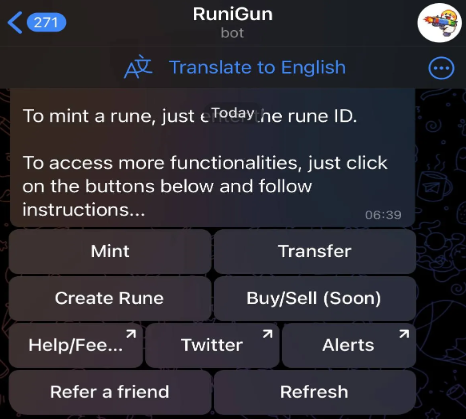
You can mint Runes by entering their Rune ID. For example, the RuniGun bot on Telegram allows minting via Rune ID. So if you know the ID, you don’t need third-party UIs to mint. You can check this bot here (disclaimer: I’m not affiliated, just found it on X).
Rune Symbol: A non-unique currency symbol $, ⧉, or 🧿, or a generic symbol ¤. More technical terms provided by Leonidas.
5. Projects, Protocols, and Tools to Watch
I originally planned to write “How to Prepare for the Runes Protocol Launch.” But there are already multiple similar posts on X covering the same protocols.
1) Projects to Watch
Key point: The Runes game is already underway. Multiple pre-launch protocols have emerged, promising Rune token airdrops upon protocol release after the Bitcoin halving block.
The hype started with the RSIC protocol (RSIC stands for Rune Specific Inscription Circuits—an NFT on Ordinals, total supply 21,000, 10% reserved by team), which mysteriously airdropped RSIC NFTs to Ordinal OG/miner wallets.
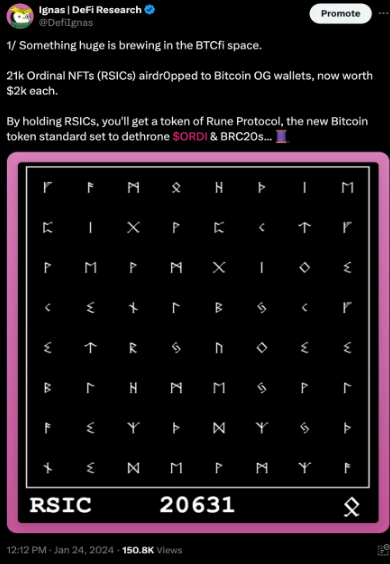
At the time, I said “something big is brewing in BTCFi,” but didn’t know how it would unfold. Now we know RSIC sparked a competition for Rune speculators’ attention.
If you don’t hold RSIC, I don’t think now is the right time to enter: holding RSIC earns RSIC points, redeemable for RSIC Rune tokens. Theoretically, RSIC should trade at $0 by halving block.
In response to the RSIC team (who kept 10% and had opaque airdrop criteria), Leonidas airdropped Runestones to 112.4k OG wallets. Holding Runestones earns you not one, but three Rune meme tokens.
Runestones currently have a market cap of $549 million, making it the second-largest (by market cap) pre-Runes collection—second only to Rune Pups + PUPS.
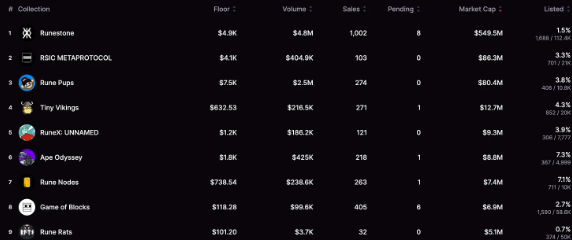
Since RSIC has been depreciating toward halving, its true valuation is ~$588 million based on whalesmarket pricing of $0.028 per RSIC Rune.
Rune Pups ($80M) + PUPS meme coin ($421M) = $501M total market cap. Remember, Rune Pups NFT and PUPS token holders will migrate to Runes with a 23% allocation split, 77% to PUPS.
There are often good arbitrage opportunities across Rune Pups NFTs, PUPS on UniSat, and Pups bridged to Solana.
Not financial advice—but would you invest at these valuations? If my short-term outlook is correct, their valuations should drop shortly after launch.
Either way, it’s a speculative decision you must make yourself. There are many other Rune protocol valuations under $100M. Check Magic Eden for a full list.
Still, I won’t sell—I entered early and am willing to hold. Besides, these three major assets are becoming focal points of the Rune ecosystem, hopefully retaining value and earning more airdrops.
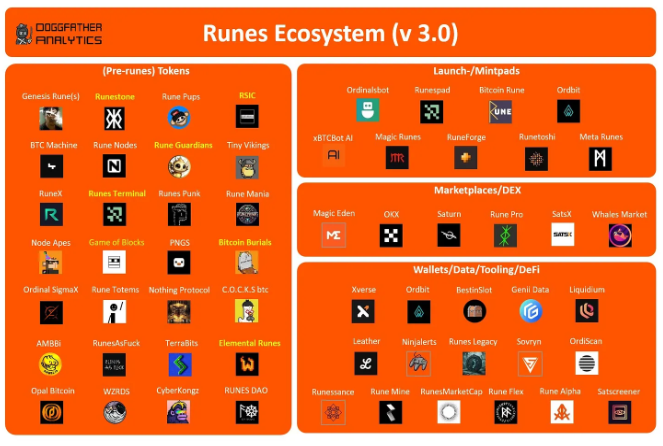
Long-term, new protocols will emerge to capitalize on Runes hype. Here are some starting points.
2) Notable Protocols
Luminex: Mint Runes and split UTXOs to mint multiple Runes within the same wallet. Promoted by Xverse Wallet, so likely solid.
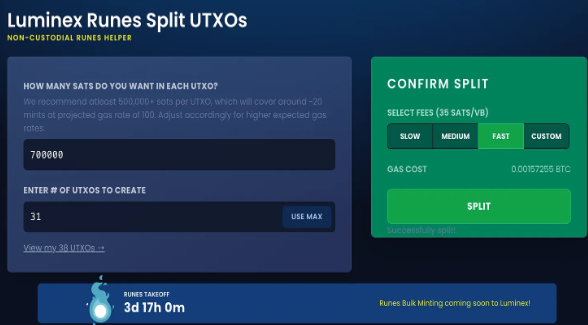
Sovryn: Runes trading/lending platform with its own sidechain. Launching at halving. Sovryn will deploy their DEX on Bob L2—my recommended platform.
RunePro: Building a DEX and minting protocol. Not live yet. https://twitter.com/Rune_Pro
Rune Bitcoin: Offers Rune minting and transfer services, also building a marketplace and DEX.
Runessance: Lending protocol for Runes and Bitcoin.
Liquidium: Lend/borrow Ordinals and Runes. Earn yield on Bitcoin. Point system active. Liquidium offers reward points for airdrops.
Saturn: AMM/orderbook exchange for Bitcoin assets. May lack sufficient liquidity during Rune launch.
RuniGun: Telegram bot for minting, creating, and managing Runes. Cannot export private keys—use cautiously.
But you’ll likely use Magic Eden and UniSat to trade Runes, plus OKX Web3 Wallet (if mobile). Personally, I’ll alternate between UniSat, Xverse, and OKX wallets.
3) Useful Tools
SatScreener: Real-time token aggregator for Runes and Bitcoin ecosystem. With poor Coingecko/CMC support for Bitcoin ecosystem, SatScreener is the best place for token info.
Runesmarketcap: Discover Runes protocols by source, market cap, type, etc.
Runealpha: Rune explorer with real-time data, minting protocols—all very practical.
Runes Terminal: Building scanner, minter, and launchpad. Has its own Ordinal, will reward RUNI airdrop post-halving.
We’re still early—please comment with other great tools/protocols for Runes!
Also, remember BTCFi is in its infancy. It’s like going back in time to 2019–2020 Ethereum DeFi, even before Uniswap existed. Opportunities will be abundant—keep learning.
Join TechFlow official community to stay tuned
Telegram:https://t.me/TechFlowDaily
X (Twitter):https://x.com/TechFlowPost
X (Twitter) EN:https://x.com/BlockFlow_News
 Ignas | DeFi Research