Trump's crypto project raised $10 million in one day
TechFlow Selected TechFlow Selected
Trump's crypto project raised $10 million in one day
Fundraising and voting in tandem.
 Navigating Web3 tides with focused insights
Text: Tuoluo Finance
Trump has unveiled a new move.
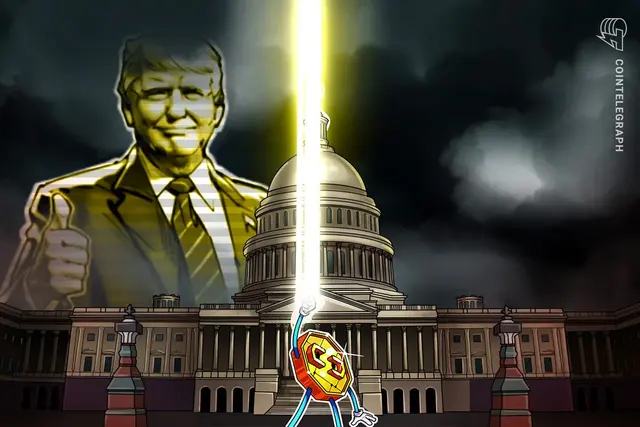
On October 15, the Trump family's DeFi project World Liberty Financial launched its public sale of WLFI tokens. Prior to this, the team had spent nearly two months building momentum, with all four members of the Trump family actively promoting it. Trump himself repeatedly endorsed the project on Spaces and X, effectively positioning himself as a new ambassador for crypto.
However, compared to its ambitious fundraising goal of nearly $300 million, the first-day token sale raised just over ten million—still far from the target. The market appears increasingly desensitized to bold promises, leading to a pullback in bets on Trump. Moreover, the project has previously faced criticism over allegations of nepotism.
On another note, with only 20 days left until the election, the precise timing of this crypto project’s launch carries additional significance.
On October 15, WLFI tokens officially went live, opening the public sale to whitelisted users. Just one day earlier, the project hosted a livestream announcing that over 100,000 qualified users were already on the whitelist.
Looking back at the project's development, promotional efforts began as early as two months ago. It started when Eric Trump suddenly declared his love for DeFi, followed by Donald Trump Jr. publicly affirming that DeFi is the future. On August 16, the elder son launched a Telegram channel named The DeFiant Ones, continuing to tease updates and stoke market anticipation.
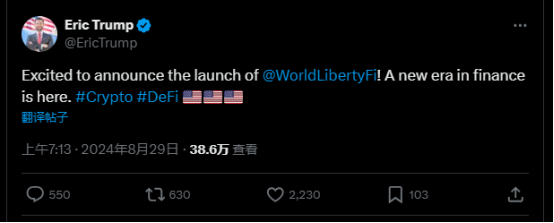
Finally, on August 29, the project lifted its veil. Eric Trump announced the launch of World Liberty Financial (WLFI), with the main guest—Trump himself—adding fuel to the fire by posting related videos and once again touting the slogan of making America the cryptocurrency capital.
Despite claims of returning financial power to the people, even now—with tokens already released—the project still hasn’t published an official whitepaper. Only a so-called “Golden Paper” offers any explanation, leaving technical details and operational methods unclear. Based on information from The Block combining the roadmap and the Golden Paper, we can glimpse fragments of the project’s vision.
World Liberty Financial is led by co-founders Steve and Zach Witkoff, Folkman, and Chase Herro, aiming to drive mass adoption of digital assets through a compliant, one-stop alternative financial platform where users can borrow and lend cryptocurrencies, create liquidity pools, and trade using stablecoins. The Trump family is deeply involved: Trump is referred to in the draft whitepaper as the "Chief Crypto Advocate," his two eldest sons serve as "Web3 Ambassadors," and his youngest son naturally assumes the title of "DeFi Visionary."
The roadmap outlines three phases. Phase one involves building on Scroll using Aave, focusing on crypto banking—an initiative already underway. Phase two integrates with exchanges, enabling users to spend via on-chain KYC verification; specifically, the plan includes launching a credit card centered around stablecoins. The final phase targets tokenizing real-world assets—returning to their roots, possibly involving real estate projects.
While the project’s plans remain vague, its token distribution is clearly defined. 63% of the token supply will be sold to the public, with 17% allocated for user rewards and 20% reserved for the team. This initial token sale aims to raise $300 million by selling 20% of the total supply at a fully diluted valuation of $1.5 billion. The total token supply is 20 billion.
To avoid SEC regulation, the token sale operates under Regulation D, limiting the scale and restricting sales to accredited investors only. Tokens cannot be transferred secondarily, though holders retain governance voting rights over project development.
As of 3:30 PM on October 16, approximately 730.53 million WLFI tokens have been sold, leaving 19.269 billion remaining. At $0.015 per token, total sales amount to about $10.96 million. For a brand-new project, this is a solid first-day performance—but falls significantly short of the targeted $300 million.
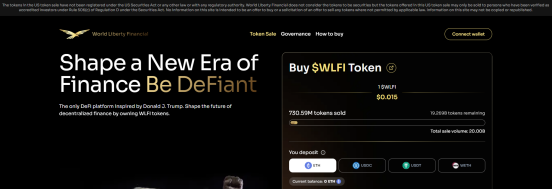
The reason the market isn't buying in is straightforward. Pouring large sums into a project without a clear whitepaper and with non-transferable tokens carries high risk. Additionally, the project itself has numerous red flags.
First, the team. Despite full involvement from the Trump family, they are traditional real estate magnates with no prior crypto experience. Their titles in the whitepaper suggest they're more figureheads than contributors—leveraging fame to attract funds. Thus, actual execution rests entirely on the co-founders.
Among them, Folkman and Chase Herro come from Dough Finance, a DeFi project built on AAVE launched in April this year. However, on July 12, it suffered a flash loan attack resulting in a $2 million loss and has since become largely inactive. Given this track record, rumors suggest WLFI may reuse the same codebase, raising security concerns. Folkman further damaged credibility due to his past involvement in creating a course teaching men how to date attractive women.
Chase Herro’s reputation isn’t better. He was imprisoned for long-term drug offenses in his youth, sold weight-loss pills and get-rich-quick courses, and a decade ago launched another venture called Pacer Capital, a crypto trading business that no longer exists.
With core operators facing reputational collapse and the Trumps lacking crypto expertise, combined with non-transferable governance-only tokens, the project’s true purpose is quickly questioned.
Industry analysts believe this project is merely a new fundraising channel for Trump—or even an alternative form of political donation. This theory isn’t baseless. Compared to the consistently well-funded Democratic Party, Republicans face fundraising challenges. According to Federal Election Commission filings, by July 31, Harris’s campaign had raised $770 million and spent $440 million, while Trump’s raised $570 million and spent $310 million. Latest disclosures show that between July 1 and September 30, Harris’s team raised $633 million—a rare pace and volume in election history—while Trump managed only $350 million in Q3, a stark contrast.
In terms of funding channels, Harris benefits mainly from Carey Committee, which allows unlimited donations plus direct contributions to candidates and parties. Trump relies primarily on SuperPACs, which permit unlimited spending on ads and promotion but lack direct donation capabilities, making fund utilization less efficient than Harris’s side.
Given these circumstances, Trump’s sudden push into crypto fundraising right before the election makes strategic sense. Token sales offer quick cash influx—aligning with the project’s audacious $300 million funding target. After all, few projects dare to demand such a massive sum immediately upon launching a governance token. Naturally, the project’s success is tightly tied to Trump’s electoral outcome. For donors, future returns matter most. Still, the Trump family remains optimistic, setting their sights on stablecoins—the cash cow of crypto.
Meanwhile, launching a crypto project now reinforces Trump’s pro-crypto stance. In practical terms, it lends credibility to his otherwise hyperbolic statements, helping secure crucial support from the crypto community.
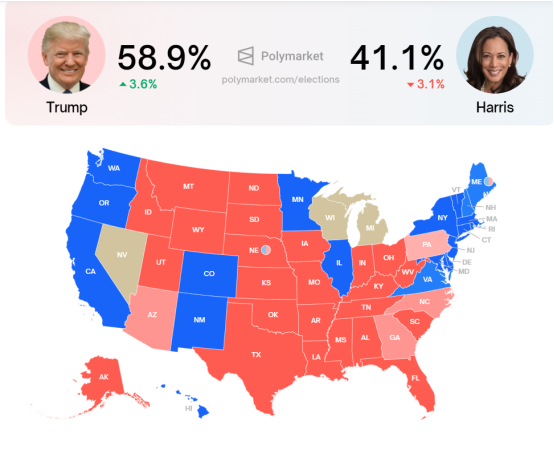
This political tint explains why the project hasn’t gained broad acclaim. Yet in terms of odds, despite Harris leading Trump by 2 percentage points in polls as of October 10 (49% vs. 47%), crypto prediction markets tell a different story: Trump leads with a 58.9% win probability—surpassing Harris by 17 points. In key swing states, Trump has regained the upper hand, leading in Michigan, Pennsylvania, and Nevada. He now leads in 6 out of 7 battleground states. If trends continue, Trump may be just one step away from winning the election.
Notably, a pivotal supporter in this campaign is none other than crypto’s longtime ally—Elon Musk. Between July 3 and September 5, Musk donated $75 million to America PAC, a political action committee supporting Trump. Though below his previously claimed $45 million monthly commitment, this sum made him one of Trump’s largest individual donors.
Strangely, back before 2020, Musk was highly critical of Trump’s withdrawal from the Paris climate agreement and openly identified as a Democrat supporter. As recently as 2022, the two were sparring online—Musk bluntly stating Trump should retire, while Trump retorted that Musk was merely a “government-subsidized businessman,” sarcastically mocking Musk’s past visits to the White House seeking subsidies.
But after Trump’s assassination attempt in July this year, their relationship abruptly reversed. In August, Musk hosted Trump on a Space discussion, drawing millions of viewers. In October, Musk appeared personally at a Trump rally, even offering $47 in cash incentives to voters who cast ballots. Coupled with major donations, Musk has now fully thrown his weight behind Trump.
According to Musk himself, his shift stems from growing misalignment between Democratic policies and his personal values. He believes the party’s embrace of racial diversity is accelerating national division. He also criticizes Biden’s weak follow-through on clean energy and electric vehicles, along with perceived targeting of SpaceX and Twitter, cementing his decision to back the Republican camp.
Beyond government contracts and regulatory pressures, Musk seems increasingly drawn to politics itself. From this perspective, aligning with Trump—who lacks deep establishment ties and remains outside the entrenched bureaucratic elite—offers clearer advantages for both business interests and political aspirations. Trump has notably shifted his stance, now endorsing electric vehicles and promising Musk a role as Minister of Cost Reduction if elected.
Yet there’s no turning back. Public endorsements carry significant risks and backlash. Musk has openly admitted that if Trump loses, he could face severe retaliation from Democrats—even personal safety threats. Under these conditions, his full-throated support becomes understandable as a self-preservation strategy.
For anyone involved in politics, elections are high-stakes gambles. Until the final result, nothing is certain. Campaign rhetoric is merely the appetizer; the real game lies in the unseen battles behind the scenes. Every move by politicians is rooted in interest and votes.
Musk’s alliance is no exception—and neither is the launch of this DeFi project. As for whether World Liberty Financial will truly serve the crypto ecosystem, in the end, perhaps no one really cares.
Join TechFlow official community to stay tuned
Telegram:https://t.me/TechFlowDaily
X (Twitter):https://x.com/TechFlowPost
X (Twitter) EN:https://x.com/BlockFlow_News