Grayscale: Potential Impact of the U.S. Election on Cryptocurrencies
TechFlow Selected TechFlow Selected
Grayscale: Potential Impact of the U.S. Election on Cryptocurrencies
Regardless of which party is in power, comprehensive bipartisan legislation may be the best long-term solution for the U.S. crypto industry.
 Navigating Web3 tides with focused insights
Author: Zach Pandl, Will OgdenMoore; Grayscale Research
Translation: Shaofaye123, Foresight News
TL;DR
-
The outcome of the U.S. election could significantly impact the crypto industry. The next president and Congress may pass legislation specifically targeting cryptocurrencies and could adjust broader tax and spending policies affecting financial markets.
-
Current polling data and implied odds from prediction markets like Polymarket indicate a highly competitive race. As of October 15, these metrics suggest Republicans are more likely to control the Senate. Given the Senate’s role in confirming presidential appointments to key regulatory agencies—such as chairs of the U.S. Securities and Exchange Commission (SEC) and Commodity Futures Trading Commission (CFTC)—a shift in Senate control is highly relevant to cryptocurrency. [1]
-
At the voter level, data shows cryptocurrency is a bipartisan issue, with Democrats holding slightly higher rates of Bitcoin ownership than Republicans. Additionally, candidates from both parties have expressed support for crypto innovation.
-
Regardless of which party wins, comprehensive bipartisan legislation may represent the best long-term solution for the U.S. crypto industry.
Although numerous issues dominate the 2024 U.S. election, the crypto industry has successfully captured candidates’ attention. This reflects shifting voter preferences: in a national survey conducted by Harris Poll on behalf of Grayscale, we found that approximately half of American voters would be more likely to vote for candidates who show greater interest in crypto education/information. Rising voter interest in crypto underscores the growing urgency for comprehensive legislation as the industry evolves and innovates.
Below, we examine potential outcomes for the White House and Congress and their possible implications for the crypto market. For each scenario, we report implied odds from Polymarket—a blockchain-based prediction market that has seen sharply rising adoption this year.
Most outcomes remain highly uncertain: both polling data and prediction markets show a tightly contested race. However, the data suggests a potential shift in Senate control—from Democrats to Republicans—appears increasingly likely. Given the Senate's pivotal role in confirming presidential appointments, this could directly impact the crypto industry.
White House
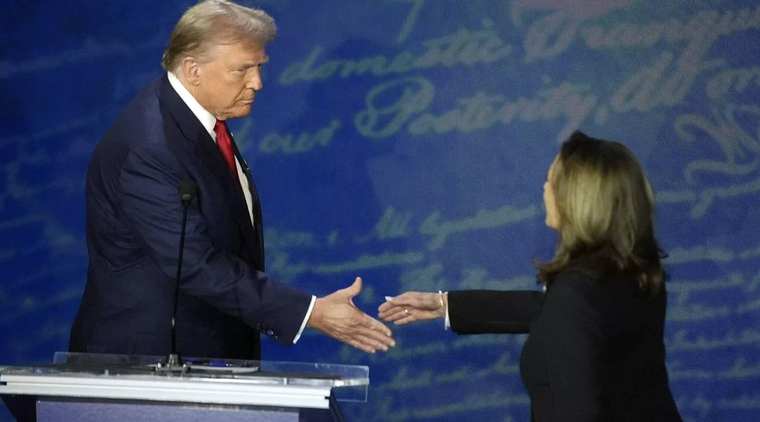
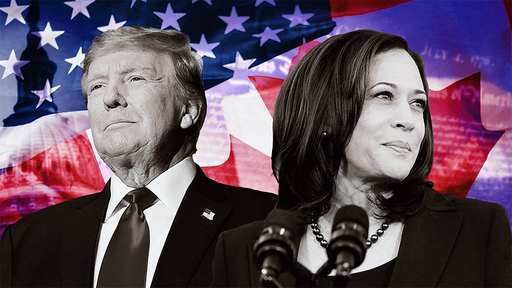
Polymarket odds: Trump 57% / Harris 43% (as of October 15, 2024)
Outcome: A Trump victory could mean more supportive regulators and larger budget deficits—both potentially positive for Bitcoin and crypto. However, Trump’s fiscal plans require congressional approval, and tariffs could create market uncertainty.
The next president will set the agenda on crypto policy, nominate leaders of major regulatory bodies, and drive broader economic decisions on taxation, spending, and tariffs. Former President Trump has shown strong enthusiasm for the digital asset sector, claiming he wants to make the U.S. the “crypto and Bitcoin capital of the world.” [2] He also announced plans to launch a crypto lending platform called World Liberty Financial, though details remain undisclosed. [3]
Vice President Harris has recently made more supportive statements about digital assets, explaining her administration would “encourage innovative technologies like AI and digital assets while protecting consumers and investors.” [4] Her campaign is reportedly planning to unveil protections for crypto assets and develop a “roadmap for cryptocurrency and other digital asset regulations.” [5]
However, Harris’s campaign has provided fewer specifics. Notably, as some market participants and commentators in the crypto industry observe, the current Biden-Harris administration has taken an adversarial stance toward the sector—launching multiple lawsuits, restricting access to traditional banking services, and vetoing bipartisan legislation. [6] Thus, a Trump administration may be more likely to appoint regulators supportive of crypto innovation. [7]
Bitcoin’s outlook may also depend on the macroeconomic policy choices of the next administration (see Bitcoin and Macro Under Biden vs. Trump for details). Research analysis indicates both Trump’s and Harris’s fiscal proposals would lead to larger budget deficits—even as federal deficits are already substantial. [8] Before incorporating either campaign’s stated plans, the Congressional Budget Office (CBO) projects federal deficits will average 6.2% of GDP over the next decade. According to the Penn Wharton Budget Model (PWBM), even though Harris intends to raise the corporate tax rate to 28%, her proposed expansions of the child tax credit and other reforms would increase the 10-year average deficit to 6.5% of GDP. [9] Meanwhile, PWBM analysis suggests that former President Trump’s plan to extend the 2017 tax cuts and lower other tax rates would increase the 10-year average deficit to 7.8% of GDP (Chart 1). [10]
Grayscale Research believes that, all else equal, large budget deficits are likely to weigh on the U.S. dollar and benefit Bitcoin over the medium term.

Chart 1: Neither candidate proposes reducing federal deficits
In practice, however, market impacts are uncertain. First, fiscal policy changes require congressional approval, and it remains unclear which campaign proposals will become law—especially under divided government. Second, former President Trump also plans significant tariff increases. Higher tariffs tend to strengthen the dollar and pressure risk assets, particularly if other countries retaliate. [11] While tariffs do not directly affect Bitcoin, crypto valuations correlate with broader market dynamics, so tariff hikes could pose downside risks to prices.
Senate
Polymarket odds: Republican control 78% / Democratic control 22%
Outcome: Although members of both parties support certain aspects of crypto policy, Republican control of the Senate could have a more positive impact on the crypto industry due to the chamber’s critical role in confirming regulatory appointments.
The Senate, together with the House, is responsible for passing changes to fiscal policy [12] and crypto-specific legislation. The Senate also confirms presidential appointments, including leadership roles at key regulatory agencies such as the SEC, CFTC, and Federal Reserve Board. Because the regulatory status of many crypto assets remains uncertain, Senate oversight of agency appointments is crucial to the industry.
Crypto legislation considered in this Congress has been bipartisan, including the Digital Commodities Act in the Senate Agriculture Committee and stablecoin legislation in the Senate Banking Committee. [13] In contrast, Republican senators have generally shown stronger support for the crypto industry. For example, Stand With Crypto, a crypto advocacy group, gave an “A” rating on crypto issues to 39 out of 49 Republican senators, compared to only 6 out of 51 Democratic senators. [14][15] Voting patterns also reflect stronger Republican support: when the Senate voted to overturn the SEC’s Staff Accounting Bulletin (SAB) 121, [16] 48 Republicans voted in favor versus only 12 Democrats.
Democrats currently control the Senate, giving them committee chairmanships, legislative agenda-setting power, and ultimately decisive votes on several presidential appointments. Given that Republicans generally show stronger support for crypto innovation, Grayscale Research believes a change in Senate control could positively impact crypto markets—and due to the Senate’s key oversight role in agency appointments, this may be the most important electoral outcome for the industry.
House of Representatives
Polymarket odds: Republican control 44% / Democratic control 56%
Outcome: Control of the House is crucial in determining whether the government will be unified or divided, which will influence the next president’s ability to achieve stated fiscal policy goals and thus have broader implications for financial markets.
Like the Senate, any changes to fiscal policy or passage of crypto-specific legislation require House support. Legislation considered in this Congress received bipartisan backing, but with stronger Republican support. For instance, on the House Financial Services Committee’s FIT21 bill, [17] 208 Republicans voted in favor compared to only 71 Democrats—including former Speaker Pelosi and Democratic whip Clark.
Control of the House determines committee assignments and legislative priorities, which could influence crypto policy. But the most consequential factor is whether one party controls both the White House and both chambers of Congress—“unified government”—or if power is split between parties—“divided government.” Under divided government, enacting fiscal policy changes becomes significantly more difficult.
Eight Scenarios
The upcoming U.S. election involves three institutions—the White House, Senate, and House—each with two possible outcomes (Republican or Democratic control). This creates eight distinct scenarios, each with different implications for the crypto industry. Figure 2 shows Polymarket’s implied odds for each scenario.

Figure 2: Prediction markets show high uncertainty around election outcomes
Grayscale Research highlights several key points. First, among the four more likely scenarios, none clearly dominates—meaning post-election power balances remain highly uncertain. Second, observers are divided on whether we’ll see a unified or divided government: the combined probability of either Democrats or Republicans sweeping all branches remains close to 50%. Third, according to Polymarket data, the only specific outcome with notably high odds is Republican control of the Senate. So long as this holds, we believe the election outcome leans favorable for crypto markets, given the Senate’s pivotal role in confirming presidential appointees.
Crypto Is a Bipartisan Issue
At the voter level, cryptocurrency is a bipartisan concern. National survey results from Harris Poll on behalf of Grayscale show that self-identified Democrats report higher Bitcoin ownership and familiarity with crypto than Republicans, and Democrats have shown increased interest in crypto this year. [18] Moreover, any new crypto legislation will require a supermajority in the Senate, necessitating bipartisan support.
Nonetheless, given the Senate’s critical role in confirming regulators nominated by the president, Grayscale Research views Republican control of the Senate as a significant positive for the crypto industry. Therefore, current polls and prediction market odds both currently point to a favorable environment for crypto markets.
However, significant uncertainty remains regarding legislative prospects for crypto under the next administration or potential adjustments to fiscal policy. In Grayscale Research’s view, the best long-term outcome for the crypto industry would be continued bipartisan efforts to establish more comprehensive legislation.
Harris Poll Methodology
This survey was conducted online within the United States by Harris Poll on behalf of Grayscale using its Harris On Demand omnibus product from September 4–6, 2024, among 1,841 adults (aged 18 and over) who plan to vote in the 2024 presidential election. Data were weighted where necessary by age, gender, race/ethnicity, region, education, marital status, household size, household income, employment, and internet usage propensity to align with known population proportions. Respondents were selected from individuals who have agreed to participate in our surveys. The sampling precision of Harris Online polls is measured using Bayesian credible intervals. For this study, the sample accuracy is within +/- 2.8 percentage points at a 95% confidence level. The credible interval is wider within subsets of the surveyed population of interest. All sampling surveys and opinion polls, regardless of whether they use probability sampling, are subject to various other sources of error that typically cannot be quantified or estimated, including but not limited to coverage error, non-response error, errors related to question wording and response options, and post-survey weighting and adjustment.
Join TechFlow official community to stay tuned
Telegram:https://t.me/TechFlowDaily
X (Twitter):https://x.com/TechFlowPost
X (Twitter) EN:https://x.com/BlockFlow_News
 @Grayscale