How to Measure the Open Value of On-Chain Data | Da Gong Column
TechFlow Selected TechFlow Selected
How to Measure the Open Value of On-Chain Data | Da Gong Column
On-chain data has become the "water and air" indispensable to Web3.0 innovation activities.
 Navigating Web3 tides with focused insights
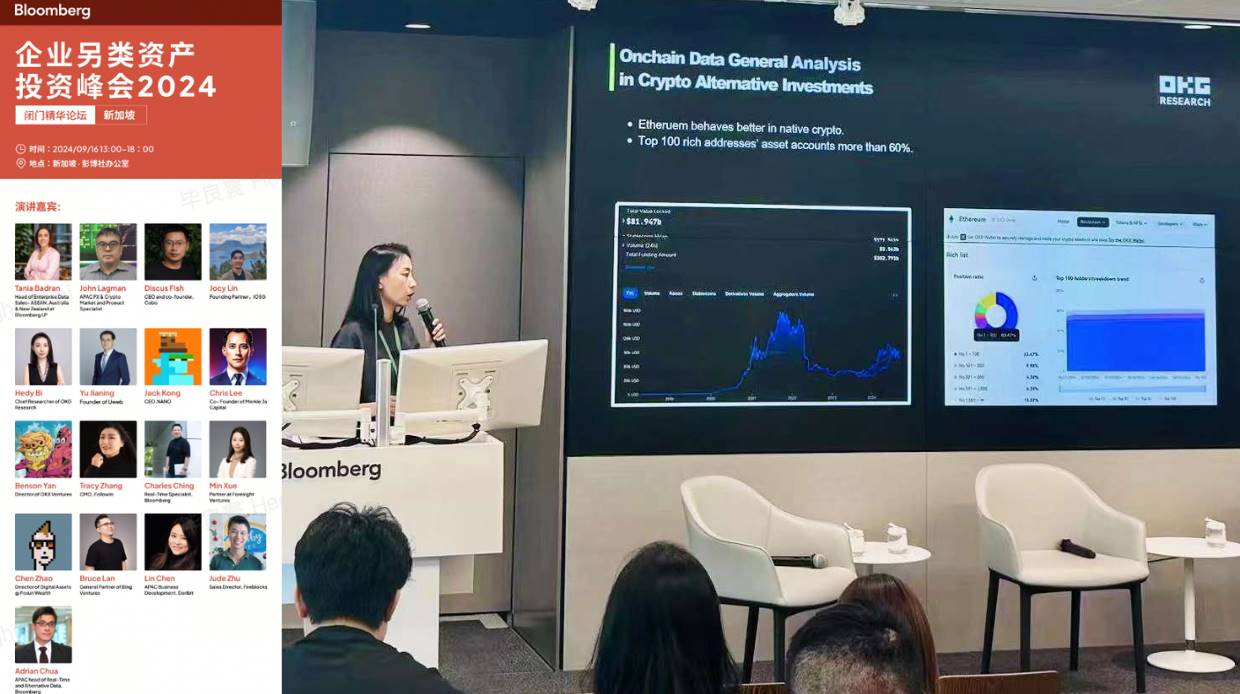
During Token2049 in Singapore, OKG Research was invited to attend Bloomberg's 2024 Corporate Alternative Assets Investment Summit, where they engaged in in-depth discussions with multiple experts on the future forms and prospects of data.
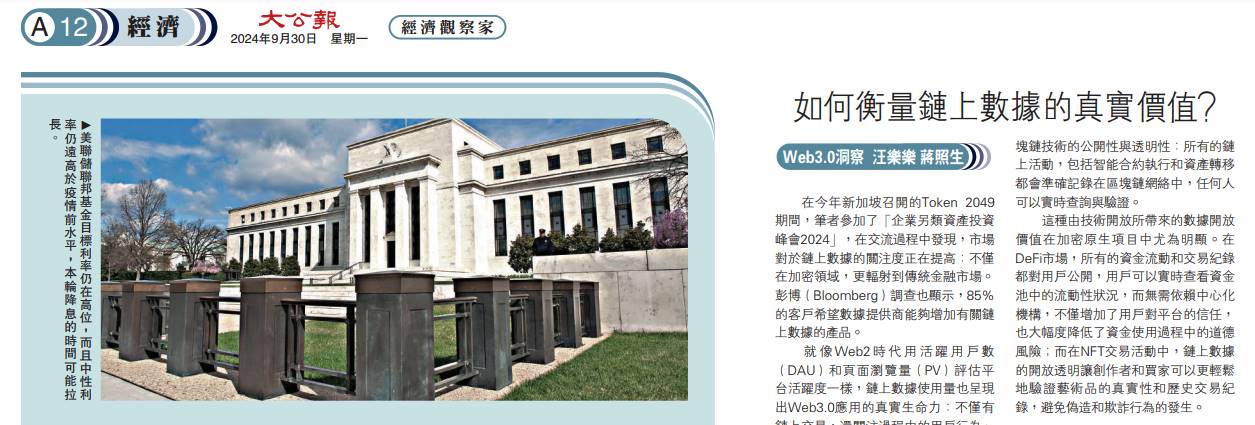
Following the event, Lola Wang, Head of OKG Research, and Jason Jiang, Senior Researcher, co-authored an article published in Ta Kung Pao titled "How to Measure the Real Value of On-Chain Data?", offering a deep analysis of the open value and application potential of on-chain data within the Web3 ecosystem.
1. On-chain data usage is a key metric for evaluating Web3 applications
Just as active user count (DAU) and page views (PV) were used to assess platform engagement in the Web2 era, on-chain data usage reflects the true vitality of Web3.0 applications: beyond mere transactions, it encompasses multidimensional data such as user behavior, smart contract executions, on-chain interactions, and voting—revealing an application’s overall capabilities in user retention, interaction quality, and innovative expansion.
According to incomplete statistics from OKG Research, there are now over 1,000 public blockchains in existence. Take OKLink by OKGroup as an example: within just a few years, it has accumulated more than 2,000+ TB of on-chain data—equivalent to 660,000 movies, 1 billion photos, or 2 billion e-books.
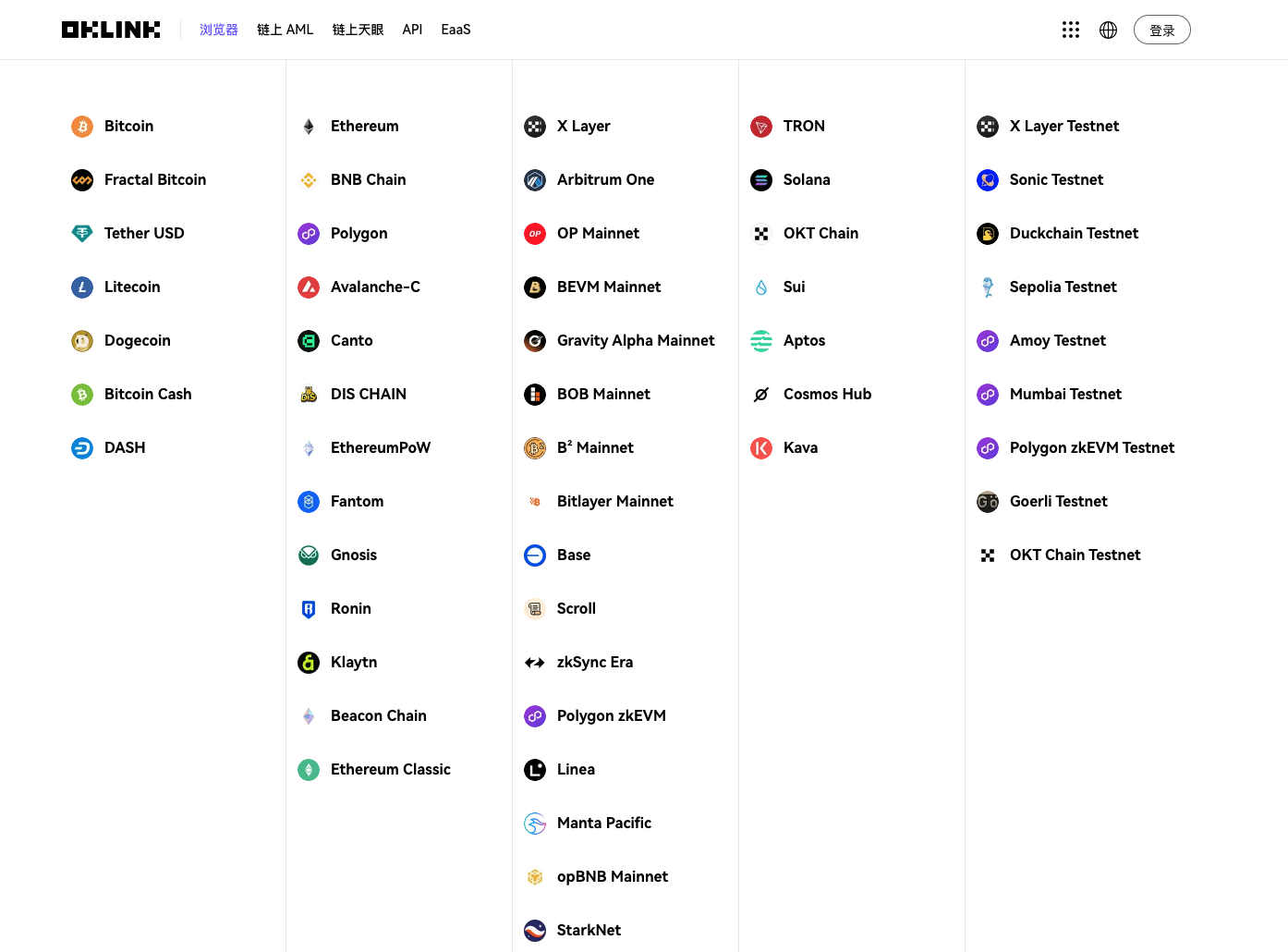
Image source: OKLink
Beyond public chains, other blockchain architectures are also placing increasing emphasis on on-chain data usage. Take AntChain, for instance. In its early exploration of blockchain technology, AntChain focused primarily on increasing transaction volume. However, when recently introducing its first RWA product, it highlighted for the first time improvements in on-chain data usage—by 2023, daily on-chain data reads on AntChain had reached 100 million. Therefore, whether public, consortium, or private chains, despite differences in technical architecture and development paths, on-chain data usage remains a critical indicator of blockchain application activity and value.
However, like other types of data, on-chain data can genuinely reflect actual blockchain usage but does not directly generate value. Thus, it becomes increasingly important to extract and interpret data that was previously “visible but unusable,” and further provide more accessible data productivity tools to unlock stronger data-driven innovation. HKEX-listed company OKGroup (01499.hk), as a Hong Kong-based on-chain data service provider, offers over 50 mainstream public blockchain explorers, data API services, and the latest EAAS (Explorer as a Service) solution tailored for developers—all built upon its vast repository of on-chain data—to continuously improve data utilization efficiency and unlock data value.
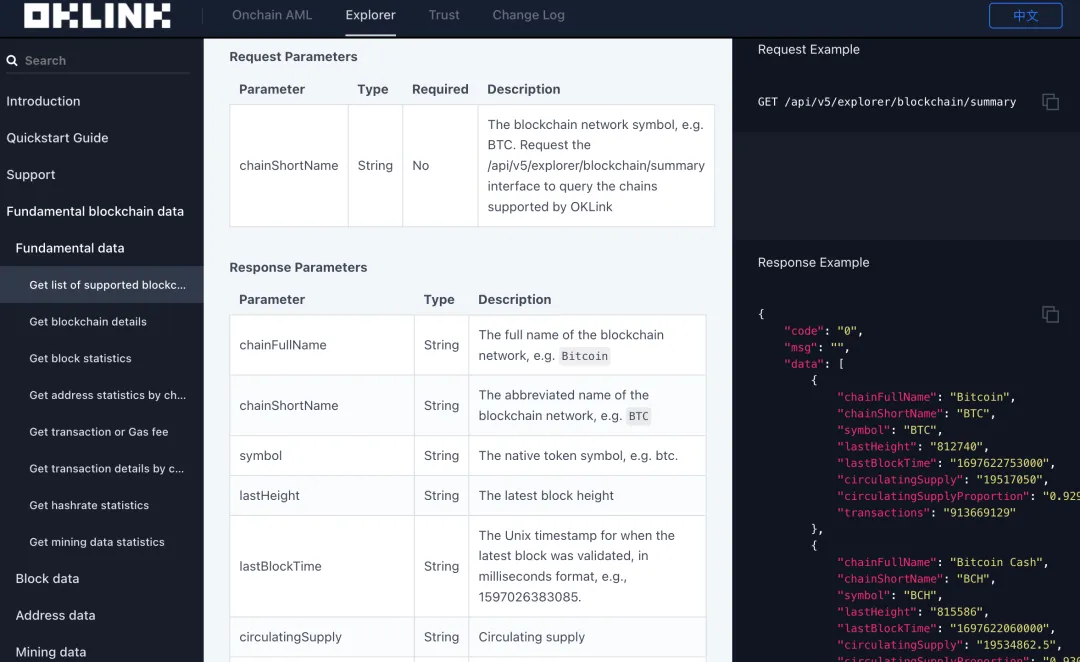
Image source: OKLink
In this sense, whether it’s Bloomberg serving traditional financial markets or Web3 tech companies specializing in on-chain data, unlocking data value is a shared mission.
2. The open value of on-chain data exceeds imagination
Of course, these efforts alone are insufficient to fully unleash the application potential of on-chain data.
As more social production and economic activities migrate onto blockchains at scale, the volume and open value of on-chain data will continue to grow. Whether it’s the Hong Kong government issuing tokenized green bonds on a blockchain network, or institutions like JPMorgan Chase and DBS Bank using the Aave protocol to complete foreign exchange and bond transactions on Ethereum, global traditional finance is actively exploring integration between blockchain technology and existing operations.
As Justin Chapman, Global Head of Digital Assets and Financial Markets at Northern Trust, previously stated,
"There are compelling use cases that have the potential to bring new asset classes and products to market, leveraging the power of tokenization, platforms, ecosystems, and new data sources to deliver efficiencies across the value chain and provide better management and actionable insights."
Underpinning these blockchain-based innovations is actually a massive flow of on-chain data.
The openness of on-chain data fundamentally stems from the inherent transparency and public nature of blockchain technology: all on-chain activities—including smart contract executions and asset transfers—are accurately recorded on the blockchain network and can be queried and verified in real time by anyone. This data openness, driven by technological transparency, is especially evident in crypto-native projects. In DeFi markets, all fund flows and transaction records are publicly available; users can monitor liquidity conditions in real time without relying on centralized institutions, enhancing trust and significantly reducing moral hazards. In NFT trading, the transparency of on-chain data allows creators and buyers to easily verify the authenticity and transaction history of digital art, preventing forgery and fraud.
More importantly, on-chain data is not only open but also public: individuals, organizations, and institutions alike can leverage it for analysis, research, and innovation. Developers can build decentralized applications (DApps) based on transaction data, researchers can study on-chain economic behaviors through user data, and businesses can gain forward-looking market insights via on-chain analytics. This public nature greatly enhances data utilization, enabling value creation not just for individual users or companies, but for the entire Web3 ecosystem.
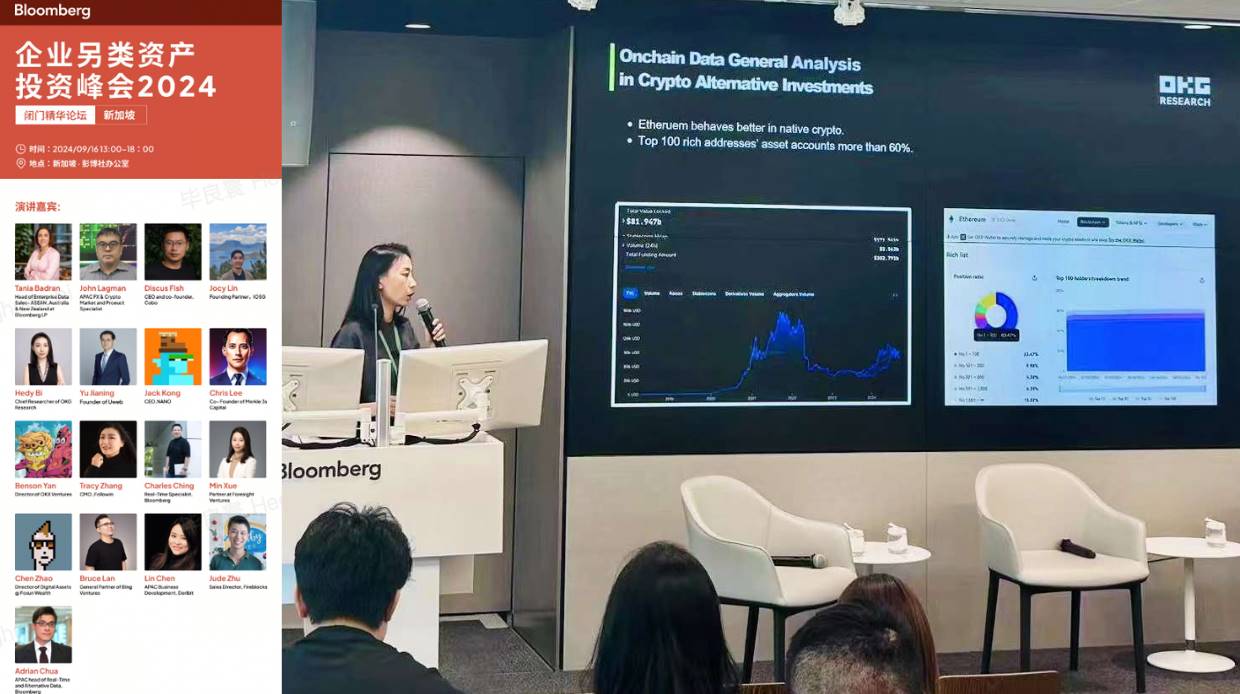
Image source: Bloomberg🇸🇬 Closed-door meeting
OKG Research presented live demonstrations of on-chain data applications as keynote speaker
However, openness and public accessibility only ensure that on-chain data is theoretically trustworthy and usable. Actually harnessing this data to realize its full value requires much more work. Clearly, expecting every individual to possess comprehensive skills in extracting, processing, storing, integrating, and analyzing on-chain data is unrealistic—and would lead to redundant efforts. This underscores the need for more developers and tech firms to handle the foundational work of data preparation, making on-chain data more accessible and user-friendly. Just as generative AI empowers everyone to become a "content creator," better data analysis tools will enable anyone to become a true "on-chain data analyst."
Today, the nature of data value is undergoing a quiet yet profound transformation. We once likened data to oil or treasure in the digital age, but now it is gradually becoming as essential as water and air—ubiquitous, open, and inclusive. Unlike the closed systems of traditional data infrastructure, on-chain data—through its openness and public availability—is redefining how data elements are used, produced, shared, and monetized. It is increasingly becoming the indispensable "water and air" powering innovation in the Web3.0 era.
Join TechFlow official community to stay tuned
Telegram:https://t.me/TechFlowDaily
X (Twitter):https://x.com/TechFlowPost
X (Twitter) EN:https://x.com/BlockFlow_News
 @OKLink