Who will divide this $100 billion business?
TechFlow Selected TechFlow Selected
Who will divide this $100 billion business?
Exploring the Integration of Blockchain and Texas Hold'em Again.
 Navigating Web3 tides with focused insights
Author: Brother Gua
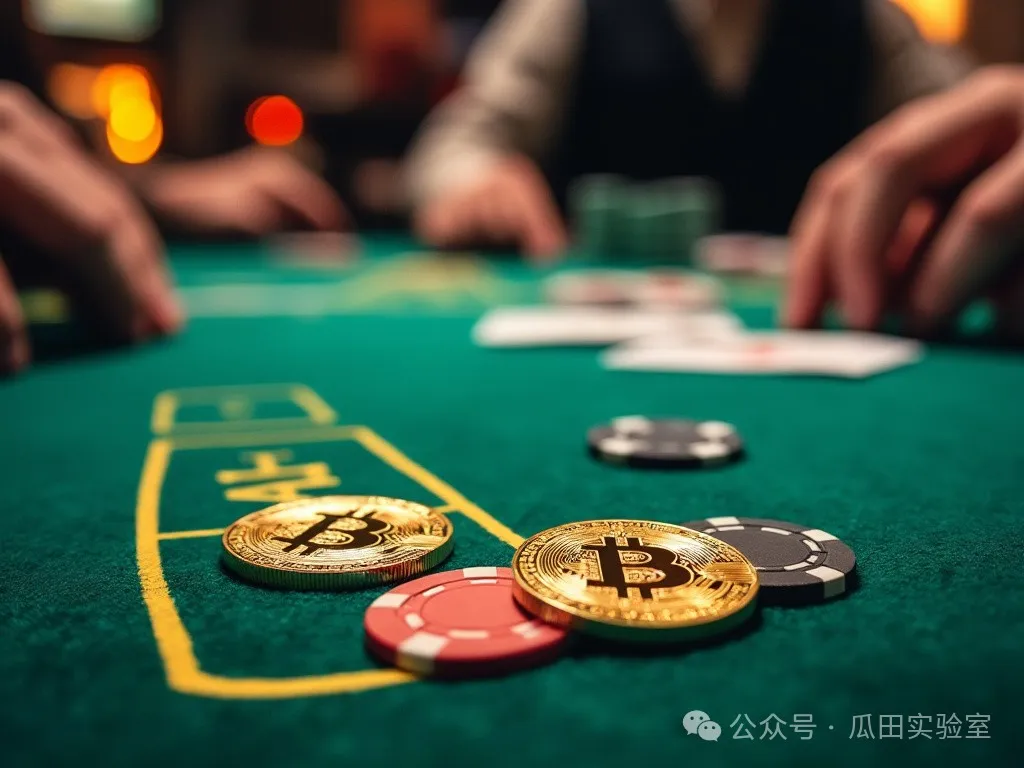
Recently, I read a 100-page report published last year by ResearchAndMarkets.com analyzing the current state and future development of the online poker market. The report predicts that by 2032, the global online poker market will reach $283.4 billion, up from approximately $96.8 billion today.
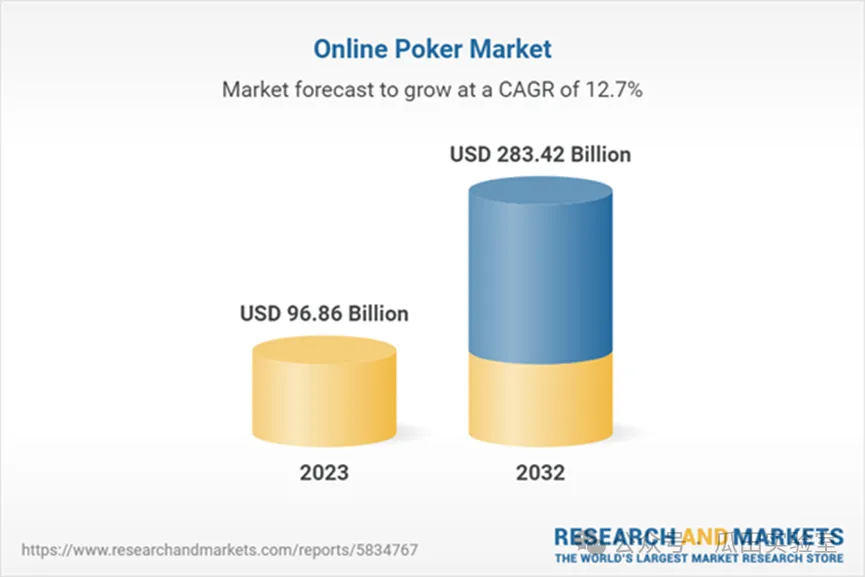
Texas Hold'em dominates the online poker landscape, with other variants like Omaha being far smaller in scale. This article therefore uses online Texas Hold’em as a case study to analyze the necessity and practical examples of integrating competitive online poker with Web3. Online Texas Hold’em can be further divided into two categories: cash games and tournaments. Cash games are what most people play casually during social gatherings, allowing players to rebuy chips multiple times. Currently, international regulators mostly classify cash games as gambling. In contrast, tournament-style Texas Hold’em has been officially recognized as an e-sport in many countries and regions—including Germany, the UK, Switzerland, several U.S. states, and Taiwan in Southeast Asia—where laws explicitly support Texas Hold’em tournaments as legitimate e-sports events.
To be honest, I’ve been playing Texas Hold’em for over a decade now—a casual player who plays poorly and doesn’t have much addiction to it. But I’ve studied the theory extensively, bought several books and taken detailed notes, and never get tired of watching Texas Hold’em videos. Still, I never realized that online Texas Hold’em was actually a multi-billion-dollar industry. After entering the crypto space, I noticed that the proportion of people who play poker here is no less than in the finance world, for several reasons:
-
First, although Texas Hold’em emphasizes skill and psychology, its underlying gambling nature and reliance on luck are fundamental attractions drawing players in;
-
Second, those who thrive in the crypto world tend to either excel with numbers or be highly social—both traits perfectly suited for Texas Hold’em;
-
Third, crypto folks spend all day staring at computers—it gets boring. Having an accessible online game as a social tool helps connect people and adds emotional value.
As such, user profiles in the crypto community align closely with typical Texas Hold’em player characteristics. It’s no surprise then, after engaging more deeply with the Web3 poker scene, we’ve surprisingly discovered that many top-tier players frequently seen at high-stakes tables on platforms like WPTpoker or Hustler are actually major figures in the crypto world...
If this alignment were merely about overlapping user bases, the narrative wouldn't be compelling enough for W Labs to maintain long-term interest in "crypto + online poker." Regular readers of W Labs may recall our second 10,000-word research piece from mid-2022 titled *“The Future of GameFi Blockchain Gaming Economic Models”* (https://mirror.xyz/0x5c15d8bE6A1dcb715d998d60ed06732f71DCf432/PZscW7w1sbaOdXRUriLYZy8NZKYHH9cb8alShek4Lyc), where we used Texas Hold’em as an example to illustrate which types of games are best suited for blockchain adaptation.
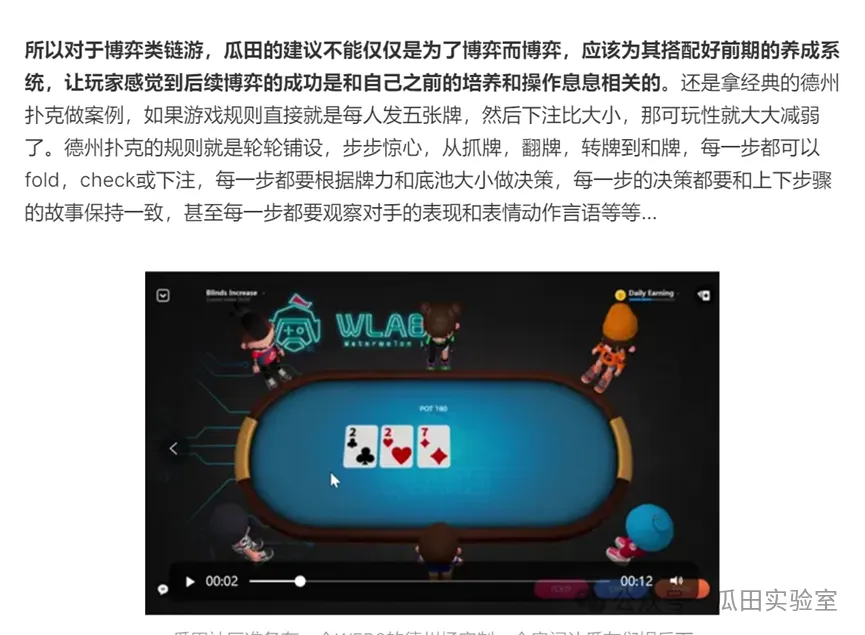
Looking back, that article only argued from the perspective of gameplay—games that are easy to learn yet full of tension, like Texas Hold’em, make ideal candidates for blockchain gaming. However, it didn’t delve into how blockchain’s core features could fundamentally improve aspects of the existing industry. Could integrating blockchain’s inherent properties bring transformative changes to online Texas Hold’em?
In late 2022, W Labs partner Huige wrote another article: *“Comparative Analysis of Texas Hold’em GameFi Games”* (https://mirror.xyz/0x5c15d8bE6A1dcb715d998d60ed06732f71DCf432/PbYqPxB7EuRBs3AGuVxIokA8KmgtyZ2QFAYoDUxxEM4). That piece touched upon potential improvements blockchain technology could bring to online Texas Hold’em. We originally wrote it as a byproduct after providing economic model consulting for a Web3 poker project—just jotting down some initial thoughts. The article briefly mentioned payment convenience and card-dealing transparency as areas improvable via blockchain. Two years later, I’m glad to see some of these ideas are now being developed and tested.
Two years on, the Web3 industry has experienced its ups and downs, teams have formed and disbanded. After personally experiencing the frustration of realizing “it’s all just a bubble,” we’ve become more focused on projects that leverage blockchain’s intrinsic capabilities to genuinely transform certain Web2 industries or products—even if only slightly—because even marginal improvements feel more sustainable than Ponzi schemes built on the mindset of “I know it’ll crash eventually, but I believe I can exit before others do.” Amid today’s depressed market, we’re selectively tracking specific sectors or products we believe hold long-term potential. Online poker is the first such sector we’ve chosen.
(1) How Blockchain Technology Can Transform Online Texas Hold’em
Blockchain technology can directly address key pain points in the current online poker landscape—an understanding widely shared among teams building in blockchain-based poker. Let’s systematically explore how.
1.1 Proving Fair Dealing: Transparency in Card Shuffling
I remember when I first started playing online Texas Hold’em, an old classmate who ran private online poker games warned me: “Never play big online—the cards can be manipulated.” He had a point. With centralized dealing software, couldn’t the platform’s own engineers easily rig the deck? That’s why later on, whenever I felt the urge, I only played small stakes on PokerStars—because it’s the largest operator globally, and they simply don’t need to cheat small players. But still—they *could* cheat if they wanted to! Just like centralized entities in crypto, they constantly balance brand reputation against potential gains from misconduct. Imagine you’ve deposited hundreds of millions of USDT on a centralized exchange like Binance. When facing liquidity issues, wouldn’t they be tempted to quietly挪用 your funds? Don’t test human nature.
If card dealing is handled through protocol-level randomness, recorded immutably on the blockchain, and verified collectively using Zero-Knowledge Proofs (ZKP) to confirm no tampering occurred, we’d achieve perfect transparency in card dealing. ZKP is a powerful cryptographic concept—Professor Andrew Yao from Tsinghua University’s Yao Class is a pioneer in this field. It allows one party to prove the truth of a statement without revealing any additional information about it.
Some might argue that leading online poker platforms already use Random Number Generators (RNG) instead of simple deterministic algorithms—doesn’t that ensure fairness? As a non-technical person, I humbly consulted coding experts. Their conclusion: RNG quality varies significantly based on design, and crucially, remains under centralized control. Even if the RNG process itself is sound, inputs and outputs can still be manipulated. So if RNG alone is “Anti-Cheat System V1,” combining RNG with blockchain and ZKP creates “Anti-Cheat System V2.”
Embedding zero-knowledge proofs into the dealing system while maintaining smooth gameplay and user experience has been an active area of development for various teams over the past two years—it's expensive, but essential. I believe this foundational improvement is the most critical way blockchain can transform online Texas Hold’em; everything else builds upon it.
1.2 Preventing Collusion and Multi-Accounting: Ensuring Player Fairness
Completely eliminating collusion and multi-accounting in online poker is impossible—human greed knows no bounds. What project teams can do is: continuously increase the cost of cheating for colluding or multi-accounting players, while minimizing disruption to legitimate players’ experiences.
We’ve seen various Web3 poker projects adopt different anti-collusion measures, primarily through rule design. For example, some projects allow cash games only via admin-invited links that expire after one use. Another notable example is MTT Sports—their current campaign at Token2049 in Singapore offers massive incentives (they’re launching official competitions in October, awarding 1 BTC weekly, totaling 100 BTC for top global players). They’ve abandoned the cash game model entirely, focusing solely on competitive tournaments. High-level tournaments require stricter identity verification, including facial recognition, and participants are randomly reassigned to different tables during events.

Blockchain enhances this by enabling data-driven detection of suspicious account clusters (potential colluders or alts) within defined parameters, followed by appropriate enforcement actions. Players can appeal decisions, since all prior actions are permanently recorded on-chain.
1.3 Securing Funds: Decentralized Wallets
If poker players still remember how Full Tilt Poker collapsed spectacularly over a decade ago, they should wholeheartedly support the adoption of decentralized wallets in online poker.

Full Tilt Poker was once second only to PokerStars, endorsed even by poker legend Phil Ivey. Yet due to its centralized structure, the team mismanaged $400 million in player deposits, leaving only $60 million remaining—leaving countless players ruined.
This kind of incident is all too common in crypto—FTX was just a modern replay of Full Tilt Poker. If online poker platforms allowed login via decentralized wallets, kept users’ main assets securely in their own wallets (inaccessible to the project), and only held minimal operational funds in centralized accounts to facilitate gameplay, even if the project disappeared, the vast majority of user assets would remain safe in personal wallets.
1.4 Seamless Transactions: Cross-Border Smart Contract Settlement
Back when I first played on PokerStars, I had to buy chips through third-party Taobao sellers—a bizarre business model born purely out of payment friction. What if someone lives in a region without access to Taobao? The final advantage blockchain brings to online poker: anyone with internet access can acquire entry chips; rewards are automatically distributed via in-game smart contracts; and cashing out is possible anytime through Web3 withdrawal channels.
In summary, we’ve outlined several native advantages blockchain brings to transforming traditional Web2 online poker—each directly addressing real user pain points that players have long endured under Web2 platforms' manipulative practices. Projects that integrate blockchain meaningfully create stronger, longer-term alignment among builders, investors, and users—the sense that this project is genuinely trying to fix broken systems. In the next part, we’ll dive into concrete examples of actual Web3 poker projects.
Continued...
Join TechFlow official community to stay tuned
Telegram:https://t.me/TechFlowDaily
X (Twitter):https://x.com/TechFlowPost
X (Twitter) EN:https://x.com/BlockFlow_News
 瓜田实验室W Labs