
A Closer Look at Jupiter's Second Token Distribution Proposal: Where Will the $190 Million in JUP Go?
TechFlow Selected TechFlow Selected
A Closer Look at Jupiter's Second Token Distribution Proposal: Where Will the $190 Million in JUP Go?
JUP staking users could extend another year of 55% "guaranteed" returns.
 Navigating Web3 tides with focused insights
By Azuma, Odaily Planet Daily
Jupiter, the largest decentralized exchange on Solana, is moving forward with its second major vote (J4J #2) regarding the allocation of its JUP token, which will directly determine the fate of approximately 215 million JUP tokens (worth around $190 million).
At the beginning of August, the Jupiter community passed the first major vote on JUP distribution (J4J #1) with a 95% approval rate. That proposal decided to burn 3 billion JUP tokens—30% of the total supply—to reduce Jupiter’s maximum token supply.
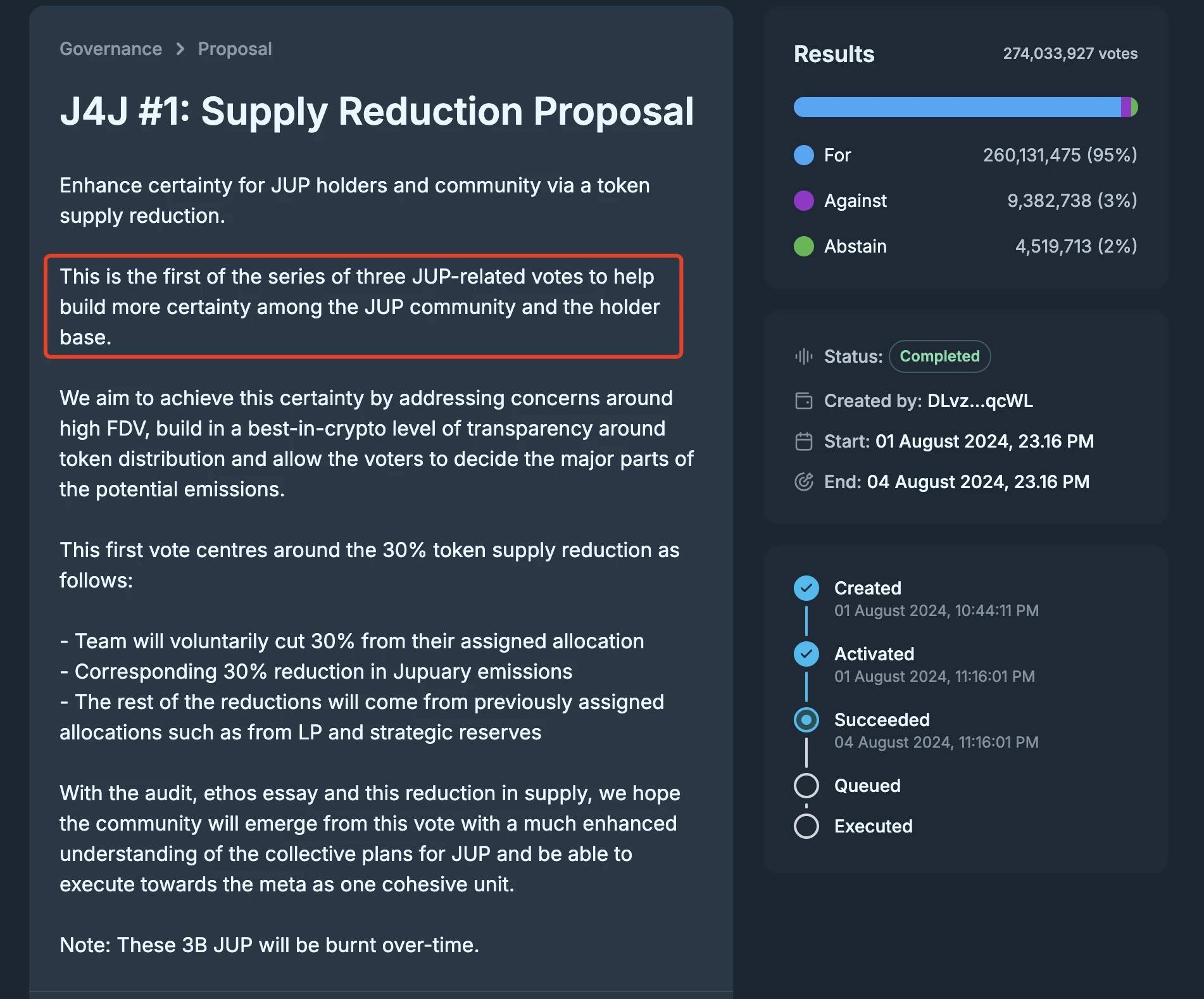
As previously outlined by Jupiter founder meow, Jupiter plans to conduct three JUP distribution governance votes under the "J4J" initiative. These votes aim to address JUP’s high FDV, establish optimal transparency in token allocation, and allow the community to vote on potential future token issuance.
The current proposal is the second of these three pivotal votes—J4J #2.
The background of this proposal lies in Jupiter’s earlier “Jupuary” airdrop campaign. Since not all airdropped tokens were claimed, approximately 215,461,850.21 JUP tokens remain unclaimed. At the current market price of about $0.88 per token, this amounts to a total value of $190 million—a significant sum for any protocol.
Last night, Jupiter founder meow initiated a governance draft on the forum proposing how to allocate these 215 million JUP tokens. The draft outlines three potential options:
-
Use the tokens for the Active Staking Rewards (ASR) program over the next year;
-
Burn the tokens;
-
Return the tokens to the community multisig wallet.
Meow noted that the Jupiter team currently leans toward the first option, as ASR has proven effective over recent months in driving community engagement in proposals, discussions, and voting. Allocating funds to ASR would further support the continued growth of the Jupiter community.
Below, we’ll briefly analyze the current scale of ASR and calculate how each option could impact the existing ASR reward structure.
ASR, or Active Staking Rewards, is a core incentive mechanism designed by Jupiter to reward users who stake JUP and actively participate in governance, voting, and discussions, thereby encouraging deeper integration into the Jupiter ecosystem.
ASR rewards are funded through two main sources: 0.75% of LFG Launchpad fees (which come from individual LFG projects and thus consist of various tokens), and an initial treasury allocation of 100 million JUP.
In early July, Jupiter distributed the first round of ASR rewards, allocating 50 million JUP to community members who voted on proposals between March and June. Another 50 million JUP remains in the ASR pool and is scheduled to be distributed in October to users who participated in voting from July 1 to September 30.
Judging from performance across the past two quarters, ASR has significantly boosted community activity.
As of meow’s post, a total of 585,000 addresses have staked 361 million JUP. Following the launch of the program, an average of 280 million JUP has participated in each of the 12 voting events, with extensive discussion and feedback visible on every governance page.
Given these results, meow and the Jupiter team recommend allocating the remaining 215 million JUP to fund the ASR program for the next year—releasing 50 million JUP per quarter, with the surplus 15 million returned temporarily to the treasury for future needs.
Based on current staking levels, adding 215 million JUP to the ASR pool means that holders of the existing 361 million staked JUP could receive a base annual yield of 55%—not including additional rewards from the 0.75% LFG Launchpad fees.
Clearly, this approach would maintain the attractiveness of the ASR program and sustain community involvement in Jupiter’s development.
This is precisely why meow and other Jupiter team members have openly endorsed this option and are urging community support.
However, this does not guarantee its passage. Among the alternative options listed by meow, some community members view direct burning as more aligned with the interests of all JUP holders—not just stakers. Still, given that voters are primarily those already participating in ASR and benefiting from it, the first option remains more likely to pass.
According to the current timeline, the proposal will go live for voting at 15:30 UTC on September 27 (23:30 Beijing time). Odaily Planet Daily will continue to monitor developments.
Join TechFlow official community to stay tuned
Telegram:https://t.me/TechFlowDaily
X (Twitter):https://x.com/TechFlowPost
X (Twitter) EN:https://x.com/BlockFlow_News
 Odaily