Coinbase Enters Wrapped Bitcoin Arena, Market Cap Jumps to Third Despite Transparency Controversy
TechFlow Selected TechFlow Selected
Coinbase Enters Wrapped Bitcoin Arena, Market Cap Jumps to Third Despite Transparency Controversy
Less than two weeks after its launch, cbBTC—a key alternative in the market—has risen to become the third-largest wrapped Bitcoin. However, concerns are mounting over its asset transparency.
 Navigating Web3 tides with focused insights
By Nancy, PANews
After WBTC faced a trust crisis, several competitors have emerged in the market, with the most notable being cbBTC, backed by Coinbase—the largest cryptocurrency exchange in the United States. In less than two weeks since its launch, cbBTC has rapidly climbed to become the third-largest wrapped Bitcoin asset. However, it is simultaneously drawing market concerns over asset transparency.
Rising to Third Largest Wrapped Bitcoin, Yet Market Share Remains at 1.2%
On September 12, after several days of previewing, Coinbase officially launched its version of wrapped Bitcoin, Coinbase Wrapped BTC (cbBTC), fully backed 1:1 by BTC and operating on both Ethereum mainnet and Base.
As the largest crypto exchange in the U.S., Coinbase—renowned for its compliance advantages—has quickly captured market share with cbBTC, particularly as major whales and established DeFi projects like SKY (MakerDAO) and AAVE increasingly abandon WBTC, once the dominant player.
According to Dune data, as of September 24, the circulating supply of cbBTC reached 2,944 BTC, with Ethereum accounting for 53.9% and Base for 46.1%. The current market cap of cbBTC exceeds $180 million, with nearly $1.31 billion in trading volume over the past 24 hours, primarily concentrated on Aerodrome (93.3%) and Uniswap (4.4%).
Meanwhile, the latest data from IntoTheBlock shows that the number of cbBTC user addresses has surpassed 3,500, which collectively settle an average of $472 million worth of Bitcoin transactions daily on Base.

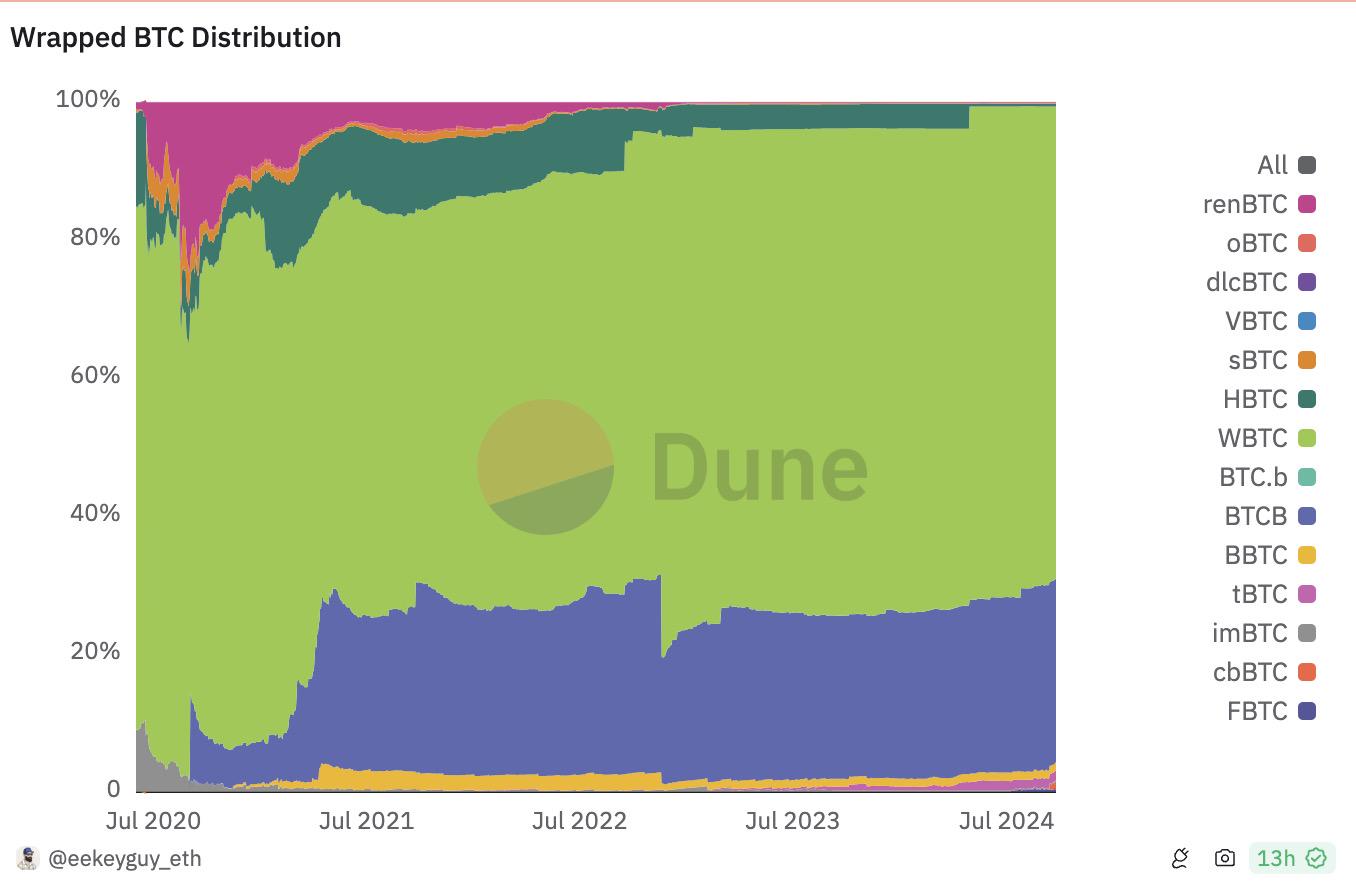
In terms of market share, Dune data indicates that as of September 23, cbBTC ranked joint third alongside BBTC with a 1.2% share, still far behind WBTC (68.5%) and BTCB (26.6%). However, Hassan Ahmed, Coinbase's head for Southeast Asia, recently revealed at the Solana Breakpoint event that cbBTC plans to expand onto Solana, potentially accelerating its market growth.
Facing Repeated Criticism Over Terms of Service and Transparency; Official Responds With PoR Plans
Trust is the cornerstone of value for wrapped assets. Shortly after launch, cbBTC became embroiled in controversy over reserve holdings and its service terms.
Earlier this month, just days after its launch, cbBTC was criticized for lacking transparency regarding its Bitcoin reserves. At the time, crypto analyst Tyler Durden suggested that Coinbase allowed BlackRock to borrow Bitcoin without posting collateral, implying the two firms might profit by manipulating Bitcoin prices. In response, Coinbase CEO Brian Armstrong denied claims that Bitcoin had been sold to BlackRock or that cbBTC lacked 1:1 backing. He emphasized that the minting and burning of Bitcoin for BlackRock’s spot Bitcoin ETF are transparent and conducted on-chain. However, due to privacy considerations, Coinbase cannot disclose wallet addresses of institutional clients. Armstrong acknowledged that cbBTC is supported by a centralized custodian—in this case, Coinbase itself. He added that BlackRock runs its own blockchain nodes to verify IBIT’s Bitcoin holdings, ensuring client asset security. While BlackRock will show these verification data to clients upon request, it does not make them publicly available.
Shortly afterward, controversy arose over cbBTC’s terms of service. Community members pointed out that the user agreement states that if Bitcoin is lost due to malicious activity or unforeseen events, Coinbase will not fully compensate users but instead distribute remaining Bitcoin proportionally.
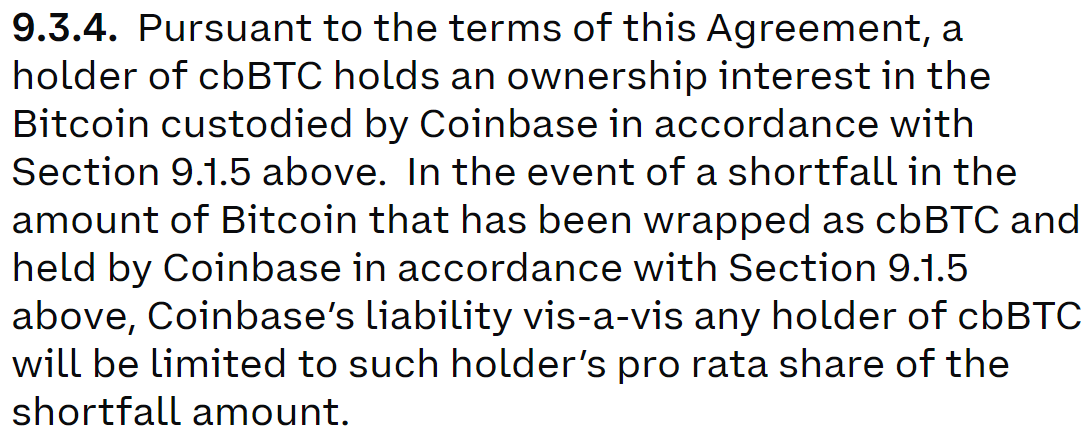
In response, Coinbase Chief Legal Officer Paul Grewal clarified that if underlying Bitcoin is lost, Coinbase will fully reimburse customers. This policy is intended to limit the exchange’s liability for external losses stemming from complex trades or leveraged positions entered into by users. For example, if a trader uses cbBTC as collateral on a lending platform and faces liquidation due to the loss of underlying Bitcoin from malicious activity, Coinbase will fully reimburse the lost Bitcoin but will not cover any fees or financial losses resulting directly from the loan liquidation itself.
However, Coinbase’s explanation has not fully quelled external skepticism. TRON founder Justin Sun further fueled criticism by stating, “cbBTC is not BTC.” There are key differences between WBTC and cbBTC in terms of user asset protection. WBTC’s issuer, BitGo, offers an on-chain insurance fund of up to $250 million, whereas cbBTC provides no such financial safeguards, and its reserve holdings remain opaque.
Recently, DeFiLlama founder 0xngmi posted on social media: “To be honest, almost every cross-chain bridge—including WBTC—provides proof of reserves (PoR) so users can verify whether issued tokens are sufficiently backed. Yet Coinbase does not do this. cbBTC falls significantly below standard transparency expectations. That’s exactly why we haven’t listed it on DeFiLlama—because we cannot verify its TVL. If we don’t make exceptions for other cross-chain bridge projects whose TVL cannot be verified, we won’t make one for Coinbase either. We apply the same standards to all projects.”
Hildobby, a data analyst at Dragonfly, also commented: “I’m disappointed to see Coinbase launching cbBTC without any proof of reserves—very similar to cbETH two years ago. When cbETH launched, I raised concerns but was told we could only rely on their centralized dashboard for exchange rates. In last year’s research, Coinbase accounted for 12% of staked ETH—a figure never formally confirmed. Additionally, while Coinbase previously disclosed staked ETH amounts in quarterly reports, they omitted this information in the most recent report.”
Moreover, some community members noted that the cbBTC service agreement is signed with Coinbase Inc., which is not a regulated financial institution. Last year, it was accused by the SEC of operating as an unregistered securities exchange, broker-dealer, and clearing agency. It is distinct from Coinbase Trust Company, the crypto custody business regulated by the New York Department of Financial Services (NYDFS).
In response, cbBTC product lead Lukas Staniszewski stated: “We understand the importance of proof of reserves. From the early stages, we’ve planned to implement proof of reserves for cbBTC, and the team is working hard to make it happen. We didn’t publicly communicate this earlier because we wanted to focus first on building.”
Join TechFlow official community to stay tuned
Telegram:https://t.me/TechFlowDaily
X (Twitter):https://x.com/TechFlowPost
X (Twitter) EN:https://x.com/BlockFlow_News
 PANews