








"Zhengzhi" and "Fanzhi" in the Eyes of Trading Masters
TechFlow Selected TechFlow Selected
"Zhengzhi" and "Fanzhi" in the Eyes of Trading Masters
When the interest rate cut cycle begins, crypto markets and other risk markets may benefit first.
 Navigating Web3 tides with focused insights
Host: Joe Zhou, Deputy Chief Editor of Foresight News
Guests: Willy Chuang (WOO COO), Rocky (Co-Founder of Blue Ocean Capital), Liang Li (WOO Product Manager), Phyrex (Data Analyst), Da Chengzi
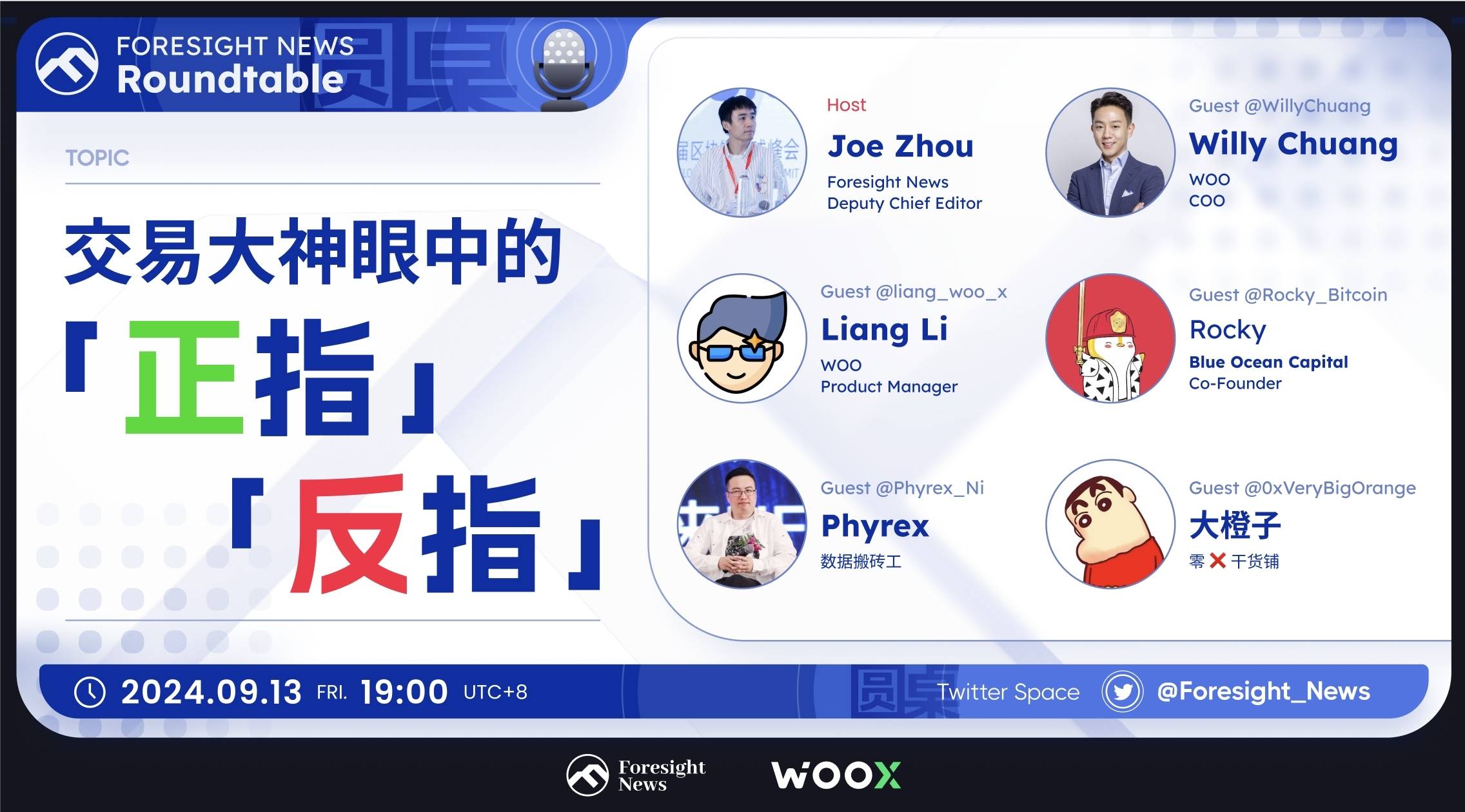
Experienced cryptocurrency traders use various methods—such as following market indicators, counter-indicators, and exchange products—to enhance trading efficiency. To explore this further, Foresight News invited seasoned crypto traders, executives from major exchanges, and KOLs to share their insights on crypto trading.
Host: Please introduce yourselves and share key lessons learned from recent crypto market cycles.
Rocky: I'm a co-founder of Blue Ocean Capital, a Web3-focused fund specializing in secondary markets. I fully entered the crypto space at the end of 2016, after working as an analyst at Yangtze Securities. Since then, I’ve lived through two complete market cycles.
From these cycles, I've drawn several important lessons. First, focus on earning returns from macro cycles. The entire crypto market moves in tandem with global monetary easing expectations. What we benefit from is essentially the excess premium brought by loose liquidity—achieving higher speculative returns within asset investments.
A key element here is avoiding swing trading. Swing trading fosters overconfidence; one failed trade can wipe out previous gains, leading to ultimate failure. Even if you succeed a few times, it might just be due to riding a bull market rather than skill. Traders who chase momentum often earn the least because they’re constantly buying high. While such behavior gives dopamine-driven satisfaction, long-term holding usually yields better results.
Second, research outweighs trading—thinking determines success. There's a saying: “Speculate on new, not old.” Depth of research directly impacts your ability to catch early opportunities. Our strategy focuses on fast-growing trends, especially when new narratives emerge. For example, StepN’s “running-to-earn” model looked promising early on, and GMT eventually became a 100x token. In our most recent cycle, back in October 2022, we spent significant time researching and identified RNDR, accumulating positions around $0.5 with heavy allocation. It later surged to over $10, and despite pulling back to $5 now, the return remains solid. Another proud pick was KAS. After Ethereum's shift to PoS left many GPU miners stranded, we conducted deep research and found KAS as a viable mining option. Research matters greatly, yet many traders waste time monitoring price charts, scrolling group chats, or refreshing Twitter feeds instead.
Third, take profits. This is crucial—buying is for apprentices, selling is for masters. Without profit-taking, all activity in the market is meaningless. I personally suffered two severe rollercoaster experiences. In 2017, I participated in ICOs but didn’t cash out timely. I gave some funds to friends in the finance sector to invest while I stayed detached, skeptical about ICOs lacking real assets. But those friends delivered ~4x returns within two months, prompting me to quit my job decisively in late 2016. The peak era was during the ICO boom, where asset inflation was staggering—anyone involved in early-stage projects could expect 50x–100x returns upon listing. Unfortunately, by the end of 2017, I only withdrew enough to buy a house and car. Everything else evaporated, returning to zero by the end of 2018. The second blow came during the March 12 crash—I went long BTC at ~$7,800 with 100 BTC worth of exposure using 1x leverage, thinking it was safe. Still got liquidated. So avoid futures, avoid leverage, and never trade with borrowed money.
Fourth, identify core narratives. Each cycle has dominant themes. This cycle features clear narratives like AI, DePIN, RWA, Bitcoin ecosystem developments, and the emerging TON ecosystem.
Willy Chuang: Hi everyone, I’m Willy, COO of WOO. WOO offers two main products: WOO X, a centralized exchange, and WOOFi, a decentralized exchange. WOO X has been operating for over three years, while WOOFi is entering its second year. WOO X targets professional traders, with most users coming from Europe. From UI design to trading features, everything aims to improve execution quality and experience for advanced traders. Our ecosystem token WOO is listed on Binance, OKX, and nearly all major exchanges, including regional spot platforms in Europe and North America. WOOFi supports two types of swaps: a DEX perpetual contract platform and cross-chain swapping across 11 EVM-compatible chains. We’ll add Solana support by month-end. Our DEX derivatives platform sees around $300 million in average daily trading volume.
WOO serves as the native token for both WOO X and WOOFi, with a mature and well-tested tokenomics model. Despite being active for over three years, we’ve avoided building our own blockchain or infrastructure layer. Instead, we’ve focused entirely on application-level development. Infrastructure today is oversupplied and highly commoditized. In my view, the current bull market feels relatively short-lived and lacks staying power—partly due to macroeconomic conditions, but also because innovation in narratives has stalled. Homogeneous competition has led to excessive points farming and airdrop chasing. Value accrual has shifted toward distribution channels rather than underlying projects. Launching tokens is becoming harder for teams. In this cycle—and likely the next—projects that simplify DeFi and deliver superior user experiences will ultimately prevail. We aim to attract more users through strong product experience and relentless focus on usability.
We recently launched Social Trading—a copy-trading feature. Many traders get the direction right but fail in execution. Our goal is to address key pain points. First, enable vetted expert traders on our platform to guide less experienced ones. Second, transparency: many existing copy-trading platforms lack visibility. For instance, a trader might be long on one platform and short on another. Followers can only mirror one side. To solve this, we introduced reverse-following: users can mirror the inverse of a leader’s entire portfolio.
Phyrex: Macro trends are increasingly influential. Since late 2021, many participants have significantly upgraded their understanding of macroeconomics. Throughout each cycle, tracking liquidity shifts remains critical. The primary driver? U.S. Federal Reserve policy. Second, identifying dominant trends is essential—even missing minor narratives isn't fatal, but catching major waves solves many problems. Looking ahead, we must watch three things: liquidity changes, Fed monetary policy, and the U.S. election cycle. Trump is actively courting crypto voters and making promises. Whether he fulfills them matters less than whether he wins office with pro-crypto messaging—either way, it would provide substantial tailwinds for the industry.
Liang Li: Hello, I’m Liang Li, Product Manager at WOO. Previously worked at another top-tier exchange. Before entering crypto, I spent years in traditional finance developing financial products and tech solutions. I joined the space relatively late compared to others here. When designing products, we prioritize fairness and transparency to ensure reliability and tangible value for users.
Da Chengzi: Hi, I'm Da Chengzi. Entered crypto back in 2013—pretty much lived through every hype cycle. My personal approach boils down to dollar-cost averaging (DCA), hodling, and yield generation. My background leans toward quant strategies, so I emphasize yield-generating activities. Yesterday I saw news that El Salvador has bought 1 BTC daily for over 600 consecutive days, resulting in an average cost of ~$40k. That strategy likely outperforms 90%, maybe even 95% of market participants. So DCA + hodling remains a sustainable path in this space. This year, yield-generating strategies gained traction. Many projects are creatively aggregating fragmented BTC and ETH holdings from the market to deploy in quantitative strategies.
Over the past two years, market sentiment dominates everything. Right now, there’s strong resistance against VC-backed projects—that’s why early-stage VC funding looks terrible this year. That’s exactly why we need to engage deeply with communities—to understand prevailing market psychology. Lastly, risk management is paramount. At its core, risk management means position sizing. It’s the single most important lesson across crypto cycles—you need to build antifragility into your strategy.
Host: Share your views on copy-trading from user and product perspectives.
Liang Li: From a product standpoint, the ultimate goal of copy-trading is helping retail users profit. Retail traders face information overload—they lack time to analyze, study, or learn. Not everyone has the bandwidth or capability. Copy-trading fills this gap. We carefully select skilled traders and conduct thorough due diligence to verify their historical performance. Reliability and transparency are central metrics. We also emphasize fairness. On other platforms, followers often lose all capital and still pay performance fees to leaders—an unfair outcome. Our solution introduces innovation: we only distribute performance fees when the follower’s overall return is positive. No profit, no fee.
This creates a virtuous cycle: when followers gain confidence, they allocate more capital, which incentivizes top traders to join our platform knowing the reward system is fair. Ultimately, it becomes a win-win. One more point: reverse-following adds strategic flexibility. Both followers and leaders benefit. Followers can choose based on their own market views and assessments of leader behavior—agreeing or disagreeing with the leader’s calls. They can opt for forward or reverse replication. Some may specifically target known "reverse indicators" and follow them inversely. For leaders, even if their own trades lose money, anyone doing reverse-following could profit—and thus generate fee income for the leader.
Da Chengzi: From a user perspective, treat copy-trading signals as input—not gospel. Never follow just one so-called “guru.” Cast a wide net: allocate small amounts to multiple strong traders, collect their signal data, build your own quant-based strategy using their inputs, and continuously refine it. If you blindly follow a single person, you're no different from gambling on an individual’s directional call.
Host: Share some “bullish” and “bearish” indicators you frequently monitor in crypto trading.
Phyrex: It depends on your own trading framework. Currently, under the U.S. monetary system, the overarching trend is clearly shifting toward rate cuts—from tightening to loosening. That implies improving liquidity, a major tailwind. Within that macro trend, there will be fluctuations—some up, some down. But I remain particularly bullish on Q4, combining potential rate cuts, the U.S. election, and the post-Bitcoin halving surge cycle.
During periods of monetary easing, sector rotation occurs. While crypto is part of the broader risk market, it's still small relative to U.S. equities or ETFs. When liquidity expands, capital typically flows first into undervalued or heavily discounted U.S. stocks. Conversely, if the economy weakens, investors favor defensive assets like consumer staples, healthcare, or government infrastructure.
Crypto tends to rank lower in priority—it benefits only after excess capital spills over. Moreover, crypto lacks independent momentum, earnings reports, or forward guidance. It largely follows U.S. equities, especially tech stocks. Bitcoin itself is increasingly treated as a large-cap tech stock. Therefore, rather than relying on external “indicators” or “anti-indicators,” develop your own robust trading system. External opinions should serve only as reference points. Use them to reinforce your thesis—if aligned, increase conviction; if conflicting, investigate who might be wrong.
Rocky: I track two levels: macro and technical. On the macro front, I closely follow Bloomberg and The Wall Street Journal, especially Bloomberg. Their data is powerful—prediction accuracy reaches about 80%, which functionally equals certainty. For example, Bloomberg provided early estimates on Bitcoin ETF approvals, forecasting over 70% likelihood, which proved accurate.
Willy Chuang: First, technological innovation—projects that improve efficiency, overcome technical bottlenecks, and unlock new use cases. I’m particularly optimistic about AI. Second, ecosystem growth—recently, Ton (The Open Network) has attracted attention. Its user base comes from diverse regions—less from Western or East Asian markets, more from Russia, Southeast Asia, Africa, and Latin America. Third, regulatory signals. Over the past two years, regulation has significantly impacted the industry. About a year ago, U.S.-linked market makers largely halted operations. When they pulled out, market liquidity dried up, making trading less favorable and suppressing trend formation. By year-end, new European crypto regulations will take effect, restricting services—including spot and derivatives offerings by offshore exchanges targeting EU residents—as well as limiting market makers and liquidity providers. These dynamics are worth watching.
Da Chengzi: Trading falls into two categories: left-side (contrarian) and right-side (momentum). Most people call me a “reverse indicator” because I chase momentum—I’m purely a right-side trader. You’ll notice I performed well when BTC rose from $20K to $70K. But during subsequent consolidation phases, I kept hitting stop-losses repeatedly. Constantly getting stopped out earned me the nickname “reverse indicator” on Twitter. Long-term traders differ significantly from short-term ones, especially swing traders.
Host: What product innovations on DEXs and CEXs in this cycle have helped you the most? Which ones do you find noteworthy?
Da Chengzi: My current strategy combines grid trading with long options (double-buy). Option premiums are currently low, making them very affordable. This strategy suits the ongoing sideways market well. If a breakout happens, the long options provide protection. If the market keeps ranging, grid trading generates consistent profits. I used to dislike grid strategies, but pairing them with options creates balanced downside protection—making it suitable for current conditions. As for arbitrage, centralized exchange arbitrage yields have dropped absurdly low—lower than U.S. Treasury returns. However, cross-chain arbitrage on DEXs still offers decent returns.
Liang Li: From a product perspective, exchange innovation hasn’t been as rich as in pre-2022 periods. This cycle hasn’t seen many groundbreaking developments. I’m paying attention to innovation in specific areas. First, RWA (Real World Assets)—this may be blockchain’s most viable path to real-world adoption. Tokenizing physical assets can deeply integrate blockchain infrastructure and transaction behaviors into everyday life, driving meaningful progress. Second, AI-powered tools excite me. Some third-party data platforms now use machine learning and AI to filter and analyze information, offering actionable insights. These help both retail and institutional investors process vast amounts of data efficiently. We’re actively integrating AI into our trading tools to deliver smoother, smarter trading experiences.
Rocky: I’m most excited about improvements in DEX trading experience. While CEXs have made great strides, project listings remain a major bottleneck. Many promising projects struggle to get listed—even on top-tier exchanges. How DEXs can offer better listing mechanisms beyond simple IDOs is an important area of innovation we’re exploring. Second, liquidity fragmentation is extreme. Solving this dispersion will likely become a focal point for many upcoming projects.
Phyrex: On DEXs, I mainly look for assets with poor or no liquidity on CEXs. Listing strategies differ between CEXs and DEXs. Memecoins or early-stage tokens often lack sufficient capital or traction to list centrally, but that doesn’t mean they’re bad projects. DEXs can provide vital liquidity support. Also, DEXs offer various arbitrage strategies—for LPs or bots alike. But I haven’t seen fundamental differences emerge; sandwich attacks persist, and liquidity issues remain unresolved.
Rocky: Pre-market trading is quite useful—it allows users to lock in value and gauge project valuations early. Another interesting mechanism is structured stablecoin yield products like shark-fin notes. If you can anticipate future trends, expected returns from such instruments far exceed standard stablecoin yields. Limit orders have also proven valuable, especially during meme coin rallies this cycle.
Host: What is your trading strategy this year? Has it changed since年初?
Rocky: Early this year, especially in February, the market was extremely hot, with high risk appetite. Our strategy was aggressive, with elevated positions. Now, we’ve shifted toward conservatism, focusing on core assets within dominant narratives. We’ve streamlined our portfolio—from 35 positions at the start of the year down to 15. We prioritize essential projects—those integral to a narrative or the first name that comes to mind in a given sector. Return expectations have moderated—we now aim for 5x–10x gains. Risk control remains critical. Although volatility appears lower, prices still swing widely within ranges. Markets are consolidating. Under these conditions, managing exposure around key levels and macro data releases is essential to prevent large drawdowns.
We believe the market peak may occur in Q3 2025. Rate cuts need time to take effect, and post-election policy rollouts will require additional time to unfold. Once prices reach—or fail to reach—our targets near that timeframe, we plan to gradually exit.
Phyrex: My strategy hasn’t changed—I buy on dips. I still believe Q4 could bring the best returns. For 2025, my main concern is economic recession. If signs point to a downturn, I may exit. Otherwise, I’ll hold and see how things develop.
Da Chengzi: For spot holdings, I continue DCA + hodl + yield generation—my core unchanged strategy. Earlier this year, I chased momentum via right-side trend following. Given the current range-bound environment, I’ve switched to grid trading combined with long options (double-buy).
Liang Li: WOO primarily serves professional traders and institutional clients, whose habits differ greatly from retail investors. However, starting this year, we’re expanding functionality tailored to retail and low-frequency traders. Going forward, much of our effort will involve collaborating with KOLs and communities to attract retail users and deliver enhanced services. Frequent community feedback helps us optimize the trading experience on WOO.
Join TechFlow official community to stay tuned
Telegram:https://t.me/TechFlowDaily
X (Twitter):https://x.com/TechFlowPost
X (Twitter) EN:https://x.com/BlockFlow_News
 Foresight News






