Three-Minute Overview of Pipe Network: How to Build a Decentralized Content Distribution Network?
TechFlow Selected TechFlow Selected
Three-Minute Overview of Pipe Network: How to Build a Decentralized Content Distribution Network?
The centralization of traditional CDNs brings various risks. Single points of failure can disrupt content delivery, while the high operational costs of running large data centers are passed on to customers.
 Navigating Web3 tides with focused insights
By: 1912212.eth, Foresight News
In the internet era, massive streams of videos, GIFs, audio, and other content surround every online user around the clock. Today’s faster and more convenient access to this content is thanks not only to improved 4G/5G/WiFi networks but also to the critical role played by Content Delivery Networks (CDNs).
By deploying multiple server nodes globally, CDNs distribute static or dynamic resources—such as websites, applications, videos, and audio—to the nearest node relative to each user. This significantly improves access speed and stability, reduces network congestion and latency, alleviates load on origin servers, and enhances the availability and security of websites and applications.
However, with digital content consumption continuing to surge, traditional CDNs struggle to keep pace with innovation. As demand grows for faster, more reliable delivery of web pages, videos, and interactive experiences, businesses are often forced to make trade-offs between performance and cost.
Recently, content delivery network Pipe Network raised $10 million in funding led by Multicoin Capital, with participation from Solana Ventures, Robot Ventures, and Anatoly Yakovenko. Pipe Network aims to address these challenges through a decentralized CDN that delivers superior performance and scalability via its permissionless infrastructure.
What Is Pipe?
At its core, Pipe Network is a decentralized CDN built specifically to meet the demands of the modern internet. Unlike centralized CDNs that rely on a few large data centers to serve global audiences, Pipe Network uses a distributed network of permissionless nodes to decentralize content delivery. These nodes are operated by individuals and organizations worldwide, forming a robust and scalable system capable of adapting in real time to traffic demands.
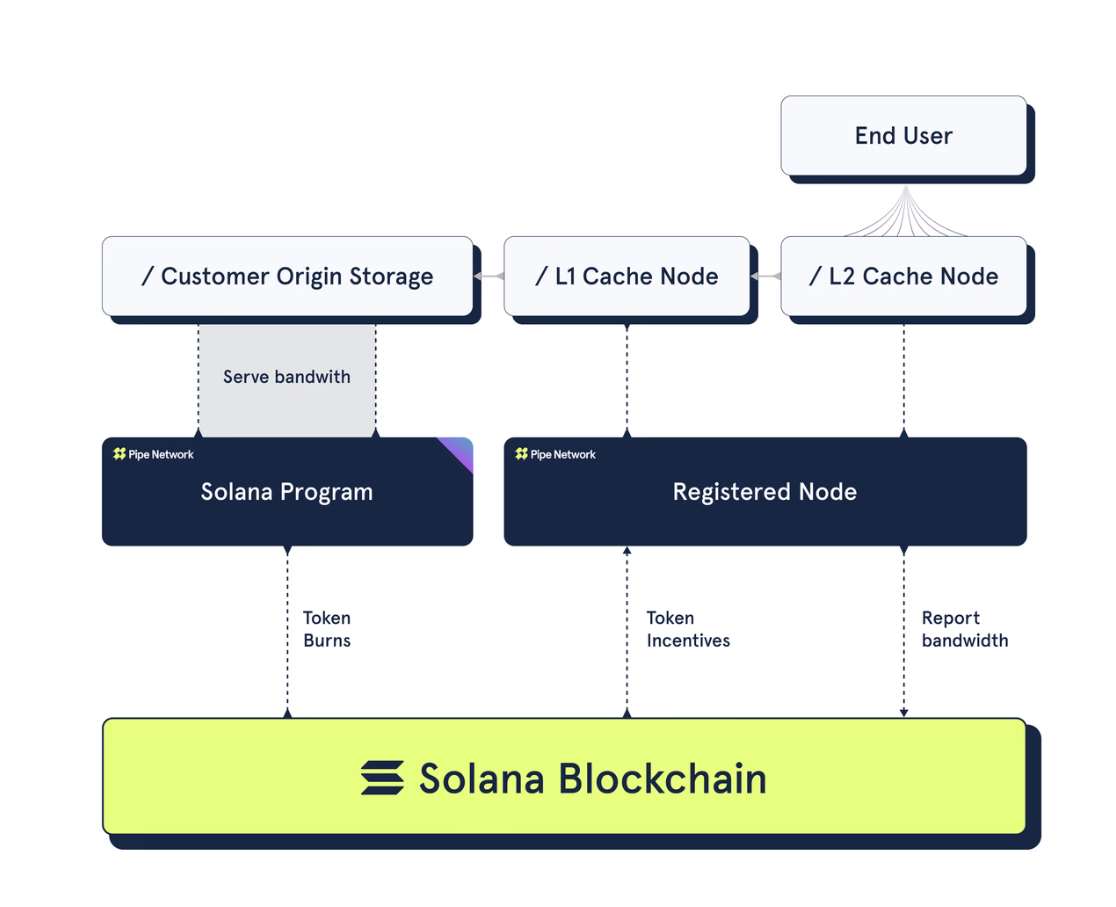
Centralization in traditional CDNs introduces multiple risks. Single points of failure can disrupt content delivery, while the high operational costs of running large data centers are often passed on to customers. Additionally, centralized systems typically struggle to adapt quickly to fluctuating traffic, leading to performance bottlenecks during peak usage times.
Pipe Network addresses these issues by creating a permissionless, distributed network where anyone can operate a node. This dramatically increases the number of Points of Presence (PoPs), reduces latency, and ensures better redundancy. By enabling broader participation, Pipe Network can handle traffic spikes and maintain content delivery even during unexpected network outages.
Key Advantages
Ultra-Local PoP Nodes for Ultra-Low Latency
One of Pipe Network’s core strengths lies in its ability to deploy ultra-local Points of Presence (PoPs). Strategically positioned close to end users, these nodes minimize latency and ensure fast, efficient content delivery. Whether users are located in major cities or remote regions, Pipe Network’s decentralized model guarantees consistent global performance.
Permissionless Node Participation
Unlike centralized CDNs owned and operated by single entities, Pipe Network allows anyone to contribute by running a node. This permissionless model democratizes content delivery, enabling broader participation and fostering a larger, more resilient infrastructure that scales naturally with growing demand.
Real-Time Cache Control and Invalidation
Users have full control over caching behavior, with the ability to instantly invalidate outdated content. Whether pushing urgent updates or ensuring users always receive the latest version, Pipe Network puts control directly in the hands of developers and content providers.
DDoS Protection and Security
Pipe offers built-in DDoS protection to safeguard endpoints against malicious attacks. Thanks to its decentralized architecture, the network is inherently resilient to single points of failure, greatly reducing the risk of widespread outages.
Advanced Filtering and Customization
Pipe provides complete control over how content is delivered, enabling precise customization. Users can filter specific URL queries, block or enable access by geographic region, and manipulate HTTP headers to deliver content exactly as intended. This granular level of control allows for tailored experiences based on user needs and location.
Flexible Geolocation-Based Delivery
Controlling where content is delivered is crucial in the global digital economy. With Pipe, users can restrict or allow access based on specific geographic locations, ensuring compliance and optimal user experience across regions.
How Does Pipe Balance Consistency, Availability, and Partition Tolerance (CAP)?
Building a decentralized CDN presents significant technical challenges, one of which revolves around the CAP theorem—a foundational principle in distributed systems. First proposed by computer scientist Eric Brewer, the CAP theorem states that a distributed system can generally guarantee only two out of three properties: consistency, availability, and partition tolerance.
Consistency means every read receives the most recent write. Availability ensures the system remains operational even if some nodes fail or become unreachable. Partition tolerance means the system continues functioning despite communication breakdowns or interruptions between nodes.
Pipe prioritizes availability and partition tolerance, making deliberate trade-offs with consistency when necessary.
For availability, Pipe leverages a globally distributed network of permissionless nodes to ensure rapid, uninterrupted content delivery to users—even at the cost of increased redundancy. By prioritizing partition tolerance, individual nodes can continue operating locally and serving cached content even during network delays or outages.
When perfect consistency cannot be guaranteed, Pipe mitigates this through its cache invalidation mechanism, allowing users to manually trigger updates and ensure content is refreshed as quickly as possible.
Join TechFlow official community to stay tuned
Telegram:https://t.me/TechFlowDaily
X (Twitter):https://x.com/TechFlowPost
X (Twitter) EN:https://x.com/BlockFlow_News
 Foresight News