Fed's major pivot begins, market volatility intensifies
TechFlow Selected TechFlow Selected
Fed's major pivot begins, market volatility intensifies
A 50-basis-point rate cut provided a short-term boost to the market, but expectations about the U.S. economic outlook remain sharply divided.
 Navigating Web3 tides with focused insights
By BitpushNews
On Wednesday afternoon local time, Federal Reserve Chair Jerome Powell announced a 50-basis-point cut in the benchmark interest rate to a range of 4.75%–5.0%, marking the beginning of a monetary easing cycle in U.S. policy.
In addition to this first rate cut in over four years, the latest FOMC projections indicate that the Fed will lower rates two more times in 2024. Most officials expect a total of 100 basis points in cuts this year. Rates are projected to decline further in 2025, settling at an estimated 3.4%, with the long-term rate bottoming out at 2.9%. Such an environment typically supports market activity, as traders tend to favor risk assets amid expectations of looser monetary policy.
Bitcoin data shows that BTC quickly rallied and then pulled back, surging from its $60,000 support level to an intraday high of $61,357 before returning near the $60,000 support. At the time of writing, Bitcoin was trading at $60,231, with less than 1% volatility over the past 24 hours.
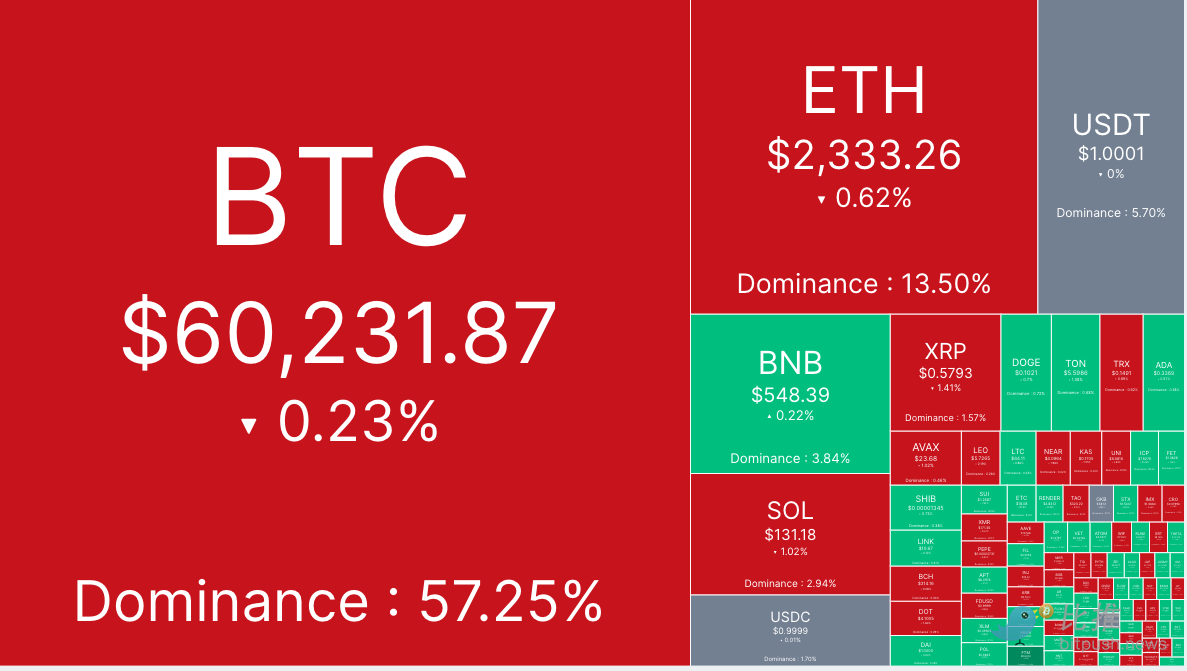
The altcoin market showed mixed reactions. Among the top 200 tokens by market cap, ZetaChain led gains with a 20.6% rise, followed by Saga (SAGA) up 13.7% and Nervos Network (CKB) up 11%. On the downside, KuCoin Token (KCS) declined the most, falling 6.1%, while OriginTrail (TRAC) dropped 5% and Echelon Prime (PRIME) fell 4.3%.
The total cryptocurrency market capitalization currently stands at $2.09 trillion, with Bitcoin’s market dominance at 57.2%.
In traditional markets, U.S. equities surged following the rate-cut announcement but later retreated. By market close, the S&P 500, Dow Jones Industrial Average, and Nasdaq Composite were all down—falling 0.29%, 0.25%, and 0.31%, respectively. Spot gold briefly broke above $2,600 per ounce during Chair Powell’s press conference but gave up those gains, trading at $2,557.30 per ounce at the time of writing, down 0.46% on the day.
Volatility Expected to Increase Further
Joel Kruger, market strategist at LMAX Group, said in a report: "The Fed met market demand by delivering a larger 50-basis-point rate cut. With the market already so heavily pricing in accommodative policy, the next concern will be whether it can sustain optimism toward risk assets under future Fed easing."
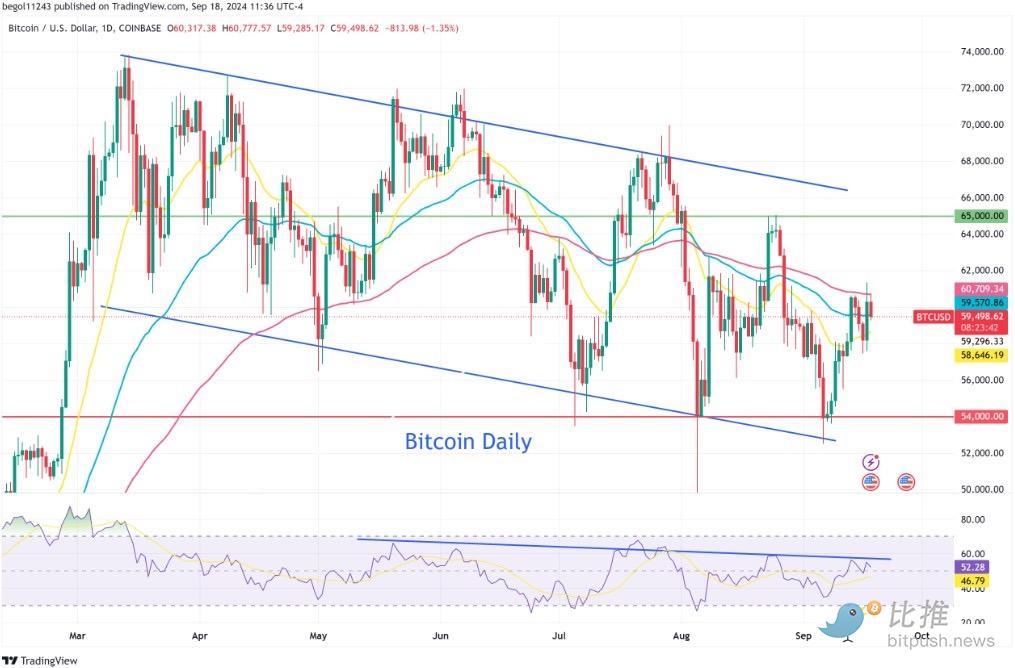
From a technical perspective, analysts at Secure Digital Markets noted that Tuesday’s attempt by BTC to break above $61,000 failed, with prices retreating after Wall Street closed. Daily charts show a clear bearish rejection at the 100-day moving average, along with a persistent pattern of lower lows over the past month.
Arthur Hayes, co-founder of BitMEX and chief investment officer at Maelstrom, also issued a warning during his keynote speech at Token2049 about asset price prospects following the first rate cut, suggesting it could trigger a sharp decline in risk assets.
"I think the Fed's rate cut is a massive mistake, because the U.S. government is printing and spending more money than ever during peacetime. While many people may have been hoping for a rate cut, thinking it would boost stock markets and other assets, I believe the market will collapse within days of this easing," he said.
Although historically, liquidity-easing cycles have benefited BTC, Hayes cautioned that this move could exacerbate inflationary pressures and strengthen the Japanese yen (JPY), triggering broad risk-off sentiment. He added: "Cutting rates now is a mistake because inflation remains a structural issue in the United States, primarily driven by government spending. Cheaper borrowing will only add fuel to inflation."
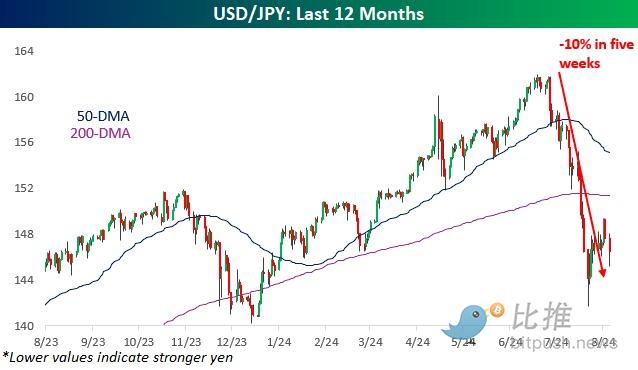
He also warned that potential rate cuts could lead to market declines by narrowing the interest rate differential between the U.S. dollar and the Japanese yen. (In early August, a wave of deleveraging in yen-based carry trades triggered a market crash, sending BTC below $50,000.)
Eamonn Ghisler, founder and CEO of Block Scholes, also raised concerns about the impact of the newly announced rate cut on markets and yen carry trades.
"A 50-basis-point cut signals that the Fed is more concerned about deteriorating labor market conditions than a resurgence of inflation. This additional easing will weaken the dollar and could lead to a modest appreciation in USD/JPY. Although the Bank of Japan is expected to pause rate hikes, a weaker dollar may prompt renewed unwinding of yen carry trades, potentially affecting risk assets," Ghisler said in a report.
He added: "Given the correlation between Bitcoin and U.S. equities since the launch of Bitcoin ETFs, the performance of the S&P 500 during past rate-cut cycles can serve as a useful indicator for what may come next. Historically, recession cycles triggered by a 50-basis-point rate cut began amid widespread concerns about macroeconomic weakness, leading to prolonged underperformance in risk assets. However, this rate cut might be different—it could be seen as the Fed taking preemptive action to reinforce the labor market."
The 50-basis-point cut has provided short-term market support, but expectations for the U.S. economic outlook remain sharply divided. While some investors anticipate a soft landing, others remain cautious about inflation and geopolitical risks. In the near term, market movements are likely to become more complex and volatile.
Join TechFlow official community to stay tuned
Telegram:https://t.me/TechFlowDaily
X (Twitter):https://x.com/TechFlowPost
X (Twitter) EN:https://x.com/BlockFlow_News
 比推 BitpushNews