25 bps = "huge loss," 50 bps = "panic"! Facing market pressure, how will the Fed cut tonight?
TechFlow Selected TechFlow Selected
25 bps = "huge loss," 50 bps = "panic"! Facing market pressure, how will the Fed cut tonight?
The market is now heavily betting on a 50-basis-point cut; if the Fed cuts only 25 basis points, it will be seen as "hawkish," causing significant market losses. Conversely, if there is a 50-basis-point cut but subsequent actions fall behind market expectations, it could trigger panic and lead to a renewed tightening of financial conditions.
 Navigating Web3 tides with focused insights
Author: Zhao Ying, Wall Street Insights
The Federal Reserve is set to cut interest rates tonight for the first time in five years. With the decision approaching, speculation over the size of the rate cut continues to intensify. Wall Street remains divided between a 50-basis-point or 25-basis-point cut, significantly increasing market uncertainty—how will this "rate-cut journey" begin?
On Thursday (September 19) at 02:00 AM, the Fed will announce its September interest rate decision, followed by Chair Jerome Powell’s press conference at 2:30 AM. A rate cut is now almost certain, but the magnitude remains unclear.
Recent data, including inflation and nonfarm payrolls, have failed to provide clarity on the cut size, leaving markets oscillating between expectations of a 25- or 50-basis-point reduction. As Fed officials entered their blackout period, media reports suggesting a 50-basis-point cut shifted market sentiment toward that outcome. Currently, markets assign a 60% probability to a 50-basis-point cut—up from just 30% previously.
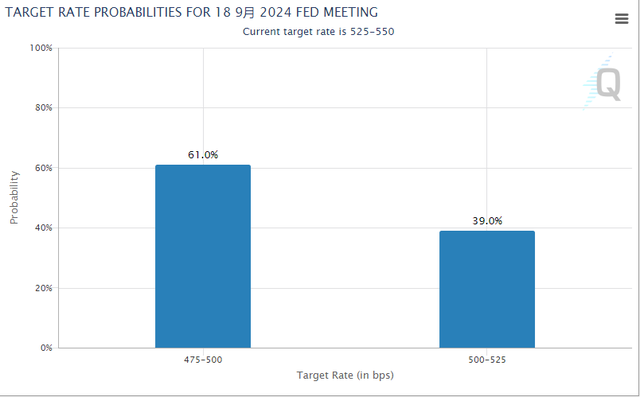
Wall Street remains split. One camp, citing concerns about labor market weakness and the Fed being "behind the curve," supports a 50-basis-point cut. The other, worried about persistent inflation and preserving policy flexibility for future cuts, advocates for a 25-basis-point move.
Yet regardless of whether the cut is 25 or 50 basis points, markets are likely to experience significant volatility. With current positioning heavily skewed toward a 50-basis-point cut, a smaller 25-basis-point move would be seen as hawkish and could trigger sharp risk-off reactions. Conversely, a 50-basis-point cut might spark panic if subsequent actions lag market expectations, potentially leading to tighter financial conditions.
Besides the cut size, attention will also focus on the Fed's "dot plot" and economic projections—the September dot plot’s outlook for this year’s rate path will be especially critical—as well as Powell’s comments during the press conference.
The Most Contested FOMC Meeting: 25 BPs Means "Heavy Loss," 50 BPs Triggers "Panic"
Fed meetings are always closely watched, but content is usually predictable. This time, debate over the cut size has reached a peak.
Latest data have been mixed—neither inflation nor employment figures have settled the debate. Last Wednesday’s CPI report showed sticky inflation, boosting odds of a 25-basis-point cut. But Thursday’s cooler-than-expected PPI data slightly increased the chance of a 50-basis-point reduction.
Late last week, a 25-basis-point cut appeared more likely—until Friday, when sentiment abruptly shifted, putting a 50-basis-point cut back into play. This shift was largely driven by reports from The Wall Street Journal and Financial Times citing unnamed sources, with no immediate pushback from Fed officials amid ensuing market moves.
Seema Shah, Chief Strategist at Principal Asset Management, said:
For the Fed, the key question is which risk is greater: cutting 50 basis points and reigniting inflation pressures, or cutting only 25 basis points and risking an economic downturn. Having already faced criticism for responding too slowly to past inflation surges, the Fed may lean toward caution on recession risks, choosing proactive rather than reactive measures.
However, either move could shake markets. Markets are now heavily positioned for a 50-basis-point cut. If the Fed delivers only 25 basis points, it would be perceived as hawkish, triggering severe risk-off shocks.
Analysts note that record-breaking bets are now locked in on a 50-basis-point consensus cut. Should the Fed opt for a standard 25-basis-point move instead, markets would face massive repricing. Ninety-two percent of economists expect such an outcome; if the Fed surprises, federal funds futures would need dramatic adjustments, dragging down all asset classes.
Since last weekend, trading volume in October fed funds futures has surged to the highest level since 1988. More alarmingly, most new positions are betting specifically on a 50-basis-point cut, with holdings spiking sharply just this week.
If the Fed opts for a 50-basis-point cut, such a sharp easing suggests serious economic distress—yet economic forecasts and corporate earnings expectations remain surprisingly strong. This presents a contradictory picture: expecting both aggressive rate cuts and continued robust profit growth. Historically, rate cuts correlate with reported earnings falling by 20% or more—so a 30%+ decline would be more plausible.
Moreover, unless the economy shows clear improvement, the pace of future cuts could slow relative to market expectations. If the Fed is perceived as falling behind, the Financial Conditions Index (FCI) could tighten again, pushing oil prices lower, reducing inflation expectations, exerting upward pressure on real interest rates, and strengthening the dollar.
The Dot Plot’s Outlook for This Year Is Crucial
Just as important as the rate cut itself is the “dot plot.” With the Fed set to release updated 2025 interest rate projections, markets will look for clearer signals on the future pace and scale of easing—which will also influence market performance in September.
David Wilcox, former head of the Fed’s Research and Statistics Division and now Director of U.S. Economic Research at Bloomberg Economics, said:
The year-end dot plot has become particularly important—it’s receiving far more attention now that the Fed stands at the edge of a rate-cutting cycle.
In detail, the dot plot will reveal internal FOMC disagreements—such as how many members support further cuts in November and December. If a large number favor additional 50-basis-point reductions before year-end, it would signal a potentially more aggressive easing path ahead.
The dot plot will directly affect market pricing of interest rates. Since early August, following disappointing July jobs data, traders have priced in a full 100 basis points of rate cuts by year-end.
If the new dot plot shows more participants backing deeper cuts, markets may adjust asset valuations accordingly, pushing rate expectations even lower.
If the median projected policy rate returns to—or falls below—levels seen in March, it would indicate a distinctly dovish monetary stance.
The Fed will also update forecasts for unemployment, GDP, and inflation.
Analysts expect the biggest revision to concern unemployment. The Fed is almost certain to raise its projection from June’s 4.0%, given the current 4.2% rate. Inflation forecasts may be lowered; the June projection was 2.8% for core PCE inflation, while the July reading came in at 2.6%.
Goldman Sachs noted in a report that inflation appears lower than the FOMC’s June forecast, and earlier-year inflation upticks now seem more seasonal than indicative of renewed acceleration. Thus, a key theme of this meeting will likely be a shift in focus toward labor market risks.
What Will Powell Say?
Besides updates to the dot plot and economic forecasts, the FOMC statement will also be revised to reflect the expected rate cut and other forward guidance.
Goldman Sachs expects the FOMC may revise its statement to express:
Greater confidence on inflation, describe risks to inflation and employment as more balanced, and reaffirm its commitment to achieving maximum employment.
Jefferies economist Thomas Simons believes:
I don’t think they’ll offer very specific forward guidance. At this stage of the cycle, when the Fed doesn’t actually know what it will do next, forward guidance is of little use.
Join TechFlow official community to stay tuned
Telegram:https://t.me/TechFlowDaily
X (Twitter):https://x.com/TechFlowPost
X (Twitter) EN:https://x.com/BlockFlow_News