Multicoin: Why We Invested $12 Million in Fuse to Solve Problems in the Energy Sector?
TechFlow Selected TechFlow Selected
Multicoin: Why We Invested $12 Million in Fuse to Solve Problems in the Energy Sector?
Fuse is re-examining the retail energy supply chain from first principles to minimize efficiency losses at every stage of the lifecycle, from power generation to distribution.
 Navigating Web3 tides with focused insights
Authors: Shayon Sengupta & Tushar Jain
Translation: TechFlow
Today, we are excited to announce that Fuse has raised $12 million in funding. Fuse is a core contributor to Project Zero, a renewable energy DePIN aimed at solving major energy coordination challenges.
Fuse was founded by Alan Chang and Charles Orr, early employees of Revolut who played key roles in its early growth. In 2022, they turned their focus toward addressing the energy crisis. Since then, Fuse has built a modern, tech-driven energy company with robust data and engineering systems designed to serve customers at lower costs than the incumbent "Big Three" utilities.
Fuse currently operates large-scale solar and wind farms and installs distributed energy resources (DERs), serving tens of thousands of households across the UK as a licensed electricity supplier.
Yet this is still not enough to meet the scale of the challenge. To satisfy rising global energy demand, we need to add approximately 4,000 terawatt-hours of generation capacity annually over the next decade—equivalent to rebuilding the entire US grid every year. Additionally, by 2030, an extra $4 trillion per year must be invested in grid modernization, storage, and transmission infrastructure—more than the annual GDP of Germany or Japan.
Geopolitical complexity further exacerbates the problem: thousands of jurisdictions, fragmented regulations and regulators, and numerous market participants with misaligned incentives and constraints. We face immense energy challenges over the coming decade that demand entirely new solutions—this is precisely where Project Zero comes in.
The Fragmentation of the Energy Industry
The current trend in the energy sector is horizontal consolidation within specific domains—generation, transmission, or retail—rather than vertical integration across the full value chain.
Installers like Trinity specialize in deploying distributed energy resources (DERs) but do not engage directly in energy retail. Conversely, retail suppliers such as NRG Energy typically don't offer DER installation unless bundled with traditional power supply. Vistra Corp, a major U.S. power producer with diversified assets spanning gas, coal, nuclear, and solar, operates multiple retail brands including TXU Energy, Ambit Energy, and Dynegy, yet lacks efficient coordination between supply and demand in its generation portfolio. Most companies operate independently, limiting their ability to achieve maximum economies of scale.
These inefficiencies are severe. Inconsistent data formats and incomplete consumption data make real-time monitoring and demand forecasting difficult for grid operators. Dispersed permitting frameworks across jurisdictions hinder scalability for renewable installers and service providers. Data silos prevent retailers from accurate pricing and risk management.
Fuse is rethinking the retail energy supply chain from first principles, intentionally operating across every stage to minimize efficiency losses throughout the generation-to-distribution lifecycle. Their mission is to deliver cheap, clean energy at scale—and they're working backward from that goal.
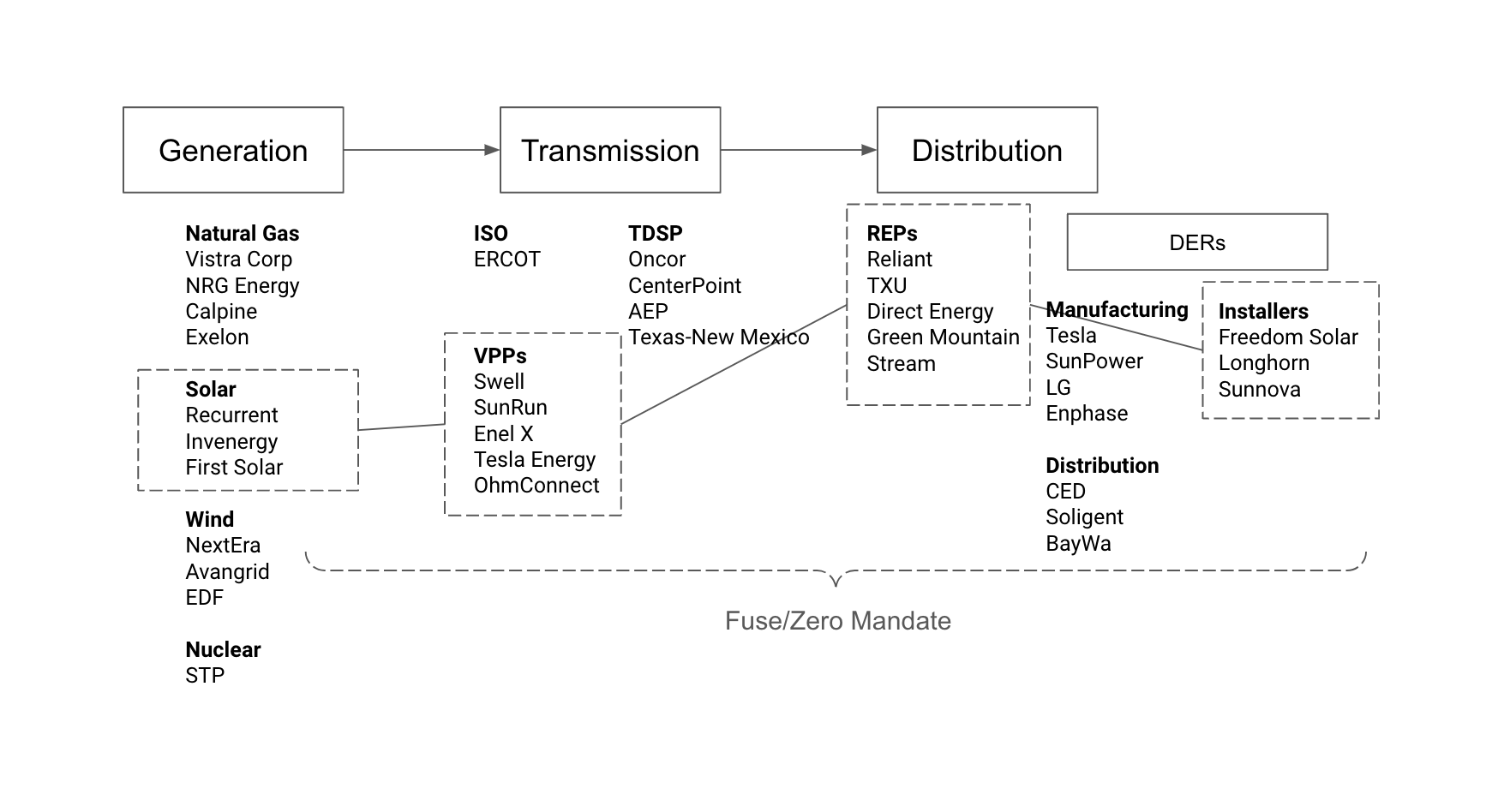
In the near term, this means tackling two specific problems:
-
Consumer inertia in energy transition—How can we incentivize consumers worldwide to shift their usage habits, enabling more effective grid load balancing through demand response programs while accelerating adoption of home-based renewables and DERs such as EV chargers, batteries, solar inverters, heat pumps, and smart thermostats?
-
Fragmented standards in retail energy distribution—How can we integrate the disjointed processes among retail suppliers, grid operators, virtual power plants (VPPs), and DER installers that have historically made it difficult to achieve economies of scale in retail energy via geographic expansion?
Project Zero complements Fuse’s vertically integrated strategy by acting as an incentive layer that helps consumers flexibly adjust consumption and grow new renewable capacity.
Aggregating Energy Assets at Scale
Fuse aims to transform homeowners into conscious and active participants in energy decisions. The planet needs consumers who actively respond to resource availability—not those who treat energy merely as a monthly bill line item. By creating delightful consumer experiences and managing the distribution of Project Zero incentives, Fuse accelerates this shift, shaping consumption patterns and encouraging new capacity installations.
As a customer-facing energy retailer, Fuse is structurally positioned to capture and distribute value created by solving some of the industry's most complex coordination problems—such as enabling demand response programs (DRPs), operating virtual power plants (VPPs), building low-latency metering systems, and pioneering interoperable data standards.
Demand Response Programs (DRPs)
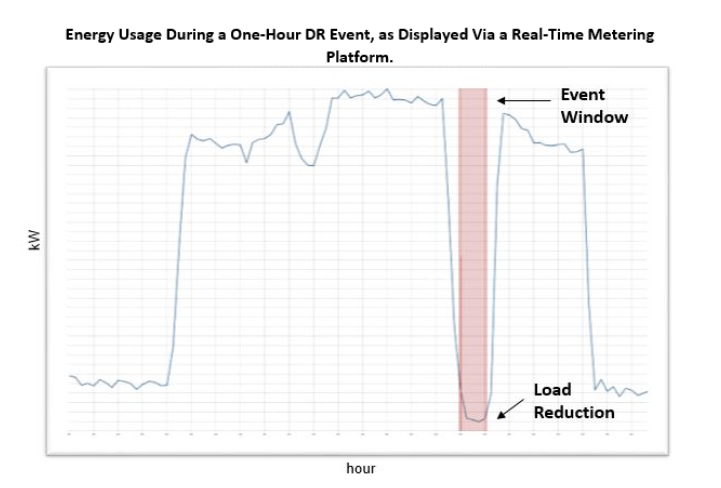
Fuse unlocks the full potential of demand response by dynamically adjusting energy consumption at the grid edge. While DRPs can reduce peak electricity demand by up to 20%, most eligible households globally remain unenrolled. This represents hundreds of gigawatt-hours of flexible load that could be shifted or reduced during critical times, significantly lowering operational costs.
When electricity demand spikes or supply dips, Project Zero offers token-based incentives—not just discounts—to owners of energy assets such as smart appliances, water heaters, thermostats, combined heat and power units, solar panels, and batteries, encouraging them to reduce or shift usage. This balancing capability allows Fuse to stabilize the grid during critical moments, aligning supply and demand.
Source: NYC DCAS
Such shifts in consumption behavior can generate over $3,000 in value per household for each megawatt-hour of demand reduced. At scale, a portion of these program revenues can be returned to consumers via token incentives, which can offset energy bills or be redeemed for instant rewards.
As more households dynamically adjust their usage through Project Zero’s incentive mechanisms, Fuse gains stronger and more predictable load reduction capabilities, allowing it to submit more competitive bids in demand response programs (DRPs). We believe utilities and grid operators will pay a premium for this reliability.
Virtual Power Plants (VPPs)
Distributed energy resource (DER) installers—including solar panel, battery, EV, and smart appliance providers—often fail to coordinate with energy retailers, resulting in suboptimal system sizing and configuration for homes. This leads not only to lower DER penetration in high-need areas but also to systems that operate in isolation from the broader grid.
In Fuse’s vision, Project Zero uses incentives to encourage households to add new renewable capacity and ensures these resources are used efficiently. This enables Fuse to function as a virtual power plant (VPP), aggregating all distributed energy into a single, flexible entity capable of delivering valuable services to the grid.
When the grid faces high demand or supply shortages, Fuse instructs DERs to increase generation or discharge stored energy. For example, solar-plus-storage systems within a VPP can rapidly inject or absorb power to maintain grid frequency within tight tolerances, while smart thermostats and water heaters can temporarily turn off or adjust in response to demand signals.
As a VPP, Fuse participates in wholesale energy markets, aggregating its local DER footprint to bid larger, more predictable capacity blocks—going beyond the role of a simple energy retailer. It can also provide essential services such as voltage support, crucial for grid stability. These services generate significant revenue—up to $100,000 per MW annually in some cases.
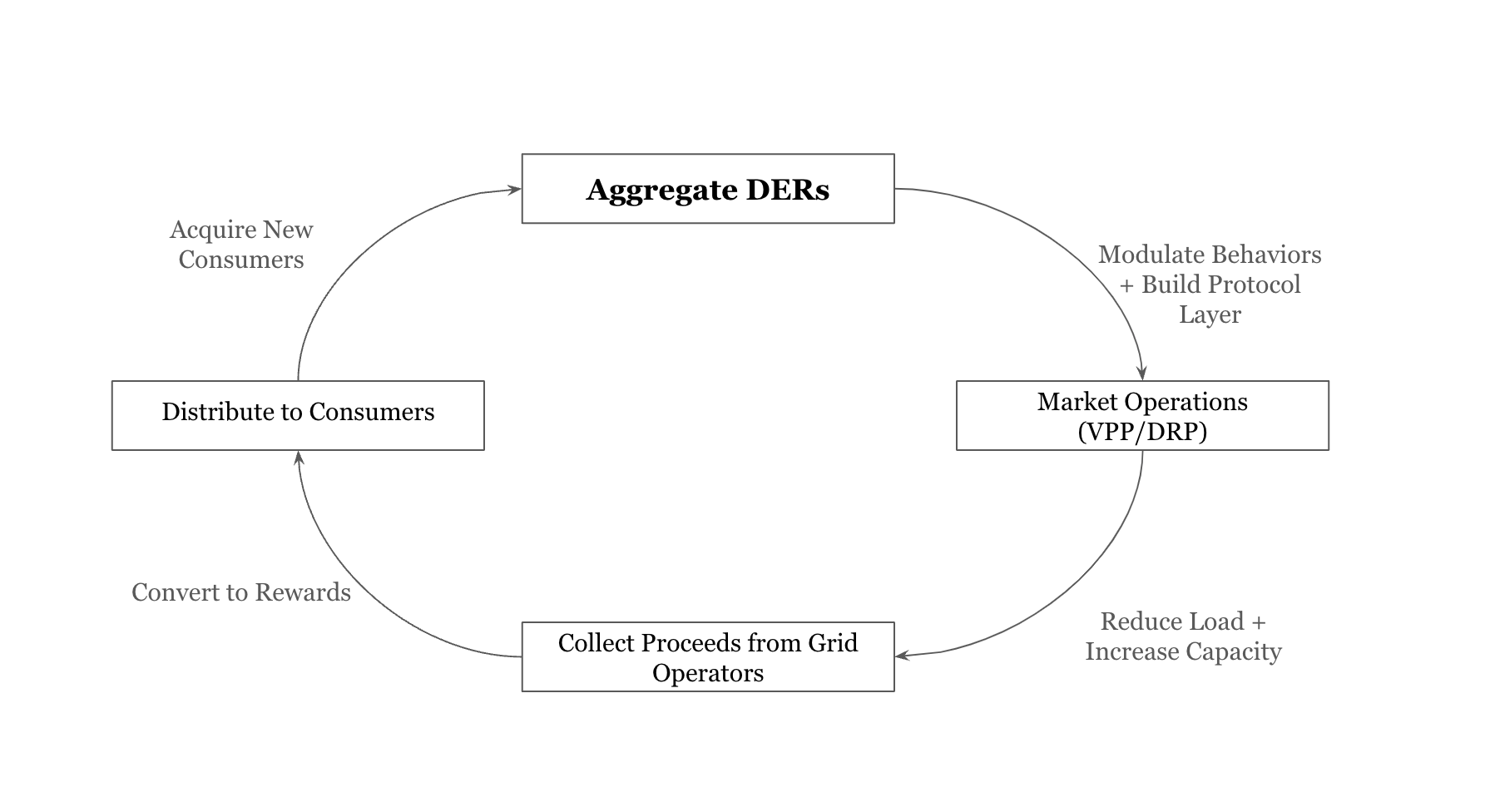
By enhancing the reliability of these services through advanced metering and analytics, we expect Fuse to secure more favorable contracts and higher compensation from grid operators. Ultimately, the proceeds from these open-market operations flow back to users contributing assets to the network.
Advanced Metering and Real-Time Data
A persistent challenge for energy producers and retailers is the lack of real-time data on power plant outages, demand fluctuations, and other factors directly impacting generation. This makes profitable energy pricing extremely difficult.
Fuse bridges this gap by collecting granular, minute-by-minute data through direct relationships with consumers. This real-time information feeds into Fuse’s advanced billing engine, informing all pricing decisions. We believe this positions the company to profitably participate in wholesale markets, ensuring cheaper, cleaner energy across every market it serves.
With an expanding customer base and deep visibility into the grids they serve, Fuse holds a structural advantage over most competitors in engaging profitably with energy markets—and in helping others do the same.
Building an Open Protocol
At scale, Project Zero functions as an open platform, providing transparent access to all generated and consumed energy resources—permissionlessly accessible to any participant in the energy value chain.
As Fuse accumulates more energy assets at the network edge, Project Zero evolves into a powerful, trusted, neutral layer. This is the right way to build a 21st-century global energy system: connecting accessible energy resources through consistent, interoperable data standards, enabling anyone to build products and services on top.
Toward an Energy-Abundant Future
Fuse’s unfair advantage against industry giants lies in using cryptographic coordination primitives to strategically remove friction from the system. This approach should more effectively acquire and engage users in a closed-loop generation and distribution model, positioning Fuse as a new kind of global energy retailer—one that profits from asymmetric data and system advantages, drives renewable adoption, and ultimately rewards customers at every step.
Alan and Charles bring deep operational experience from regulated consumer environments. The Fuse team consists of customer-focused builders and market operators dedicated to solving the most urgent energy challenges of our time.
Fuse is gradually evolving Project Zero into its first core contribution: an open, shared platform bringing us closer to energy so cheap it’s nearly free. For more information, visit www.zero2050.com.
Join TechFlow official community to stay tuned
Telegram:https://t.me/TechFlowDaily
X (Twitter):https://x.com/TechFlowPost
X (Twitter) EN:https://x.com/BlockFlow_News
 Multicoin Capital