42 people, earning $6.6 billion annually—OnlyFans makes more money than all of Silicon Valley's AI startups combined
TechFlow Selected TechFlow Selected
42 people, earning $6.6 billion annually—OnlyFans makes more money than all of Silicon Valley's AI startups combined
OnlyFans defined a certain type of creator economy.
 Navigating Web3 tides with focused insights
Curated by: Founder Park
OnlyFans is back in the headlines of the tech section.
This adult content platform generates $6.6 billion in annual revenue—more, some estimate, than all the new AI startups in Silicon Valley combined. It's the most successful British company since DeepMind and the most influential content platform since TikTok.
OnlyFans has defined a certain type of creator economy.
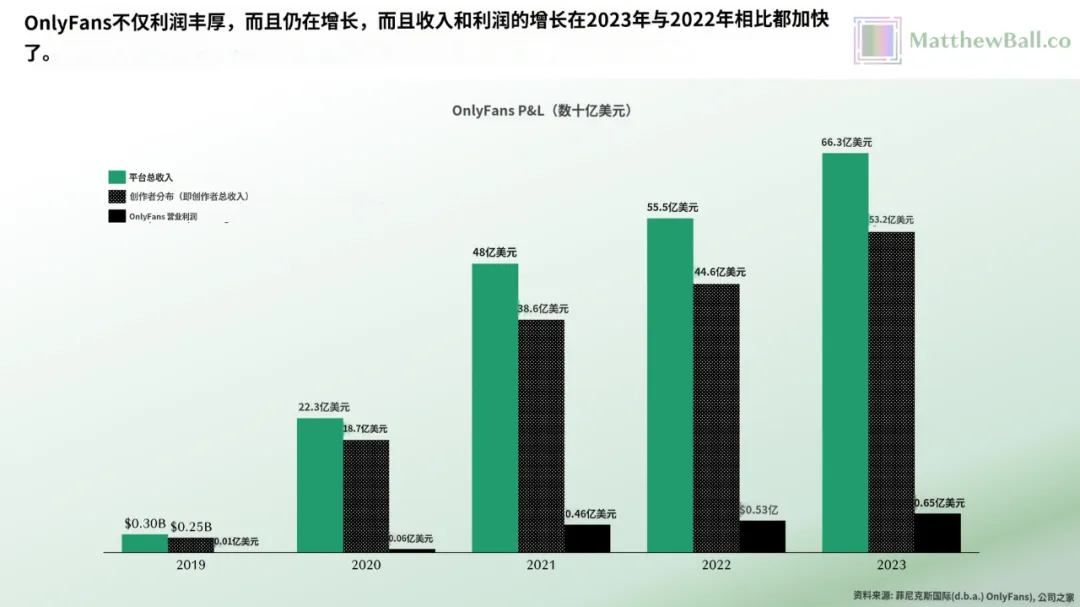
Even more striking: in 2023, it distributed $5.3 billion of its revenue to creators—and still managed to earn an operating profit of $649 million.
In an interview, CEO Keily Blair declared that OnlyFans does not use recommendation algorithms, will not introduce virtual AI characters, and for now has no plans to launch any AI-related features.
All these decisions are made with one goal: to protect creators' rights and ensure users and creators have greater choice.
Content compiled from Matthew Ball’s article and WSJ interviews, with edits by Founder Park.
01 The Most Influential Content Platform Since TikTok
Although private, as a UK-based company OnlyFans must disclose certain operational and financial data. While limited, this information offers insight into its revenue, profitability, scale, and market position.
In many ways, OnlyFans is one of the most successful British companies since DeepMind was founded in 2010, and the most impactful content platform since TikTok rose to fame via Musical.ly in 2014—especially within the creator economy.
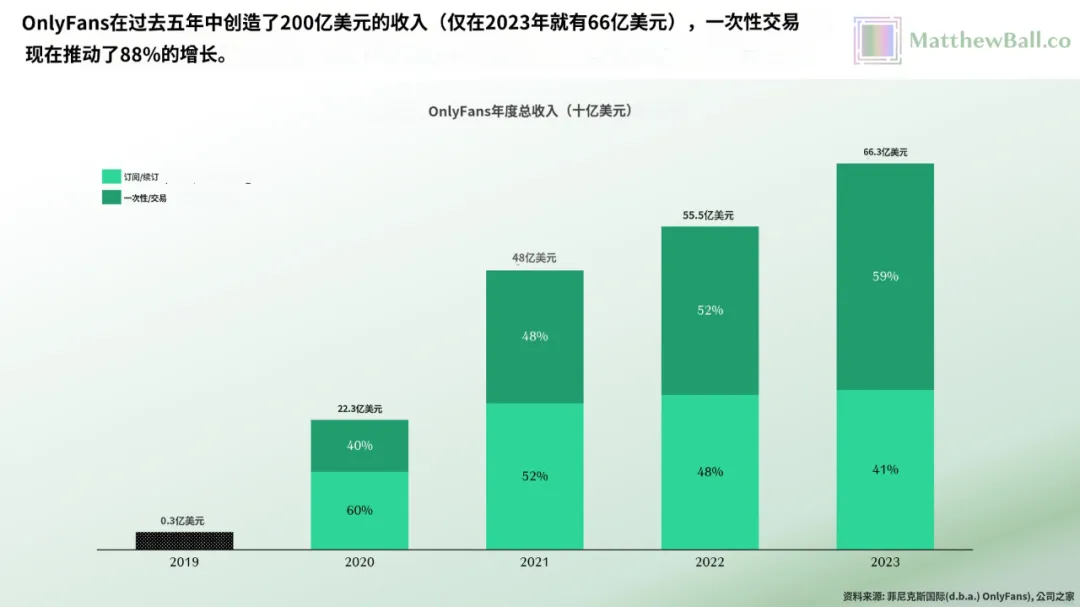
In 2023, OnlyFans achieved an astonishing $6.6 billion in annual revenue, up from $300 million five years ago. Although the explosive growth seen during the pandemic is unlikely to repeat, 2023 revenue still grew 19% year-on-year—an increase of $1.1 billion—3 percentage points faster than in 2022. Despite being subscription-based, over 60% of spending now happens through one-time transactions, often amounting to tens of dollars at a time.
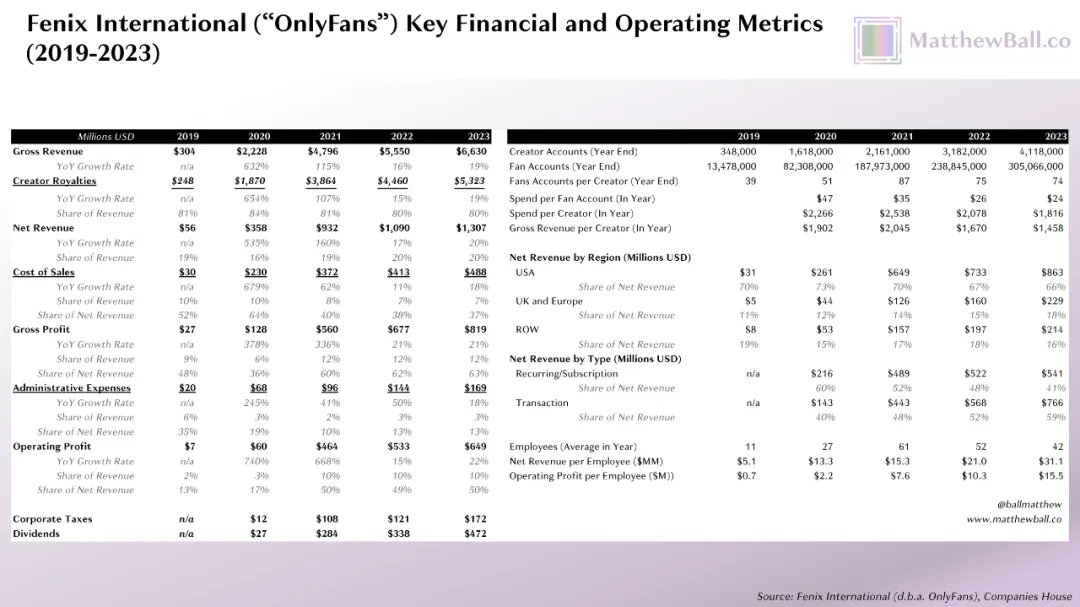
Since 2021, subscription revenue has grown only 9%, while transaction revenue has surged 70%, accounting for 88% of total revenue growth. OnlyFans’ revenue is now double that of Aylo, the adult industry giant housing brands like PornHub, Brazzers, RedTube, YouPorn, and XTube. The platform has over 300 million registered users—though not all are active or paying, and exact figures aren’t disclosed. Geographically, two-thirds of revenue comes from the U.S., 16% from the UK and Europe combined, and the remaining 17% from the “rest of the world.”
02 Growth Drivers: Market Gaps and High Payouts
Growth first stems from rising brand awareness (“OnlyFans” has become synonymous with creators monetizing their private audiences), along with the influx of high-profile creators (some of whom don’t even produce explicit content).
In addition, regulatory crackdowns forced many adult platforms to remove vast amounts of content (often uploaded without compliance checks) and introduced burdensome identity verification for new uploads.
Meanwhile, platforms like Reddit and Tumblr banned adult content altogether, creating a market gap and pushing popular creators to redirect their followers elsewhere. Many OnlyFans creators now treat sites like Reddit, Imgur, Instagram, TikTok, and Twitter as traffic funnels to attract subscribers. Typically, platforms discourage or block attempts to steer users to competing services—or at least try to build integrated features to replace them.
Yet these platforms don’t directly compete with OnlyFans (and crucially, most ban adult content), so they often allow such behavior as long as it complies with their terms and isn't overly public. In fact, they often benefit from OnlyFans promotions, gaining viral content at no cost.
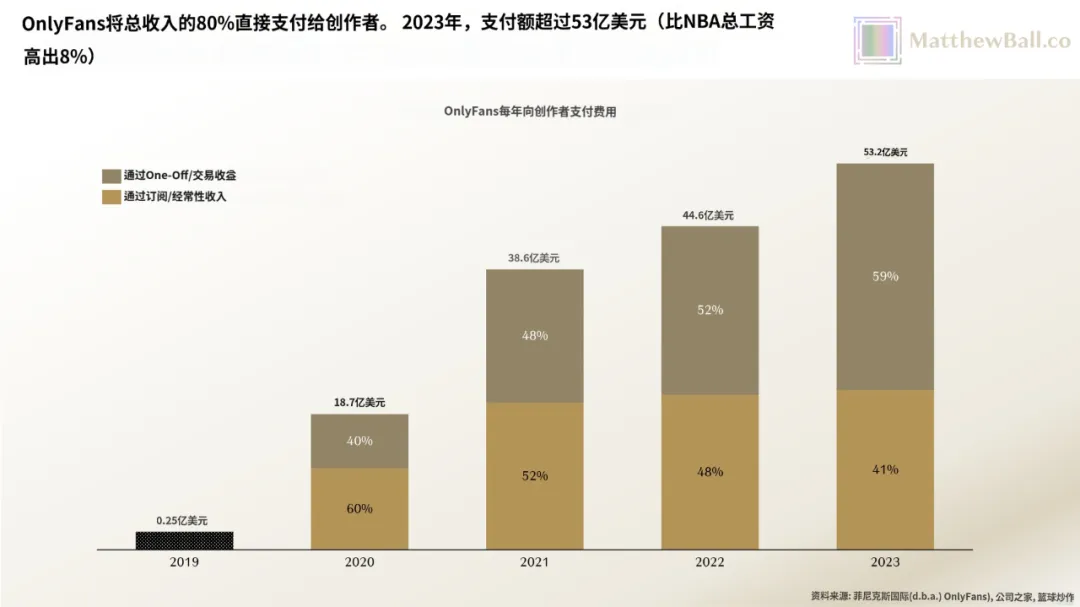
Another key factor in OnlyFans’ success is its exceptionally high 80% revenue share for creators, far exceeding what performers earn working for production companies or agencies.
In 2023 alone, OnlyFans creators received a staggering $5.3 billion. For comparison, the NBA paid $4.9 billion in salaries during the 2023–2024 season, while the NFL’s cap was $7.2 billion. Over the past five years, OnlyFans creators have collectively earned over $15 billion. Of course, those leagues each have 500–1,700 players, whereas OnlyFans has around 4.1 million creators.
Overall, OnlyFans is gradually overtaking the entire adult industry. Creators and adult stars can earn more money in safer conditions, gain greater autonomy, and deliver more authentic, differentiated, and valuable experiences to their audiences.
Incidentally, OnlyFans’ high payout rate is feasible because it does not pay Apple a cut (which would take 15–30% of all revenue). In fact, both the iOS App Store and Google Play prohibit adult apps. Normally, such bans would be fatal to a business model, but browser-based access works well enough for image/video viewing and messaging (less so for gaming). Most potential OnlyFans users aren’t deterred by a web experience that’s slightly less smooth than an app, or by slower, more cumbersome payments (unlike casual gaming or e-commerce, where friction kills conversion).
03 Top Creators Take the Vast Majority of Earnings
As with other user-generated content (UGC) platforms, OnlyFans’ revenue is highly concentrated among top creators, who capture most of the earnings, while the majority make very little.
There are over 4.1 million creator accounts on OnlyFans (the company doesn’t disclose unique counts—some run multiple accounts) and over 305 million fans. Some creators reportedly generate millions per month, but income follows a typical power-law distribution.
On average, a creator has 74 subscribers who pay $24 annually ($2 monthly), totaling $1,800 per year (with $1,450 going to the creator). However, median earnings are likely much lower. According to internal OnlyFans data, the top 0.1% of creators (some earning millions monthly) make 15 times more than the top 15%.
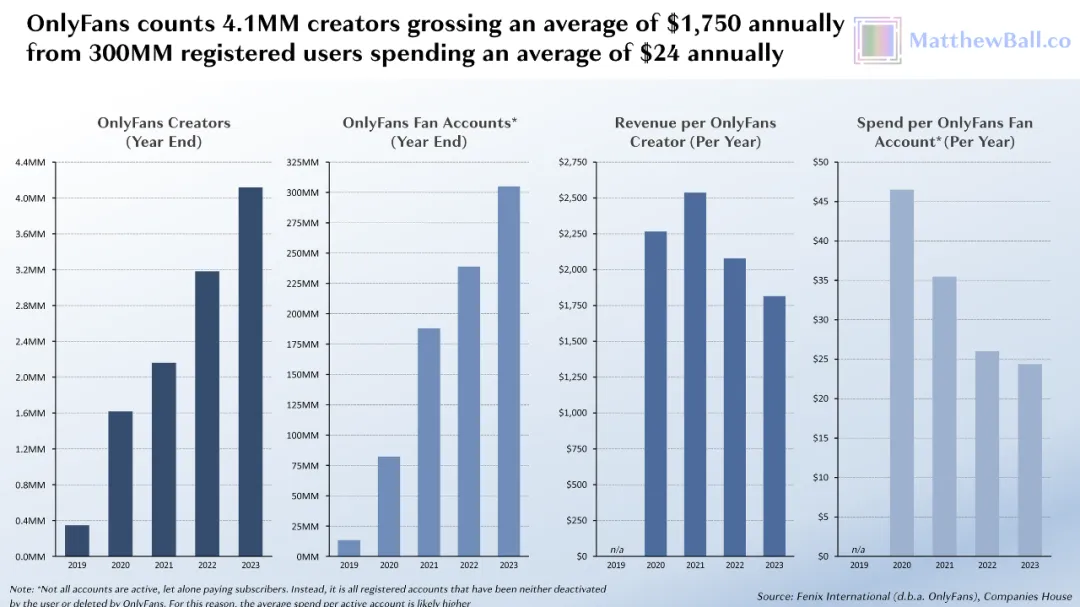
Still, few platforms worldwide boast over 100 million daily active users spending more than $20 annually.
A common tactic among top creators is tiered pricing: free, basic ($5/month), standard ($10/month), VIP ($100/month), etc., often with additional one-off purchases (e.g., pay-per-message or exclusive images).
To reduce churn, many perks are reserved for long-term subscribers. Top-tier subscribers can communicate directly with creators (enabling requests that may lead to further charges). Often, replies are actually written by team members—remember, many top creators now run multi-million-dollar businesses—though such practices have sparked legal disputes.
In this sense, we must recognize that many fans are paying for parasocial relationships and connection fantasies, not just photos and videos. Many top accounts aren’t explicit; some focus on content akin to Patreon or Substack, or offer paid access to private (but PG-13-level) Instagram-style photos.
Despite passing 80% of revenue to creators, OnlyFans generates substantial profits. In 2023, net revenue reached $1.3 billion, with gross profit of $819 million (at least half of the $488 million in sales costs went to credit card fees, the rest to bandwidth, servers, etc.). After all expenses, operating profit stood at $649 million (50% of net revenue and 10% of total revenue), totaling $1.74 billion over the past five years.
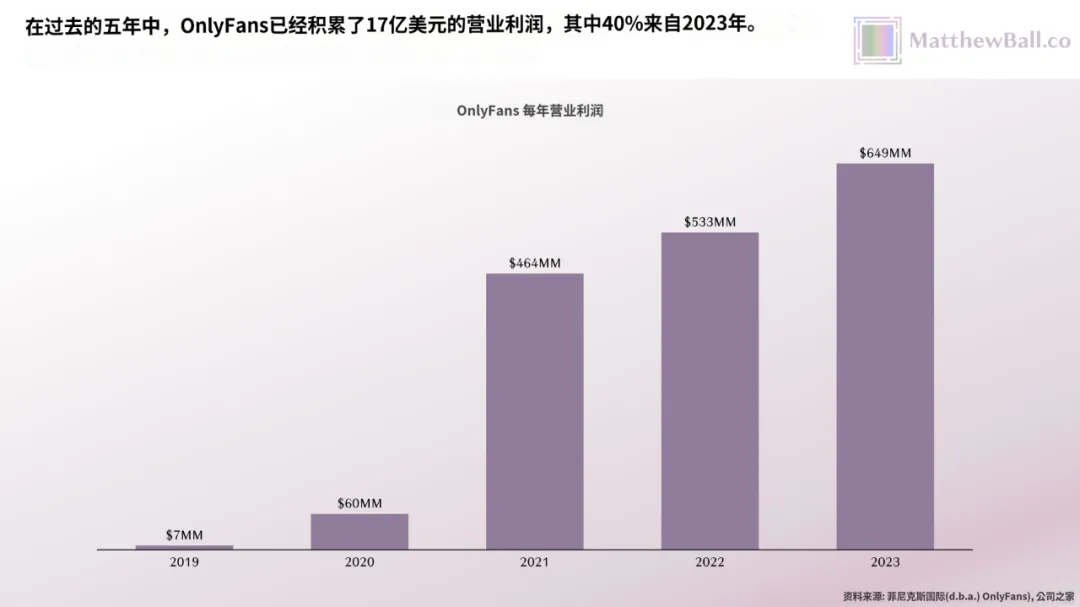
In 2023, the company averaged just 42 employees (down from 61 two years earlier). That year, each employee generated $31 million in net revenue and $15.5 million in operating profit.
Since 2019, OnlyFans has paid $1.1 billion in dividends to its two owners, including $472 million in 2023 alone. Notably, Leonid Radvinsky, who founded a porn livestreaming company in 2018, acquired 75% of OnlyFans at a time when cumulative profits likely hadn’t exceeded $1 million.
04 New Threats: X’s Adult Content Push and AI
In recent years, several competitors have emerged, some offering creators even higher revenue shares. Yet OnlyFans’ two-sided scale (users and creators) has proven resilient—not just profitable.
Beyond “How big can OnlyFans get?”, two other questions stand out.
First, can X succeed in entering this space, and how will that affect OnlyFans? In June 2024, Elon Musk lifted the platform’s ban on adult content, shortly after launching paid subscriptions and private messaging.
Second, how will generative AI—beyond just images and videos—affect this category?
As more alternatives emerge, demand for authenticity declines, while the premium for genuine parasocial connection rises. This trend is predictable. Generative AI can give you exactly what you want, tailored exclusively to you. Unlike real creators, AI can speak multiple languages, be available anytime, and potentially integrate into immersive 3D environments in the future.
05 No Recommendation Algorithms, No AI
In May this year, OnlyFans CEO Keily Blair discussed the platform’s stance on content recommendations and AI in a media interview. Founder Park provides a brief translation.
No Algorithms, No AI
Jeff: How do you attract fans without a recommendation system?
Keily Blair: We don’t have any personalized fan recommendation systems.
Jeff: Okay, do you plan to incorporate AI into your product?
Keily Blair: We don’t allow AI-generated content. Real creators can use AI to enhance their content, but fully AI-driven virtual personas are prohibited.
Jeff: Daily usage time is crucial for social media companies. How do you improve this metric?
Keily Blair: Unlike many other social platforms, this isn’t actually a key growth metric for us.
Jeff: What’s your site’s biggest traffic source?
Keily Blair: I don’t know. I don’t track that metric.
Jeff: …Then how did you get this job? (laughs) But you’re clearly good at user growth—you must have a background in that, right?
Keily Blair: Actually, unlike many tech CEOs, I studied law, specializing in cybersecurity and privacy—probably says a lot.
Jeff: But anyway, you’re making serious money easily now, right?
Keily Blair: I think what’s truly interesting about OnlyFans is that we provide a space where adults can have authentic adult experiences. Sometimes that includes “adult content,” but it can also include sports, comedy, MMA—basically anywhere creators want to monetize their fanbase, as long as they follow our terms.
No Ads, Strict Creator Verification
Jeff: Why doesn’t OnlyFans help users discover popular accounts through platform recommendations? After all, ad-driven models are core to nearly every social media platform.
Keily Blair: Because ad-driven models are central to social media growth, platforms are typically built around them. But OnlyFans is different—we’re aligned with our creator community. We only succeed if creators succeed. Since launch, we’ve paid out $15 billion to creators. In our model, for every dollar we earn, creators earn four. I’m very proud of that.
Jeff: So OnlyFans isn’t trying to mimic ad-driven mainstream platforms—an almost contrarian move these days. We’ve seen TikTok, YouTube Shorts, Instagram, and Facebook aggressively push subscriptions and direct creator payments. Ironically, this trend coincides with them reducing payouts to creators.
I’m curious—what’s your view on this competitive landscape, and what trust and safety considerations should a platform adopting OnlyFans’ model keep in mind?
Keily Blair: Yes, other platforms are beginning to imitate OnlyFans, especially in creator monetization and subscription mechanics, though they may not be as generous with revenue sharing.
I think creators and younger generations crave more interaction and fairer compensation. Younger adults, particularly Gen Z, want to connect with creators and believe they deserve fair pay.
A key distinction with OnlyFans is that creators always retain copyright to their content. They can remove it anytime—it doesn’t belong to us, it belongs to them. For platforms relying on ads, I understand it’s another monetization layer. But OnlyFans has always followed this subscription model, and both users and creators are used to it. I think the challenge for others shifting to subscriptions is that users are accustomed to free content. They need to feel it’s exclusive, that they’re getting more value.
On the creator economy side, we’ve noticed subscription revenue now makes up a smaller share of our total than “microtransactions”—one-off purchases like unlocking content, private messages, custom content, or behind-the-scenes extras. Sometimes, as a user, I don’t want a full subscription—I just want one specific thing. So enabling flexible monetization—subscriptions or microtransactions—is critical.
As for trust and safety, it’s fundamental to our operations. At OnlyFans, we take this seriously. We start with creator onboarding—that’s the most important step. Creators go through a rigorous verification process, providing up to nine types of personal information. In jurisdictions like the U.S., this includes Social Security numbers. We require government-issued ID, full name, bank details, and links to other social media accounts, so we can confirm consistency across platforms. We don’t use this data for anything else—it’s solely to protect our community and establish accountability.
Jeff: But in some countries, you can’t obtain valid ID from creators. How do you handle that?
Keily Blair: It’s tricky. In places where we can’t verify identities, we simply don’t operate there. We must confirm age and identity before someone joins, especially if they intend to share adult content.
Jeff: Clearly, minors aren’t allowed on the platform, either as creators or viewers. But what if I, as a creator, want to share a photo of my child with my fans?
Keily Blair: Definitely not allowed.
Jeff: Alright. What if—just hypothetically—I wanted to role-play on my OnlyFans as a girl in a school uniform?
Keily Blair: That’s also not allowed. We prohibit any roleplay suggesting underage themes, Jeff. It’s a matter of principle. I have two kids myself—one 9, one 11. I want them to grow up in a healthy online environment.
As a social platform, we prioritize robust safety controls. We understand every platform model carries risks. That’s why we’re confident everyone on our platform is over 18, which allows adult content. We face different risks, so we invest heavily in content moderation. That’s also why we don’t use end-to-end encryption—even in private messages—so we can focus on protecting the community and ensuring it remains adult-only.
Banning AI to Protect Creators
Jeff: Your decisions around AI really puzzle me. Take chatbots—they might not excel at everything yet, but they’re pretty good at simple conversations. Beyond subscriptions, creators spend a lot of time chatting. It’s no secret—popular creators have customer service teams. They could train bots to mimic themselves and save huge costs. Why not allow that?
Keily Blair: You call it “simple conversation,” but private messages on OnlyFans often involve deeply personal content—bots can’t handle that. But beyond that, I see significant risks with generative AI, including legal issues. Everyone talks about AI’s future—some say revolutionary, others fear dystopian takeover—but they’re ignoring current problems like copyright and ownership. These aren’t hypothetical future concerns—they’re happening now, actively violating creators’ rights. Letting AI run freely in our system is too risky. We allow creators to use AI to enrich content, but it must clearly belong to them and be verifiable.
Jeff: Meta uses bots that sometimes pretend to be parents of NYC public school kids. Are you saying you’ll never allow generative AI for content creation or social interaction?
Keily Blair: Right now, the benefits don’t outweigh the risks. But we’re closely monitoring developments. I don’t have a crystal ball—technology moves fast. So we have a team of lawyers, privacy experts, technologists, and developers studying existing tools and how they might support our creator community. If we ever gain confidence in safeguards, we might explore it. But under current conditions, it’s not suitable.
More Choice for Users and Creators
Jeff: I noticed you’ve publicly criticized recommendation algorithm platforms. Yet in a way, you seem to rely on them—most successful OnlyFans creators already have traction on Instagram, Twitter, or YouTube. Do you see this as a symbiotic relationship? Isn’t your business partly dependent on the very model you appear to dislike?
Keily Blair: Every creator runs their own business. At heart, we’re a platform that helps creators and fans connect.
There’s an interesting report showing most creators operate on seven or more platforms, tailoring content for different audiences. If other platforms change how creators interact with fans—if they negatively impact engagement—we benefit. Creators might eventually choose OnlyFans as their primary platform, provided they’re over 18 and pass verification.
Yes, I do see a degree of symbiosis between us and other platforms, because it all revolves around creators and their audiences. But we still need safeguards and control over our platform. Giving users choice—letting them pick each subscription, each creator they follow—is essential. As a fan, I’m not interested in everything—only certain things. I’m a fan of certain people, musicians, journalists…
We don’t want push notifications—we want choice, control. Creators also want control over their audience. They can block fans, decide who follows them. So for us, maintaining alignment of incentives, focusing on exceptional user and creator experiences, is vital.
Jeff: Is that right? You seem to suggest the platform can serve as an alternative to poor experiences elsewhere. But should we consider how the internet itself could improve in these areas? Or should we act now? Is OnlyFans built on the assumption that it will forever remain an internet outlier? What’s your view on the evolution of social products online?
Keily Blair: I’m an optimist. I truly hope we can build better social platforms and drive change. The structural issues we discussed earlier do make it difficult. What sets us apart is our success in security—we proactively identify and manage widespread risks on social platforms.
Because we baked security into our design from day one, rather than retrofitting it later, we protect users more effectively and provide creators with a safer, more controlled environment. This forward-thinking approach lets us stand out in the social media landscape and create real value for users and creators.
Of course, reactive efforts are still valuable—better than nothing. So I remain hopeful that the internet can move in this direction. I look forward to seeing more transformation across social platforms and a more positive, optimistic future for social media.
Join TechFlow official community to stay tuned
Telegram:https://t.me/TechFlowDaily
X (Twitter):https://x.com/TechFlowPost
X (Twitter) EN:https://x.com/BlockFlow_News