








The smooth listing of a suspected scam project, while the community gets burned? What's behind the Neiro uppercase/lowercase controversy?
TechFlow Selected TechFlow Selected
The smooth listing of a suspected scam project, while the community gets burned? What's behind the Neiro uppercase/lowercase controversy?
Now it's a bit awkward.
 Navigating Web3 tides with focused insights
Author: TechFlow
Recently, the Ethereum mainnet has been buzzing with on-chain activity. Various new application tokens haven’t even finished their hype cycles when the two-month-long battle between uppercase and lowercase Neiro takes another dramatic turn.
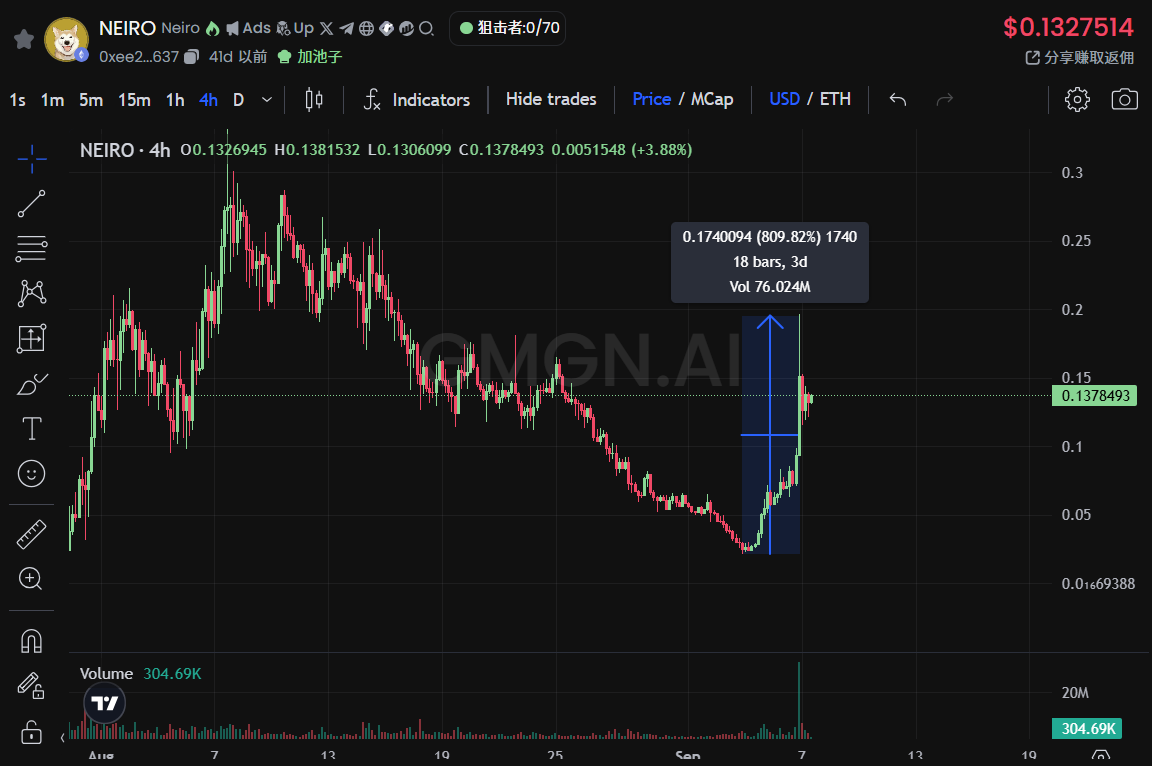
Yesterday, two major exchanges successively launched futures contracts for uppercase $NEIRO. Upon the news breaking, $NEIRO surged sharply, gaining up to 200% within the day and nearly 800% from its weekly low. Notably, before this listing news emerged—and while $NEIRO had no apparent catalyst—it first plunged 60%-70%, only to rally over 300% in just three days. Such clear signs of artificial manipulation further reinforce market perceptions that uppercase $NEIRO is controlled by a coordinated syndicate.
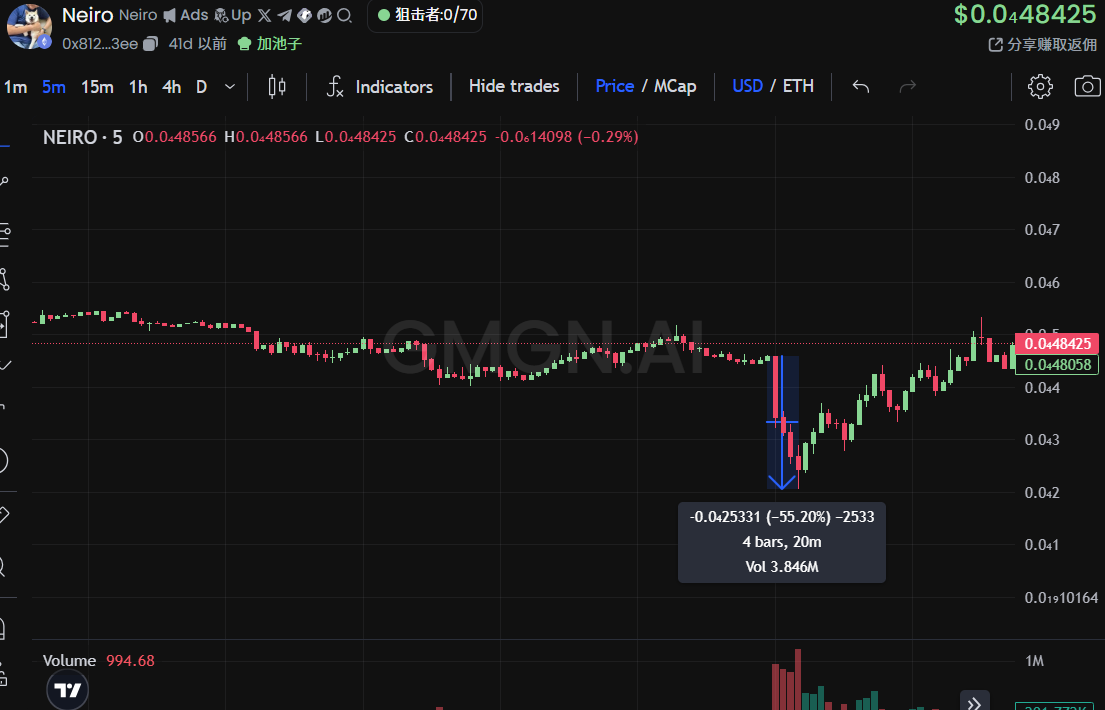
Of course, the excitement isn't limited to uppercase $NEIRO. The lowercase $Neiro, long seen as representing community spirit, immediately plummeted following the exchange listing announcement—its price halved within 20 minutes. While uppercase $NEIRO's market cap raced toward $200M, lowercase $Neiro fell to around $9M.
Interestingly, just yesterday we published a roundup of current mainnet meme trends, briefly mentioning the Neiro case as one of the week’s key narratives. At the time, we said the outcome was still undecided—barely finishing that sentence when news broke about Binance launching futures...
Related reading: Ethereum Disappoints, But On-Chain Memes Are Booming? A Weekly Roundup of Hot Projects
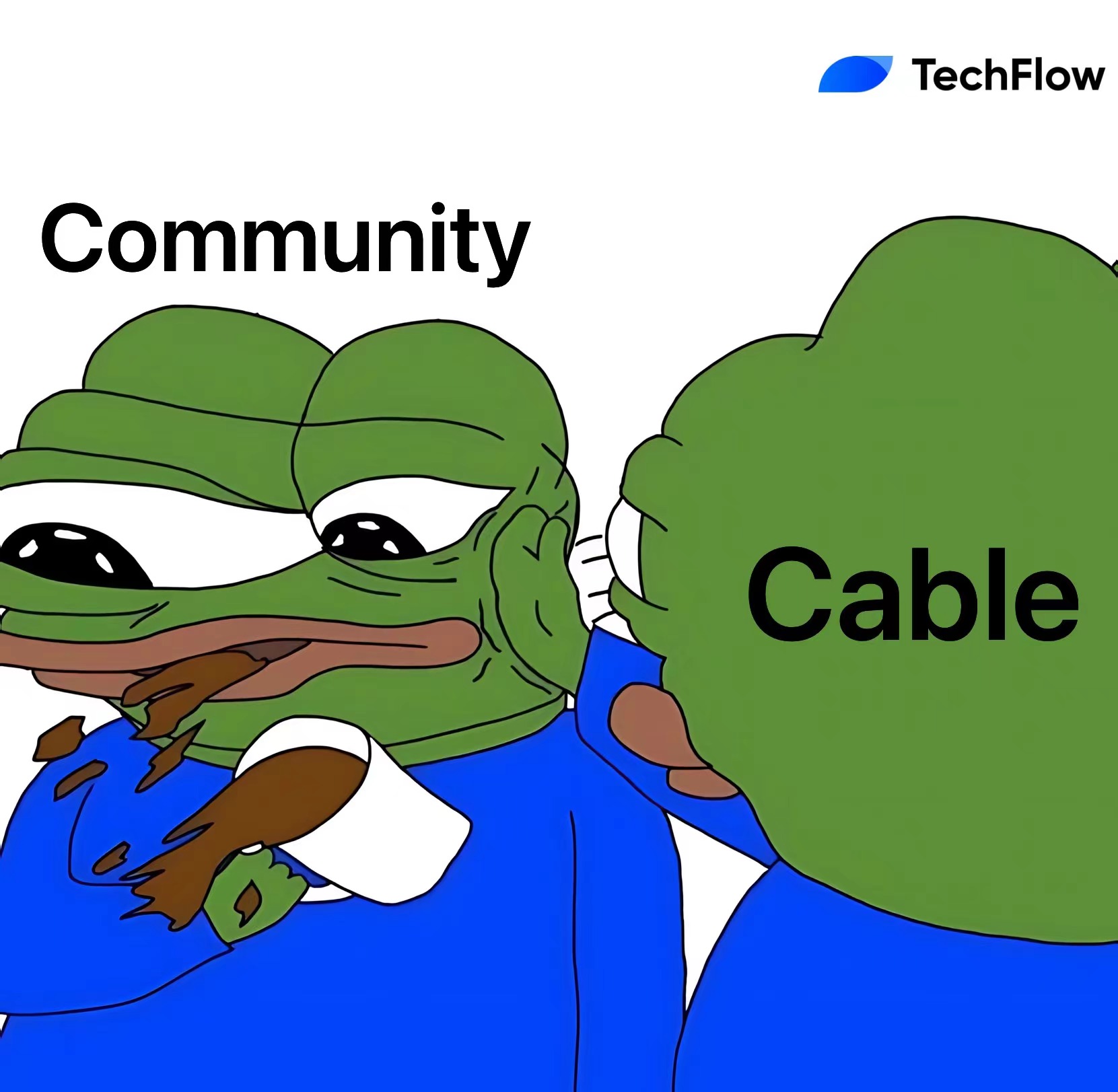
CTO vs Cable: The Uppercase vs Lowercase Neiro Battle
When Neiro first emerged, Solana—the chain known for fastest PVP action—was the first to react. An identically named token instantly appeared on Pump.Fun, and the initial uppercase/lowercase clash actually erupted on Solana, with Ethereum mainnet deployments lagging slightly behind.
But as everyone now knows, Solana’s PvP environment is extremely volatile—liquidity floods in and out rapidly—so Neiro’s momentum gradually shifted to Ethereum, where players tend to stick around longer.
At that point, news of the shifting fortunes between uppercase and lowercase Neiro flooded every kind of on-chain alert and data feed. Over time, however, their price trajectories began to diverge.
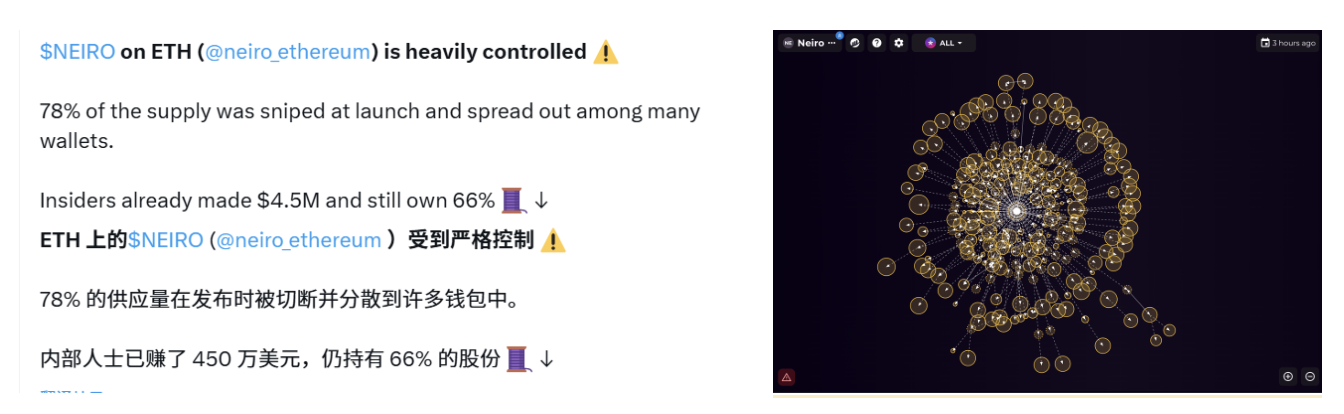
From launch onward, uppercase $NEIRO followed the classic pump-and-dump script. On July 31, just a week after launch, @bubblemaps exposed that 80 addresses controlled 78% of the token supply, with highly sophisticated distribution tactics—a textbook case of a coordinated syndicate.
After this scandal broke, $NEIRO’s price halved overnight. Ironically, the drop lasted less than half a day; over the next ten days, the price surged again by 300%. It seems being labeled a "syndicate" wasn't a weakness—it acted more like bullish news.
Only when insider wallets began dumping did uppercase $NEIRO start its sustained downward spiral.
In contrast, lowercase $Neiro’s trajectory looked far more “community-driven.”
Initially, its marketing team tried mimicking $SHIB’s playbook by sending 4% of the supply directly to Vitalik to ride the publicity wave—but the move backfired. Vitalik later sold all those tokens, and during this period, $Neiro’s price fluctuated wildly without clear direction.
It wasn’t until grassroots (community) energy poured in, and Twitter rallied behind lowercase $Neiro, that the price finally gained real momentum—delivering gains like “40x in 3 days.” This rise truly reflected the gradual formation of a genuine $Neiro community.
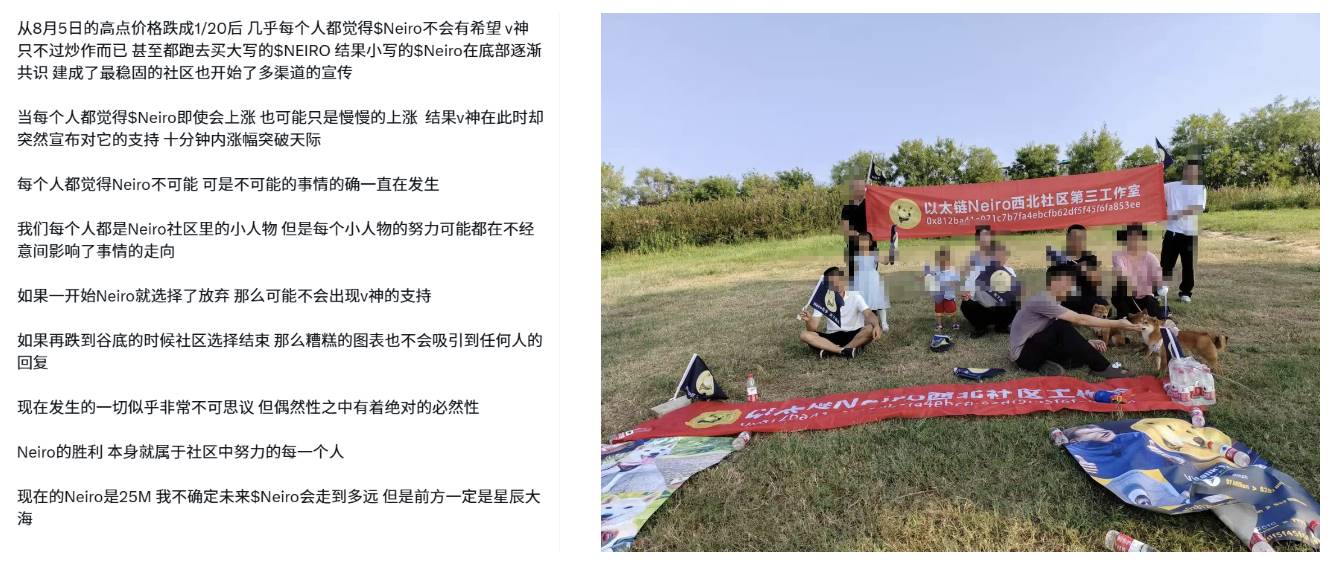
Divergent Reactions
As confidence in lowercase $Neiro grew and uppercase $NEIRO continued falling, the battle seemed all but over—until exchanges suddenly made an unexpected move that stunned the entire market.
If the conflict between “syndicate vs community” once felt abstract, yesterday’s “big up, small down” event laid bare, in front of the entire crypto world, how easily a syndicate can crush a community.
The global crypto community reacted with shock, though amid the outcry, alternative views also surfaced.
Viewpoint 1: Exchanges openly backing a syndicate—where’s the spirit of crypto? Shame!
Naturally, most voices were outraged. Criticism and condemnation of exchanges flooded social media: the core of this battle is “community versus syndicate.” Just as the community was gaining ground, exchanges stepped in and slapped the idea of “community spirit” right across the face. So much for building things together—now it’s clear: whoever has more money and acts more ruthlessly wins. That’s the future of the industry then?
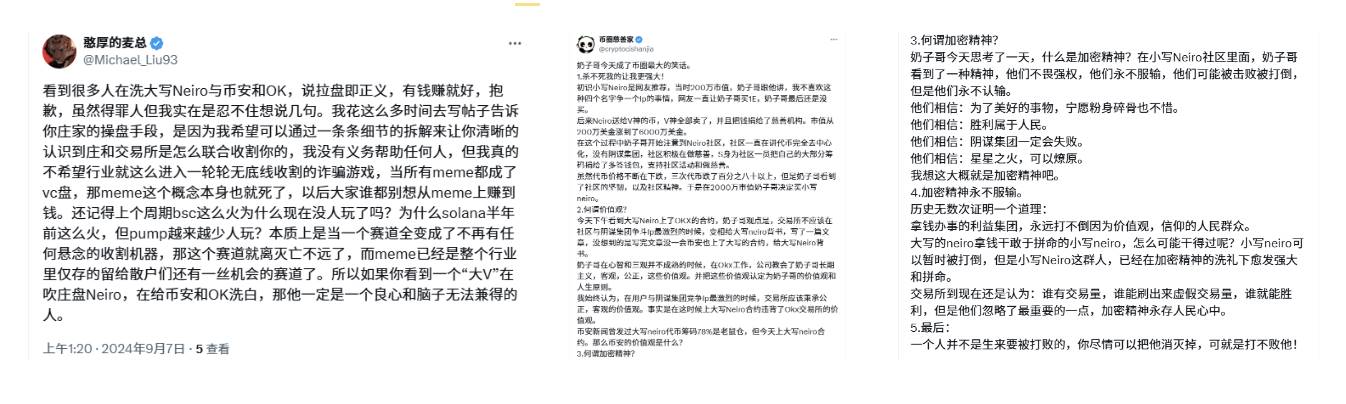
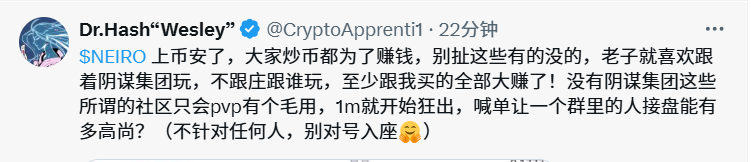
Viewpoint 2: The idea of community is a bit too utopian. We’re all here to make money anyway—so isn’t it all just PVP in the end?
Who will ultimately absorb the bag in a community project? Isn’t it simpler to just dance with the whales and cash out quickly? We’re all here to profit—who’s really morally superior?
Syndicate Path Is Easy, Community Road Is Long and Hard?
In the aftermath of this “big up, small down” incident, memes started flying.
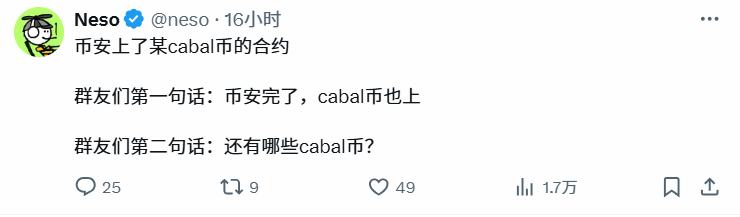
Some memes were pure satire, but others carried a tinge of resignation.
From both initiator and participant perspectives, building a real community is inherently far harder than forming or joining a syndicate. A syndicate needs only capital and coordinated action, entering the market purely to exit with profits—rarely getting trapped themselves.
Meanwhile, communities built on shared belief plus financial incentive inevitably face the challenge of balancing “community ideals” with actual profitability—especially when syndicates can simply spend money to inflate prices.
The exchange listing may have handed a short-term victory to the syndicate, but this doesn’t mean markets should work this way. While a syndicate’s consensus is strong, it exists solely to exploit others. In the long run, such behavior damages the ecosystem profoundly—no one wants to keep playing in a market where syndicates always win. Ultimately, it could lead to a grim “all lose together” scenario.
At the time of writing, lowercase $Neiro has largely recovered from yesterday’s sharp drop. For now, the community hasn’t collapsed under the exchange’s interference. What happens next—whether we’ll see a GameStop-style retail revolt or whether the community eventually gives up and disintegrates—is impossible to predict.
But the harsh reality remains: the phenomenon of “everyone hates the syndicate, yet everyone wants to be the syndicate” isn’t unique to memecoins. It permeates the entire industry—and indeed, human society at large.
The path toward true co-creation still has a long way to go.
Join TechFlow official community to stay tuned
Telegram:https://t.me/TechFlowDaily
X (Twitter):https://x.com/TechFlowPost
X (Twitter) EN:https://x.com/BlockFlow_News
 深潮TechFlow


