Exclusive Interview with Ryan Chow, Founder of SolvBTC: Asset Innovation for the Next Trillion in Liquidity
TechFlow Selected TechFlow Selected
Exclusive Interview with Ryan Chow, Founder of SolvBTC: Asset Innovation for the Next Trillion in Liquidity
Ryan Chow believes SolvBTC will undoubtedly become the gateway to BTCFi.
 Navigating Web3 tides with focused insights
Interviewee: Ryan Chow, Founder of SolvBTC
Interview & Writing: Pzai, Foresight News
In the long history of cryptocurrency, Bitcoin has played a pivotal role as the longest river in asset adoption. In recent years, whether in terms of compliance or on-chain ecosystem development, the Bitcoin ecosystem has experienced strong growth. However, unlike other ecosystems with unified approaches, Bitcoin has undergone multiple forks and divergent technical paths for scalability. On the asset side, due to Bitcoin's native lack of extensibility, existing custody solutions vary significantly, leading to relatively fragmented liquidity across different ecosystems that requires integration.
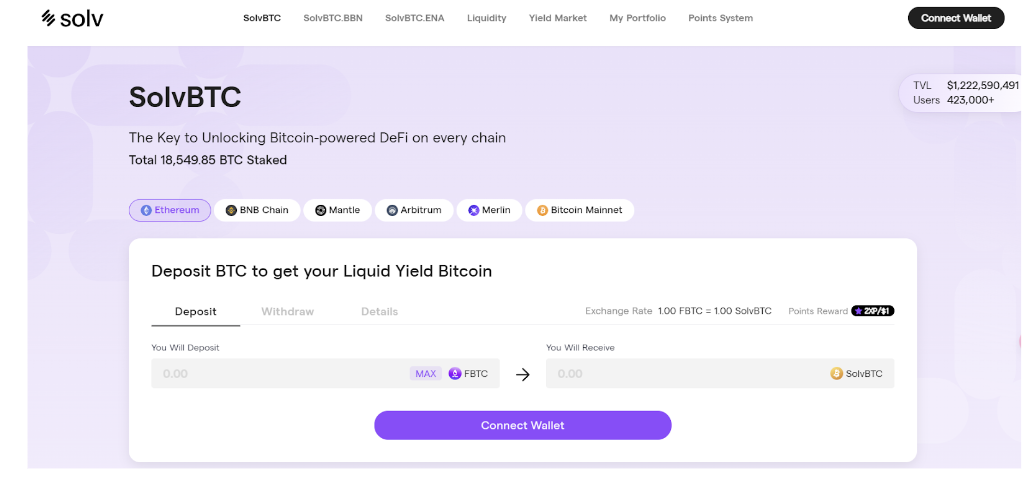
Solv, one of the early protocols involved in asset innovation (such as ERC-3525 semi-fungible tokens), began focusing on opportunities related to new asset issuance by the end of 2022, eventually settling on Bitcoin. Since April this year, SolvBTC has successfully integrated assets such as BTC and BTCB, bringing over 20,000 BTC into circulation across nearly ten ecosystems. With the official launch of restaking protocols like Babylon and the construction of more yield-generating scenarios tied to Bitcoin, SolvBTC is preparing for an even greater explosion in BTCFi. How will the BTCFi ecosystem evolve in the future? What role will SolvBTC play within it? In this edition, Foresight News interviews Ryan Chow, co-founder of SolvBTC, to explore BTCFi’s development from the perspective of SolvBTC.
Financial Innovation Shifts to the Asset Side
Ryan stated regarding financial innovation: "In crypto financial innovation, there are two types: algorithmic innovation and asset innovation. The previous cycle's algorithmic innovations were mainly reflected in stablecoins and protocol innovations like Aave and Compound—what I would call Version 1.0. Then DeFi gradually shifted toward asset innovation, such as Ondo focusing on RWA, Ethena introducing derivative yields, and restaking layers like EigenLayer/Babylon—all aiming to bring diverse assets (and their yields) into the crypto space." Growth in the crypto market relies heavily on these innovations, and amid today’s highly competitive project landscape, asset innovation has become the key to ecosystem breakthroughs. Thus, selecting the right underlying asset becomes the top priority for many teams. A strong foundational asset can act as both a catalyst and booster for flywheel effects, serving as the first step toward future prosperity.
On asset selection, Ryan’s team had prior achievements in the DeFi sector: "Initially, we looked at promising sectors including BTC, ETH, and stablecoins. Later, due to factors like Bitcoin halving and traditional capital entering the market, we decided to focus specifically on building around Bitcoin as a single asset class." He also acknowledged that inscriptions and BTC Layer 2 narratives have contributed to some degree of asset innovation within BTCFi. "In my definition, BTCFi specifically refers to the broader development of the entire Bitcoin ecosystem—simply put, how we can better utilize Bitcoin, how we can leverage Bitcoin’s mainchain to create new assets, and how we can serve Bitcoin holders by creating more use cases, consumption scenarios, and yield-generating opportunities. These are all part of the BTCFi ecosystem. So I believe inscriptions and runes fall under this umbrella. At the very least, we see many users who make profits from trading inscriptions and runes end up holding Bitcoin and actively exploring what else they can do with it. Therefore, I view inscriptions, runes, and BTCFi as mutually reinforcing—they exist within the same ecosystem and influence each other."
Within the Bitcoin ecosystem, a stable base-layer asset is the cornerstone of vibrant circulation. Over the past decade of cryptocurrency development, Bitcoin has firmly established itself as digital gold and a store of value. However, if it remains merely a static asset, its potential will never be fully realized. Liquidity is not only essential for the thriving of the Bitcoin ecosystem but also the core driver enabling Bitcoin’s intrinsic value to be fully expressed and enhanced. WBTC emerged during the 2020 DeFi Summer and began securing its position in the ecosystem. Recently, however, subtle connections between Justin Sun and BitGo have sparked industry skepticism about WBTC. Meanwhile, the development of Bitcoin L2s is accelerating rapidly. Ryan commented, "These Bitcoin L2s have effectively served as low-cost tools assisting speculation around inscriptions and runes." From these assets, basic on-chain liquidity is being supported by vehicles such as wBTC and cbBTC. "After four years of development, WBTC alone accounts for $10 billion within the total DeFi scale—an impressive figure. WBTC has clearly captured this红利 and secured its place." Looking ahead, Ryan believes that with large-scale institutional adoption and continued BTCFi ecosystem growth, "We’ve always believed BTCFi will experience a major breakout driven by increasing asset规模, which is why SolvBTC was created—to handle the trillions in liquidity that will come with this surge."
Addressing Challenges from Multiple Angles with Precision
When discussing how SolvBTC addresses challenges in the BTCFi space, Ryan highlighted three key issues: "First is secure reserves—this is arguably the most important. We see projects like tBTC also emphasizing security. While maintaining decentralization and on-chain transparency, we collaborate with trusted custodians (like Fidelity). Second is minimizing friction costs for users, particularly through multi-chain liquidity provision and interoperability, which requires sophisticated technological innovation. Third is building yield infrastructure for users. Here, we've developed a Ce-DeFi model that allows users to package various yield sources—including quantitative strategies and options—via our technical architecture. Over the past four years, the overall DeFi market has ranged between $80–100 billion."
After a long journey of experimental asset innovation and on-chain practice, Solv chose to specialize in BTC staking and has since become the platform with the highest TVL in this domain. Thanks to its high consensus, SolvBTC has attracted over 200,000 users and holds more than 20,000 BTC in reserves, surpassing $1 billion in market cap and ranking in the Top 60 on CoinMarketCap—one of the most widely recognized BTC-based assets globally. Its on-chain reserves rank fourth worldwide, behind only Ethereum, TON, and BNB Chain, and exceed those of most BTC ETFs, placing sixth globally.
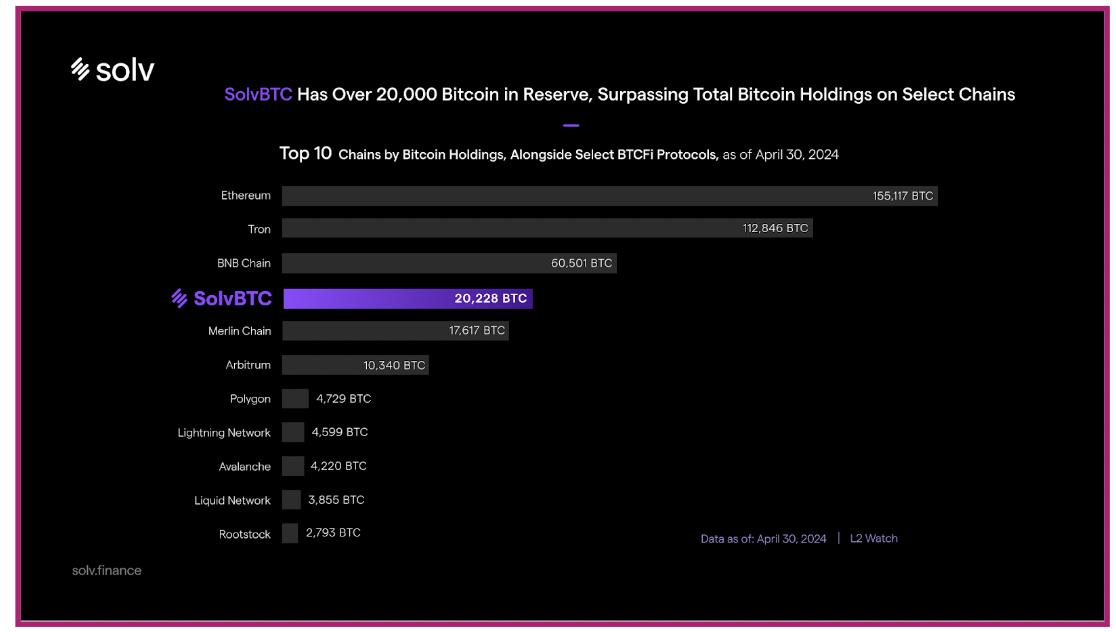
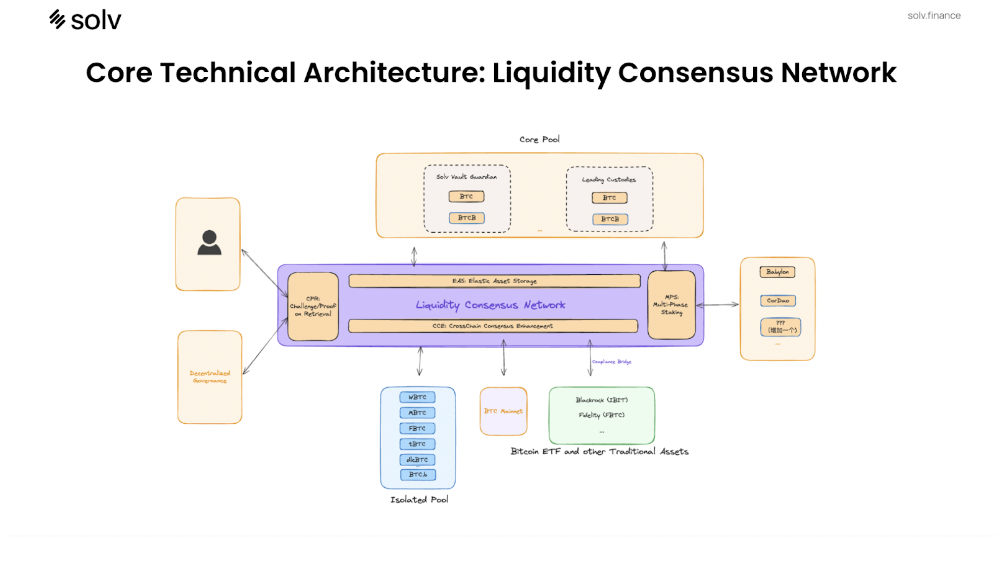
Regarding the security of the underlying assets: "We’ve built elastic storage capabilities based on a Liquidity Consensus Layer (LCN), using smart contracts to ensure transparent 1:1 backing. For risk management, we employ a 'Core Zone' and 'Observation Zone' tiered design. The Observation Zone allows users to deposit less common assets (such as tBTC, FBTC) while maintaining backward compatibility with the Core Zone—ensuring system-wide security while enhancing asset liquidity. Underlying infrastructure features a complex yet elegant backend architecture to safeguard user funds. Additionally, inspired by Rollup designs, we’ve introduced proof mechanisms to secure withdrawal processes. We also leverage Chainlink CCIP to enable cross-chain liquidity for SolvBTC."
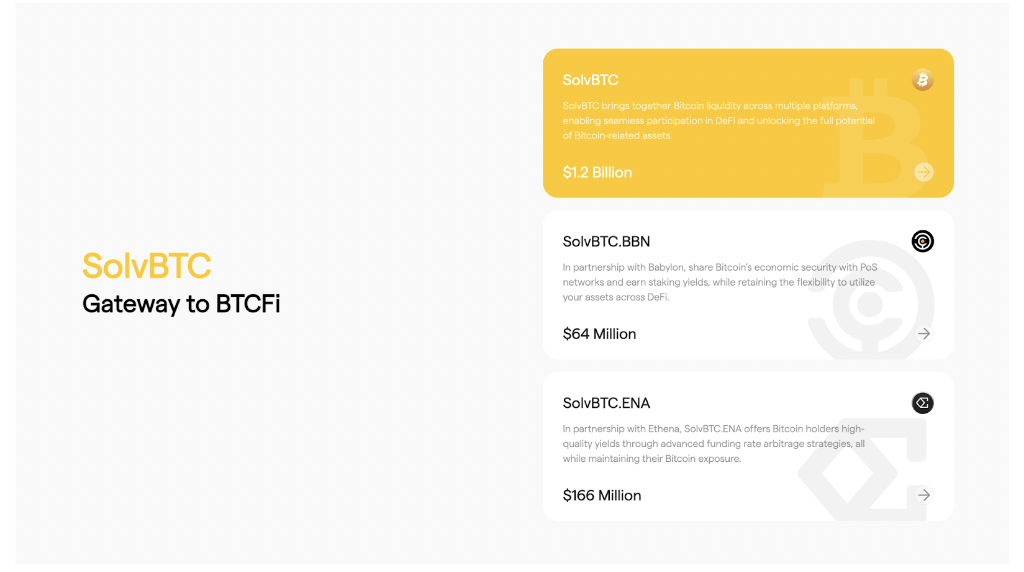
Beyond addressing inherent asset challenges, user application scenarios are equally critical for asset operations. Ryan explained: "Current use cases primarily revolve around on-chain trading—for example, users can purchase SolvBTC, use it for borrowing and lending, or split the asset via protocols like Pendle. Additionally, SolvBTC enables participation in yield opportunities across various public chains and earns reward points." Recently, Babylon’s launch of staking has opened broader application possibilities for Bitcoin assets. SolvBTC launched its dedicated Babylon staking pool early on, and Ryan expressed enthusiasm for the collaboration: "In the restaking space, we’ve always admired the new asset categories Babylon is creating. As a protocol with substantial Bitcoin reserves, we established the SolvBTC.BBN staking pool, allowing users direct access to restaking yields. We believe restaking can support yield generation at a scale of tens of billions of dollars. We’ve also launched the SolvBTC.ENA staking pool in partnership with Ethena, unlocking rich yield scenarios for Bitcoin holders."
In fact, SolvBTC.BBN has become the largest Babylon LST, with over 3,000 tokens issued and more than 30,000 participants. Supported by a robust multi-chain circulation ecosystem covering major blockchain networks, this LST supports multi-chain minting and efficient cross-chain transfers—making it the only Babylon LST with full multi-chain minting and cross-chain interoperability. On-chain, SolvBTC has already integrated with over 20 DeFi protocols, offering users diverse DeFi applications and yield opportunities. It is currently the only BTC LST that fully establishes DEX liquidity, integrates lending protocols, and supports premium yield farming opportunities.
Preparing for the Next Trillion-Dollar Liquidity Wave
The era of trillion-dollar liquidity is approaching, but packaging this liquidity into on-chain assets remains a pressing bottleneck. To address this, SolvBTC aims to tap into real institutional demand via ETFs—one of the primary entry points for traditional institutions. Ryan also hopes Solv can contribute to defining the value proposition of Bitcoin reserve assets to increase institutional appeal. "We’ve always aimed to bring hundreds of billions, even trillions, of dollars in liquidity into the Bitcoin ecosystem. We maintain strong partnerships with chains like BNB Chain and Base to promote SolvBTC adoption. As mentioned earlier, I firmly believe BTCFi’s breakout will unlock trillions in asset circulation. This process involves three core demands: financial services, yield generation, and inscription/rune trading. This year, Bitcoin has gained wider recognition, and due to various factors, infrastructure readiness and financial service frameworks have matured significantly. As a result, both the asset and ecosystem sides have seen explosive growth this year. SolvBTC aims to comprehensively cover these needs—building cross-chain liquidity for financial services and integrating Babylon staking for yield."
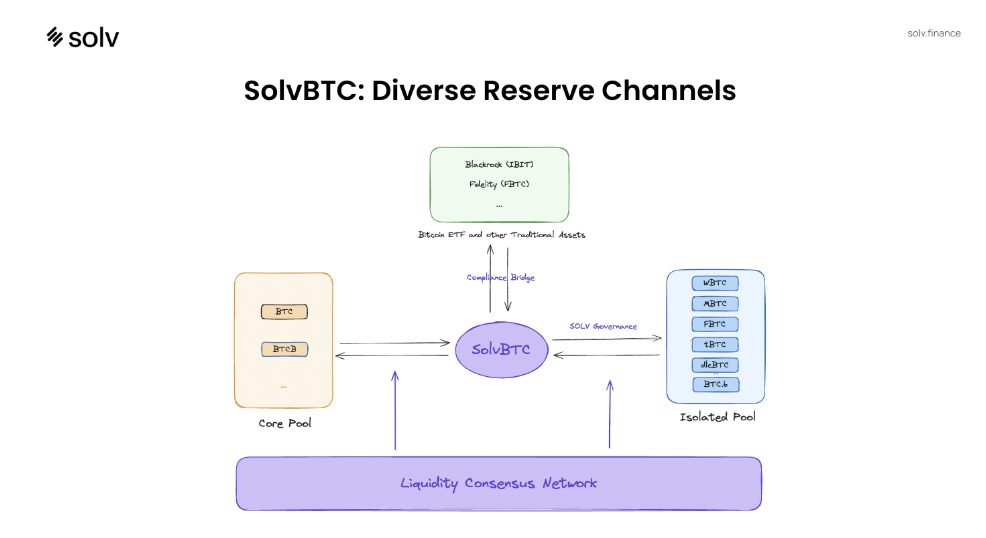
Besides consolidating BTC liquidity across EVM ecosystems, SolvBTC plans to open diversified asset channels. Within the next six months, SolvBTC will officially launch a decentralized mapping solution for BTC mainnet assets. SolvBTC will also actively collaborate with traditional financial institutions and BTC ETFs to onboard significant institutional liquidity.
Every staking project faces scrutiny over genuine user demand. Ryan acknowledged: "Previously, people said our protocol only attracted users through point emissions. But now, we’re confident we can transfer value directly to the product and business model through actual demand. I believe SolvBTC is currently the largest on-chain Bitcoin reserve solution, holding close to 20,000 BTC, with scale still expanding. Our platform offers users an easy one-click way to generate yield. And I truly believe it will become the biggest yield source because it’s the most intuitive and scalable option available."
Finally, Ryan concluded: "I firmly believe SolvBTC will undoubtedly become the gateway to BTCFi—and we are actively moving toward that goal. We want SolvBTC to be the portal that enables easier participation in BTCFi. Overall, our objective is clear: we aim to ignite the BTCFi ecosystem in this cycle. In the past month, I feel this momentum continues to build. With the emergence of various BTCFi ecosystem projects, this sense of acceleration grows stronger. Throughout this process, Solv hopes to play the dual role of the largest on-chain Bitcoin reserve and the primary entry point to BTCFi. Although we’re already the largest today, we still have much work ahead. Reaching $10 billion is just the beginning—we envision reasonable targets at $50 billion, $100 billion, even hundreds of billions. We see the real market demand and size expectations. That’s the role we need to fulfill now." We look forward to seeing SolvBTC push forward steadily on the eve of BTCFi’s full bloom.
Join TechFlow official community to stay tuned
Telegram:https://t.me/TechFlowDaily
X (Twitter):https://x.com/TechFlowPost
X (Twitter) EN:https://x.com/BlockFlow_News
 Foresight News