








Explore the "Pump.fun" on Each Chain: Where to Play and Profit?
TechFlow Selected TechFlow Selected
Explore the "Pump.fun" on Each Chain: Where to Play and Profit?
Overview of Major Memecoin Launch Platforms: Where Can You Still Make Money?
 Navigating Web3 tides with focused insights
Author: Shaofaye123, Foresight News
While the broader crypto market has been experiencing ongoing volatility recently, interest in Memecoins continues to rise. On August 13, Pump.fun set a new record for protocol revenue, surpassing $100 million in cumulative income. Shortly after Sun.pump launched, multiple Memecoins on the platform rapidly exceeded $1 million in market capitalization. This surge caused gas fees on the TRON blockchain to spike and pushed TRX, which had remained stagnant for years, to its highest price in nearly three years. It could be said that Sun.pump almost single-handedly revitalized the entire TRON ecosystem.
In addition, Moonshot has introduced a new token launch mechanism, while BNB Chain sees continuous Meme-related activity. Memecoin launch platforms across various blockchains are flourishing. Which one can rival Pump.fun? Where should users go to make profits? This article provides an overview of major Memecoin launch platforms across chains and analyzes their competitive advantages.
Solana
Solana laid the foundation for this bull cycle starting last year, as Bonk rose alongside SOL. This year, Bome reached Binance within three days, creating frequent thousand-fold returns. The influx of users and capital created fertile ground for Pump.fun's success. The ecosystem features constant innovation in launch mechanisms. Beyond Pump.fun, several other platforms are worth watching.
Pump.fun: From Attention Economy to Asset Issuance Innovation
Pump.fun is the undisputed leader among Memecoin launch platforms. Although many competitors have emerged, most are mere clones. Pump.fun remains unmatched in terms of market attention and热度. Launched at the end of January this year, it initially attracted little notice until gradually entering the mainstream spotlight around April. Its success stems not only from mastering the attention economy but also from clever asset issuance design. From a product standpoint, it holds clear competitive advantages:
-
Clear positioning—Focused market + defined user base = solving real problems. "Users want easier, faster, lower-cost ways to achieve higher returns."
-
Mechanism innovation—Optimized asset issuance. In-pool fundraising combined with a rational pricing curve further reduces issuance costs and accelerates deployment.
-
In mid-August, Pump.fun updated its model: creators no longer pay the $2 creation fee and receive a 0.5 SOL reward upon successful launch. This brings asset issuance cost down to zero, aligning with its original goal of simplifying UGC asset issuance efficiency.
-
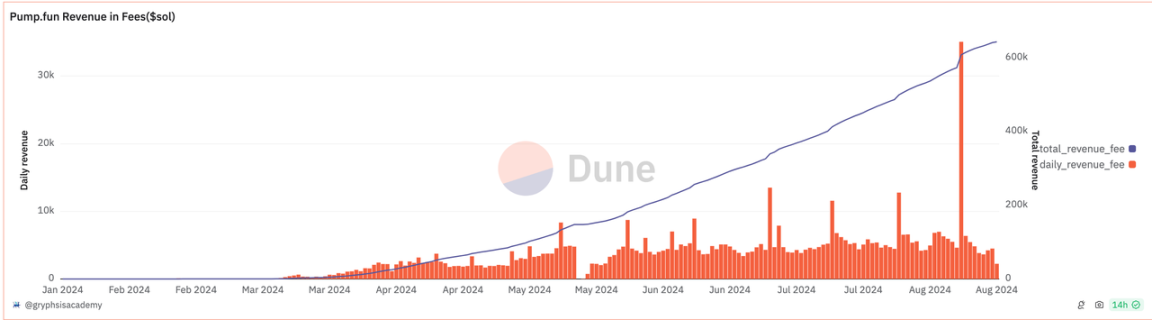
Business闭环—Massive trading volume generates substantial profit. Revenue streams are transparent: 1% platform trading fee before listing on Raydium, plus a 6 SOL "listing fee" during the Raydium integration process.
-
Marketing momentum—Frequent breakout tokens attract traffic and boost fees. A legendary token emerges every month, driving up transaction fees. (As shown in the chart: spikes in Dune’s fee revenue correlate with breakout tokens.)
-
UX optimization—Extremely simple participation with vibrant interface colors. Lowers entry barriers and stimulates engagement.
MakeNow.Meme: Optimizing the Market-Making Model
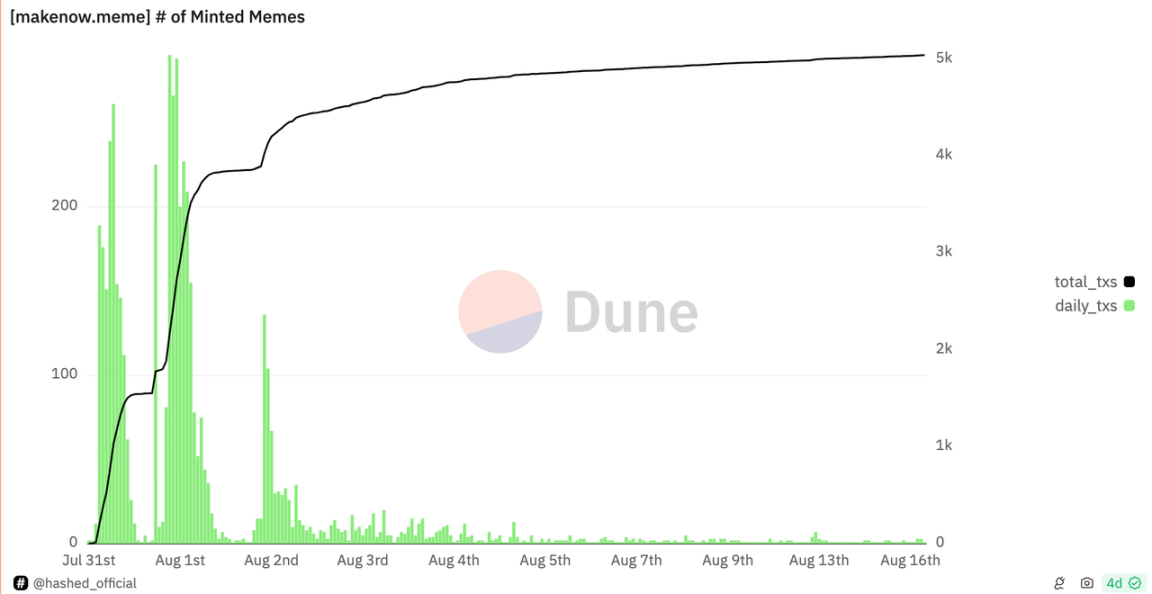
Though currently low in热度, MakeNow.Meme sparked significant excitement at launch, triggering a wave of celebrity-themed coins. At one point, over 2,600 Memecoins were launched in a single day, generating over 230+ SOL in revenue. Compared to Pump.fun, MakeNow.Meme not only further simplifies asset issuance but also introduces a novel market-making model.
-
Further simplified issuance—Post a tweet starting with "$" followed by a ticker symbol and token description/video/image, @ the official account, then wait for the team to reply with the contract address in the comments.
-
Market-making model improvement—Fair launch appears to give everyone equal access via blockchain scanning. However, KOLs or projects might privately coordinate with the platform to acquire low-cost positions early.
Moonshot: Leveraging DEX Screener's Natural Traffic
Developed by DEX Screener around June this year, Moonshot benefits from integration within a high-traffic DEX aggregation platform. Yet its data pales in comparison to Pump.fun. In my view, Moonshot failed to effectively capture and convert DEX Screener’s organic traffic. As a trading aggregator, DEX Screener offers limited and opaque functionality for Moonshot—no metadata preview before launch, non-transparent launch history, and absence of social commenting like Pump.fun. These shortcomings prevent degens from tracing origins, retail investors from communicating, and whales from orchestrating pumps. While Moonshot’s minimalist UI reflects professional development, such a “正规军” approach seems ill-suited for the wild west of doge coins. That said, Moonshot continues iterating; in mid-August, it announced a collaboration with Meteora to introduce a new Meme token launch mechanism incentivizing developers.
Base
The Base chain never lacks active users. The synergy between Farcaster and Memecoins quickly boosted ecosystem activity. Numerous Memecoin launch platforms exist here, though most lack staying power and fail to sustain热度.
Ape.Store: A Near-Identical Clone
Ape.store is functionally and visually almost indistinguishable from Pump.fun. Developers can create tokens for free (excluding gas), and once a token reaches 69K market cap, it auto-lists on Uniswap at the same price, followed by immediate LP burn. After Pump.fun's update, Ape.store immediately tweeted that until August 31, 2024, any developer launching a project and listing on Uniswap would receive 0.1 ETH. Unlike Pump.fun, Ape.store features transparent leaderboards based on trading volume and referrals, hinting at potential future token emissions.
Rug.fun: Horse Racing Game
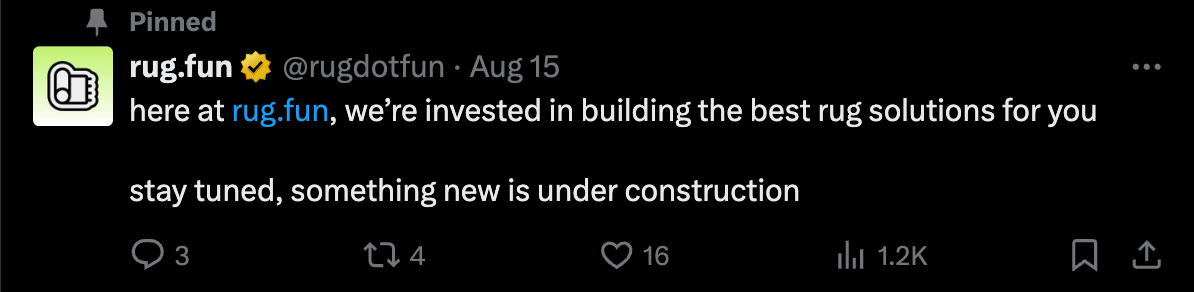
Originating from the Farcaster ecosystem, Rug.fun introduces a relatively unique gameplay mechanic resembling a horse race. Players must correctly predict both the #1 and #10 finishers to earn high odds. Each round lasts 12 hours, during which players can create or buy into tokens. Initially, players may freely switch their bet without extra cost. Over time, switching fees increase. Eventually, other projects add liquidity to the top pool, driving up its price. After two months of silence, the official Twitter account announced on August 15 that updates are underway.
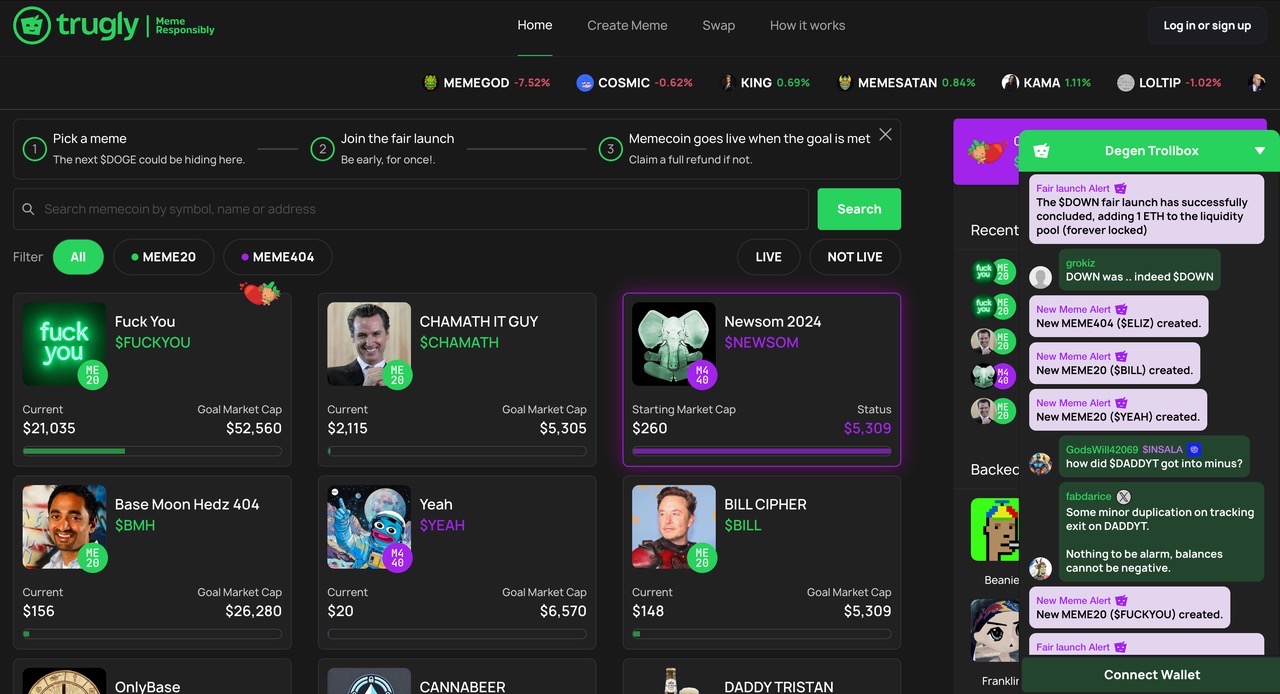
Trugly.meme: From MemeX to Meme 404
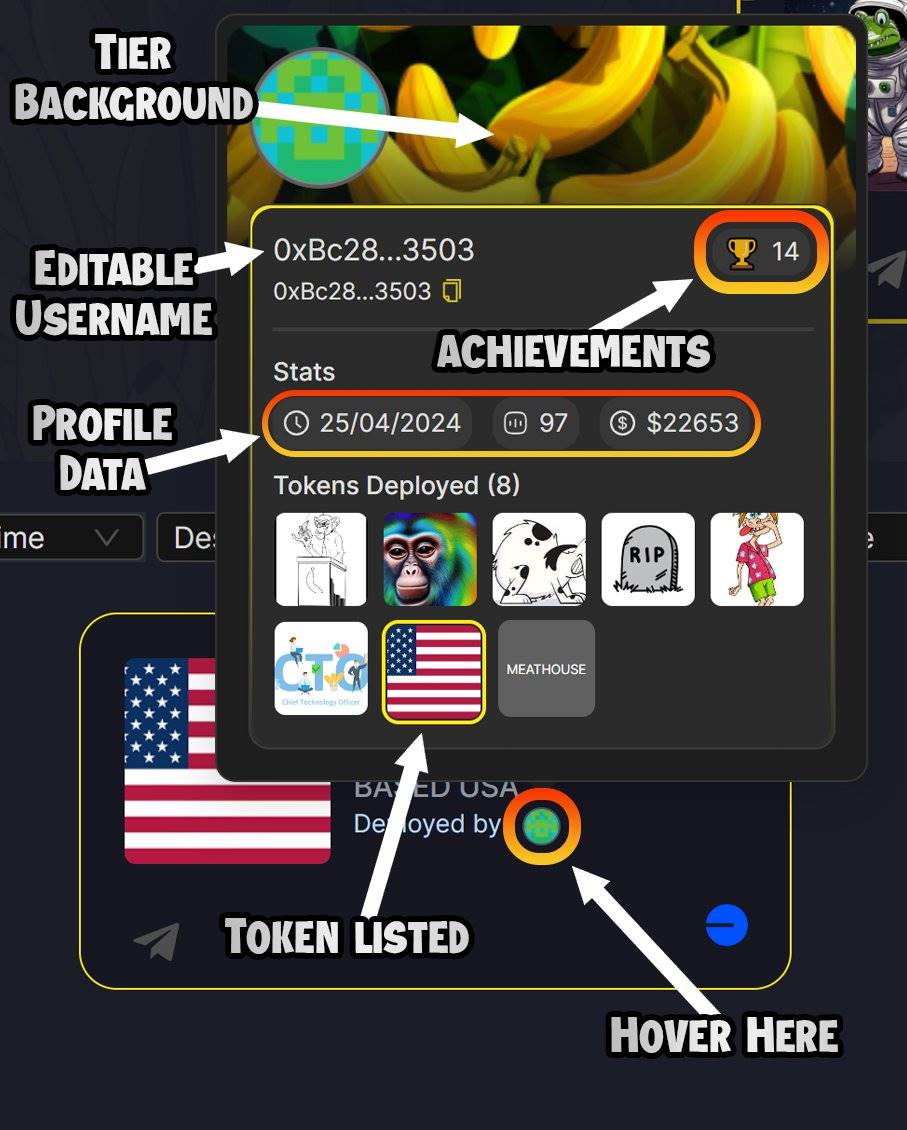
As a Memecoin launch platform, Trugly.meme doesn’t differ much from Pump.fun in issuance mechanics, but offers more diverse玩法. Its MemeX feature allows anyone to create a memecoin for a Twitter account, but only the account owner can claim it. Upon claiming, 80% of trading fees are redirected to the owner. Additionally, it adopts the MEME404 token standard, enabling holders to display balances via NFTs and unlock different tiers. MEME404 includes built-in mechanisms that automatically mint and burn NFTs based on balance changes, ensuring tier levels stay updated.
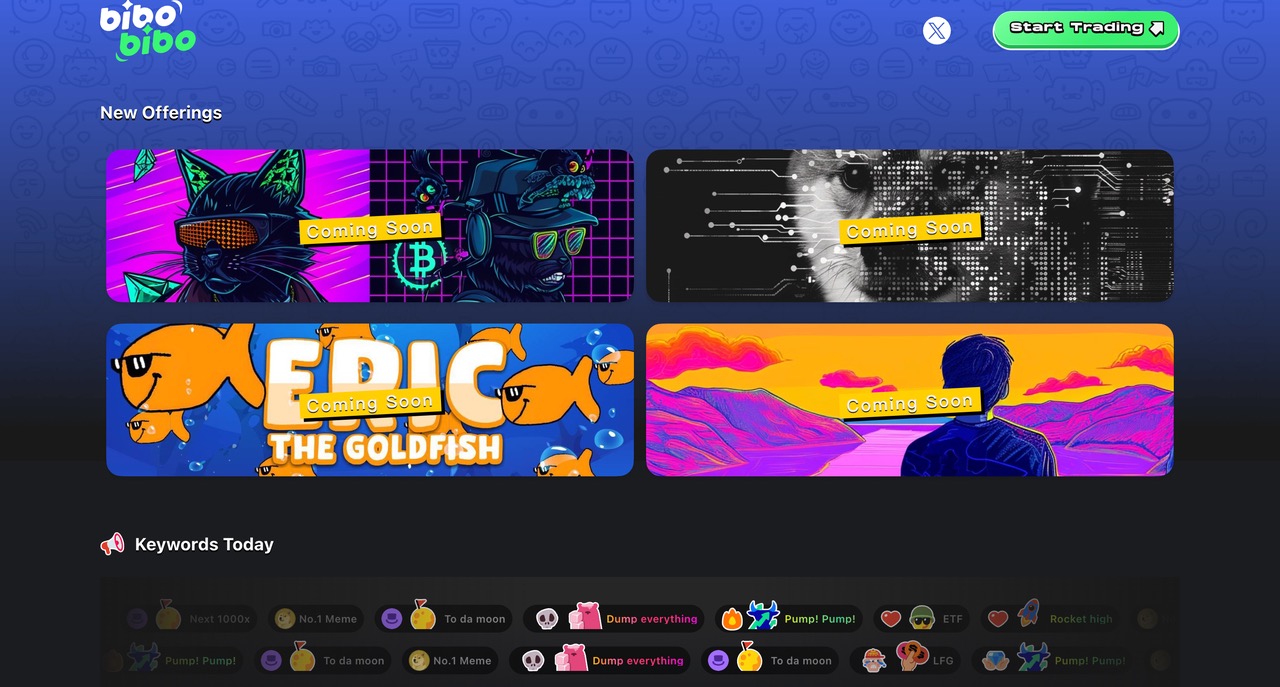
Bibobibo: Bullet-Chat Social Trading
Bibobibo sounds similar to Bilibili, and its core functionality mirrors that platform. It positions itself as a bullet-chat-style trading platform centered around memes, allowing users to interact in real-time while participating in Memecoins—an expansion of Pump.fun’s comment feature. However, unlike MakeNow.Meme where attention drives value upfront, Bibobibo’s attention mechanism kicks in later. The project remains in early stages and hasn’t officially launched yet.
BNB Chain
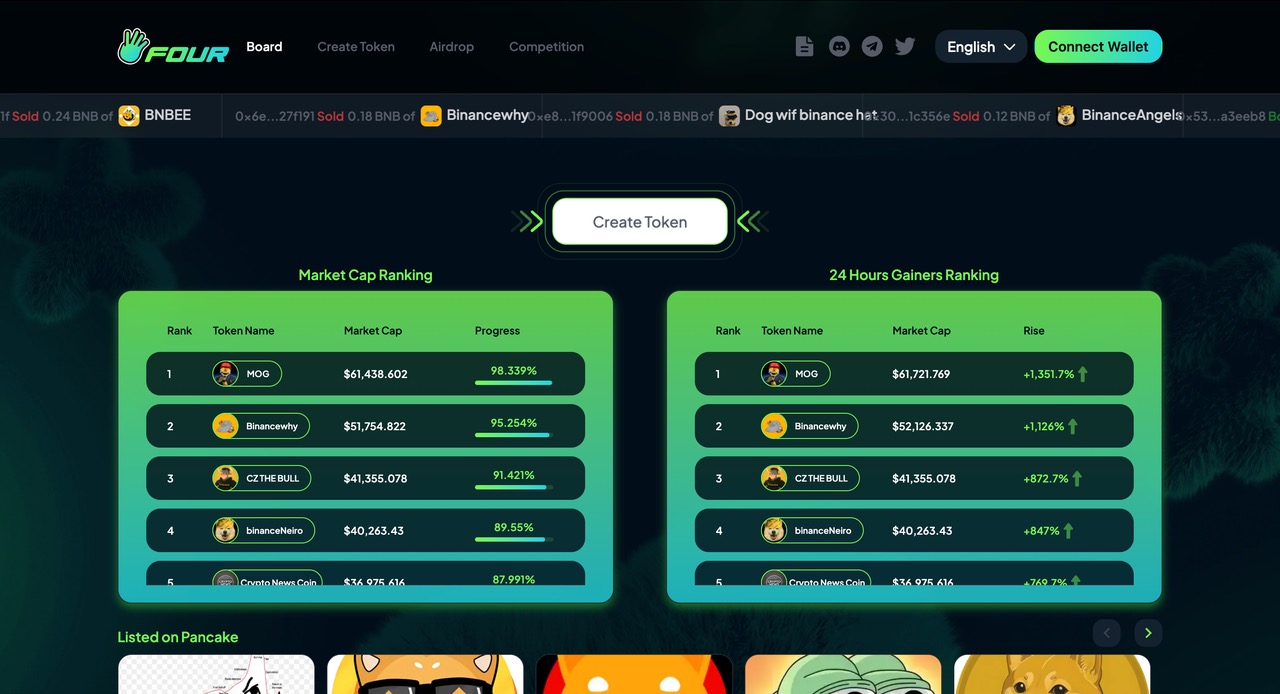
Four.meme: Origins of Four
Four.meme, a launch platform on BNB Chain, clearly draws inspiration from BNB—from its name to its brand logo, referencing CZ’s iconic “Four” hand gesture. Additionally, 4chan, a Web2 incubator for Memecoins, may have influenced the naming. Whether judging by founder statements or promotional events, Four.meme has received considerable support from BNB Chain. It partnered with the FOUR token on an airdrop campaign: users complete tasks on the platform to earn points redeemable for FOUR and WHY, two Meme tokens in the BNB Chain ecosystem. Backed and retweeted by BNB Chain, the announcement drove FOUR’s price up over 65% in 24 hours. In mid-August, Four.meme launched a Meme creation contest with a prize pool of 1 million Four.meme points and $20,000 worth of Meme tokens, inviting guests including Bili (founder of In2Ventures), NBA star Tristan Thompson, and teams behind WHY and FOUR.
Flap: Advanced PVP Mechanism
Flap is a decentralized social application protocol on EVM, born from ETHGlobal Hackathon. The team boasts strong backgrounds from renowned institutions such as KuCoin, Microsoft, MIT, and Morgan Stanley. Flap’s standout feature is its advanced and abstracted PvP mechanism.
In Flap duels, when a Memecoin reaches $24,000 market cap, it enters the duel candidate pool. Tokens compete head-to-head; during duels, participants can only buy, not sell (driving prices up). Each match lasts 30 minutes, and the token with the highest total purchase volume wins. The losing token’s liquidity is fully used to buy the winner, boosting its market value and community size. If the winning token reaches ~$1M market cap, it gets listed on a decentralized exchange. OKX Wallet has already integrated Flap to enhance user experience. Flap also plans to host trading competitions where participants earn airdrop points for trades, redeemable for future airdrops.
Tron
Sun.pump: Rapid Rise, Breakout in a Week
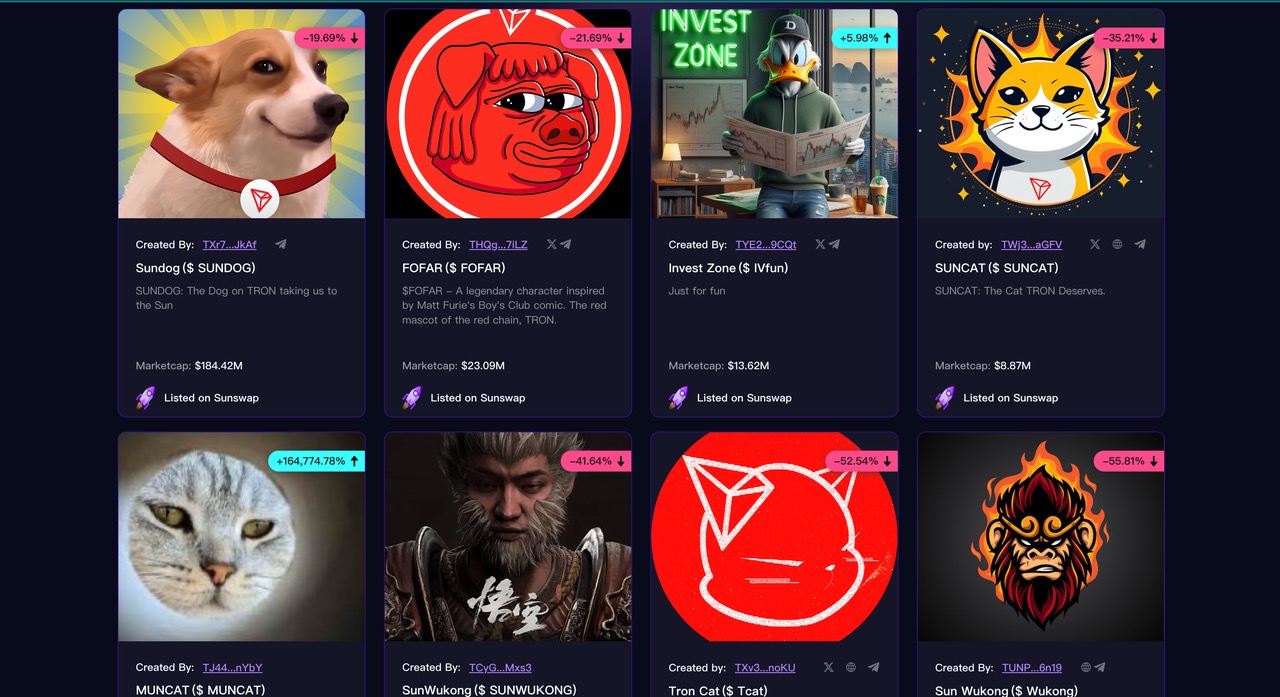
Sun.pump is the first meme issuance and trading platform launched on TRON. Its beta version went live on August 13 and quickly formed strategic partnerships with Dex Screener, Huobi HTX, and Poloniex. Together with Trondao, it launched a $10 million Meme ecosystem incentive program, attracting massive speculative capital and achieving rapid virality.
Within just one week of its beta launch, multiple Meme projects on Sun.pump surpassed $1 million in market cap. Sundog peaked near $300 million with over $5 million in 24-hour trading volume. The platform actively promotes hype: after Justin Sun changed his Twitter profile picture to the Monkey King from *Black Myth*, the associated Memecoin SUNWUKONG briefly surged eightfold to $5 million in market cap. Sustained marketing efforts have also contributed to rising TRX prices.
Aptos
Uptos: Platform Token = Memecoin
Uptos is a Memecoin launchpad on the APT chain. Beyond basic token issuance, it integrates distribution and burning tools for developers, with plans to add claim and linear release functions. Launched in April, the platform issued its own token UPTOS, which briefly reached a $13M market cap. However, subsequent projects failed to retain capital, and UPTOS has since dropped to a $1.2M valuation.
Avalanche
BellumExchange: The DeFi Version of a Memecoin Launchpad
BellumExchange is a Memecoin launchpad on the AVAX chain, using a liquidity order book model similar to Trader Joe. Users can create custom pricing curves to implement diverse issuance strategies. Compared to other platforms, BellumExchange stands out with customizable pricing curves, adjustable total supply, and no fees for token creation or LP migration—emphasizing affordability. Additionally, it offers stakers a 0.25% JLP yield per epoch, mirroring Trader Joe’s incentive mechanism.
Fractal Bitcoin
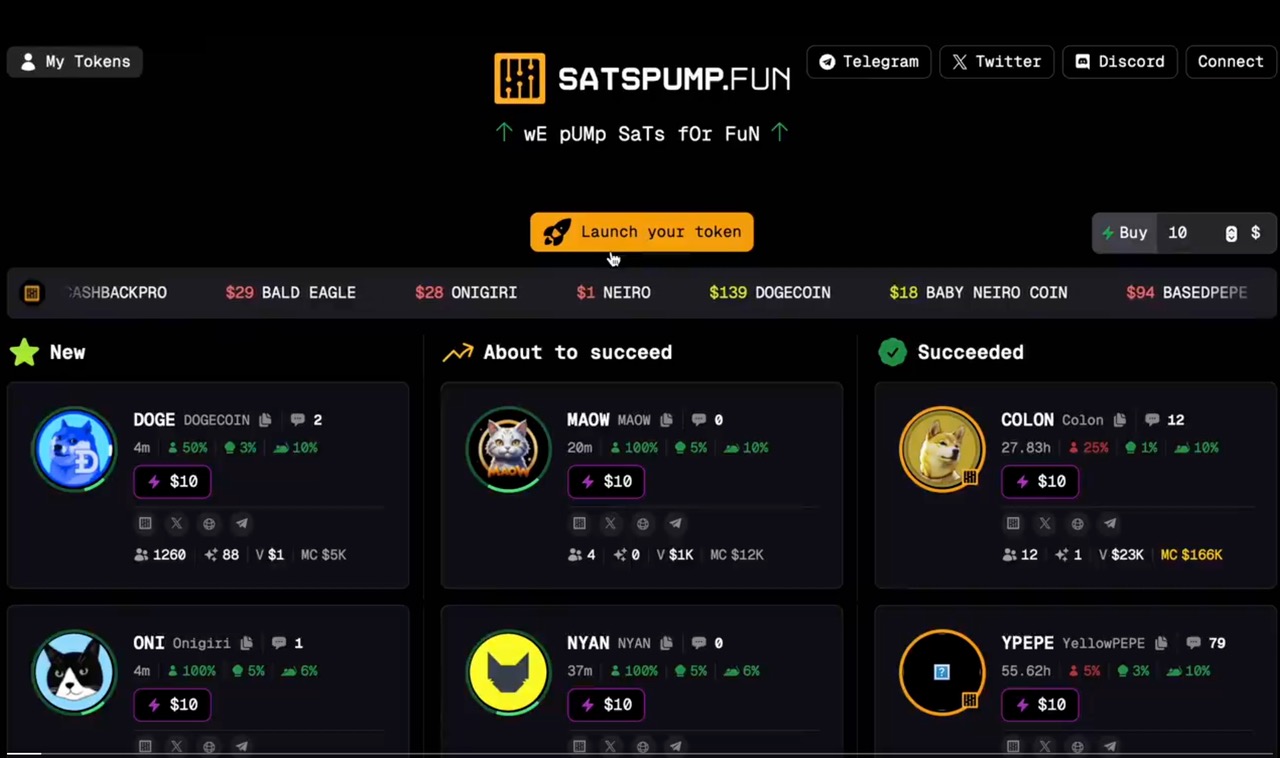
Satspump.fun
Satspump.fun is a Memecoin issuance platform on Fractal Bitcoin, an extension network of Bitcoin. It has partnered with UniWorlds, a gaming infrastructure provider in the Bitcoin ecosystem. On August 9, the team announced a BRC-20 airdrop: users holding whitelisted BRC-20 tokens (ORDI, SATS, PIZZA, SHNT, WZRD, HONK, RATS) valued at $300 or possessing three bitmap NFTs qualify for the drop. Currently, the Fractal Bitcoin mainnet has not launched and is scheduled to go live on September 1.
Summary: Platforms Grow More Diverse, Liquidity Gets Fragmented
Today, nearly every chain has its own version of Pump.fun. As various blockchain-based Memecoin launch platforms emerge, traffic across the Memecoin market is being fragmented. With insufficient new liquidity entering the market, it's harder to inflate token valuations—the pie is being sliced thinner. Increased competition isn't reducing PvP intensity; instead, it's becoming fiercer. Under the battle of Web2 giants, price wars bring generous user subsidies and perks. But in the Memecoin space, without fresh liquidity, fragmentation across platforms makes it harder for users to profit.
Memecoins represent a zero-sum game heavily reliant on luck. Kelly Criterion calculations consistently warn against participating without solid strategy—it's essentially a gambling game where nine out of ten lose.
Currently, Sun.pump has captured significant attention as a rising star, driving up TRX prices. For now, speculative capital is flowing in, liquidity is abundant, and new TRON users are surging—making it a platform with visible profit opportunities. However, sustainability remains uncertain. Meanwhile, Solana remains the most liquid blockchain for Memecoins, and user habits are hard to shift. But after a short-term loss of attention, whether it can regain momentum remains to be seen. Base and BNB Chain have official backing and events, yet wealth effects remain underwhelming.
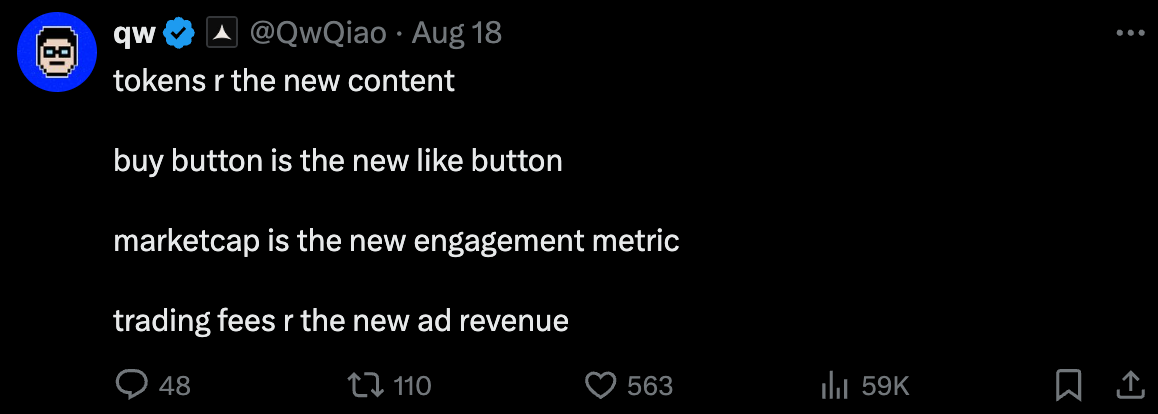
"Tokens are the new content, the buy button is the new like, market cap is the new engagement metric, and trading fees are the new ad revenue." Despite appearances of diversity, today's Memecoin launch platforms face hidden crises and urgently need new narratives to expand market size.
Join TechFlow official community to stay tuned
Telegram:https://t.me/TechFlowDaily
X (Twitter):https://x.com/TechFlowPost
X (Twitter) EN:https://x.com/BlockFlow_News
 Foresight News






