Bloomberg Decodes the Worldcoin Orb Factory: Humanity's Bold and Absurd Defender
TechFlow Selected TechFlow Selected
Bloomberg Decodes the Worldcoin Orb Factory: Humanity's Bold and Absurd Defender
Before defending against the potential crisis of super artificial intelligence, Orb has already become a technological marvel.
 Navigating Web3 tides with focused insights
By Ashlee Vance, Bloomberg
Translated by Luffy, Foresight News
Nuremberg, Germany is picturesque and charming, with little in the way of high-tech flair at its city center. It has a castle and a cathedral, billboards promoting German sausages, and rows of ice cream shops that attract tourists. Yet on an ordinary weekday in mid-May, the city hosted a serious gathering of tech enthusiasts.
At Josephs, a futuristic-themed retail store along a main thoroughfare, visitors encountered a mysterious metal orb about the size of a cantaloupe. This object, called Orb, was polished with shiny chrome and mounted atop a black rod extending from a large rectangular wooden base. The entire device sat near a window at the edge of Josephs’ main exhibition hall. Nearby, one of its creators, Alex Blania, took a seat at the far end of the room, answering questions from an interviewer in front of dozens of German computer science and engineering students—locals celebrating the success of their hometown prodigy.
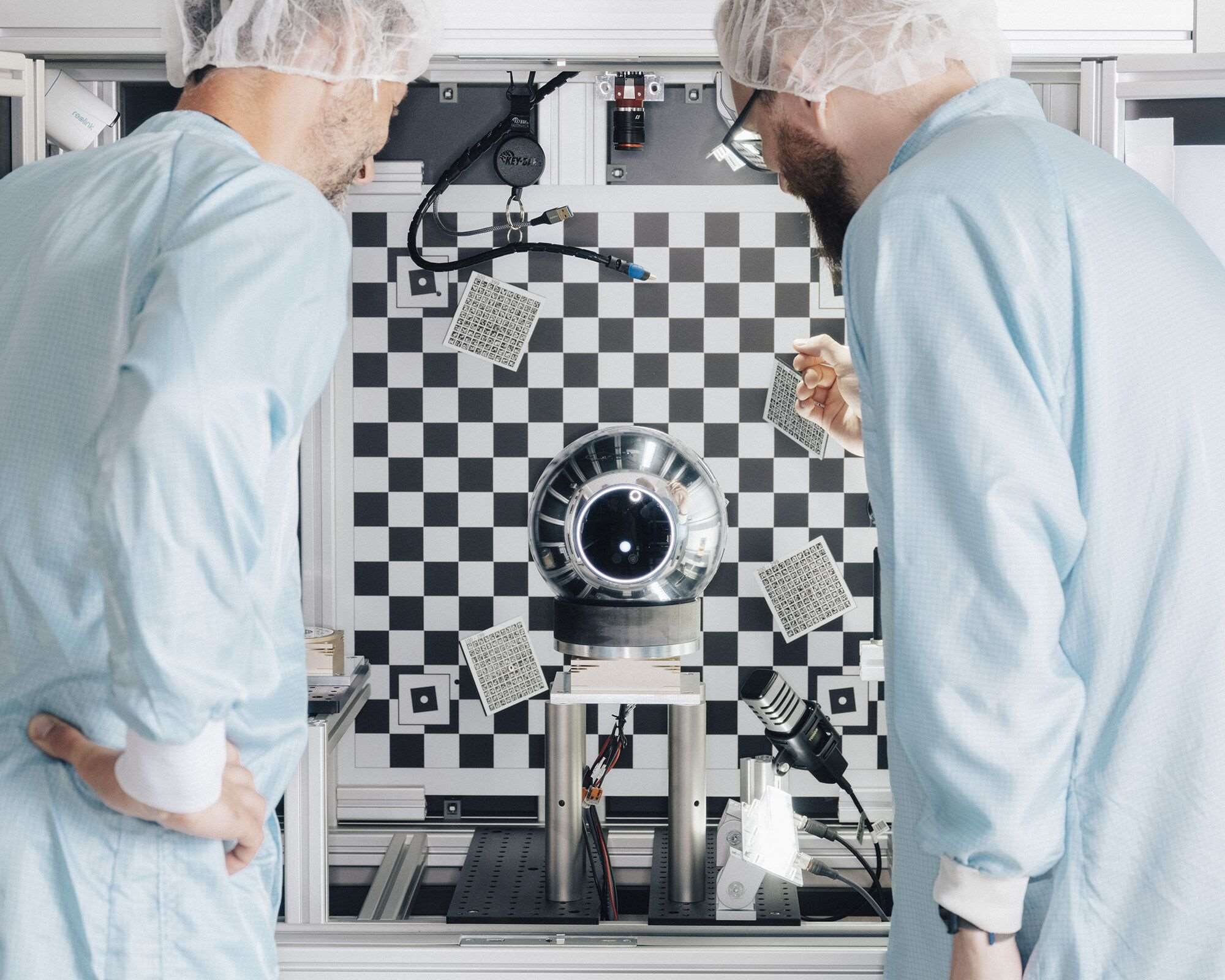
Workers observing Orb. Source: Bloomberg Businessweek
Europe has seen some major tech successes, but it has long lagged behind the U.S. in both the number and quality of tech companies and entrepreneurial ideas. That’s precisely why people are cheering for Blania. He is CEO of Tools for Humanity Corp., a company using Orb to verify the identity of every person on Earth—as part of the cryptocurrency system Worldcoin. Tools for Humanity is headquartered in San Francisco and Erlangen, Germany. The company was founded by Sam Altman, who is also its primary financial backer, along with investors including Tiger Global Management, Fifty Years, Khosla Ventures, Andreessen Horowitz, and dozens of others who’ve contributed over $250 million, according to the company’s website, toward building a “fairer economic system.”
To achieve this ambitious goal, Tools for Humanity wants to create a global identity system for humanity. Their idea is that AI is advancing so rapidly that we’ll soon need a way to distinguish humans from machines. In other words, to prevent the internet from being flooded with deepfakes, scams, and other harms caused by superintelligent AI, we must answer a fundamental question: Are you human or not? That’s where Orb comes in. Under human supervision, it captures images of people’s irises and grants them a unique World ID, binding a real human to a machine-generated string. You can then use your World ID to log into Shopify, Reddit, or Discord servers, making interactions safer because everyone knows they’re dealing with real, flesh-and-blood humans—not artificial intelligence.
Registering on Orb at Josephs. Source: Bloomberg Businessweek
Yet this is only the first step in a highly futuristic vision. People who obtain a World ID also receive a reward in the form of WLD, a cryptocurrency issued by Worldcoin. Tools for Humanity, which manages Worldcoin, Orb, World ID, and all related products, believes cryptocurrency is essential for addressing income and resource distribution challenges posed by AI. The company hopes to build a financial network capable of distributing regular subsidies to those in need. In this scenario, the Worldcoin network would serve as a government-independent financial safety net for people around the globe.
Blania and Altman formally unveiled their Worldcoin master plan about a year ago, and the response since has been mixed. On one hand, they’ve convinced more than 6 million people to register a World ID via Orb, and registration rates have surged this year. The total market value of the WLD cryptocurrency exceeds $550 million. Orbs are now being mass-produced at a factory in Germany and will soon be distributed worldwide.
On the other hand, many find Worldcoin’s ambitions absurd and dystopian—a privacy nightmare straight out of Orwell. Several countries have halted iris scanning operations, concerned that individuals standing before Orb don’t fully understand what they’re agreeing to. As Hong Kong’s regulator said in May, collecting biometric data is “unnecessary and excessive.”
Thirty-year-old Blania is well aware of these criticisms and acknowledges that Worldcoin got off to a rocky start. Bloomberg first reported on the company’s activities in 2021, and months passed before the founders were ready to articulate their intentions. “We took early hits,” Blania told the students at Josephs.
But over the past year, Blania and his team have worked to systematically address each of Worldcoin’s challenges. They’ve improved Orb’s security features and refined how the company handles user data. They’ve met repeatedly with regulators and successfully persuaded countries like South Korea and Kenya to lift bans on Orb. Yes, the Worldcoin project sounds crazy—even Blania himself puts its chances of success at just 5%. Still, in interviews with Bloomberg Businessweek, he insists governments and the public haven’t caught up with the technological shifts ahead, nor built the tools needed to manage AI’s impact when it arrives. “Having Orb and failing is better than never having Orb at all,” he says.
“This is really what’s coolest about Silicon Valley,” Blania told the students. “You can raise $250 million on a crazy idea. If it works, everything changes. If it fails, at least it was worth trying.”
Blania stands 6-foot-3, lean, and radiates an easygoing charm even when discussing protocols, blockchain, and biometric systems. He’s fluent in all the latest tech jargon, yet approaches Worldcoin and its mission with the meticulous rigor of a classic German engineer.
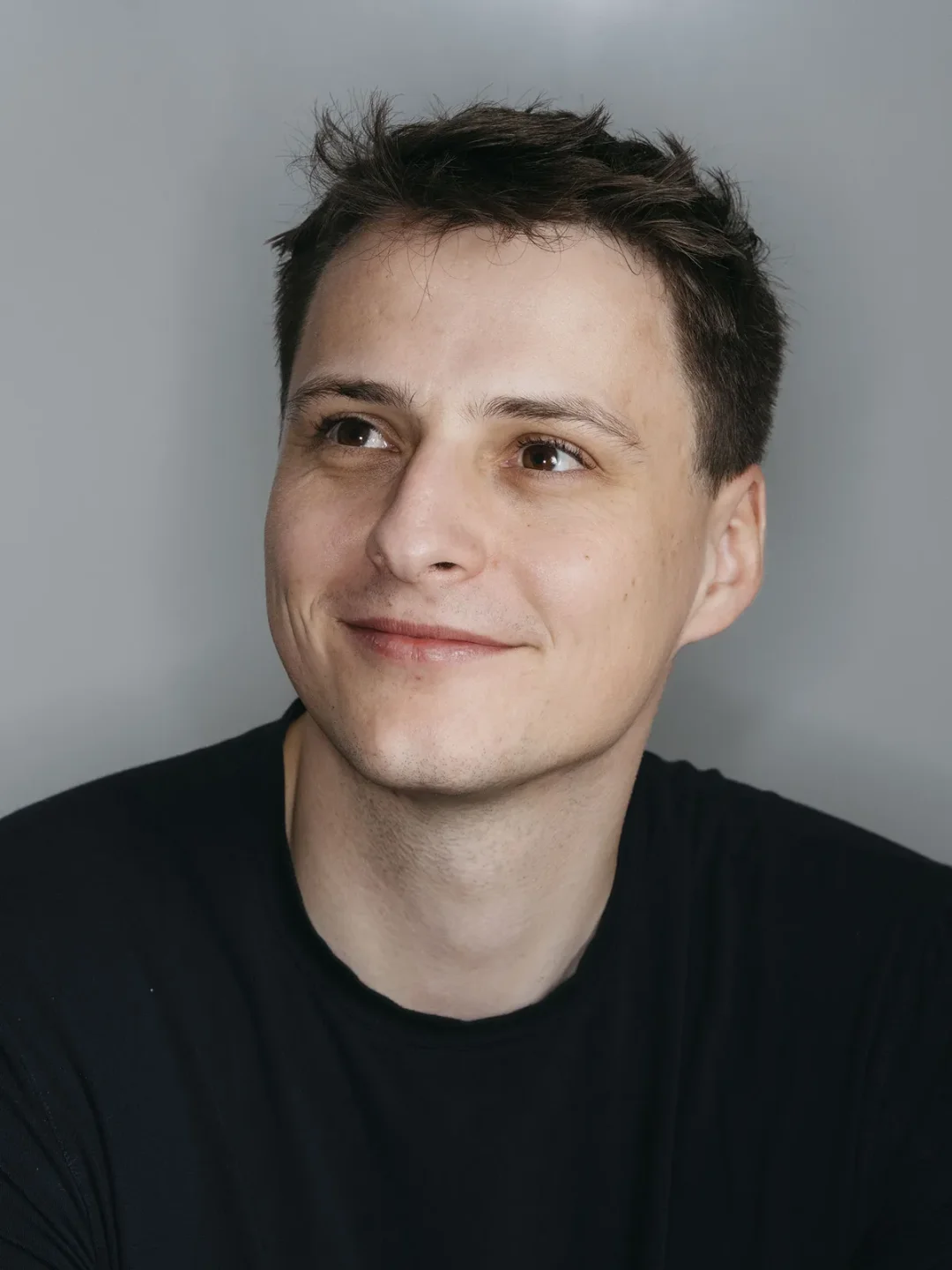
Alex Blania
Over coffee at a riverside café along the Pegnitz River, Blania shared his story. He grew up in a small rural town about a 45-minute drive from Nuremberg. His father held an unusual consulting role, serving as interim CEO at several troubled companies. His mother worked in accounting and finance. From a young age, Blania loved mechanical engineering, electronics, and computer programming. He undertook various projects at home: modifying an Austin Mini car, building an automated beetle counter to monitor forest health, and constructing a vertical farm.
In college, Blania developed a strong interest in physics and artificial intelligence. He earned a master’s degree in physics from Friedrich-Alexander University Erlangen-Nuremberg and later studied at Caltech, seemingly destined to become a theoretical physicist.
But the stories and legends of Silicon Valley pulled him in. He made periodic trips from Europe to San Francisco, seeking entry into the startup world. While studying at Caltech, Blania drove his beat-up Toyota Corolla to San Francisco every weekend, trying to meet entrepreneurs. These efforts eventually paid off. Over time, he built enough connections that one day he received a random email from Max Novendstern, a young Harvard graduate known for novel fintech ideas.
It was October 2019. Novendstern wrote that he and Altman had been brainstorming a cryptocurrency project and wondered if Blania would be interested in an interview. “I didn’t know anything about cryptocurrency,” Blania said. “The email included a two-page vision statement written by Sam and Max, but I honestly couldn’t understand any of it.”
Still, Blania deeply admired Altman, who had served as president of the startup incubator Y Combinator and was then the new CEO of OpenAI. Blania took two weeks off from school and read as much as he could about cryptocurrency and universal basic income (UBI)—a concept Altman was personally obsessed with, referring to unconditional, regular payments from governments to citizens. Blania became fascinated too, starting to believe that if cryptocurrency went mainstream (rather than remaining a tool for financial speculation and scams), it could unlock greater economic freedom and financial possibilities for people. “Another idea was that AI would become widespread, society would restructure, and we’d need infrastructure to ensure these technologies benefit humanity,” Blania said.
ChatGPT wouldn’t be released by OpenAI for another three years, and the public hadn’t yet begun daily discussions about AI’s impact. But Altman and Novendstern were already thinking deeply about it—and now so was Blania. Altman declined to be interviewed, but he had multiple conversations with Blania about the future: if left unchecked, AI could dominate the internet and cause economic upheaval, and only a flexible financial system distributing funds and computing resources globally could correct this. Blania found the Worldcoin plan both “ridiculous” and “ambitious”—a combination he loved—and decided to drop out of school to join the venture as a co-founder.
The Worldcoin project was originally supposed to be based entirely in San Francisco—an obvious choice. But the global pandemic redirected those plans.
In March 2020, Blania boarded a flight to Germany, intending to visit old classmates and learn about designing top-tier biometric systems. Just before takeoff, President Trump announced the U.S. would close its borders. Blania expected the restriction to last a month or two. Instead, he ended up stranded in Germany, and Worldcoin’s second headquarters was established in the university town of Erlangen, where Blania assembled a team that built the first Orb.
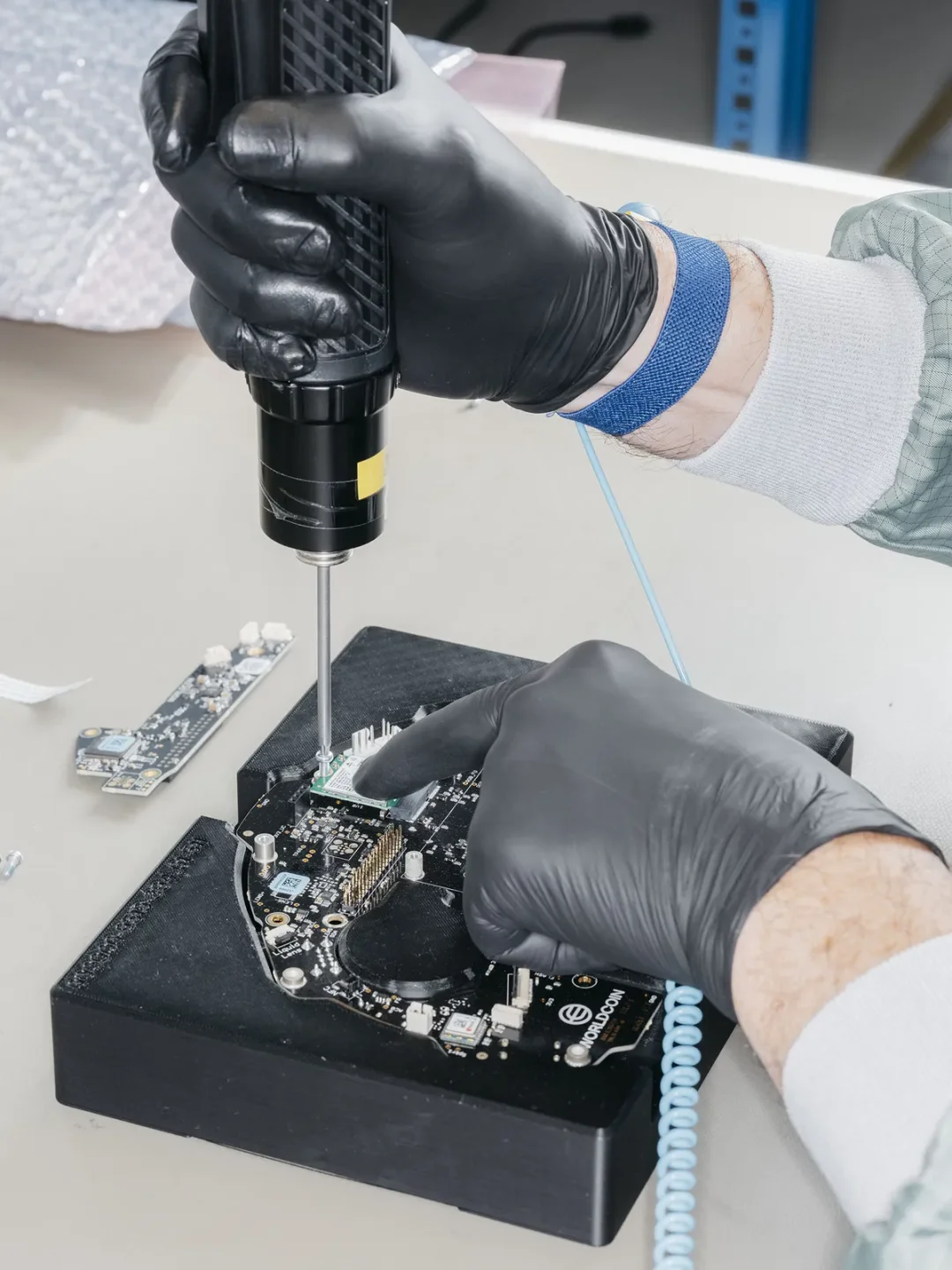
Orb assembly plant in Jena, Germany. Source: Bloomberg Businessweek
Early Worldcoin staff spent months analyzing existing biometric systems and poring over technical documents, searching for the best way to register billions of people on a single identity platform. They quickly realized that some of the most common systems—like facial recognition and fingerprint scanning—didn’t meet Worldcoin’s technical requirements.
Their biometric scanner first needed to confirm that a live human was present. This meant detecting biological heat signals, among other things. It also had to instantly verify that the person being scanned wasn’t someone already registered. The only system that seemed to align with Worldcoin’s goals was India’s national biometric database, which uses iris scanning for identity verification.
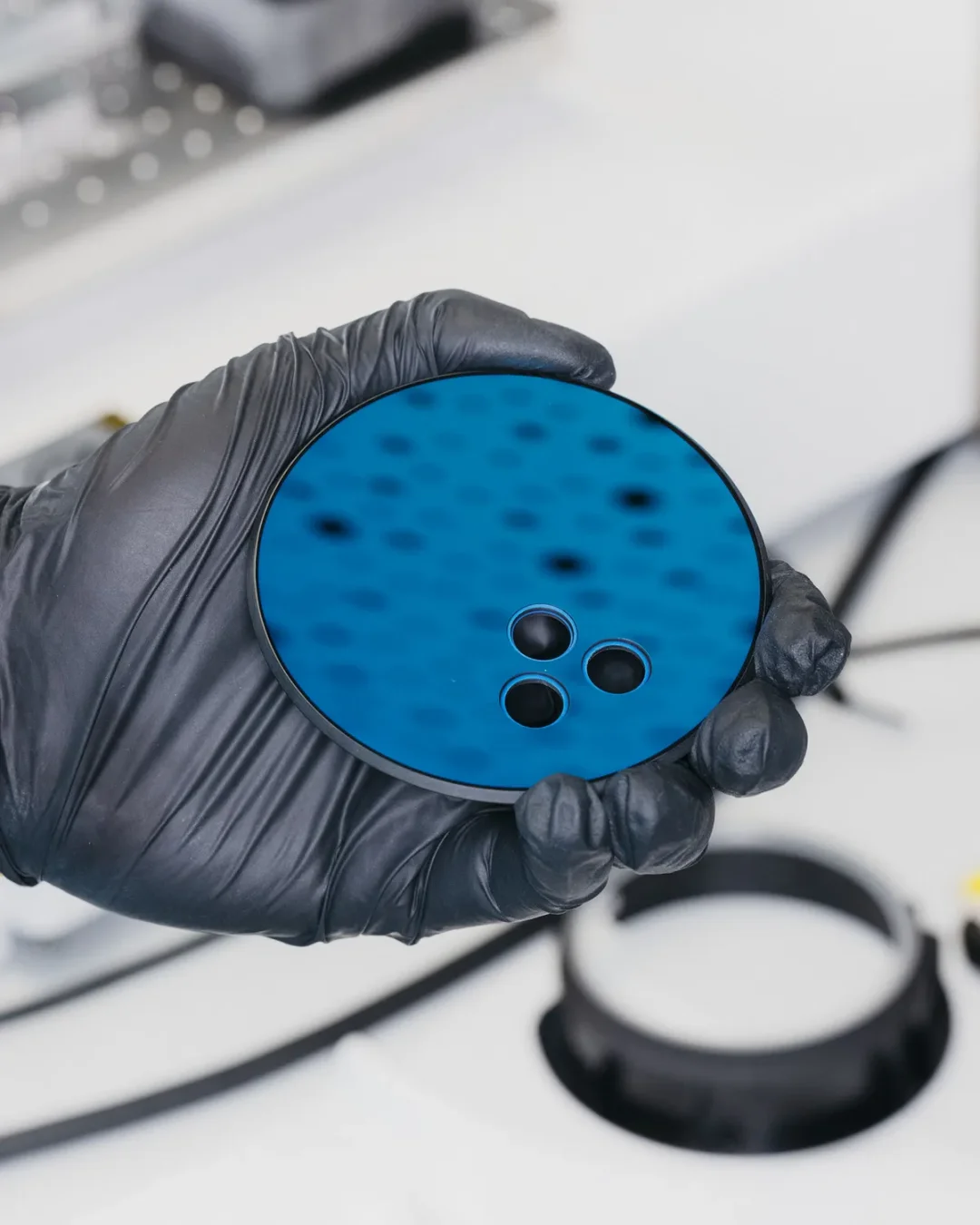
Optical filter. Source: Bloomberg Businessweek
One drawback of smartphone biometrics is that, in Mission: Impossible-style scenarios, humans (or superintelligent robots) can fool them by wearing masks or replicating fingerprints. Iris patterns, however, are far harder to mimic due to their high degree of variation—what biometric experts call entropy. Irises contain diamond-shaped pits called crypts, circular lines at the outer edge called furrows, and broad pigment gradients that give eyes a marbled appearance. Even identical twins have different iris patterns.
The Worldcoin team’s task was to adapt iris-scanning technology from India and elsewhere, combining it with additional techniques to prove a live human is present during scanning. Engineers had to make this process fast and simple for users.
Worldcoin could have designed a plain box to house all the hardware—a more production-friendly approach. But the founding team felt they needed to make a statement. They chose a shiny metallic sphere that resembled a giant robot eye.
The first Orb designs were created in humble conditions. Blania recruited Fabian Bodensteiner, a former classmate from Friedrich-Alexander University. After graduation, Bodensteiner started a hardware engineering consultancy and reserved space in his Erlangen office for initial design work. The cramped area overflowed with circuit boards and cameras, and beds were placed alongside the equipment where Blania, Bodensteiner, and others rested.
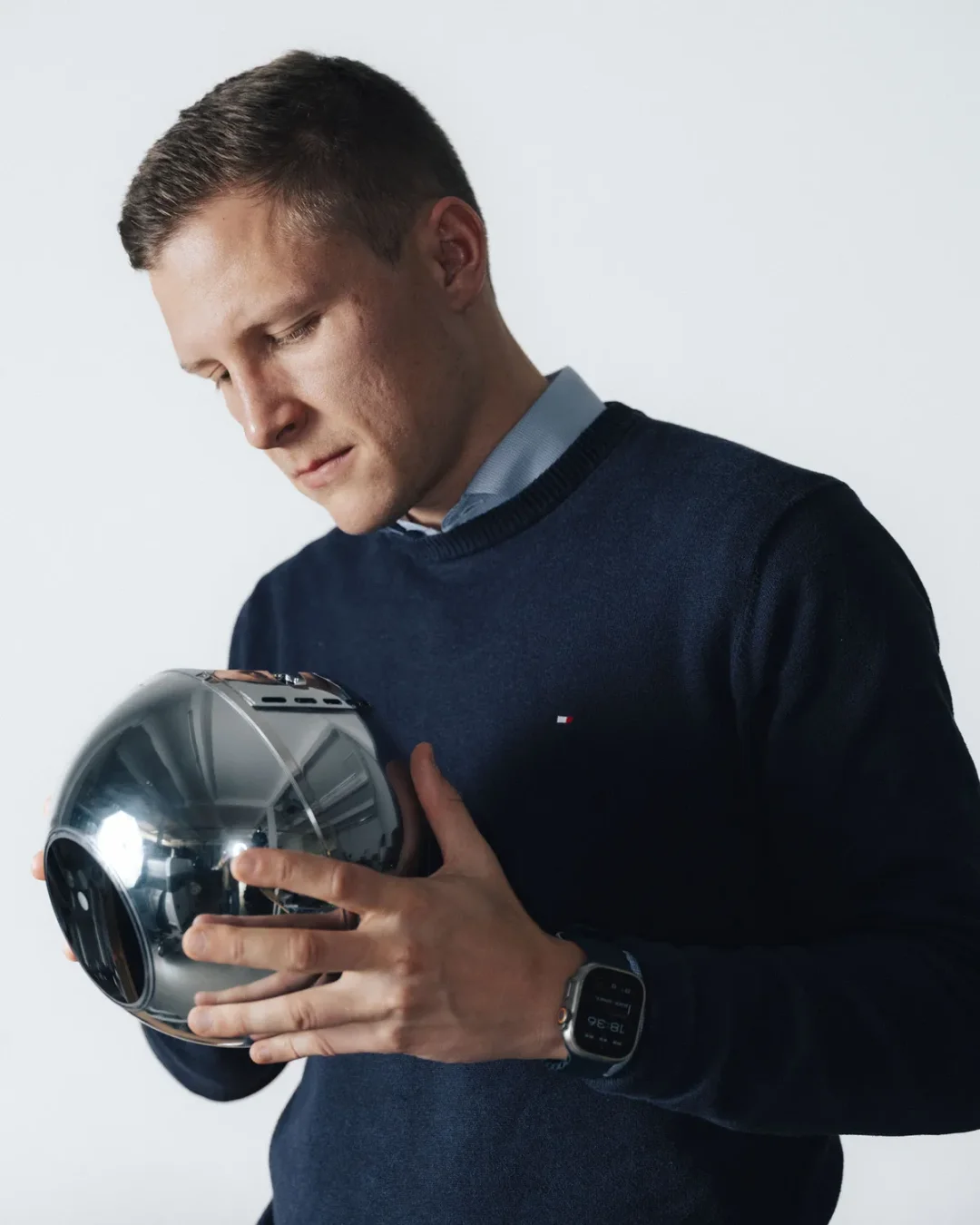
Bodensteiner. Source: Bloomberg Businessweek
By summer 2021, Blania and his team had built Orb prototypes and began field testing. The Orb wasn’t just spherical and visually striking—it also dispensed a physical metal coin from a slot on the front when people registered. (This “feature” was intended to make cryptocurrency feel more tangible; Worldcoin later abandoned the gimmick.) Blania and his team set up in Erlangen’s city square, introducing the product and attempting on-the-spot registrations.
The event did not go smoothly. The device’s speaker beeped and chirped, instructing people to move closer or farther from the Orb to improve camera focus. Meanwhile, a Worldcoin engineer had to wirelessly connect to the device and debug software in real time to complete registrations. “We stood there looking like fools,” said Chris Brendel, an early Worldcoin team member and now head of AI and biometrics. “It was terrible.”
Three years later, today’s Orb is a technological marvel. At its core are several interconnected circuit boards performing various functions. One board checks for attempts to hack or tamper with the Orb. Another contains an Nvidia Corp. chip that runs computer vision and other AI software through neural networks directly on the device. Additional sensors track the Orb’s GPS location and enable wireless data transmission. An aluminum plate embedded between electronic components helps dissipate heat.
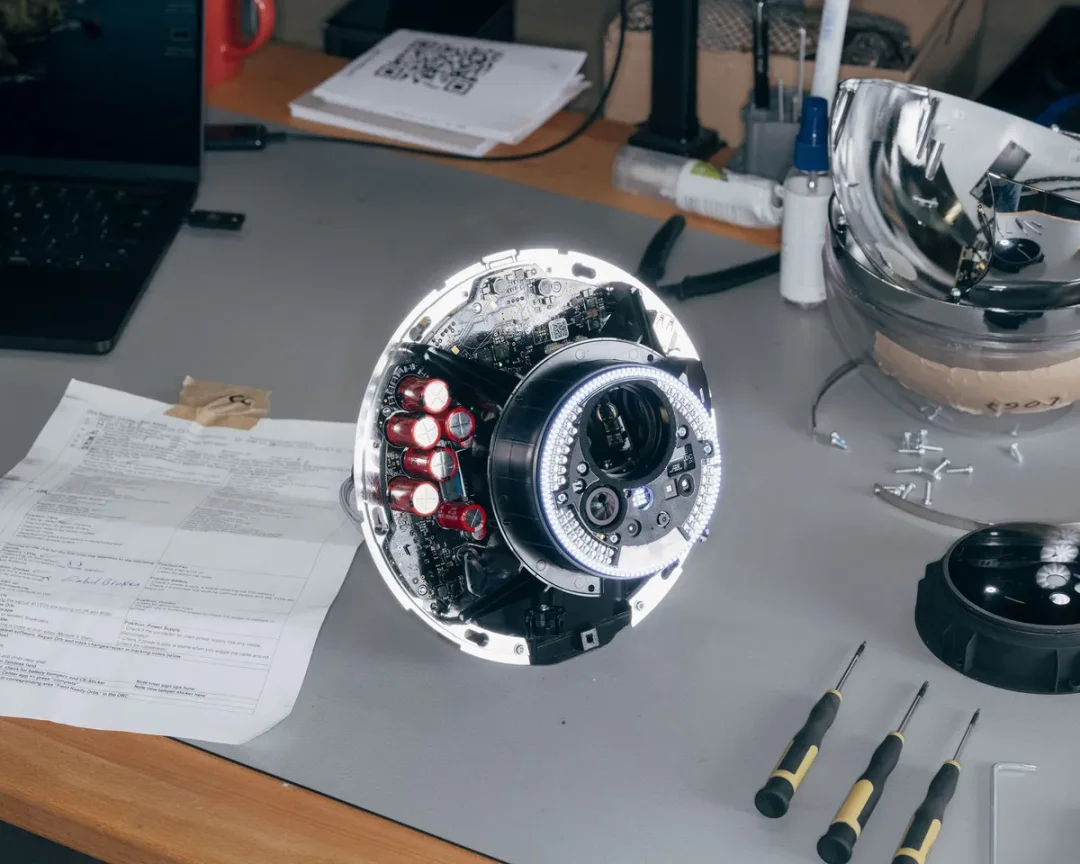
Orb main circuit board. Source: Bloomberg Businessweek
The optical system required even more careful, customized engineering. Worldcoin wanted people to simply walk up to the Orb and scan their irises without detailed positioning instructions or time-consuming adjustments. This proved extremely challenging. During testing, the company found some people pressed their faces against the Orb while others stood far away, swaying unpredictably.
To solve this, Orb uses two lenses. A wide-angle lens assesses the scene and uses neural networks to predict the likely position of the eyes. A telephoto lens on a gimbal moves to capture a close-up. Worldcoin partnered with a Swiss company to develop a novel focusing mechanism: a lens made of a thin membrane filled with oil that can be reshaped by electric current. The oil can be pushed into the membrane to change the lens’s focal length within milliseconds, magnifying the iris without bulky mechanical parts. “It’s much more compact compared to traditional methods requiring multiple lenses,” said Bodensteiner, who led much of the Orb’s engineering.
To further ensure system integrity, Orb also includes a thermal sensor and two sensors that scan depth and infrared wavelengths, detecting whether someone is holding up a screen displaying an iris image rather than presenting a living eye.
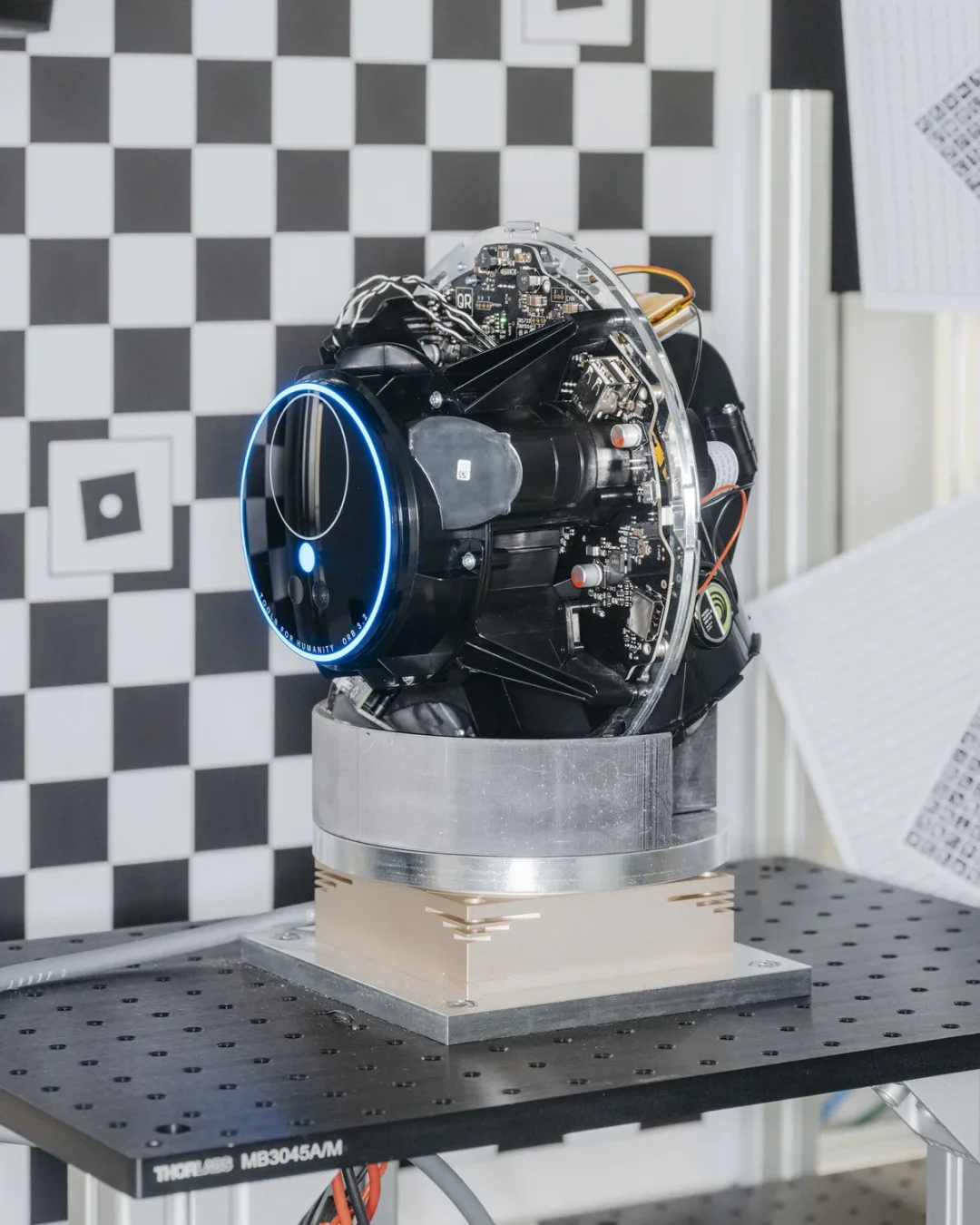
Orb undergoing lens calibration test. Source: Bloomberg Businessweek
Jabil Inc., a manufacturing partner, assembles Orb in Jena—a town with a long history in optics, about two and a half hours north of Nuremberg. Carl Zeiss opened his first optical lab there in 1846, and Jena remains home to many optical experts, some of whom now handcraft Orb units. About a dozen workers assemble and test electronic components at different stations before adding the chrome casing and sealing all parts. Each Orb costs about $1,500 to produce. Unlike typical consumer electronics, there’s no need to manufacture millions or package them elaborately. A second production line at the Jabil factory has just launched and should produce the tens of thousands of Orbs Blania believes are needed to register a billion people. To date, Worldcoin has manufactured 3,300 Orbs.
An undercurrent of irony and sci-fi doom shadows every twist in Worldcoin’s journey. Through OpenAI, Altman seeks to build powerful AI systems that make something like Worldcoin necessary. He creates the problem, then sells the solution. Moreover, one can only imagine how superintelligent AI might feel about being downgraded to “non-human” status online—and whether it might develop hostility toward Altman, Blania, or others.
Indeed, many remain skeptical of Worldcoin. Last year, the Washington-based think tank Electronic Privacy Information Center clearly outlined two major concerns surrounding the project. Jake Wiener, the organization’s legal counsel, wrote: “Worldcoin’s practices pose serious privacy risks by bribing the poorest and most vulnerable people to surrender immutable biometrics—such as iris scans and facial images—for minimal compensation.” “Massive biometric collection like Worldcoin’s poses a massive threat to personal privacy.”
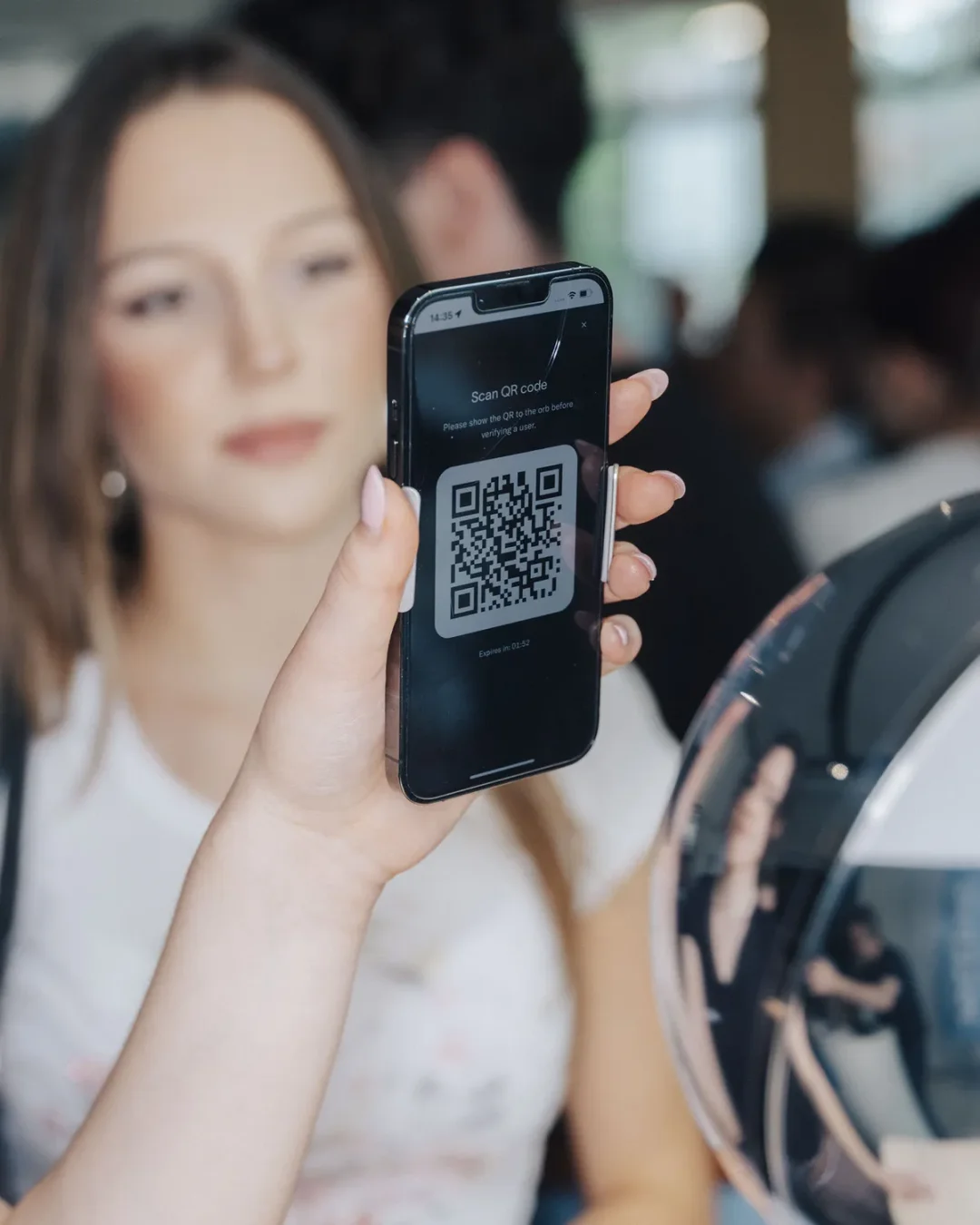
World ID registration. Source: Bloomberg Businessweek
Regulators currently agree with some of these concerns. When Worldcoin first launched, Orb was accessible in over 20 countries. Now, the list on Worldcoin’s website has shrunk to 12, as governments across Europe, Asia, and Africa have paused registrations, citing fears that Worldcoin could lose or misuse identity data. In the U.S., people can still join the Worldcoin identity system by scanning their irises at a few tech-forward retail stores—but they won’t receive any WLD cryptocurrency. Due to ongoing regulatory uncertainty around crypto, Worldcoin still has significant hurdles to overcome before becoming a mainstream service. Although Orb registration has grown steadily over the past year, Worldcoin remains far behind its original targets.
Of course, for decades people have traded privacy for convenience. Alphabet, Apple, and Amazon store vast amounts of personal data from billions—data arguably more private and valuable than random strings derived from iris photos. Many smartphone users have already handed over their location, calendars, and emails to their chosen tech giants. A startup proposing to become a global identity and financial broker is novel, though not fundamentally different from previous tech firms.
On a recent weekday morning, about 15 people lined up outside a Worldcoin registration site in Mexico City. Mostly young and middle-aged men, they gathered in the city’s historic district, surrounded by bridal and formalwear shops displaying quinceañera gowns in their windows. The Worldcoin center, operated by contractors, featured a waiting area with white folding chairs and a temporary sign hung on a rope advertising the service. A security guard and two local staff—one wearing a Worldcoin hoodie, the other a black T-shirt—guided people through registration.
Forty-five-year-old Juan Juarez, who had registered weeks earlier, brought his 18-year-old son Santiago for a scan. Juarez had been thinking about the money he’d earned from Worldcoin’s rising value and hoped to invest it in other cryptocurrencies. He also liked the technology’s grand vision. “I think it’s a good thing because in the future it will help us see who is truly human and who isn’t,” Juarez said. His son hoped to use earnings from Worldcoin to pay for his electronics studies.
In Singapore, registering for Worldcoin has become a tourist activity. Recently, at the Orb center inside Centennial Tower, visitors from Bangladesh, China, and India underwent iris scans in exchange for some cryptocurrency. About a dozen people—including an electrician, several students, and others in tech—waited in line to complete the two-minute registration. Thirty-three-year-old Mitesh Kha from India was happy with the quick payment. “It’s free money,” he said. “I’m glad to scan my iris and let Worldcoin have the data. According to the app, I can delete my data anytime if I want.”
If Blania harbors any ill intent, he hides it well. The Orb itself stores no personal data. Iris scans are immediately deleted from the device and never uploaded to the internet. He says only encrypted strings representing the iris—composed of 1s and 0s—are transmitted. (However, users can opt to share their data with Worldcoin for training purposes, in which case the encrypted information is sent over the internet.) Worldcoin previously managed this data centrally but is now partnering with universities and other neutral parties to split the strings and store them across different data centers. Hackers would need to assemble all fragments and somehow break the encryption to steal individual codes.
Beyond that, nearly everything related to Worldcoin is open-source. Anyone can access GitHub to download detailed schematics of Orb hardware or inspect the Worldcoin protocol. The organization will begin producing Orbs in different colors and shapes this year, aiming for a friendlier appearance. Worldcoin’s near-term hope is that other organizations will choose to build their own Orbs and develop services atop the Worldcoin protocol. Blania and Altman’s ultimate goal is to transition Worldcoin out of their control and into community stewardship. They want the service to become a public good.

Iris scanning. Source: Bloomberg Businessweek
Some critics appreciate Worldcoin’s efforts and intentions but argue it has fundamental security flaws. Charles Herder, cybersecurity expert and co-founder of identity startup Badge Inc., said: “Worldcoin is doing something very important—it’s pushing the value of identity and biometrics into the spotlight.” But he noted vulnerabilities in Worldcoin’s system (some since patched). Based on his analysis of Worldcoin’s public documents, the service has flaws in how it stores data. And it’s still a company. “You have to trust that their business model won’t change in 30 years when they go bankrupt,” he said. “They have incentives to monetize this data—you must believe those incentives won’t override their promises to you.”
Altman initially funded Tools for Humanity out of pocket before helping it raise external capital. Investors collectively hold 13.5% of Worldcoin tokens, which ranks it as the 113th-largest cryptocurrency by market cap. The rest are distributed to buyers or people who scan their irises.
To fulfill Blania and Altman’s ambitions and prevent AI-driven crises, Worldcoin’s value must soar. They believe that as AI reshapes the global economy and threatens jobs, governments won’t act quickly enough. Theoretically, people in need will be able to rely on income provided by Worldcoin. “We need to try new things that don’t exist today,” Blania said.
Speaking to the students at Josephs, Blania downplayed regulators’ reactions over the past year. He’s been explaining the technology to governments and hopes they’ll eventually catch up. He believes the sudden rise of AI technology is finally alerting governments to the threat. “I think our prediction from four years ago was correct—the timeline matches exactly where we are now,” Blania said. “Now it’s about execution and explanation. Please rest assured—we won’t steal your soul.”
Join TechFlow official community to stay tuned
Telegram:https://t.me/TechFlowDaily
X (Twitter):https://x.com/TechFlowPost
X (Twitter) EN:https://x.com/BlockFlow_News
 @Bloomberg