








ETH Bull vs Bear Debate Summary: Listening to Both Sides for Clarity, Awaiting Market Direction
TechFlow Selected TechFlow Selected
ETH Bull vs Bear Debate Summary: Listening to Both Sides for Clarity, Awaiting Market Direction
In the long run, the bullish argument is more compelling, especially after this year's price volatility.
 Navigating Web3 tides with focused insights
Author: Flip Research
Translation: TechFlow
The Bull vs. Bear Divide on ETH
The bull and bear camps around $ETH are now more polarized than ever, with compelling arguments on both sides. Below is my summary of the key points from both perspectives.
Bear Case
-
After Dencun, profitability has sharply declined, and this trend doesn’t appear to be reversing in the short term:

"L2s will make Ethereum deflationary again."
No, they won't — we already have real-world evidence proving otherwise.
A report on L2s, blobs, and why the Ultrasound Money narrative has already failed without mainnet user growth.
-
Ethereum’s product-market fit is weakening. Crypto purists want BTC, mainstream investors are drawn to $SOL, and $TRX is capturing stablecoin transfers. The “one-size-fits-all” approach no longer holds.
-
L2s are becoming increasingly fragmented. Currently, @l2beat is tracking 71 L2s, 20 L3s, and a staggering 82 upcoming projects. This severely degrades user experience and poses a major barrier to mass adoption. In contrast, SOL demonstrates the potential of a monolithic chain and ecosystem.
-
The utility of DeFi is being questioned. Many projects are essentially memes with predatory tokenomics. The model of high circulating supply and low fully diluted valuation is designed to extract maximum value from retail investors and transfer it into the pockets of venture capitalists. (Cobie’s take on this is worth reading.)
-
ETH ETF performance has been underwhelming, suggesting @rewkang may have been right:
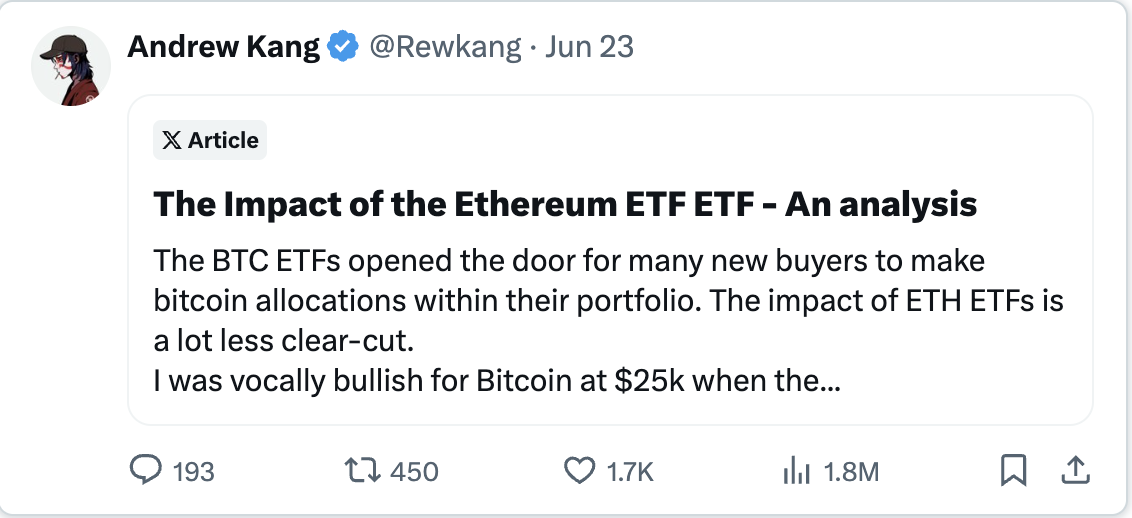
Article: Analysis of the Impact of ETH ETFs
Bitcoin ETFs opened the door for many new buyers to include Bitcoin in their portfolios. The impact of ETH ETFs, however, is far less clear.
-
Market sentiment around ETH is at historic lows. Combined with poor performance in ETHBTC and SOLETH trading pairs, we might see a death spiral and outflows from on-chain total value locked (TVL).
-
We’ve been conditioned to believe ETH is the "chosen" L1, but in such a nascent industry, this assumption isn’t necessarily valid.
-
From institutional and political standpoints, BTC remains the primary focus. Purists like Michael Saylor are championing BTC as the hardest form of money — a narrative that simply doesn’t exist for ETH. ETH struggles to find a similar high-profile "champion."

All my net worth is in this man's hands.
"No second choice," — Michael Saylor
Bull Case
-
Transaction volume on ETH and L2s has reached all-time highs, while fees remain near lows. Ethereum has successfully scaled and is ready for mass adoption:
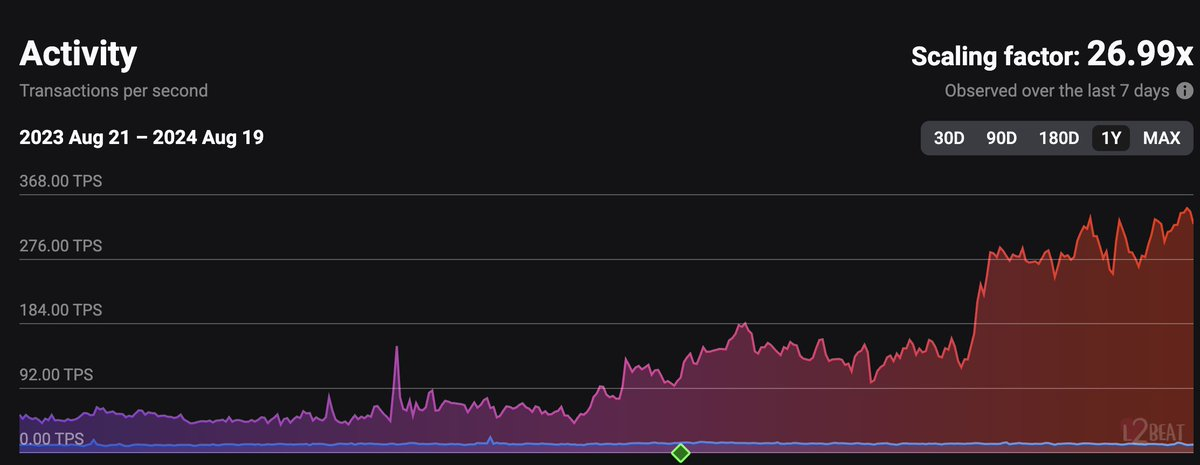
Source: L2Beat
-
ETH’s total value locked (TVL) is ten times that of its closest competitor (excluding L2s). L2 TVL still resides within the Ethereum ecosystem, and this value should ultimately accrue to ETH holders.
-
ETH remains the leading institutional-grade chain, battle-tested over years, with developer activity at peak levels. Some of the smartest minds in the space are collaboratively shaping ETH’s roadmap. Any institutional onboarding — whether tokenization of real-world assets (RWAs), prediction markets, etc. — will happen on ETH.
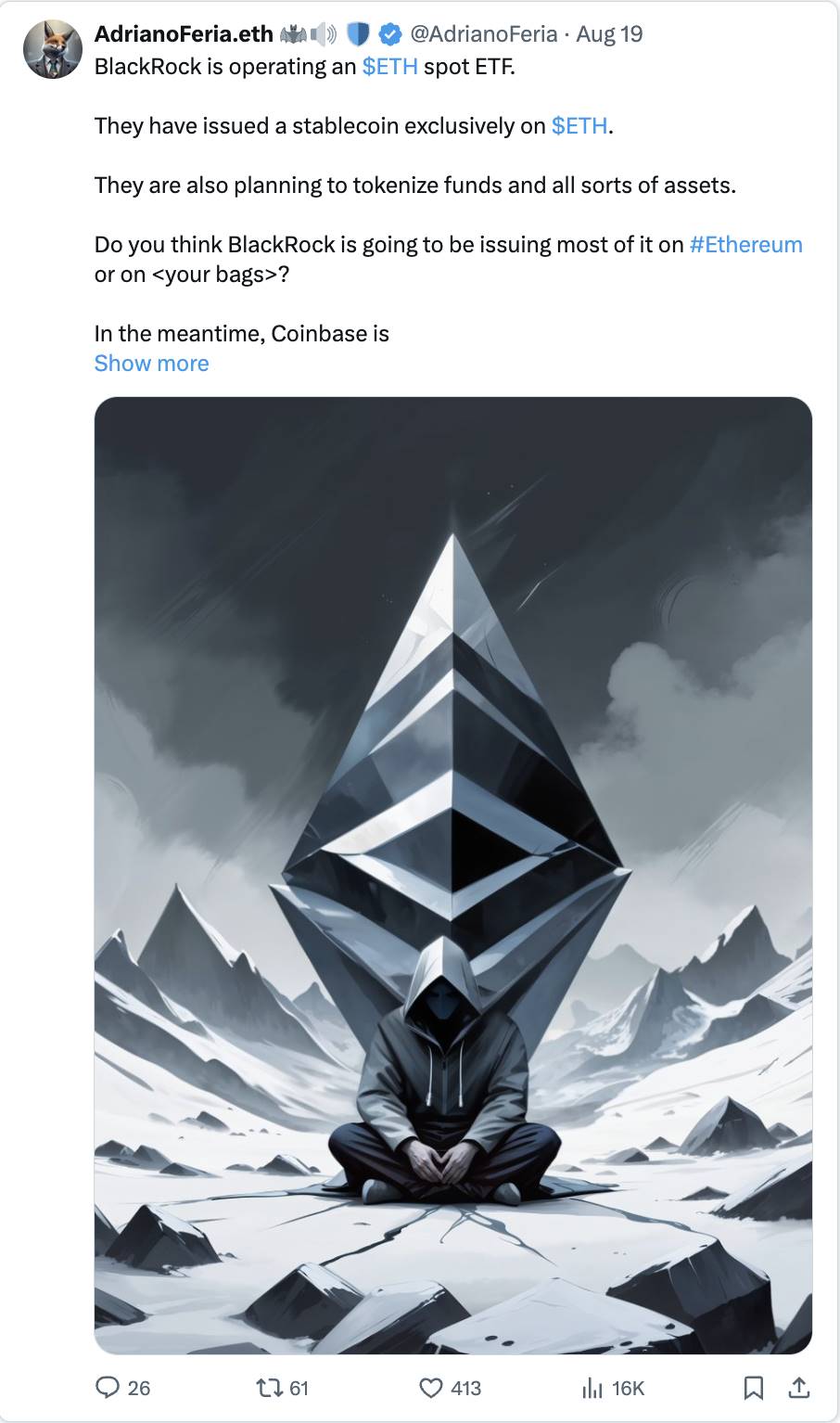
Blackrock is running a $ETH spot ETF.
They’ve already issued a stablecoin on $ETH.
They also plan to tokenize funds and various other assets.
-
ETH’s poor performance this year aligns with the broader shift from DeFi to meme speculation. However, the narrative appears to be shifting back.
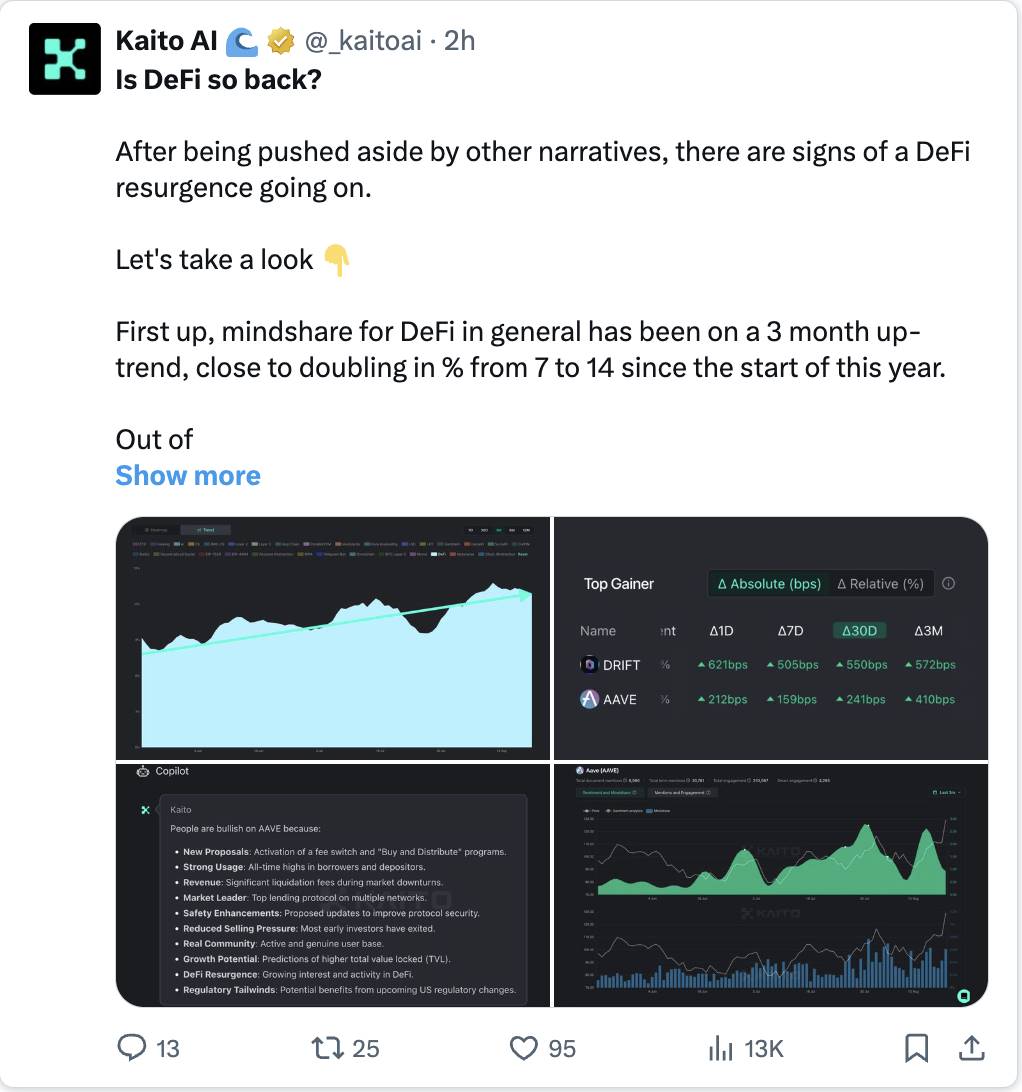
Is DeFi really coming back?
After being sidelined by other narratives, signs of a DeFi revival are emerging.
-
Developments like Coinbase’s cbBTC and Vitalik Buterin-backed L2 @megaeth_labs could spark a new wave of DeFi speculation, while the upcoming mainnet launch of @babylonlabs_io may renew interest in the broader staking/re-staking narrative.
-
ETH continues to produce killer applications this year — @polymarket being a prime example. This trend will only accelerate. By the time the next “DeFi summer” arrives, prices will already reflect reality — markets are forward-looking.

It’s hard to argue that @Polymarket isn’t the crypto app of the year.
It’s on track to reach $475 million in trading volume and 75,000 new accounts in August alone.
It’s widely cited by pollsters, commentators, everyday users, and political campaigns.
-
Multiple interoperability solutions are in development — in a few years, we may hardly need to know which chain we’re connected to. Protocols include @layerzero_labs, @synapseprotocol, @omnifdn, @wormhole, and more.
-
The ETH ETF launched in a market environment entirely different from Bitcoin’s, amid weak price performance, disappointing potential investors. Currently, political and institutional attention centers on $BTC — but as Bitcoin gains wider acceptance, people will start asking: “What’s next?” $ETH is clearly the most obvious answer.
-
Poor market sentiment at all-time-lows (ATL) creates opportunities for investors — price volatility drives narrative shifts. As speculators begin accumulating, all the above factors gradually come into focus, leading to upward price momentum.
“The day ETH hits $10,000 is inevitable.” — Legendary trader GCR
Conclusion
With such strong arguments on both sides, prices could swing significantly in either direction. While I’m admittedly biased as an ETH holder, I believe the bull case becomes more compelling over the long term, especially after this year’s price turbulence. Where do you stand in this debate?
Join TechFlow official community to stay tuned
Telegram:https://t.me/TechFlowDaily
X (Twitter):https://x.com/TechFlowPost
X (Twitter) EN:https://x.com/BlockFlow_News
 Flip Research






