









US stocks plummet, brokers halt trading—how can crypto traders avoid another "pulling the plug" moment?
TechFlow Selected TechFlow Selected
US stocks plummet, brokers halt trading—how can crypto traders avoid another "pulling the plug" moment?
Security and system stability are the lifeline of cryptocurrency trading.
 Navigating Web3 tides with focused insights
Summary: Amid market turbulence, for brokers, trading system stability outweighs low cost alone.
Earlier this month, amid factors including U.S. non-farm payroll and unemployment data and geopolitical risks, stock markets in Japan and South Korea triggered circuit breakers. Several U.S. stock brokers also issued rare announcements stating that "overnight trading has been suspended due to upstream system anomalies in U.S. night session trading."
Closing trading windows during periods of extreme market volatility leaves retail investors helpless as their assets sharply decline. The root cause behind this issue is Blue Ocean, the U.S. night session trading system provider serving multiple leading brokers.
Notably, among the Hong Kong and U.S. brokers affected by this incident, several have recently announced crypto trading services. Their crypto and U.S. stock trading operations share certain structural similarities—so how exactly does their crypto trading process work, and can it avoid similar "pulling the plug" incidents?
Blue Ocean: The Upstream Role in Trading Infrastructure
To understand why multiple U.S. brokers "pulled the plug," we first need to examine Blue Ocean and its relationship with brokers.
As a specialized service provider for U.S. night session trading, Blue Ocean partners with numerous brokers to offer access to U.S. National Market System (NMS) stocks outside regular trading hours—such as during Asian market hours—via its Automated Trading System (ATS).
Specifically, Blue Ocean facilitates overnight trading of stocks and ETFs, enabling clients of partner brokers to trade between 10:00 AM and 6:00 PM Beijing time, aiming to provide near-24-hour U.S. equity trading. In short, Blue Ocean plays an upstream role in the U.S. stock trading process, functioning as a financial trading service provider focused on specific off-hours sessions.
Last week, due to surging trading activity, Blue Ocean temporarily shut down for over two hours and canceled some trades, causing downstream brokers to suspend night trading and resulting in significant losses for many investors.
Several U.S. brokers were caught in the fallout—highlighting that when selecting upstream providers, brokers must look beyond transaction costs and prioritize technical strength and risk resilience.
In fast-moving financial markets, every minute counts. During volatile periods, even brief interruptions can prevent investors from executing strategies, directly impacting returns.
Licensed Exchanges: Core Infrastructure Behind Crypto Trading
Among the brokers affected, several have recently launched crypto trading services. Their crypto trading architecture shares structural parallels with U.S. stock trading:
Regulatory requirements stipulate that only licensed exchanges may offer crypto trading to Hong Kong investors. Currently, the Hong Kong Securities and Futures Commission (SFC) has officially approved just two digital asset platforms—one being OSL, whose parent company is listed on the Hong Kong Stock Exchange main board.
This means that brokers offering crypto trading are effectively partnering with licensed platforms like OSL, allowing customers to trade approved cryptocurrencies through integrated accounts.
Typically, these brokers open an Omnibus Account with OSL or similar licensed exchanges. They then execute client orders on the exchange for SFC-approved digital assets such as Bitcoin and Ethereum.
In essence, licensed exchanges like OSL play an upstream role in crypto trading analogous to Blue Ocean in U.S. stock trading:
- Brokers are closer to retail and traditional investors, offering one-stop trading via a single app for equities, bonds, futures, options, funds, and digital assets;
- But back-end functions—crypto custody, trade matching, clearing, and settlement—are handled by compliant platforms like OSL, which ensure asset security through rigorous safeguards and expert technical teams.
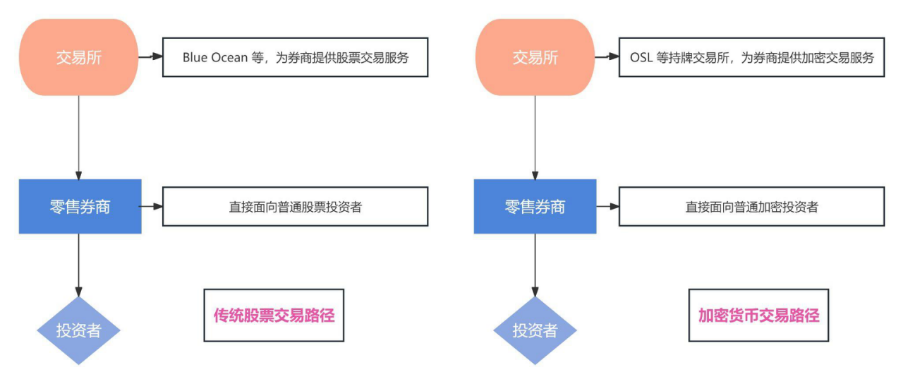
This collaborative model leverages brokers’ strengths in customer service and marketing while relying on licensed institutions’ expertise in compliance, technology, and risk control—jointly building a relatively secure and robust crypto trading ecosystem.
However, it also means smooth operation depends on tight coordination between brokers and licensed platforms. Any failure or delay on either side could impact investor experience and asset safety.
Compared to equities, crypto markets operate 7×24 without interruption and experience far greater volatility and more frequent extreme conditions—many users have likely experienced freezing or "plugged-out" moments during sharp price swings, missing crucial opportunities to adjust positions and suffering heavy losses.
Therefore, ensuring smooth and responsive crypto trading while maintaining asset security becomes critically important. Given this structure, how can licensed exchanges like OSL avoid repeating the "pulling the plug" scenario seen in U.S. stock trading during periods of extreme volatility?
Investment Quality: A Key Metric for Evaluating Products
From a business perspective, investment quality is another key factor in assessing financial products.
After all, a high-quality trading system requires substantial investment in time, money, and human resources—an unavoidable reality. Attracting users with low prices and minor incentives cannot be sustained long-term.
For crypto trading, this involves a vast infrastructure—not just R&D and system maintenance, but also establishing a full compliance framework covering licensing, asset custody, fund security, accounting, and auditing. These require continuous investment to address potential failures and vulnerabilities, ensuring uninterrupted system stability.
Take OSL, for example. Beyond heavy investment in advanced trading technology to ensure rapid, accurate execution under high concurrency, insiders reveal that its spending on compliance and security is enormous—especially on investor protection measures such as private key management and cold wallet maintenance. As a licensed exchange, OSL also insures client-held assets through third-party policies.
Regarding token listings, OSL conducts thorough due diligence on project teams, liquidity, technical security, and regulatory status to exclude scams like Plus Token. Additionally, as its parent company is listed on the Hong Kong Stock Exchange, OSL undergoes audits by one of the Big Four accounting firms, going beyond SFC requirements.
Each of these elements represents significant cost and investment. This comprehensive commitment to security, compliance, and professionalism constitutes a long-term competitive advantage far more valuable than pricing.
Thus, low prices and lax rules are never shortcuts. While such strategies might attract users initially, insufficient investment in system integrity, security, and compliance often leads to long-term losses—including system outages and data breaches.
In a 7×24 crypto market, every minute presents trading opportunities. Each "plugged-out" moment not only harms investors but also erodes trust and enthusiasm in crypto trading, potentially triggering industry-wide credibility crises and hindering sustainable growth.
Conclusion
Security and system stability are the lifelines of crypto trading.
Especially given the 7×24 nature of crypto markets and growing demand, each "plugged-out" incident risks driving users away. For brokers offering crypto trading, investors will increasingly scrutinize whether exchanges can deliver sufficient stability and security during turbulent market conditions.
Demand for compliance, security, and trading stability is non-negotiable. Regardless of market readiness, this inflection point will inevitably arrive.
Join TechFlow official community to stay tuned
Telegram:https://t.me/TechFlowDaily
X (Twitter):https://x.com/TechFlowPost
X (Twitter) EN:https://x.com/BlockFlow_News
 @osldotcom










