After focusing on infrastructure and hardware, what is the VPU encryption chip that Fabric developed with its $3.3 million funding?
TechFlow Selected TechFlow Selected
After focusing on infrastructure and hardware, what is the VPU encryption chip that Fabric developed with its $3.3 million funding?
VPU is the first custom silicon chip to use a cryptography-specific instruction set architecture.
 Navigating Web3 tides with focused insights
Written by: TechFlow
If crypto businesses seem somewhat intangible, what happens when they integrate with real-world tech industries?
As the concept of AI chips gains traction, "crypto chips" are gradually becoming a focal point for venture capitalists.
According to CoinDesk, yesterday a startup named Fabric announced it has raised $33 million in Series A funding, led by Blockchain Capital and 1kx, with participation from Offchain Labs, Polygon, and Matter Labs.
Previously, the project had already secured $6 million in seed funding led by Metaplanet.

The company is now targeting the crypto hardware space:
Fabric stated that the newly raised capital will be used to develop computing chips, software, and cryptographic algorithms. Its roadmap reveals an ambition to build a new type of processing unit called the Verifiable Processing Unit (VPU), specifically designed for cryptography. The new chip is expected to enter production later this year, with shipments scheduled for Q4.
You might associate hardware with DePIN, but clearly, Fabric’s focus isn’t on DePIN. Instead, it operates independently of typical crypto narratives, aiming to provide computational hardware/resources at the foundational level of cryptographic algorithms—similar to how CPUs support computers.
In its press release, Fabric describes the VPU as “the first custom silicon chip using a cryptography-specific instruction set architecture,” meaning “any cryptographic algorithm can be broken down into mathematical building blocks that are natively accelerated and supported by the chip.”
Understood this way, it seems all current crypto infrastructure—L1/L2 blockchains, ZK systems, smart contracts, FHE—could benefit from the computational power of this chip, effectively empowering the entire infrastructure layer through hardware.
As more VCs shift focus from “scaling infrastructure” to “scaling hardware,” what exactly could this VPU bring to the crypto industry?
What Exactly Is a VPU?
Although Fabric hasn't released a whitepaper yet, we can still get a general idea of the VPU’s functionality from publicly available information.
Skip the technical jargon. Let’s use a simpler analogy to quickly grasp what a VPU is—by understanding what's currently missing in Web3 development.
Blockchains and Web3 are fundamentally built on cryptography:
Every operation on a blockchain—from simple transfers to complex smart contract executions—requires extensive cryptographic computations.
Existing hardware like the familiar CPU and GPU can handle these tasks, but not efficiently. A CPU is like an all-around athlete, good at many things but average in specialized areas such as cryptography. While GPUs excel in parallel computing, they were originally designed for graphics rendering, not complex cryptographic operations.
Hence, creating a processor specifically tailored for cryptographic computation makes perfect sense.
Therefore, a VPU can be seen as a true "dedicated cryptography processor," combining the best features of GPUs and ASICs to create components optimized purely for encryption purposes.
A traditional CPU is like a Swiss Army knife—versatile, but inefficient at specific tasks.
An ASIC (Application-Specific Integrated Circuit), on the other hand, is like a finely crafted scalpel—excellent at one particular task but inflexible. The VPU cleverly strikes a balance between the two—like an intelligent surgical tool that can adapt quickly to different procedures.

From the information provided on the official website, this flexibility comes from a “cryptography-specific instruction set architecture.”
Sound complicated? Think of it as a cookbook specially designed for cryptography, where each recipe represents a common cryptographic operation—such as elliptic curve calculations, hash functions, or zero-knowledge proofs.
The VPU can directly understand and rapidly execute these recipes, without needing to convert them into more basic instructions like traditional processors do.
Potential Use Cases?
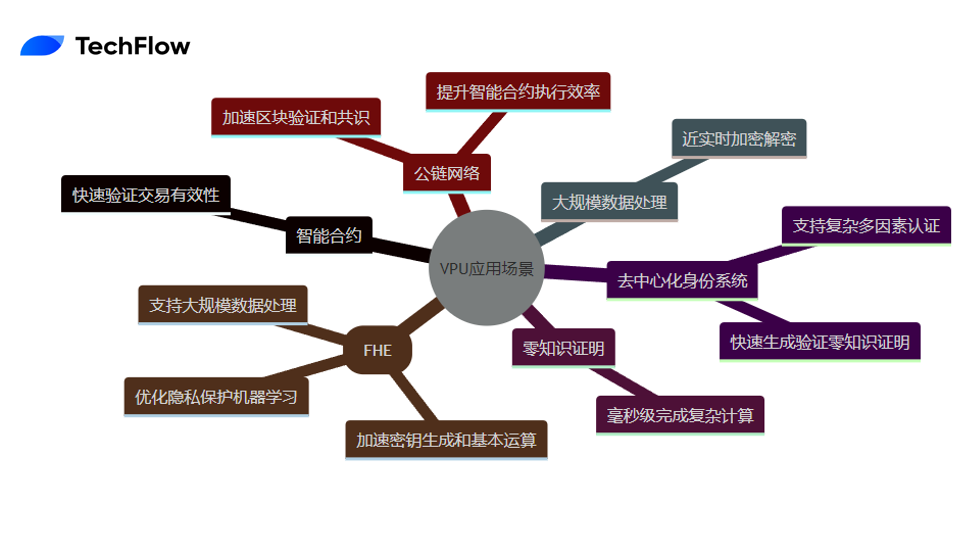
This design enables the VPU to excel in cryptographic tasks. Some obvious application scenarios include:
-
Quickly verifying transaction validity during complex smart contract execution;
-
Completing computations in milliseconds for zero-knowledge proofs—tasks that might take seconds or even minutes on a traditional CPU;
-
Enabling near real-time encryption and decryption when processing large-scale data.
In another area considered the holy grail of cryptography and also at the forefront of encryption technology—FHE (Fully Homomorphic Encryption)—the VPU could significantly boost computational efficiency:
-
Accelerating FHE key generation and basic operations: reducing key generation time from hours to seconds, and basic operations from seconds to milliseconds.
-
Supporting large-scale FHE data processing: cutting statistical analysis time on large encrypted datasets from hours to minutes.
-
Optimizing FHE model training: potentially reducing training time in privacy-preserving machine learning from days to hours.
Additionally, within familiar public blockchain networks, the VPU could notably enhance node performance:
-
Speeding up block validation and consensus processes: reducing verification time from hundreds of milliseconds to tens of milliseconds, and bringing consensus time down to sub-second levels.
-
Improving smart contract execution efficiency: execution time for complex DeFi contracts could drop to one-tenth or less compared to traditional CPUs.
In decentralized identity systems and privacy-related fields, the VPU enables faster authentication:
-
Rapid generation and verification of zero-knowledge proofs: completed within milliseconds, supporting real-time, trustless authentication.
-
Supporting complex multi-factor authentication: simultaneously processing multiple forms of encrypted biometric data for more secure and faster identity verification.
Top-Tier Talent, Dropping Out to Lead
Given the focus on chips and cryptography, domain expertise is crucial.
Public records show that both founders of Fabric are top-tier graduates, and appear to have Chinese heritage based on their names.
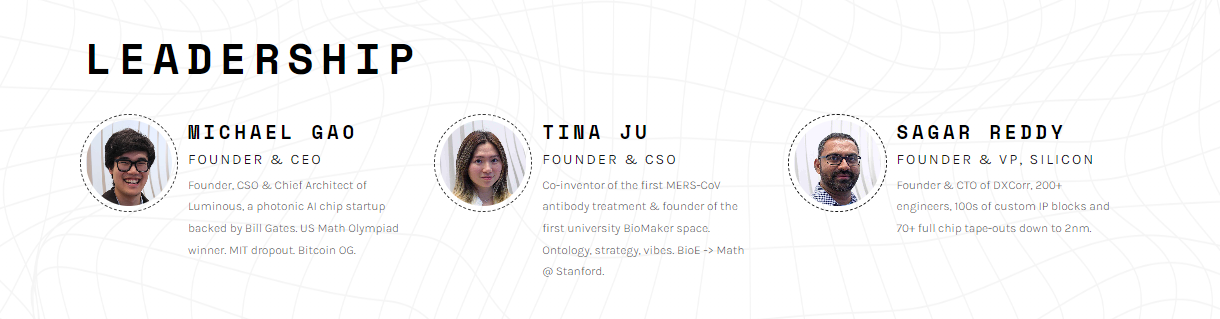
MICHAEL GAO is from MIT and was also a U.S. Math Olympiad champion. Previously, he served as an architect at a Bill Gates-backed AI chip startup and has now dropped out to lead this new venture.
Most notably, his bio lists him as a Bitcoin OG.
The other co-founder, TINA JU, has research background in biology and mathematics, and public records indicate she graduated from Stanford.
Beyond the founders, the company boasts a seasoned professional team comprising dozens of GPU and AI chip architects, software and compiler experts, and senior cryptographers—though most appear older than the founders.
This mirrors a pattern seen in previous projects founded by elite university students: young founders take center stage, backed by experienced teams providing critical support.

Towards Real-World Utility?
In a crypto and Web3 landscape long dominated by software innovation and financial models, Fabric’s push for breakthroughs at the hardware level—particularly in cryptographic chips—represents a promising entry point.
However, the primary challenge lies in uncertain market demand. Much of the growth in the crypto industry stems from speculation and hype. In such an environment, actual demand for high-performance cryptographic computing may fall short of expectations.
Software development can adapt relatively quickly to market shifts, whereas hardware R&D requires longer cycles and greater investment. If the industry takes an unexpected turn, specialized hardware risks facing a sudden drop in demand.
Whether Fabric can succeed in its journey from speculation to tangible utility remains to be seen.
Join TechFlow official community to stay tuned
Telegram:https://t.me/TechFlowDaily
X (Twitter):https://x.com/TechFlowPost
X (Twitter) EN:https://x.com/BlockFlow_News
 深潮TechFlow
![In-depth Analysis of Trade[XYZ]: How Were 92 Markets and 98% HIP-3 Trading Volume Established?](https://upload.techflowpost.com/upload/images/20260716/20260716061117965147.jpeg?x-oss-process=image/resize,p_50/quality,q_80)