








What Can Blockchain Learn from Schmidt's Leaked Speech?
TechFlow Selected TechFlow Selected
What Can Blockchain Learn from Schmidt's Leaked Speech?
If Schmidt is correct, then the application explosion of blockchain and Web3 should have occurred earlier than AI.
 Navigating Web3 tides with focused insights
By Meng Yan
Everyone has been talking about Eric Schmidt's leaked speech at Stanford recently. I find the most thought-provoking part of his talk to be the final section, where he draws a comparison between artificial intelligence and electrification.
Schmidt pointed out that after the invention of the electric motor, it took humanity nearly thirty years to fully grasp the fundamental transformation this technology enabled—namely, that motors could be built in all sizes and placed anywhere, thereby decentralizing power delivery.
Since he didn’t elaborate much during the speech, I looked into the historical context myself. Here’s roughly how it went: in the age of steam engines, a factory typically had one centralized engine room providing all mechanical power. To transmit this power across different parts of the factory and accommodate varying operational needs, factories installed a line shaft system. The line shaft—so named because it was usually suspended beneath the ceiling—was driven by the central steam engine and rotated overhead. Machines below were then connected to the shaft via gears and belts to receive power, as shown in the image below.
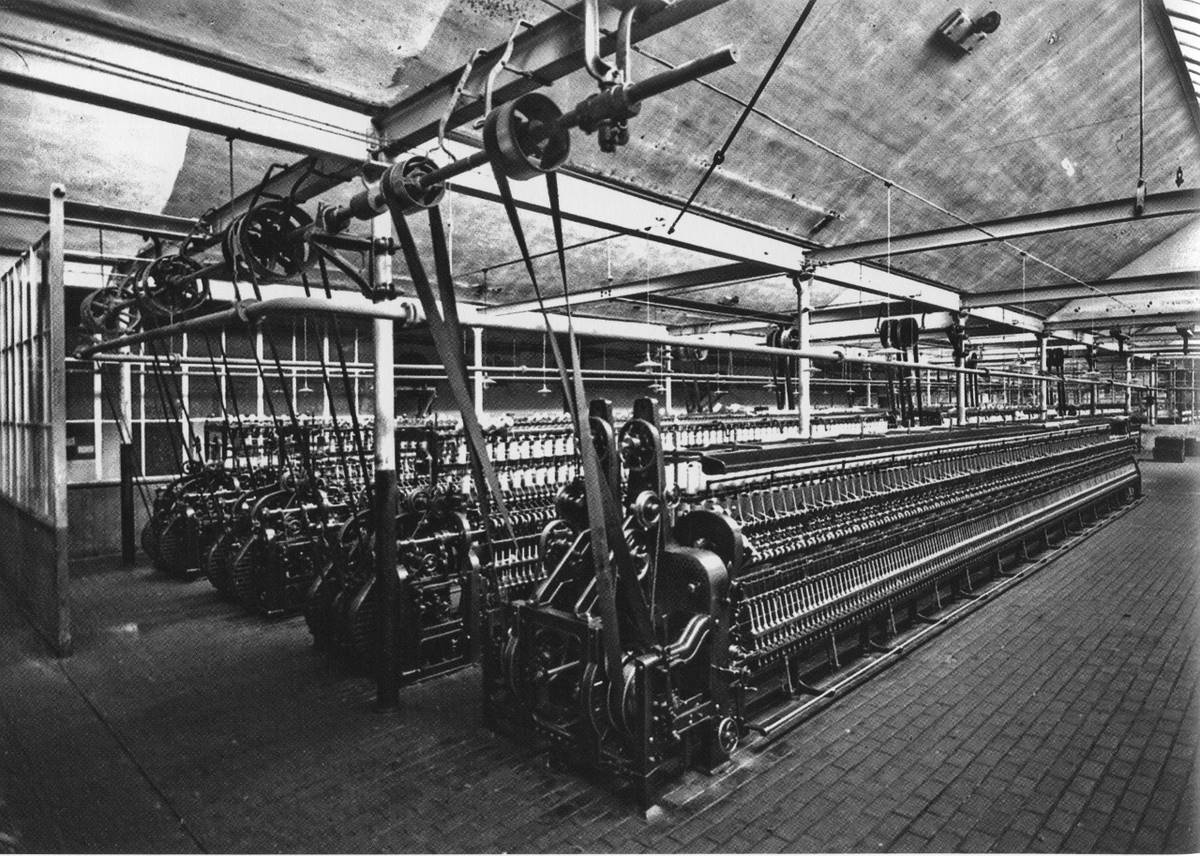
Schmidt noted that when electric motors first appeared, people simply replaced the central steam engine with a central electric motor, still using it to drive the same line shaft system. In other words, they improved efficiency and performance, but kept the old structure unchanged. It wasn’t until thirty years later that people gradually realized the real breakthrough: electric motors could be made in various sizes and power ratings, and embedded directly into machines and equipment. Let electricity travel, not mechanical force—that was the right way to use electric power. According to Schmidt, the shift toward distributed electric power triggered significant organizational innovation and fundamentally reshaped relationships among components, which is what truly changed the world.
At this point, Schmidt seems to have identified a pattern in how technological innovations lead to broader technological and economic transformation. First comes efficiency innovation—replacing key components without altering the underlying structure. Then comes structural innovation—shifting from centralized to decentralized, from hub-and-spoke to distributed systems. Finally, this structural change enables organizational innovation, unleashing massive gains in productivity. We might as well call this progression the "Schmidt Process."
By this logic, AI today remains in its early stages—still highly centralized. Only in the later phase of the Schmidt Process will AI applications become as decentralized as electricity once did. AI models will be embedded everywhere across computing infrastructure, collecting data locally, making decisions locally, and executing actions locally. We haven’t reached that stage yet. How long will it take? Perhaps not thirty years, but likely more than a decade.
I can’t help thinking: if Schmidt is right, today’s AI investors are practically saints.
What about blockchain?
Reflecting on Schmidt’s remarks, I see four implications for the blockchain industry.
First, following Schmidt’s reasoning, blockchain and Web3 represent the right direction.
At its core, blockchain decentralizes “sovereign computing” and “trustworthy computing.” Sovereign computing ensures individuals maintain full control over their digital resources—including identity, data, assets, and computation processes. Trustworthy computing guarantees that computational outcomes are fair, reliable, tamper-proof, and immutable. With these two capabilities, we can move critical value-bearing computations currently concentrated in centralized institutions—banks, payment platforms, social networks—into individual smart contracts or ZK programs. Abstractly speaking, this process resembles the electrification era, when power units moved from centralized engine rooms into individual devices and machines. Clearly, blockchain fits perfectly within the Schmidt Process and thus points toward the correct trajectory.
Second, even if it represents the right direction, success will require time. If Schmidt is correct, blockchain and Web3 should see their application breakout before AI does.
Third, blockchain innovation must start with solving real user problems.
Since the “Ethereum killer” narrative captured investor imagination around 2017, the highest-valued and most-hyped blockchain projects have mostly focused on solving problems faced by blockchain experts themselves, forming a rigid set of dogmas that dominate valuations in both primary and secondary markets. Everyone talks grand narratives about infrastructure, detached from actual users. The more detached a project is from end users, the more popular it becomes in the market; meanwhile, user-centric projects go unnoticed and unheard. It’s like endlessly boasting about how powerful your electric motor is—how much it’s worth on paper—without ever discussing what it actually powers: Will it run a car? A drill? A hard drive?
The worst consequence? After ten full years, we still haven’t cultivated a genuine user base. The vast majority of participants in this space are token speculators, not real users. Without users, there’s no driving force or direction for innovation. This is the root cause of blockchain and Web3’s current innovation stagnation. To break free, acquiring and nurturing real users must become the top priority. We should ask ourselves: What real problems do users want to pay to solve—problems that today’s internet and social platforms either can’t address or handle poorly—and that require blockchain to solve? Few people seem to be asking this question today. Most projects just spin in circles around ideologies and dogmas.
Fourth, the endgame is token economics. Schmidt emphasizes that ultimately, it’s organizational innovation that drives productivity transformation. Token economics *is* organizational innovation—it’s about reconfiguring human relationships and creating new mechanisms for collaboration. It cuts straight to the heart of the matter. What does the final state of Web3 look like? Sure, building a more convenient, freer payment and financial network would be impressive—Elon Musk once said blockchain would already be valuable if it solved payments alone. But I believe that’s just the foundation, not the most transformative aspect. Once blockchain-based payment and financial networks become widespread, the modes of collaboration among humans, between humans and AI, between humans and machines, and the structures of digital economies—and even societal structures in the physical world—will undergo fundamental change. That *is* token economics. That is the ultimate vision of blockchain.
Join TechFlow official community to stay tuned
Telegram:https://t.me/TechFlowDaily
X (Twitter):https://x.com/TechFlowPost
X (Twitter) EN:https://x.com/BlockFlow_News
 Yan Meng









