Vitalik: Ethereum's Next Decade
TechFlow Selected TechFlow Selected
Vitalik: Ethereum's Next Decade
This article is Vitalik's speech at the Ethereum Developers Conference (EDCON 2024) on July 30, 2024.
 Navigating Web3 tides with focused insights
Author: Vitalik Buterin
Translation: Elsa, LXDAO
01 Translator’s Preface
As the founder of Ethereum, Vitalik Buterin holds unique insights into its development. This speech reviews Ethereum's decade-long evolution and offers a vision for the next ten years. Through this talk, we can gain a more comprehensive understanding of Vitalik’s thinking and communication style, as well as a deeper appreciation of Ethereum’s journey and future direction.
02 Article Overview
This is Vitalik’s keynote address at EDCON 2024, the Ethereum developers' conference, held on July 30, 2024. The full text is approximately 7,500 words and will take about 30 minutes to read.
03 Main Content
Hello everyone, Ethereum has just celebrated its ninth birthday. The Ethereum mainnet officially launched on July 30, 2015. I still remember that day in the Berlin office, where many developers gathered, watching the testnet block count climb toward 1,028,201—the number that would trigger the automatic activation of the mainnet. We all sat there waiting, and when it finally reached that number, about half a minute later, Ethereum blocks began to be produced.
It worked—and quickly started producing blocks. At that time, Ethereum had fewer than 100 developers total—this includes not only Ethereum Foundation developers but also protocol contributors outside the foundation. Since then, the Ethereum ecosystem has grown vastly larger, evolving into a space capable of hosting conferences with thousands of attendees and applications serving millions of users. All the ideas from the original Ethereum whitepaper have now become reality. An important question every member of this ecosystem should ask is: What will happen to Ethereum in the next ten years? Or put differently: What will you bring to Ethereum over the next decade?
The Past Ten Years of Ethereum
A Decentralized Twitter

The image on the left shows Ethereum’s first decentralized Twitter application—EtherTweet. It was a very simple app.
When it launched in 2015, it was just a basic interface: you typed your message, clicked “Send,” and it immediately became a transaction broadcast to the Ethereum blockchain.
On the right, we have Firefly, a client developed by Mask Network. It's a multi-client that allows simultaneous use of traditional Twitter along with Farcaster and Lens—likely the two largest Ethereum-based social media platforms modeled after Twitter. So when you see me post an article, and I publish it across Twitter, Farcaster, and Lens, this is actually the tool I'm using. If you compare the UI (user interface) quality today with that of 2015, the improvement is massive.
The work and developers in 2015 were excellent—but it was like the Wright brothers’ airplane: just the beginning of decentralized software. What we have today is more like a modern commercial jetliner. What do things look like now? First, UX (user experience) is far better. Today’s interfaces appear usable even for blockchain beginners—at least they can use them and understand what they're doing. Mobile support now exists too. There are multiple Farcaster clients available, both desktop and mobile. On the left, everything happens directly on Ethereum L1, with all messages stored on-chain—each tweet costs money to send.
The right side uses a hybrid architecture. It leverages the Ethereum blockchain to store account information, combined with an off-chain data structure called CRDT (Conflict-free Replicated Data Type), which has some blockchain-like properties but not all. This enables much more efficient and lower-cost storage of actual user posts. This is what a decentralized Twitter looks like in 2024: easy to use, truly affordable, scalable, increasingly adopted—not just because it’s a crypto product, but because it genuinely delivers high utility and is actually fun.
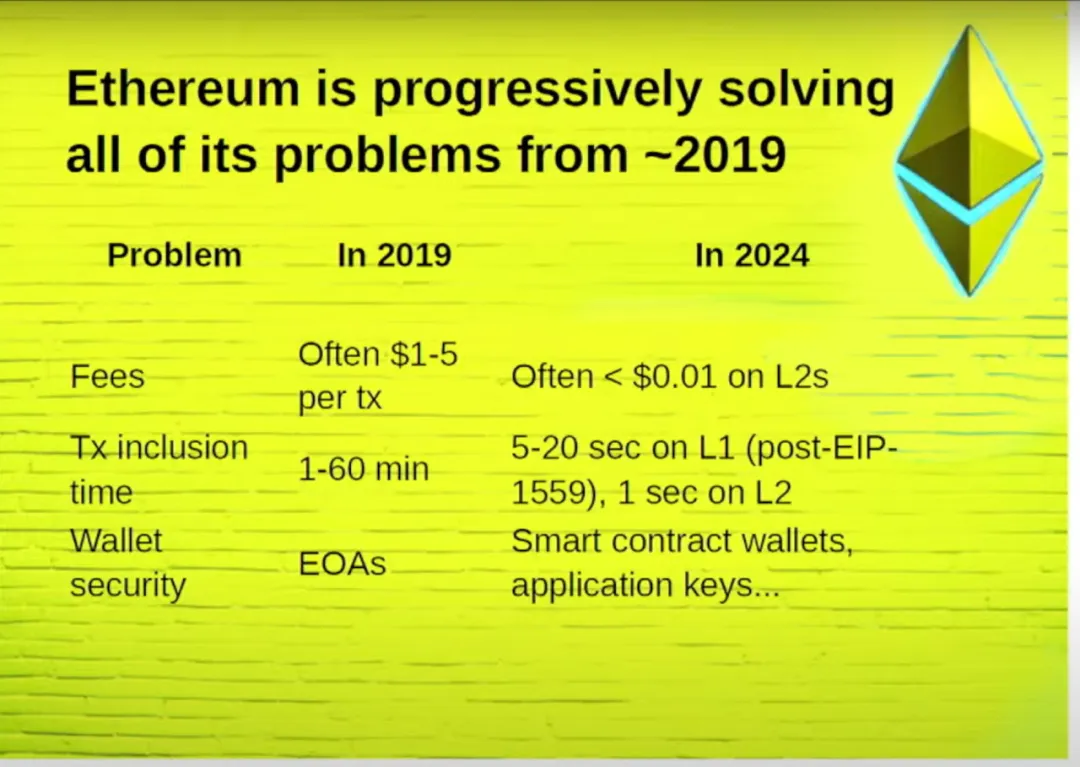
Thus, Ethereum is progressively solving all the problems it faced back in 2019. If any of you heard my talks in 2015, 2016, or 2017, I emphasized various challenges: security, scalability, privacy, the transition to proof-of-stake, account abstraction, and more. Now let’s look at where we stand today—starting with transaction fees.
Transaction Fees
In 2019, sending a transaction typically cost between $1 and $5. In bad cases, fees could exceed $50. For complex applications involving ZK-SNARKs, fees might even reach $500—I once paid over $500 to submit a ZK-SNARK to the chain. Now, L2 transaction fees are usually less than one cent. Five years ago, I commented that internet finance transactions shouldn’t cost more than five cents. Back then, Ethereum transaction costs were well above five cents, and Bitcoin maximalists laughed, saying, “Look at him! He says this is what scaling should look like, but Ethereum hasn’t scaled.” Now, in 2024, following a major upgrade—a hard fork on March 13 that introduced a feature called Blobs—we’ve significantly increased data availability for L2s. As a result, nearly every major L2 now charges less than one cent per transaction—certainly under five cents.
Rapid Progress on L1 Blockchains
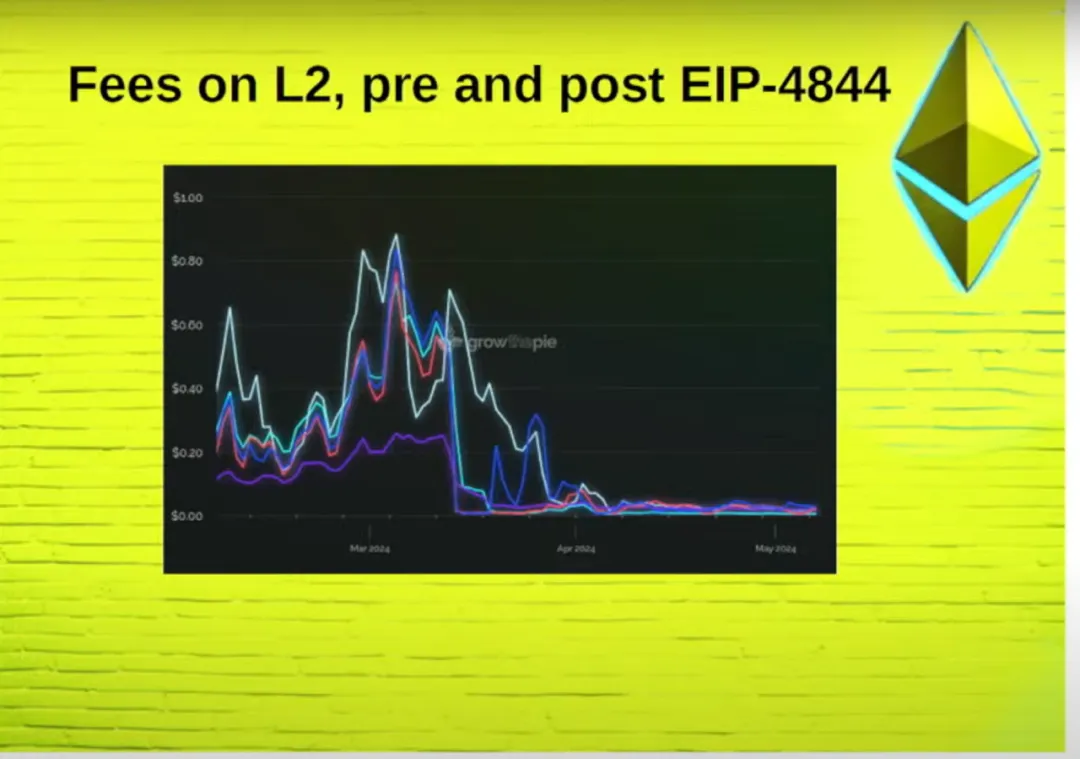
So today, Ethereum is truly affordable for everyone. Regarding transaction speed, in 2019 you typically waited 1–5 minutes to confirm a transaction, sometimes up to an hour in bad cases. Today, thanks to EIP-1559 making the fee market more efficient, confirmation usually takes just 5–20 seconds. And if you’re using an L2, many offer pre-confirmations—meaning you get near-instant feedback in under a second.
On wallet security: in 2019, almost everyone used externally owned accounts (EOAs)—accounts controlled solely by private keys. If you stored all your money, your life savings, in a single private key and lost it, your funds were gone forever. If the key was stolen, so were your assets.
Now, we have numerous smart contract wallets to choose from. How many here use Safe? Many people do, and I expect that within five years, almost everyone will be using Safe or another smart contract wallet. We now have many options for securing accounts, accessing them, and using them across different apps—greatly improving security.
Additionally, in 2019, Ethereum used Proof-of-Work (PoW), consuming electricity comparable to a small country. Today, Ethereum runs on Proof-of-Stake (PoS), using less power than a single large building. Across the board, huge improvements have been made.
These improvements focus on L1: Ethereum is evolving to become more scalable and secure, introducing ZK-SNARKs, statelessness, and many other upgrades. But the key question is: Why are we doing this? Ultimately, we need a better L1 to support better applications. So what will these better applications look like?
What Will the Next Ten Years of Ethereum Look Like?
If we ask what Ethereum can do in the next decade, most people think first of applications.
Fundamentally, I believe we already have—or are close to having—all the tools needed to build best-in-class applications in every domain suitable for Ethereum. Interestingly, the potential use cases for blockchain haven’t changed much over the past decade. Flip through the 2014 Ethereum whitepaper—over ten years ago—and you’ll find stablecoins, financial derivatives (what we now call DeFi), decentralized exchanges (also part of DeFi), decentralized domains, DAOs (decentralized autonomous organizations), and insurance. Looking at what exists today: we have DeFi, powerful decentralized exchanges, prediction markets (which we also discussed heavily in 2014). We have many DAOs and NFTs—admittedly, I didn’t foresee NFTs, nor that people would trade digital monkeys for $2 million.
There are many other developments. Interestingly, many things have evolved in parallel. So what lies ahead in the next decade? One way to approach this is to examine specific types of applications, assess how far they’ve come, and consider how much further they can go.
Prediction Markets
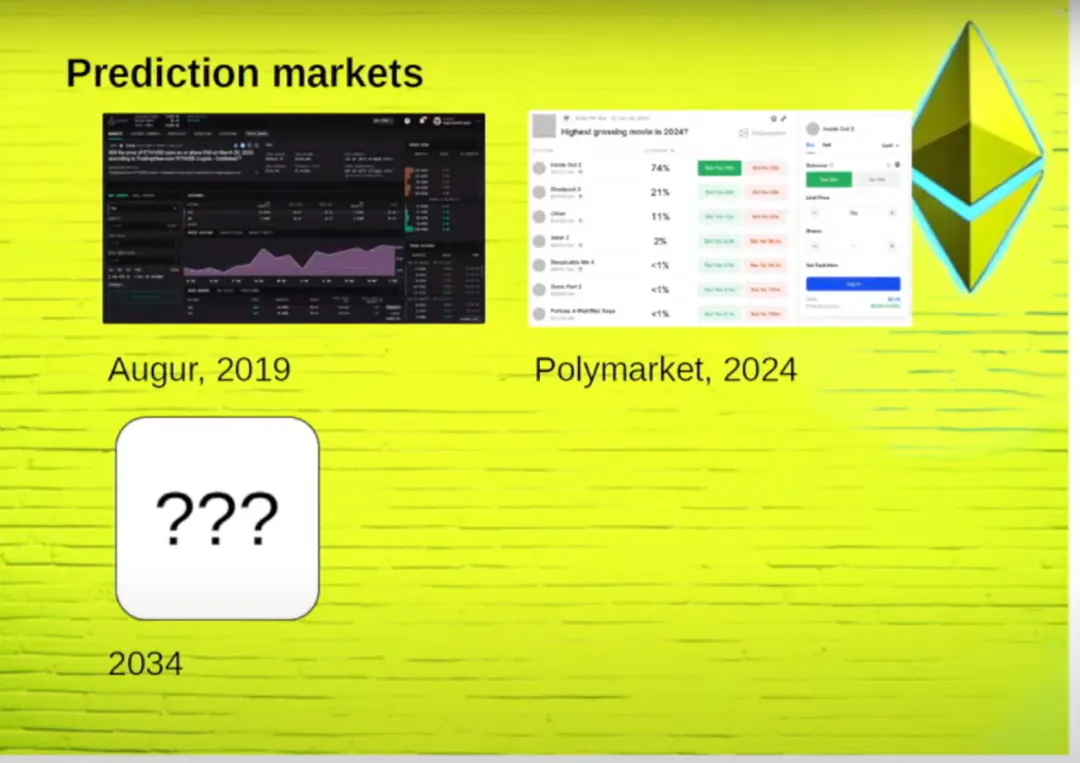
On the left is Augur from 2019, a popular prediction market at the time. On the right is Polymarket, which is more scalable, cheaper, and easier to use. I recall paying over $1,000 in fees trading on Augur in 2020. Today, Polymarket runs on an L2—specifically Polygon—with near-zero costs. So the question is: how will such systems improve by 2034? Let’s turn to wallets.
Wallets
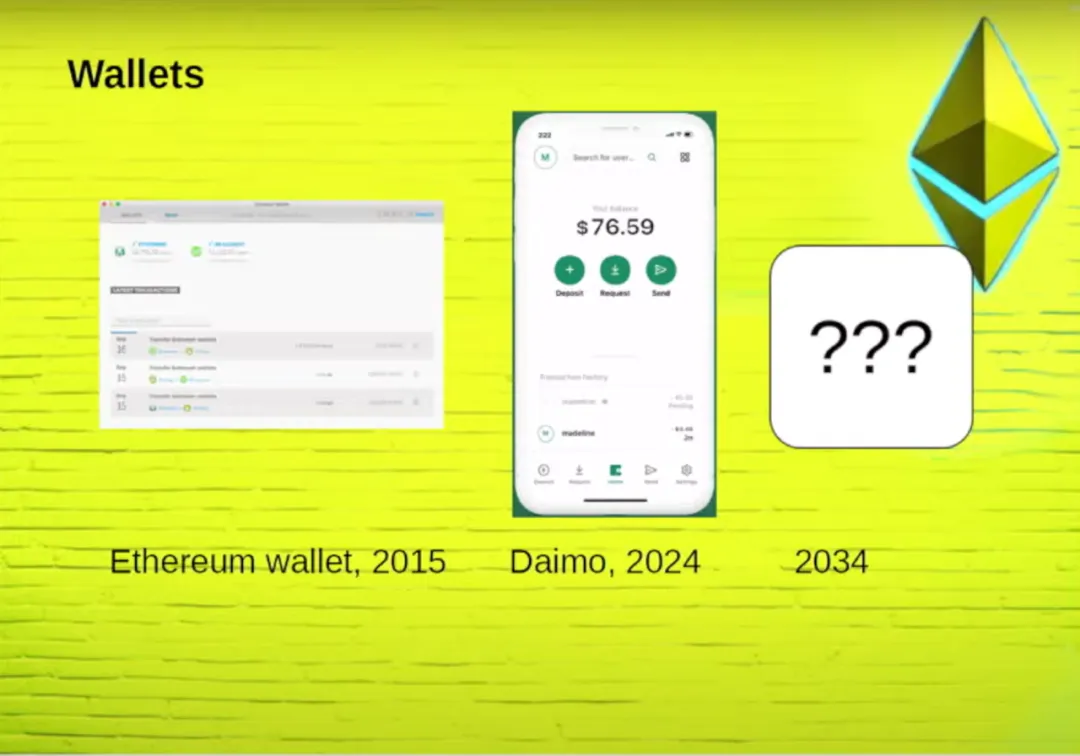
Wallets are the gateway through which most people enter the crypto world, serving two primary functions: enabling payments—which remain crypto’s original and likely most important use case—and acting as the standard interface for interacting with applications. In 2015, we had the idea of building an Ethereum browser called Mist, starting with a simple wallet for payments.
Looking at the UI, if you were in this space 15 years ago, it closely resembled early Bitcoin clients. Initially, Ethereum was heavily inspired by Bitcoin—Ethereum wallets looked like Bitcoin wallets. It was a desktop application. Now, in mid-2024, Daimo emerges—a wallet explicitly designed to be friendly and accessible for ordinary people, especially those new to crypto.
Daimo looks just like Venmo. We’ve moved from early-stage apps to ones that feel ready for mainstream users. Daimo focuses on payments. What we’re missing are applications as user-friendly and secure as Daimo, but general-purpose enough to manage access to the entire Ethereum ecosystem.
So what will wallets look like in 2034? I don’t think they’ll resemble 2015 wallets, nor even Daimo. Let’s now consider voting.
Voting
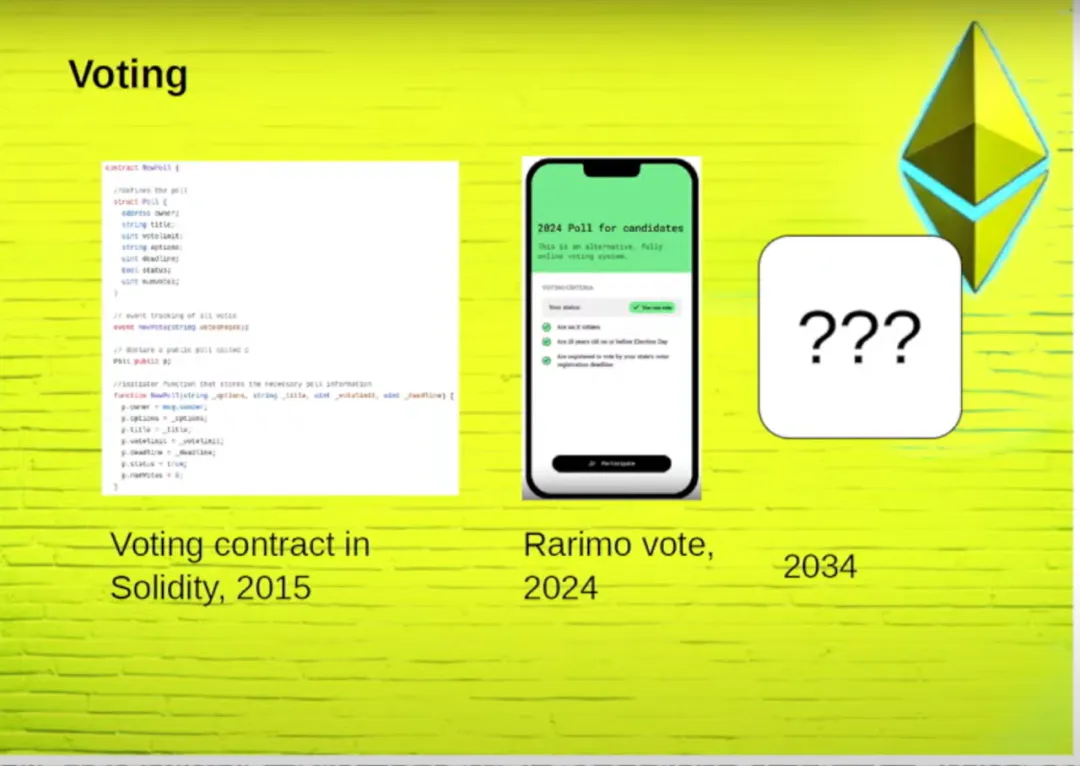
Voting is one of the earliest use cases that attracted many to Ethereum. One major difference between Bitcoin and Ethereum is that Bitcoin is about money, while Ethereum is broader—it’s about creating new kinds of social institutions. Finance is one such institution; voting is another, and it has plenty of room for improvement. We can make voting more transparent, more secure, and truly resistant to manipulation. There’s much we can do.
In 2015, people began building basic voting contracts. In 2024, Rarimo—a company based in Kyiv, Ukraine—is developing an application using zero-knowledge proofs for voting. By combining blockchain and ZK-proofs, they achieve highly trustworthy yet privacy-preserving elections. The underlying technology has improved dramatically, and the app itself is extremely user-friendly—on par with Web2 standards.
So the key question is: what will blockchain-based, cryptography-enhanced voting look like by 2034? Many associate voting only with government elections—events that happen every four years and decide national destinies. But I believe that if we can make voting more efficient and more secure, we can expand its use throughout our digital lives.
Consider likes and retweets on social media—they’re also forms of voting. They represent higher-bandwidth voting, but today they’re highly insecure. Can we use blockchain and ZK technologies to make such interactions more secure? I believe we’ll see many innovations—either resembling voting or blending voting with financial elements—that will yield exciting results by 2034. And you might be one of the people building them.
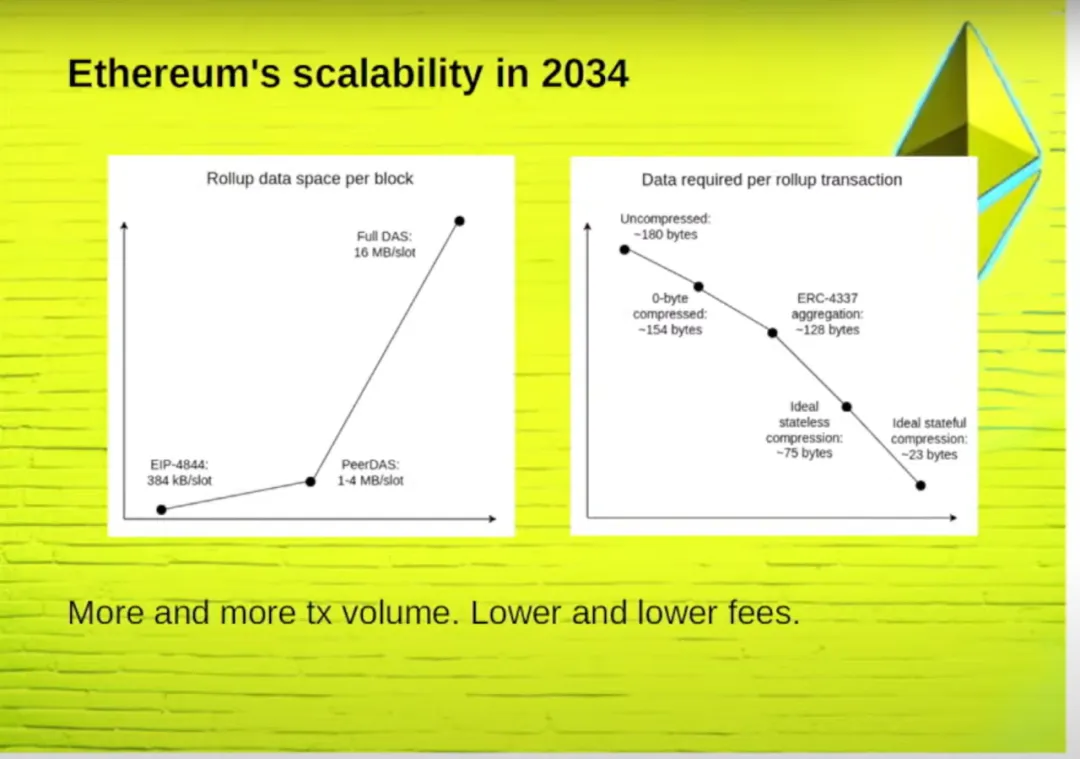
Let’s now examine scalability in 2034. The chart on the left shows projected growth in data space within Ethereum blocks over time, directly affecting how many transactions users can perform on L2s.
Scalability in 2034
The theoretical optimal size for a rollup transaction is at least 25 bytes on-chain. Now Leona from Intmax comes along and says, “Actually, you only need 5 bytes”—she’ll demonstrate this tomorrow at the Plasma conference.
That’s great—but assuming 25 bytes for now: divide 384,000 bytes by 12 seconds, giving 32,000 bytes per second. Divide that by 25, and you get around 1,280 transactions per second processable on L2s.
The next step is peer-to-peer upgrades to Ethereum’s data space, planned for next year—increasing capacity from 384 KB to 1–4 MB, potentially an 8x improvement. This brings us from ~1,280 TPS to ~10,000 TPS on L2s. Then, with full Data Availability Sampling (DAS), we could reach 16 MB every 12 seconds.
This means L2s could handle tens of thousands of transactions per second—potentially hundreds of thousands or even millions when including Plasma. In the medium term, we’re aiming for effectively infinite scalability, built on Ethereum, secured by Ethereum, and within the Ethereum ecosystem. Additionally, today’s rollup transaction data averages 150–180 bytes uncompressed. With compression, this drops to ~25 bytes; with Plasma, it could be even less.
As transaction volume grows, Ethereum users will benefit from ever-lower fees.
User Experience and Security in 2034
One adoption challenge in 2024 is token custody. There are two main ways to hold tokens. One is ultra-cautious: you own a private key, perhaps stored on your computer, written on paper, or kept on an air-gapped machine. You maximize security, but usability suffers—and mistakes still happen. Maybe you protect against theft, but lose access anyway. Or you try to secure your account across multiple scenarios, but one slip-up leads to compromise and stolen funds.
At the other extreme, people fully outsource custody: “I trust Coinbase to manage my tokens,” or “I trust Binance,” or “I’ll let this guy Sam hold them—he seems trustworthy. He speaks at forums with Bill Clinton, donates to good charities, his face is on billboards in San Francisco. Maybe I should trust him with all my tokens.” Then, one autumn day in 2022, it turns out Sam isn’t so trustworthy after all. You wake up—and your money is gone.
This happens frequently in our ecosystem. So the challenge lies between two extremes: complete self-sovereignty (trust no one), versus full reliance on centralized custodians. I’ve long believed the most interesting path is finding a middle ground—benefiting from both approaches.
One solution is multisignature wallets: instead of one key, control requires multiple keys. For example, six keys total—large transactions require four approvals, small ones only one. This method is widely used and enhances security for both individuals and organizations.
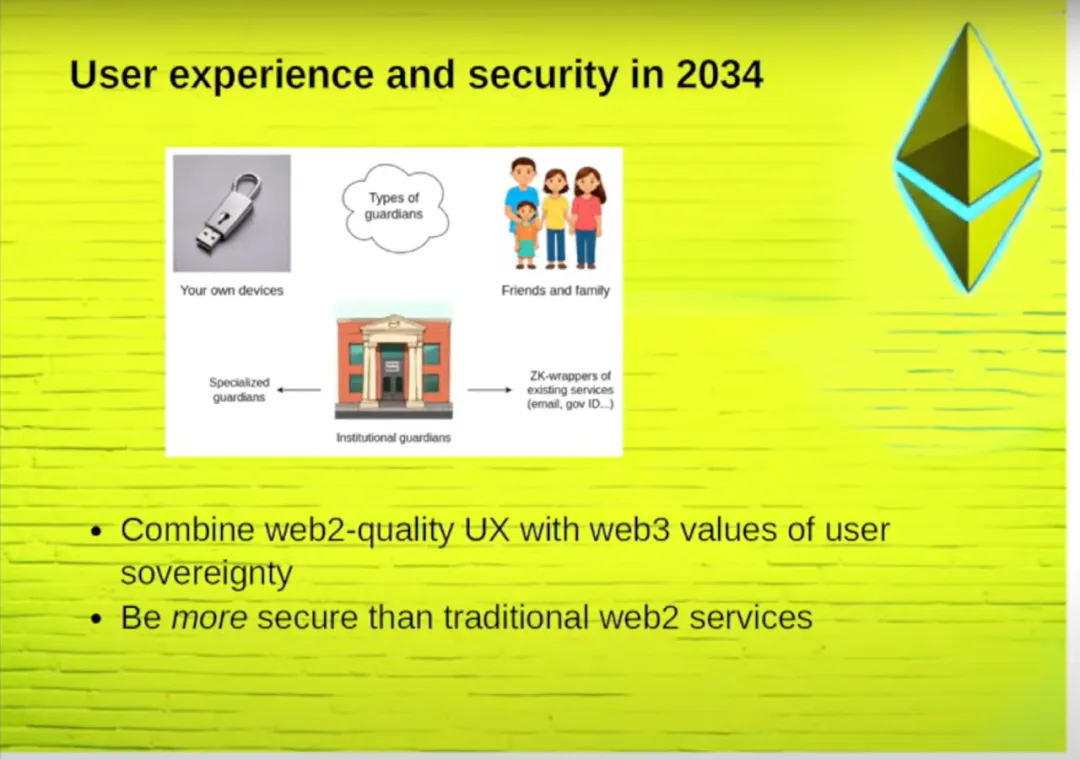
But there’s a problem: how do you actually store those six keys—especially if you’re not a crypto expert? I see three practical options. First, your own devices—your phone or computer. We can make phones safer by storing wallets inside trusted hardware chips. Hardware wallets like Ledger are another option. Or you can write down your recovery phrase on paper. Second, friends and family—if you trust someone, they can be a co-signer. Third, key management services—you can trust certain institutions to hold part of your key, helping secure your funds without giving them full control. They won’t have enough authority to unilaterally steal your money.
For institutional managers, there are two models. One is specialized custody companies created solely for key protection. The other leverages existing services—Web2 platforms, centralized IDs, email, government ID, or even Twitter accounts—wrapped via ZK-SNARKs to act as guardians. They help protect your wallet without gaining full control over your assets. I believe advancing such designs—aiming for the best of both worlds—is crucial.
We should strive to build open, decentralized systems where no single centralized entity controls your account, assets, and data—while ensuring robust security for both full-time crypto professionals and newcomers alike.
Standardization
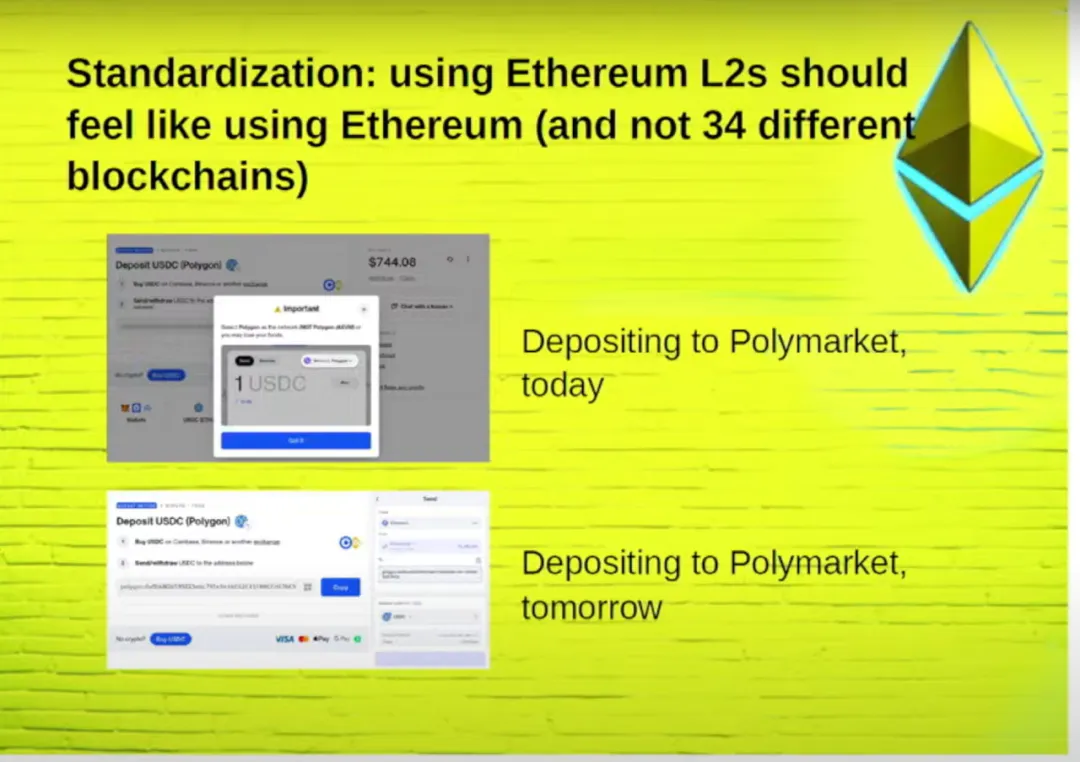
Using Ethereum L2s should feel like using Ethereum—not like navigating 34 separate blockchains. Depositing on PolyMarket today is still complicated: copy an address, switch networks to Polygon, possibly use a custom bridge app. A mistake could send tokens to the wrong place. This can—and should—be greatly simplified. I’ve written elsewhere about streamlining this: with proper cross-L2 swap and cross-L2 addressing standards, moving funds between L2s, from L1 to L2, or L2 to L1 could be as simple as transferring within a single network.
Move Beyond Chasing Web2
Another point: Ethereum developers shouldn’t merely copy Web2. We must go beyond it. If we want to build something truly valued and universally used by 2034, we can’t spend the next decade replicating 2024’s centralized tech and apps. We must follow where the frontier is heading. Here are some thoughts:
1. New Form Factors
From 2014 to now, the biggest shift has been from desktop-only to supporting both desktop and mobile. By 2034, it won’t stop there. What other form factors lie ahead? Wearables—watches, glasses. Conversations with locally-run AI. Augmented Reality (AR). Brain-computer interfaces. These are coming. Perhaps we should start designing apps with these interaction methods in mind from the outset.
2. Epistemic Technologies
Technologies that help people discern truth from falsehood, good apps from scams. Community Notes is one of my favorites; so are prediction markets.
I believe these shouldn’t exist as isolated apps or just parts of Twitter. They should be built directly into browsers and the interfaces we use to access Web3. This is something we can design into Web3 browsers—and even extend to other app types. Take encrypted messaging apps: many are building them because we love being cypherpunks, protecting individual privacy. But messaging apps already exist.
What if we go one step further? Consider how emerging technologies in the 2020s—like locally integrated AI—can enhance communication. Users could choose AIs aligned with their values and communities, running locally to help interpret and clarify what others say to them.
3. Lead in Security
Another idea: lead in security innovation. Crypto faces persistent security challenges.
In fact, the centralized world is even less secure. Its model relies on chasing wolves: when a wolf attacks, send police, central authorities, or others to catch it. If that’s your only option, that’s what you do.
What’s fascinating about crypto is that we can adopt a different strategy: armor the sheep. By building direct defense systems, we can protect users from threats regardless of location or nature—without relying solely on catching attackers. We can protect people at the source.
I believe this is the only way to make crypto meaningful, because crypto itself is inherently chaotic—global, open, permissionless by nature.
You can’t chase down attackers the way you might in other domains. My hope is that if we develop methods to protect ordinary users at the source, we can export these solutions to the wider world—making it both safer and more open. Information defense is part of this: Community Notes is one example.
Then there’s cryptographic security—ensuring the underlying blockchain software is bug-free. Formal verification techniques may make this truly achievable. Another idea is on-chain content version control: instead of accessing dApps via websites, users access them through IPFS hashes. When a dApp updates, every user sees the change. If an attacker compromises a website, they can’t instantly serve fake versions of the dApp. Such attacks become much harder. We can implement many such measures to lead in security within the Ethereum ecosystem—and I believe striving for this is deeply valuable.
Conclusion
To sum up: I believe the past ten years of Ethereum were focused on theory—ensuring things work correctly, verifying that our technology is sufficient to build with. Our applications were mostly demos. Anything built in 2016 couldn’t scale with the technology of the time. But by 2024, we have the tools.
We can now scale. Our user experience is good enough to attract mainstream users. Powerful, impactful applications already exist on Ethereum. For the next decade, we must shift our focus.
We must move beyond L1 concerns and seriously consider our real-world impact. We need to clearly identify which applications we want to build, ensuring they uphold our shared values. These apps must function well enough to attract people outside crypto and meet their needs. I don’t have all the answers. But I believe each of you—every developer, builder, and every person speaking up in the Ethereum community—has the opportunity to co-create Ethereum’s future.
Thank you!
Join TechFlow official community to stay tuned
Telegram:https://t.me/TechFlowDaily
X (Twitter):https://x.com/TechFlowPost
X (Twitter) EN:https://x.com/BlockFlow_News
 @VitalikButerin