Taking Questions as a Method: A New Framework for Understanding Chain Abstraction
TechFlow Selected TechFlow Selected
Taking Questions as a Method: A New Framework for Understanding Chain Abstraction
Starting from the concept, returning to fundamental questions.
 Navigating Web3 tides with focused insights
Author: Lydia Wu
If you felt confused when first encountering the concept of "chain abstraction," you're not alone.
——It seems important, there are many projects, lots of funding, everyone claims to be setting standards... but it's unclear what it's actually for. Is chain abstraction just another buzzword rolling off Web3’s conveyor belt?
This article starts from the fundamentals, revisiting core questions in an attempt to scoop up pearls from a sea of uncertainty.
TL; DR
-
Abstraction aims to hide complexity. In Web3, abstraction layers are often higher than in Web2 (thus more difficult).
-
Modularization lowers the barrier to building blockchains. Chain abstraction includes rearchitecting relationships between chains and improving user/developer experience.
-
Cross-chain asset transfers, cross-chain communication, interoperability, and chain abstraction—these form a subset of concepts centered on coordinating state changes (transactions) across different chains, though real-world usage often blurs the lines.
-
Solutions based on intent have become a popular architecture. Component-level products may gradually assemble like puzzle pieces toward the final vision of chain abstraction.
-
The industry's current discourse and development around chain abstraction remain overly fixated on infrastructure centrality. The legitimacy of chain abstraction as a real problem depends on on-chain activity, modularization progress, and new user and developer adoption.
-
The future of chain abstraction is far from a smooth, bright path—it must consider impacts on long-tail blockchains and explore non-DeFi applications.
What Kind of Problem Is Chain Abstraction?
-
Is chain abstraction a real problem?
-
If so, which category of problems does it belong to?
-
What distinguishes cross-chain, interoperability, and chain abstraction?
Is Chain Abstraction a Real Problem?
——Not necessarily. A problem only exists within context. Imagine asking someone 500 years ago about the energy crisis.
So where does our discussion of chain abstraction come from?
Different people might answer with keywords like: Ethereum roadmap, modularization, intent, mass adoption... Currently, the most compelling explanation may be: chain abstraction is the second half of modularization.
To understand this view, we need to clarify what chain abstraction means.
In computer science, “abstraction” refers to separating high-level operations and concepts from underlying processes, aiming to simplify understanding by hiding complexity. For example, most Web2 users only need to know how to use a browser or ChatGPT—they don’t need to understand the underlying systems or even the concept of abstraction itself.
Similarly:
-
Account abstraction: hides internal details like blockchain account addresses, private keys, and seed phrases, making accounts seamless.
-
Chain abstraction: hides internal aspects such as consensus mechanisms, gas fees, and native tokens across chains, making chains themselves seamless.
In traditional software development, abstraction and modularization are closely related core concepts. Abstraction defines system hierarchy and architecture, while modularization is the method to implement that architecture. Each module represents an abstraction level; interactions between modules hide internal complexity, enabling easier code extension, reuse, and maintenance. Without abstraction, boundaries between modules would become messy and unmanageable.
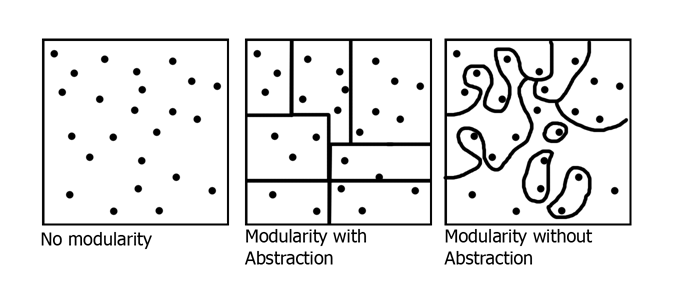
Source: https://web.cs.ucla.edu/classes/winter12/cs111/scribe/3a/
Note that Web2 typically performs abstraction and modularization within closed or semi-closed ecosystems. Abstraction levels are usually confined within a single platform or application, under relatively controlled environments, without needing to resolve cross-platform compatibility. However, in Web3, due to the pursuit of decentralization and open ecosystems, the relationship between modularization and abstraction becomes significantly more complex.
While modularization helps solve abstraction within individual blockchains and lowers the threshold for building public chains, it falls short in abstracting user and developer experiences in a multi-chain landscape. Clear silo effects exist between different blockchains and ecosystems—evident in fragmented liquidity, developers, and users. Chain abstraction proposes a re-architecture of relationships among public chains to enable connection, integration, and compatibility across multiple chains—a point affirmed in Near’s January article this year.
We can say the urgency of chain abstraction as a genuine problem is closely tied to the development of the following conditions:
-
On-chain activity: Are more dApps driving greater on-chain user engagement?
-
Progress in modular blockchains: Does increased on-chain activity drive more rollups and app chains?
-
Barriers for new users and developers: To what extent does today’s blockchain environment hinder new entrants (referring to friction during growth, not stagnation-induced frustration)?
Which Category of Problems Does Chain Abstraction Belong To?
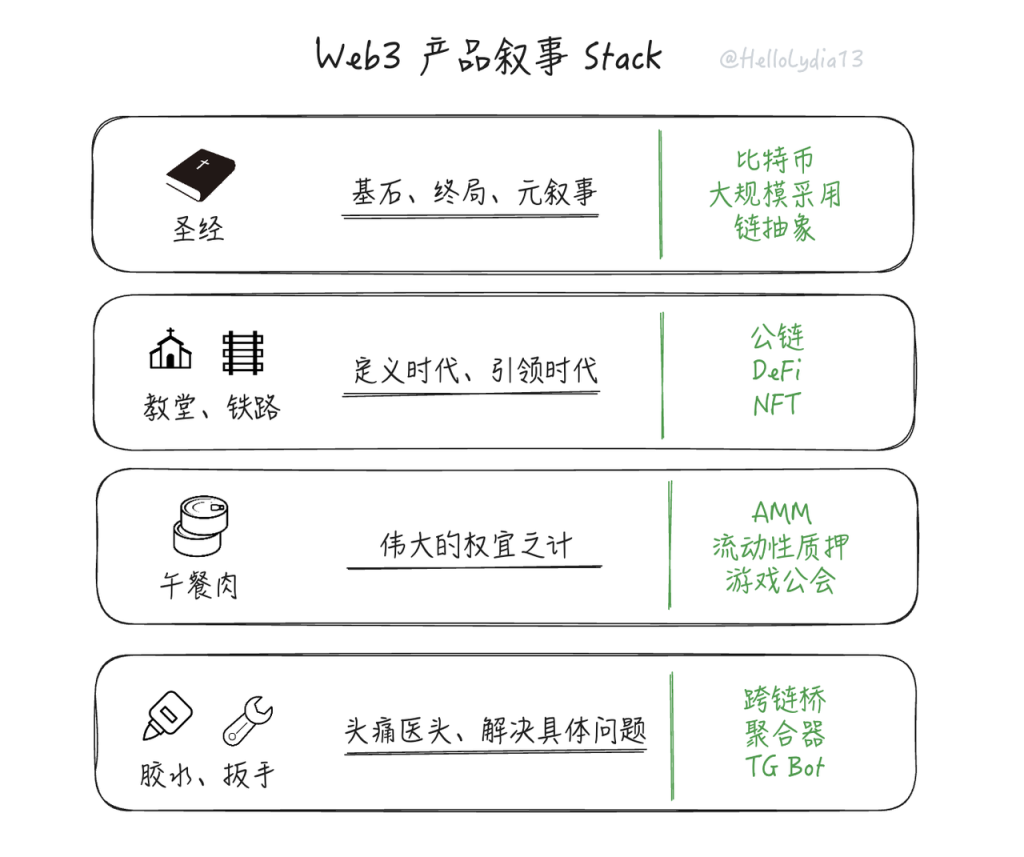
Chain abstraction itself is an abstract concept, occupying a high-level narrative position within Web3—this may partly explain why it appears all-encompassing and elusive. Specifically, it is not a solution, but rather a guiding principle.
Another example is Bitcoin today. After multiple halvings, price swings, and ETF approvals, Bitcoin has evolved beyond being merely a technical solution or asset class. It has become a timeless ideological framework and industry totem, representing core crypto values and continuing to guide innovation and development in the foreseeable future.
What Are the Differences and Connections Among Cross-Chain, Interoperability, and Chain Abstraction?
We can also understand cross-chain, interoperability, and chain abstraction along a spectrum from concrete to abstract. Structurally, they form a subset of concepts centered on coordinating state changes (transactions) across different chains, though practical usage often involves overlapping areas.
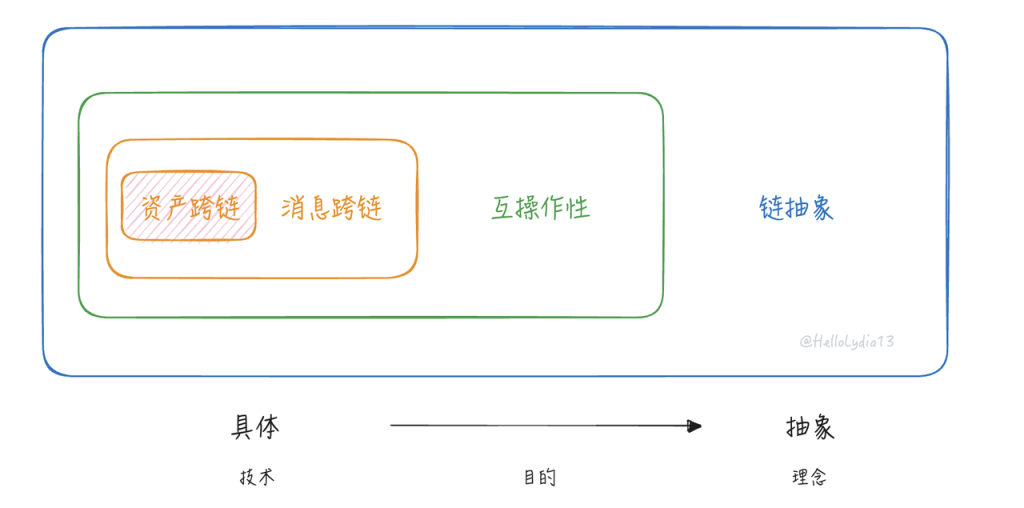
We can broadly categorize cross-chain applications and protocols into two types:
-
Cross-chain asset transfer: bridges, cross-chain AMMs, cross-chain aggregators, etc.
-
Cross-chain communication: LayerZero, Wormhole, Cosmos IBC, etc.
Asset transfers rely on message passing. The messaging layer in cross-chain asset transfer apps typically consists of on-chain smart contracts and state update logic. Abstracting this messaging functionality into a general, protocol-level solution results in cross-chain communication protocols.
Cross-chain communication protocols handle more complex operations such as governance, liquidity mining, NFT trading, token issuance, and gaming actions. Interoperability protocols go further, involving deeper data processing, consensus, and verification, ensuring consistency and compatibility across blockchain systems at a systemic level. In practice, however, these two concepts often overlap and are used interchangeably depending on context.
Chain abstraction encompasses blockchain interoperability but adds an emphasis on improving user and developer experience—closely tied to the emerging narrative of intent in this cycle. The integration of intent and chain abstraction will be discussed below.
What Specific Issues Does Chain Abstraction Include?
-
How do we achieve chain abstraction?
-
Why should we pay attention to the combination of chain abstraction and intent?
How Do We Achieve Chain Abstraction?
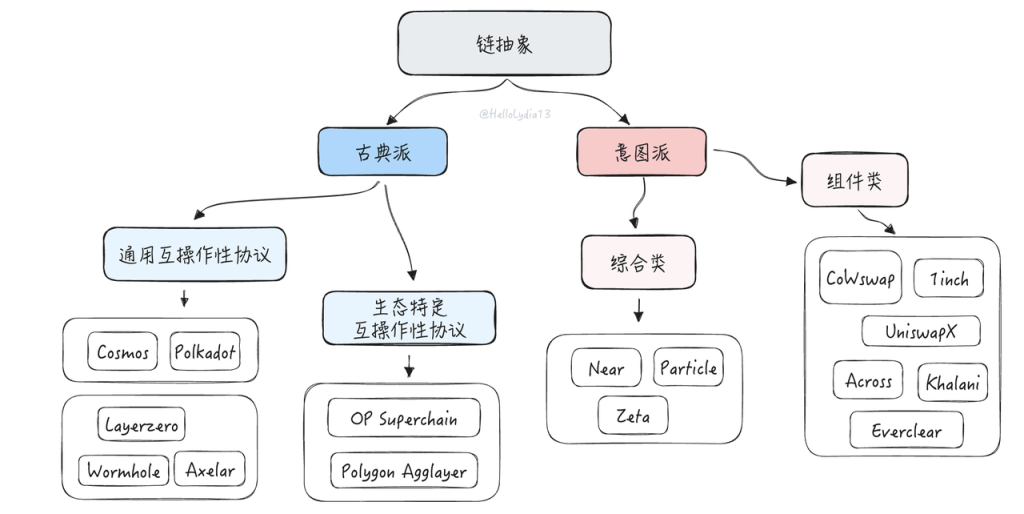
Different projects interpret and approach chain abstraction differently. Here, we divide them into two camps: the classical school, evolving from interoperability protocols with a focus on developer-side abstraction, and the intent school, embracing the new intent architecture and prioritizing user-side abstraction.
The classical school traces back to Cosmos and Polkadot, both predating the concept of chain abstraction. Newer entrants like OP Superchain and Polygon AggLayer currently focus on liquidity aggregation and interoperability within the Ethereum L2 ecosystem. Cross-chain communication-native protocols such as LayerZero, Wormhole, and Axelar are expanding to more chains and seeking broader adoption to strengthen their network effects.
The intent school includes L1s like Near and Particle Network, aiming to provide comprehensive chain abstraction solutions, as well as component-level projects solving specific issues—currently dominated by DeFi protocols like UniswapX, 1inch, and Across Protocol.
Both schools place secure, fast cross-chain interaction and friendly UX at the core of design—such as unified interfaces, seamless dApp cross-chain functionality, gas sponsorship, and management.
Why Should We Care About the Combination of Chain Abstraction and Intent?
"Intent-based xx protocols" are popping up everywhere. This section explores why this architecture has become popular and its potential.
Like abstraction and modularization, intent is not a native Web3 concept. Intent recognition has existed for decades in natural language processing and has been widely studied in human-computer dialogue.
Talking about intent research in Web3 inevitably leads to Paradigm’s famous paper. While similar design ideas had already appeared in products like CoWSwap, 1inch, and Telegram bots, the core of intent architecture was formally articulated in that paper: users only need to specify desired outcomes, not the process. The complex task execution should ideally be outsourced to third parties. This aligns perfectly with chain abstraction’s goal of improving user experience and offers a concrete solution path.
There are many frameworks for classifying chain abstraction architectures. One well-known model is Frontier Research’s CAKE framework (Chain Abstraction Key Elements), which incorporates intent architecture and divides technologies and solutions into three layers: Permission Layer, Solver Layer, and Settlement Layer. Others have made minor adjustments—Everclear, for instance, inserts a clearing layer between Solver and Settlement.
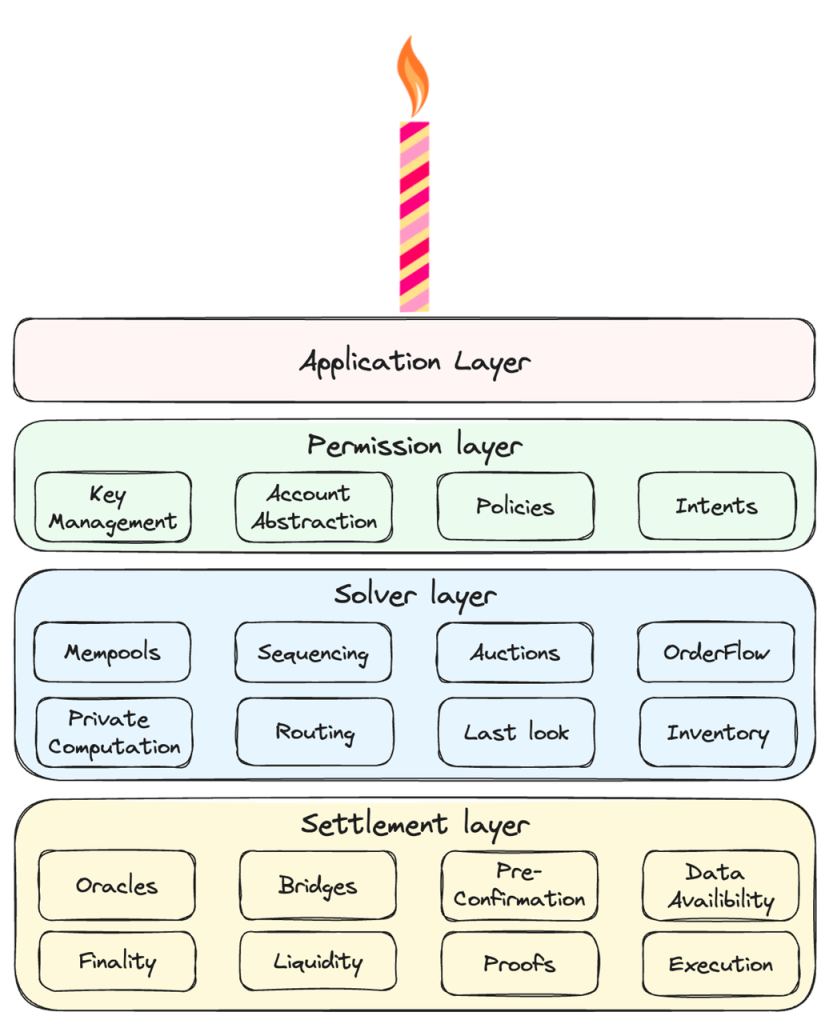
Source: Frontier Research
In detail:
-
Permission Layer: centered on account abstraction, serving as the user entry point for dApps to request intent quotes—users express their intent.
-
Solver Layer: typically an off-chain third-party solver layer responsible for fulfilling user intent—solvers compete for orders.
-
Settlement Layer: after user approval, calls oracles, bridges, and other solutions to ensure execution—users get expected results, solvers receive compensation.
Solvers in the Solver Layer are off-chain third-party entities, known across protocols as solvers, resolvers, searchers, fillers, takers, relayers, etc. Solvers usually need to stake assets as collateral to qualify for order competition.
User interaction with intent products resembles placing a limit order. In cross-chain scenarios, to fulfill user intents quickly, solvers often front-run funds and charge a risk premium upon settlement (a model akin to short-term loans: loan duration = blockchain state sync time, interest = service fee).
Comprehensive intent solutions represented by Near aim to integrate the Permission, Solver, and Settlement layers into a unified infrastructure product. These are still in early proof-of-concept stages, making direct evaluation of utility difficult.
Component-level intent solutions, exemplified by cross-chain DeFi protocols, have already shown clear advantages over traditional cross-chain models (like Lock & Mint, Burn & Mint). As the flagship product of Across Protocol, Across Bridge leverages intent architecture to achieve top-tier speed, low cost, and strong revenue generation among EVM ecosystem bridges—especially advantageous for small-volume cross-chain transfers.
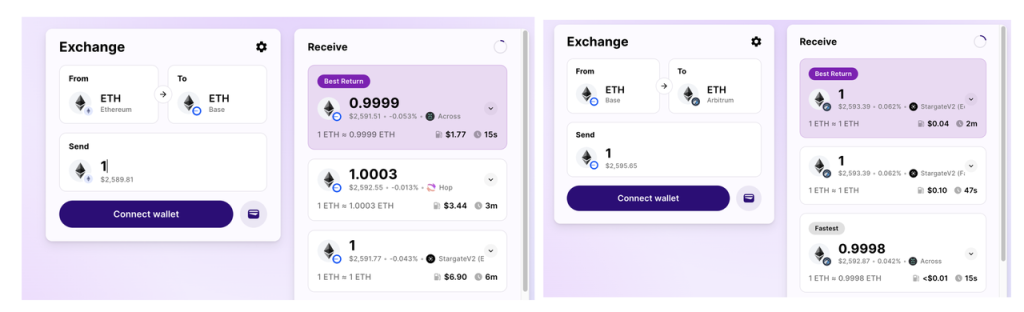
Aggregator showing cross-chain speed and fees across different products
Source: Jumper
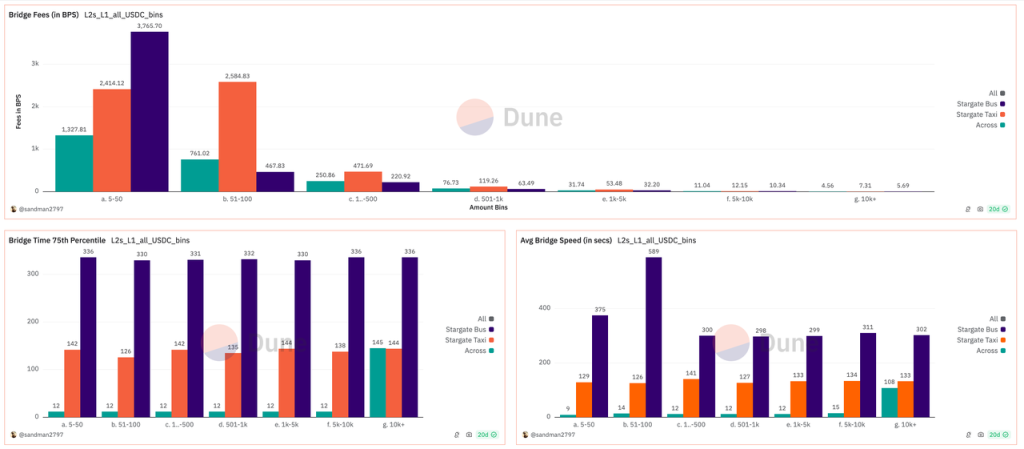
Speed and fee comparison between Across Protocol and Stargate in L2-L1 scenarios
Source: https://dune.com/sandman2797/across-vs-stargate-taxi-vs-bus-eth
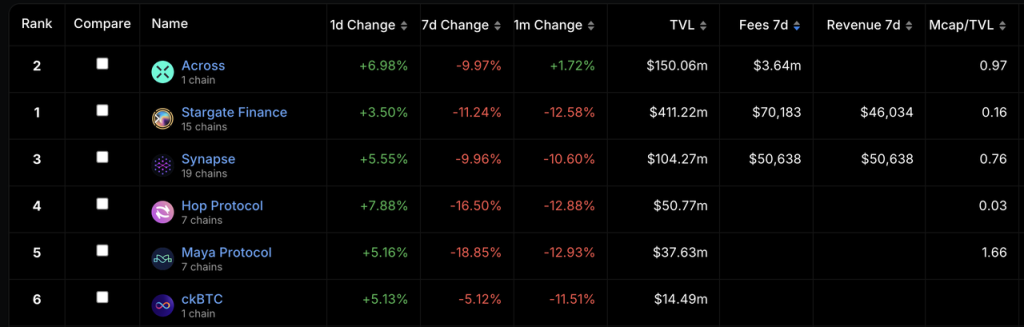
Across Protocol demonstrates stronger revenue generation capability
Source: DefiLlama
According to its roadmap, Across Protocol plans to launch a cross-chain intent settlement layer in phase three. The ERC-7683 proposed jointly by Uniswap Labs and Across aims to lower solver entry barriers through standardized intent expression and build a universal solver network. Numerous component-level products may incrementally converge toward the ultimate form of chain abstraction like puzzle pieces.
What Are the Problems in Our Understanding and Practice of Chain Abstraction?
-
What problems arise from infrastructure-centric thinking?
-
What other important questions about chain abstraction deserve consideration?
What Problems Does Infrastructure-Centric Thinking Bring?
As leaders in interoperability protocols, LayerZero has raised $290 million and Wormhole $225 million. Their tokens, often featuring multi-billion FDVs and low circulating supplies, have become emblematic of much-criticized VC coins in this cycle, damaging market confidence in the chain abstraction space.
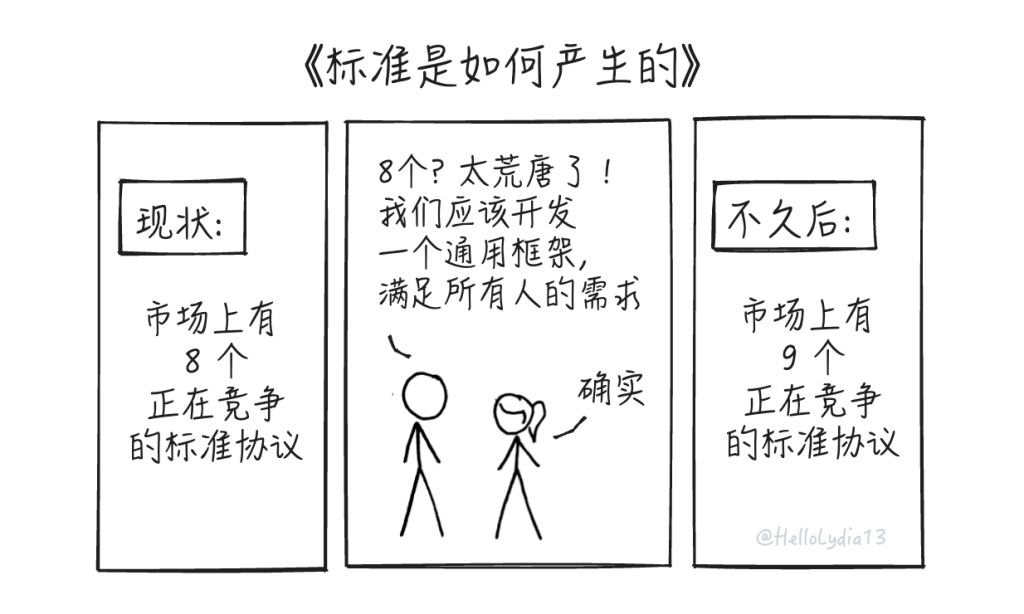
Returning to the comic at the beginning of this article—every chain abstraction project comes equipped with a tech stack and token standard. In a market lacking external growth, they’re easily accused of building “air infrastructure.” The stark data drop before and after LayerZero’s airdrop further fuels skepticism about the real demand for “cross-chain communication.”
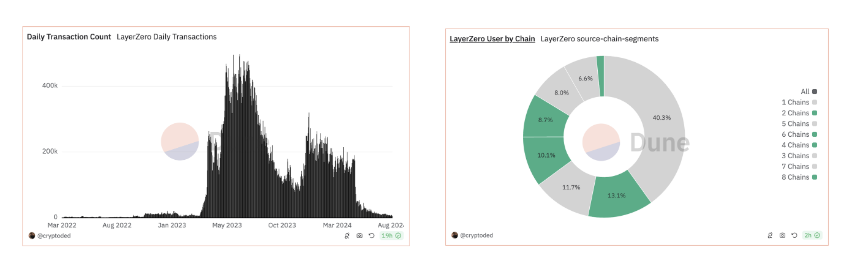
Clear data differences before and after LayerZero’s airdrop
Source: https://dune.com/cryptoded/layerzero
On the ERC-7683 forum, in response to criticism that cross-chain asset transfer functionality is too narrow, insufficiently general, and poorly supported across ecosystems, developers debated the proper scope of the ERC standard. Proponents of minimalism argue that tool-level standards are sufficient to address existing problems, can integrate with current standards, and face less resistance.
Given that intent architecture is largely application-oriented, overly ambitious “universal, full-stack, compatible” protocol standards sometimes become “too vague to mean anything” or “too large to solve actual problems,” resulting in an ironic situation: chain abstraction protocols created to solve fragmentation end up delivering fragmented solutions themselves.
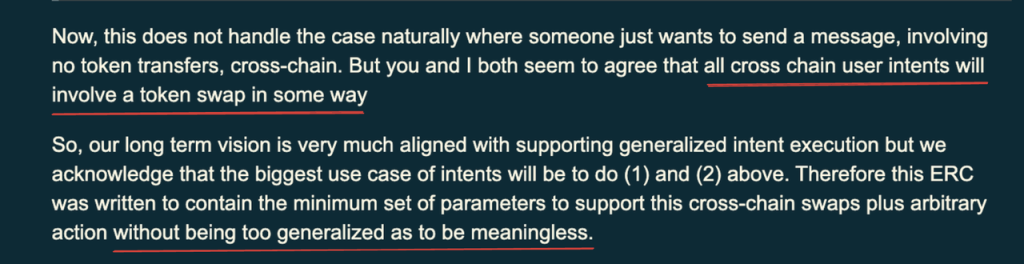
Source: https://ethereum-magicians.org/t/erc-7683-cross-chain-intents-standard/19619/18
What Other Questions About Chain Abstraction Deserve Consideration?
-
For new or long-tail blockchains, chain abstraction increases the difficulty of retaining TVL (analogous to globalization’s impact on underdeveloped regions). How might this affect adoption of chain abstraction?
-
A study by Variant suggests UniswapX could lead to a scenario where long-tail tokens are directed to AMMs while major tokens are increasingly filled via off-chain solvers. Is this the future trend for DEXs? Will a global solver layer emerge atop the global liquidity layer?
-
Beyond DeFi protocols, what forms might other intent-based product architectures take?
-
Will chain abstraction become the next big thing after modularization—or the next big bubble?
Join TechFlow official community to stay tuned
Telegram:https://t.me/TechFlowDaily
X (Twitter):https://x.com/TechFlowPost
X (Twitter) EN:https://x.com/BlockFlow_News
 Mint Ventures