








Xterio Unveiled: Can a Gaming Rollup Turn the Bull Market Wheel for Web3 Gaming?
TechFlow Selected TechFlow Selected
Xterio Unveiled: Can a Gaming Rollup Turn the Bull Market Wheel for Web3 Gaming?
This research report analyzes Xterio's business progress by starting with the Gaming Rollup architecture.
 Navigating Web3 tides with focused insights
By Tyler
On August 11, Michael Tong, Co-Founder and CEO of Xterio, spoke at Foresight 2024, stating that in this new cycle, Web3 gaming must deliver both tangible rewards and genuine playability. To achieve this, Xterio is building more accessible and efficient infrastructure while validating its approach through a portfolio of in-house developed games.
Gaming has always been a powerful catalyst for technological innovation and the rise of platform-scale giants in the digital era.
Beyond Tencent and NetEase, on June 18, 2024, NVIDIA reached a market capitalization of $3.3353 trillion, officially surpassing Microsoft and Apple to become the world’s most valuable company. Tracing back its roots, we find that gaming was actually the starting point of its success story:
Founded in 1993, NVIDIA quickly established itself by capitalizing on GPUs driven by the gaming industry. Nourished by gaming graphics cards and cryptocurrency mining, it eventually rode the global AI wave to emerge as a leader in the tech industry.
Yet in 2024, the Web3 gaming sector struggles to share in this momentum. Despite the bull market, the space remains in a relatively chaotic and hazy state. Whether through variants of the X2E model or AAA games going on-chain, efforts have sprouted across multiple fronts but have yet to generate sustained interest or establish a proven business model.
The Web3 gaming ecosystem is still searching for its breakthrough—still lacking a definitive answer for the second half of its evolution: How can it become the catalyst for widespread industry adoption and the birth of new platform-scale giants?
In this context, if fully on-chain games represent an early experimental clash between Web3 and gaming at the foundational level, then Xterio—with its Gaming Rollup architecture and a one-stop Web3 gaming platform modeled after Tencent and NetEase’s "super game factories"—offers a fresh possibility. Its leading position and deep collaboration within the BNB Chain ecosystem may well serve as a blueprint for Web3 gaming's transition into large-scale adoption in the second half.
A Vision for a Full-Lifecycle "Gaming Industry Chain"
In today’s crowded L2 landscape, which networks boast the highest user activity?
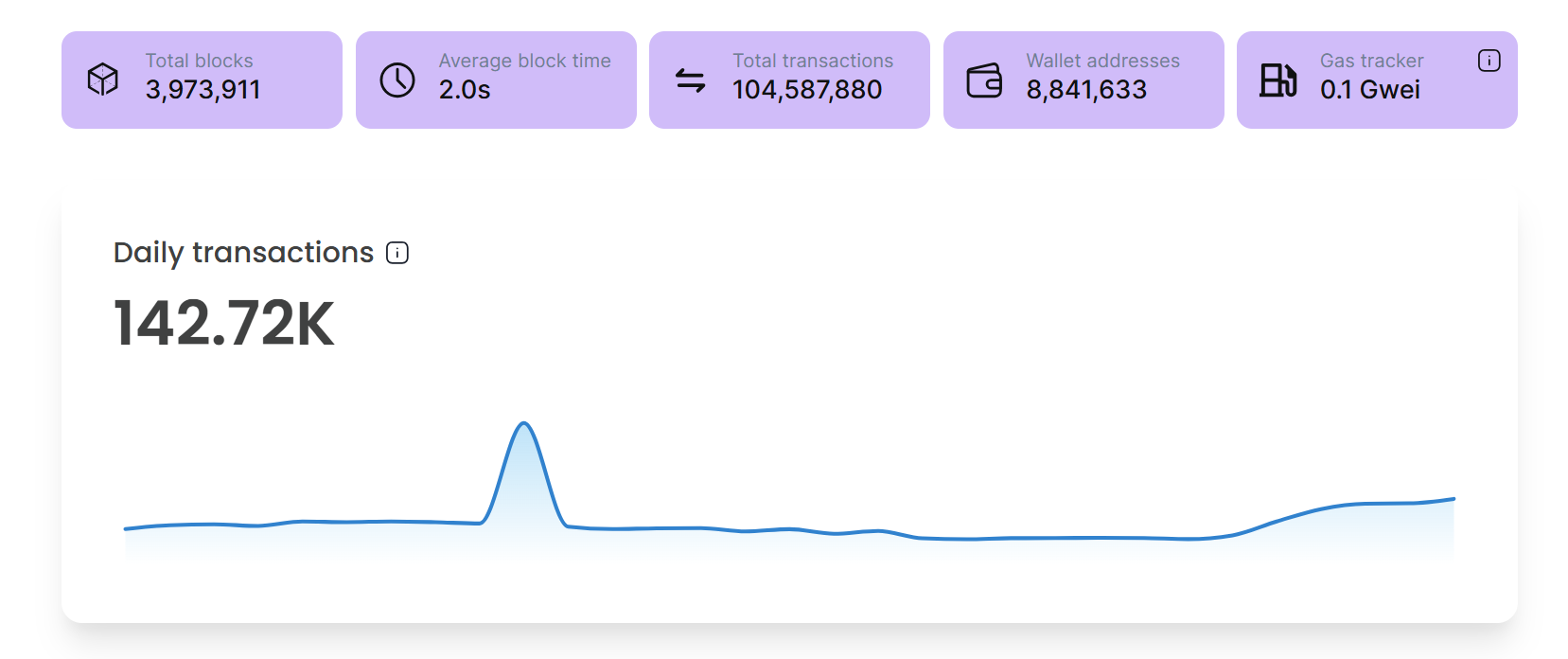
To most people’s surprise, alongside familiar names like Arbitrum, Optimism, and Base, Xterio Chain—the pioneer of the "Gaming Rollup" concept—has also emerged as a standout among L2 solutions. It has surpassed 100 million cumulative transactions, with daily transaction counts exceeding those of other gaming-focused L2s such as Arbitrum Nova (based on data from Xterio Chain stats and Orbiter Finance).
Beyond developing and acquiring high-quality games, Xterio is a Web3 gaming platform offering cross-platform access (including mobile, console, and PC). It provides core components essential for Web3 game development and iteration, delivering a full suite of turnkey solutions for developers. Players can engage with diverse gameplay through rich on-chain games, NFT markets, wallets, and community apps; meanwhile, developers can leverage Xterio’s complete toolkit to cover every stage of the Web3 game lifecycle—from creation to ecosystem deployment. This gives Xterio distinct comparative advantages in user acquisition and new game development—unique strengths not found in other gaming platforms or ecosystems.
Through partnerships with renowned game studios such as FunPlus and Com2us, Xterio enables these giants to integrate their premium titles into its ecosystem, directly tapping into Xterio’s player traffic pool to maximize effective new user growth. So far, Xterio has helped over 70 partner game projects—including REVENGE—rapidly attract large numbers of Web3 users, achieving outstanding promotional results.
Additionally, small game teams and traditional game developers can leverage Xterio’s unique advantages to integrate blockchain technology into their games and quickly launch various game genres. The platform already covers major categories—MMORPG, sandbox, strategy, MOBA, shooter—that have achieved billions of users and tens of billions in revenue in traditional gaming, meeting diverse user demands while delivering meaningful returns.
In short, as a Web3 gaming platform and publisher, Xterio aims to build an interconnected, full-lifecycle "gaming industry chain"—a one-stop ecosystem offering services spanning game publishing, virtual asset trading, and derivative value creation.
The key enabler is its comprehensive suite of functional components for Web3 game development, allowing developers and projects to use them efficiently, freely, and with low barriers—like LEGO blocks—for game publishing, asset exchange, and circulation. This establishes an entirely new model for game development and operations.
In many ways, Xterio ultimately seeks to create a new Web3-based game distribution model, invent novel gameplay formats, and pioneer a new gaming ecosystem—delivering next-generation infrastructure, standard protocols, economic systems, and organizational models for the Web3 gaming world, even enabling cross-game free trading of game assets (items, equipment, characters).
The core engine behind this vision is Xterio’s pioneering "Gaming Rollup" concept, enabling it to support more complex game formats in performance, reduce blockchain game development difficulty in functionality, and ultimately build an interconnected, full-lifecycle "gaming industry chain" at the ecosystem level.
A Veteran Team with Deep Ties to BNB Chain
Xterio holds a unique competitive edge in the Web3 gaming space: it is currently the only综合性 gaming ecosystem offering "multi-terminal, full-category" self-developed games—covering PC, mobile, and web platforms across strategy, shooter, and other genres.
This strength stems from Xterio’s founding team, drawn from top-tier game developers including FunPlus, Electronic Arts, Zynga, Activision Blizzard, Krafton, Jam City, and NetEase, with team members averaging over 15 years of industry experience.
This background makes Xterio fundamentally different. Its team deeply understands gaming’s essence and brings extensive development expertise. With years of experience across planning, development, operations, and distribution, Xterio excels at every stage. The team not only creates high-quality content but also deeply understands player needs, precisely capturing key elements such as fun, challenge, and social interaction.
Moreover, Xterio has attracted investment from multiple global top-tier firms and forged repeated collaborations with BNB Chain. To date, Xterio has raised $80 million in total funding:
-
In August 2022, Xterio completed a SAFT sale round led by FunPlus, Makers Fund, and XPLA, with participation from Animoca, HashKey, Foresight Ventures, Infinity Ventures Crypto, DST, and Matrix Partners;
-
In July 2023, Binance Labs invested $15 million in Xterio, further solidifying their strategic partnership;
As part of the long-term strategic alliance, Binance Labs will continue supporting Xterio’s growth. Xterio plans to launch its token within the BNB Chain ecosystem, deepening cooperation with Binance across game ecosystem development and tokenomics.
The Ecosystem Methodology of "Gaming Rollup"
There is no fixed formula for a hit game.
This is the most pressing reality facing the current Web3 gaming sector. Early successes like Axie Infinity and StepN are nearly impossible to replicate and have faced widespread criticism for their strong "financial" attributes. In essence, they resemble DeFi products disguised as Web3 games.
Especially under the X2N game-mining model, no Web3 game can achieve long-term, stable operations. Therefore, while "playability" is repeatedly emphasized, it is merely a means—not the end goal. A truly successful Web3 game must sustain continuous operation and feature updates, attracting both attention and capital retention. Only when users willingly invest time, effort, and money can a Web3 game be considered genuinely successful.
Xterio Chain explicitly positions itself as a "Gaming Rollup," focusing specifically on gaming-dedicated rollups to provide specialized L2 solutions for Web3 game development and operations. This sets it apart from established leaders like Gala and Immutable:
-
Gala, as a node-based L1 gaming public chain, primarily attracts players and developers by aggregating game resources but does not operate within an L2 ecosystem;
-
Immutable focuses more on providing foundational infrastructure, offering technical support and architectural backbone for game development and execution.
Xterio Chain takes a different path, specializing in gaming-specific rollups. This allows it to deliver highly customized and optimized L2 solutions tailored to the gaming industry’s unique needs and pain points—particularly in high-frequency transactions, fast confirmation, and low fees—leveraging its unique technical architecture and optimization strategies to outperform conventional solutions.
For example, Xterio is the first restaked rollup to implement MACH (fast transaction finality), ensuring transaction finality in under 10 seconds without compromising security—an indispensable feature for gaming projects.
This distinctive positioning gives Xterio Chain a clear advantage in attracting game teams to build on its platform. It is not just an L2 solution for gaming with its own game development pipeline, but also offers a full suite of development tools, aggregating other developers and users to co-create high-quality games that rival traditional gaming experiences.
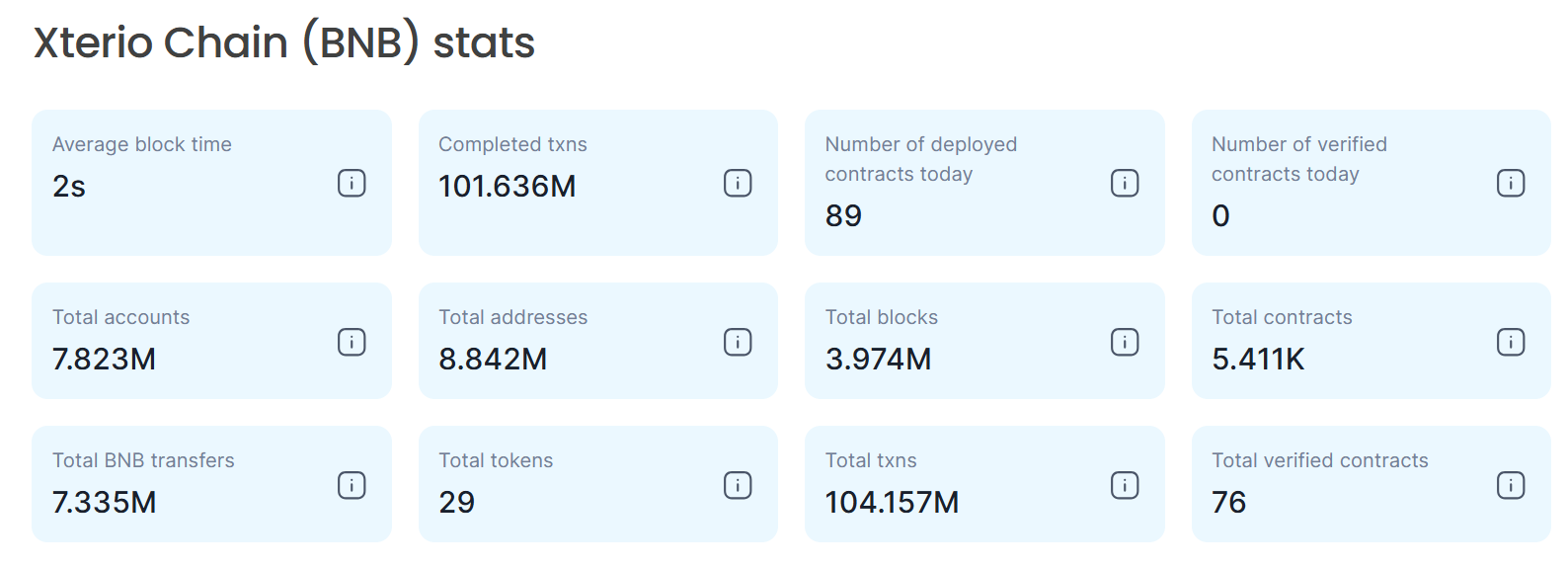
From a data perspective, Xterio Chain (built on BNB) demonstrates strong on-chain performance. Key metrics—including number of addresses, active accounts, and transaction growth—all show robust trends. Cumulative transactions exceed 100 million, with over 7.8 million participating accounts and daily active transactions growing steadily at around 150,000.
Dual Rollup Architecture on Ethereum and BNB Chain
Xterio’s rollup architecture is divided between Ethereum and BNB Chain, each playing a critical role.
On Ethereum, Xterio collaborates with AltLayer and EigenLayer to launch a restaked rollup specifically designed for gaming. Leveraging EigenLayer’s re-staking of ETH for enhanced security, it becomes the only gaming-focused AVS (Actively Validated Service), aligning perfectly with the current restaking narrative and providing strong support for decentralization and security.
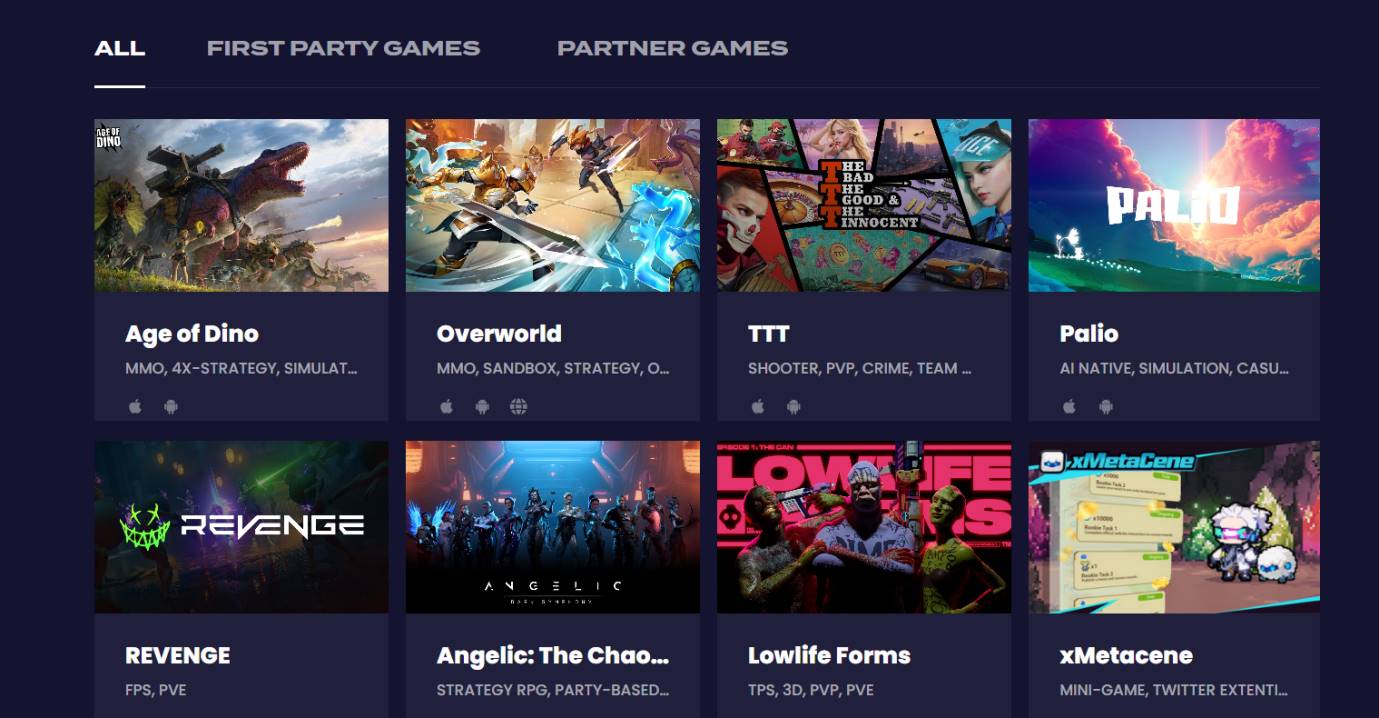
On BNB Chain, Xterio has built a relatively mature product matrix ecosystem. Games like Age of Dino and Palio have performed exceptionally well. Notably, Age of Dino—the first AAA strategy mobile game integrated with Web3 features—has brought innovation to the gaming space by offering on-chain trading, rewards, and transactions.
In the upcoming public test of Age of Dino’s new version this September, several unique Web3 innovations and iterative features will be introduced, according to official Twitter announcements:
-
Casual gameplay such as customization and collection: Players can earn rewards by collecting avatar frames, badges, and dinosaur castles, enriching gameplay beyond traditional SLG mechanics.
-
NFT crafting functionality: Newly launched Dinosity NFTs can not only be used in battles but also crafted into Furnace NFTs and Skin Factory NFTs, which in turn produce wearable NFTs in-game. This adds a "mining rig" attribute to dinosaur NFTs, creating new in-game applications for NFTs.
-
Bounty quest mechanics: Even non-NFT holders can participate in daily tasks and collect quest badges to earn dual-token rewards, introducing a new gold-farming model.
Furthermore, Age of Dino aligns with Xterio’s emphasis on mobile-first design, offering rich gameplay on both mobile and web platforms, including casual parkour via DINO SKI and 3v3 casual arena combat via DINO BRAWL.
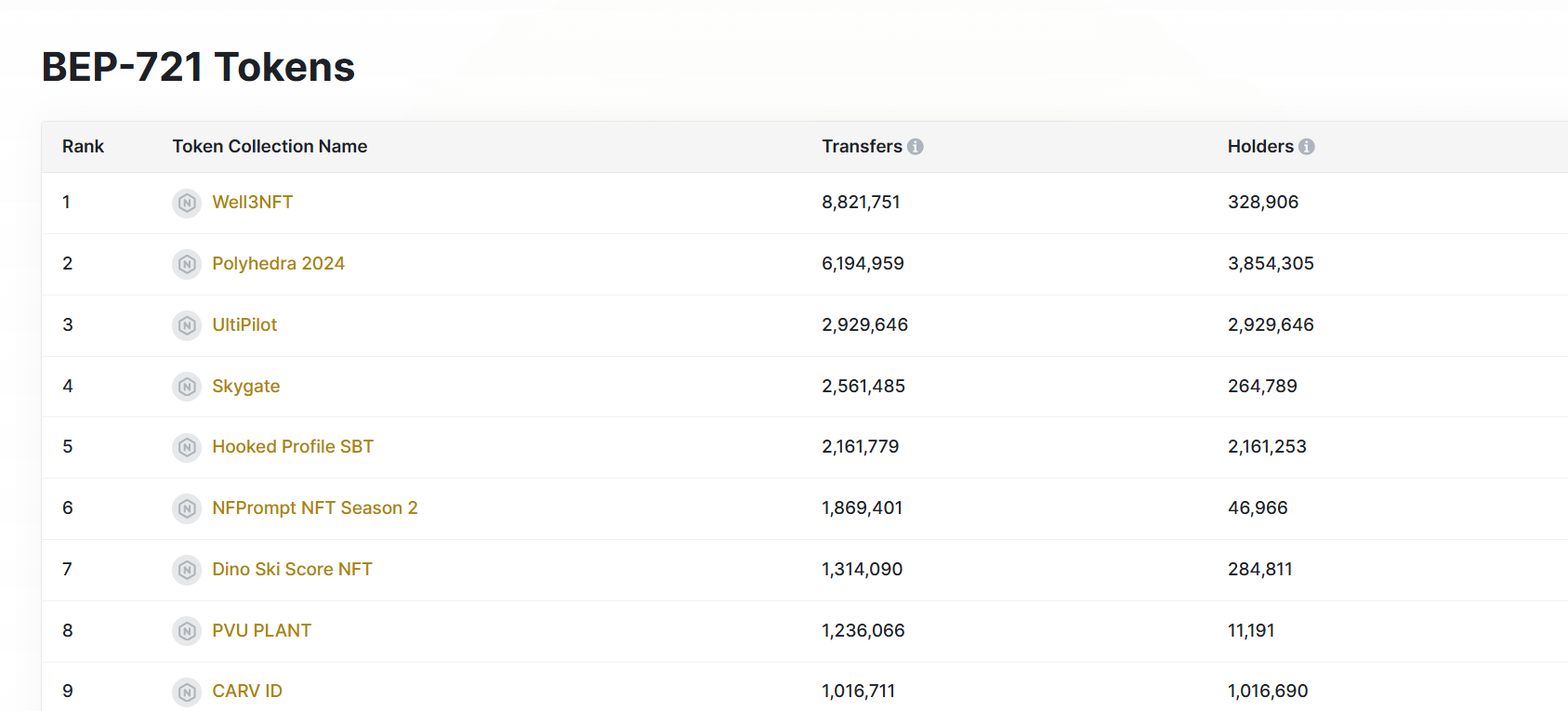
Notably, at the end of last year, Age of Dino’s Dino Ski Score NFT ranked first in 24-hour and 7-day on-chain trading volume and user count within the BNB ecosystem, briefly surpassing PancakeSwap. Although it has since declined, it still ranks 7th among all BEP721 tokens on OPBNB and leads among game-related NFTs in holder count, demonstrating strong user stickiness.
The Only Gaming-Focused AVS Service
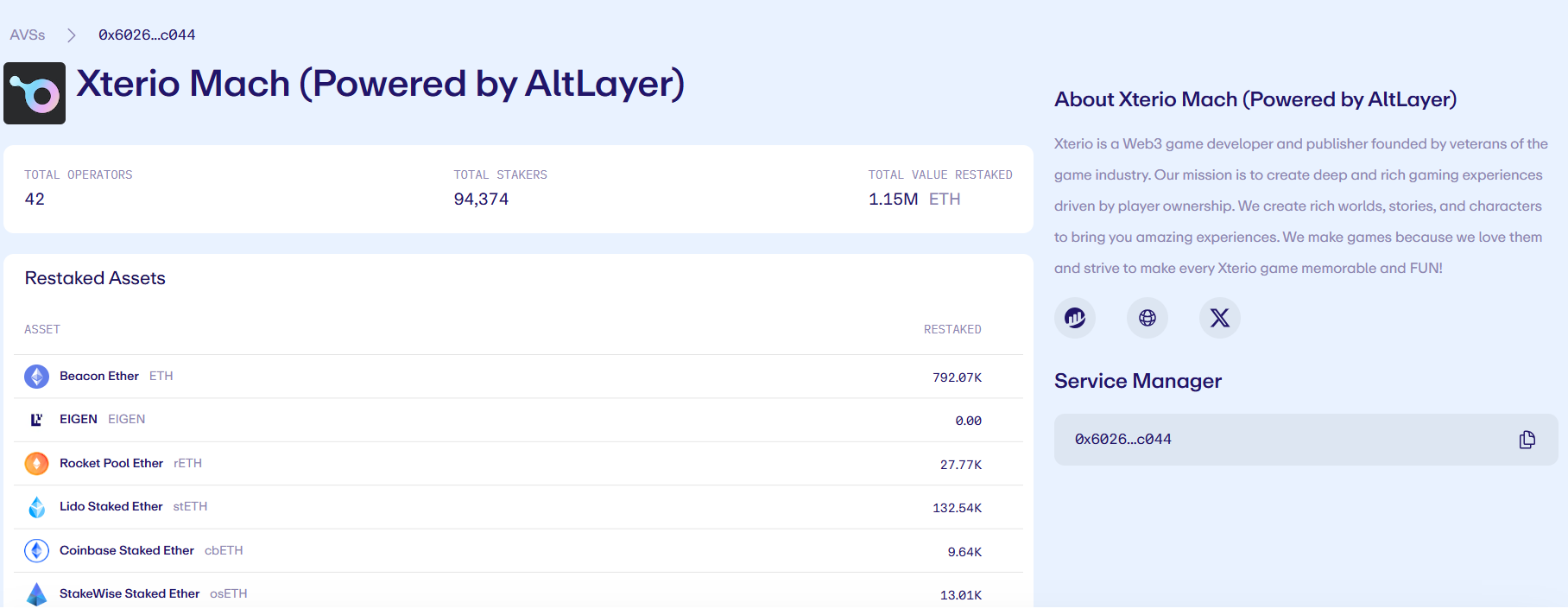
Among the first six AVS services launched on EigenLayer, Xterio is the only project dedicated to gaming. The other five are AltLayer (restaked rollup), Brevis (ZK coprocessor), eoracle (Ethereum-native oracle), LAGRANGE (non-interactive cross-chain state proofs), and Witness Chain (DePIN coordination layer).
AltLayer and EigenLayer jointly developed restaked rollups, leveraging EigenLayer’s restaking mechanism to enhance decentralization, security, interoperability, and efficiency. As the first restaked rollup using MACH (fast transaction finality) technology, Xterio delivers near-instant transaction finality—achieving finality in under 10 seconds without sacrificing security, an essential capability for gaming projects.
At the time of writing, 1.15 million ETH (approximately $3.9 billion) has been restaked on Xterio Chain, providing performance upgrades and data availability (DA) support. This significantly reduces game publishing and operating costs while enabling Xterio to share Ethereum’s economic security, making it a more cost-effective and secure choice for players.
A Growing Game Ecosystem "Matrix"
To date, Xterio has successfully launched four self-developed blockchain games—Overworld, Age of Dino, Palio, and City Shadow (formerly TTT)—and rolled out nearly 100 partnered game projects. Additionally, in October last year, Xterio launched Xterio Marketplace, a game-centric marketplace, further enhancing its ecosystem. Thus, Xterio’s game ecosystem “matrix” has taken initial shape.
A New Paradigm for "Mass Adoption" via Particle Network Integration
Despite ongoing progress in the Web3 world, a key challenge remains: the lack of real, sustainable incremental users. This explains why Axie Infinity and StepN were able to achieve billion-dollar growth through breakout appeal. Hence, achieving mass user adoption in Web3 has become a widely recognized pain point and challenge.
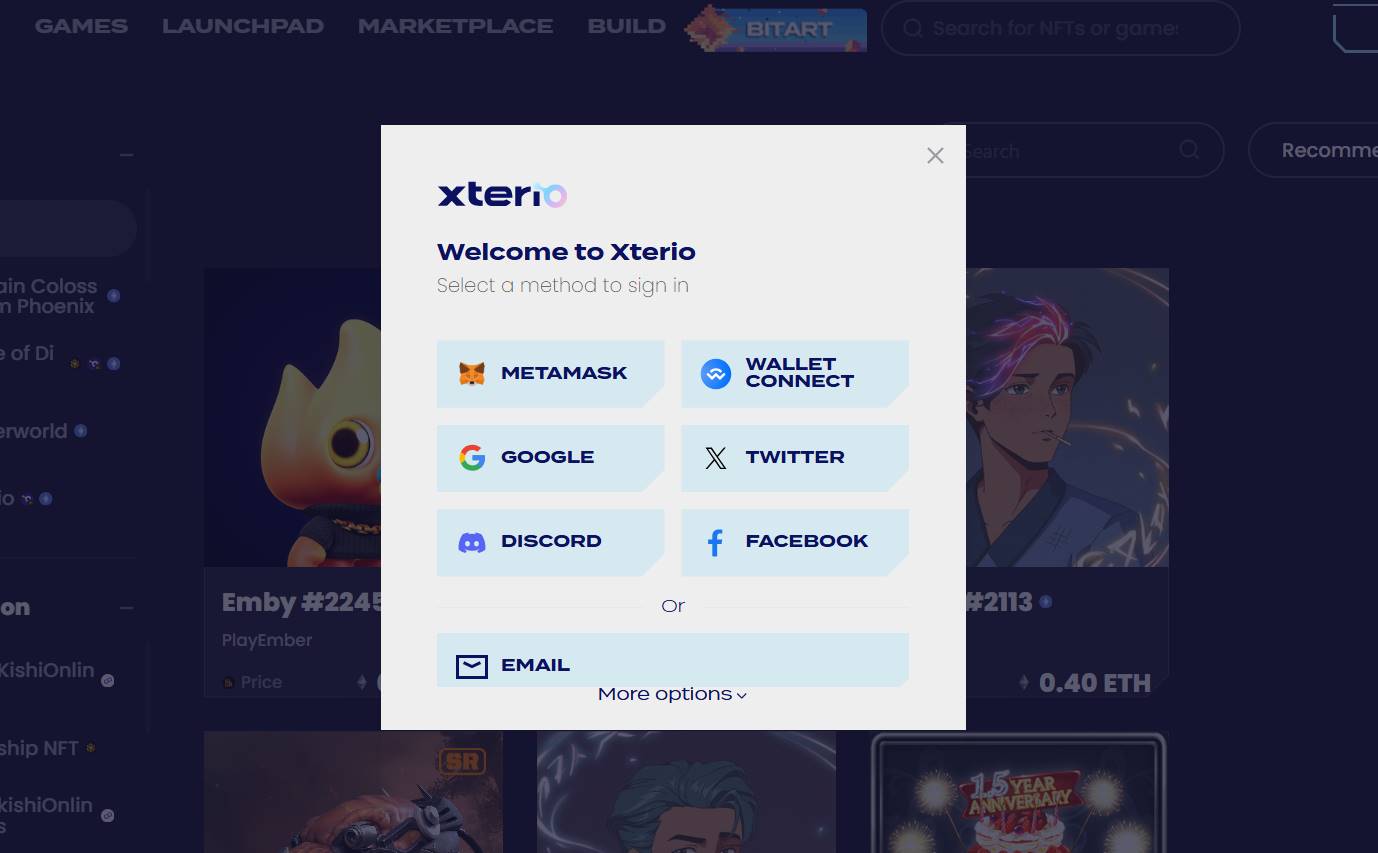
To capture the vast grassroots Web2 internet user base as a source of incremental growth and drive mass adoption of Web3 gaming, Xterio has deeply integrated Particle Network’s login and wallet middleware. Built on MPC (Multi-Party Computation) + AA (Account Abstraction), this middleware removes entry barriers at the foundational level for mass user onboarding.
Particle Network offers plug-and-play infrastructure components, including Authentication (login) services and Modular Smart Wallet-as-a-Service. These help Web3 dApps like Xterio eliminate seed phrases and improve user login and on-chain transaction experiences. Through this integration, Web2 users can seamlessly enter the Xterio ecosystem using familiar login methods—phone number, email, Google, Apple, Facebook, etc.—and immediately begin gaming.
A Token Model Designed to Capture Ecosystem Growth Value
In April 2024, Xterio announced a partnership with BNB Chain to adopt BNB as the gas token for Xterio Chain and serve as the L2 settlement execution layer on BNB Chain, utilizing OP Stack for its rollup architecture and EigenDA for data availability.
Meanwhile, Xterio Chain will focus on Web3 and AI-driven gaming and plans to use the XTER token to build an on-chain ecosystem centered around AAA games.
While detailed information on XTER tokenomics has not yet been released, official disclosures indicate that XTER differs from tokens in games like Gala. XTER will function directly across the entire gaming ecosystem as a settlement token for various internal consumption scenarios.
XTER has broad utility, including purchasing in-game assets and equipment, and participating in numerous in-game transactions. Therefore, as Xterio’s gaming ecosystem expands—with new games launching and user numbers rising—each new release will directly increase demand for the token. With a fixed supply and growing demand, this model reinforces deflationary pressure, giving the token long-term appreciation potential.
Comprehensive Ecosystem Strategy for GameFi
One flower blooming alone is not as good as watching the tides rise.
Xterio’s greatest differentiated advantage lies in its expansive and continuously innovating game ecosystem matrix—currently the only综合性 gaming ecosystem in Web3 with strong in-house game development capabilities, advancing simultaneously across multiple fronts.
Jeremy Horn, Co-Founder and COO of Xterio, recently revealed the company’s future roadmap, emphasizing continued expansion of its game matrix across diverse genres and themes. Plans include the release of the Overworld Web3 beta, offering players a broader, more immersive world; Palio’s debut showcasing AI-powered gameplay; and the launch of the City Shadow test version, aiming to deliver richer content.
Overall, whether adventure-puzzle, simulation-management, or sports competition, all game types find a place within Xterio’s ecosystem. This comprehensive strategy enables Xterio to meet diverse player preferences and attract a wider audience.
Simultaneously, Xterio emphasizes interconnectivity between games, striving to build an organic gaming ecosystem. For instance, NFT assets earned in one game may soon be usable in others. Such cross-game integration not only increases player engagement and retention but also opens up greater creative and commercial opportunities for developers.
For gamers, aesthetic fatigue with any single title is inevitable—after all, dopamine-driven pleasure diminishes over time. Moreover, unless a genre has inherent barriers, once a representative project emerges, homogenization tends to follow. Thus, no single game can retain users indefinitely. This is where “Web2 super game factories” like Tencent and NetEase hold a unique edge: by continuously experimenting with different styles, themes, and formats, they keep delivering fresh experiences, cultivating fertile ground for the next blockbuster.
From this perspective, the emergence of Xterio Chain marks the birth of a "Web3 super game factory" built on Gaming Rollup. By combining continuous innovation in AI technology, Xterio offers developers expansive creative freedom. Developers can leverage these advanced technologies to build scalable games, delivering richer and more diverse experiences to users.
This tech stack integrates not only core blockchain technologies but also cutting-edge fields like AI and cloud computing, providing developers with robust technical support and an innovation platform—positioning Xterio to capture the largest incremental value in the Web3 gaming space.
As foundational infrastructure for Web3 gaming, Xterio transcends competition and user acquisition between individual projects. Regardless of which game or product rises to prominence, Xterio can directly reach end users, capture their value, and share in the broad growth and adoption benefits of the entire Web3 gaming ecosystem.
As the ecosystem expands and new games launch, its overall resilience against risk strengthens. This makes Xterio, as a综合性 gaming ecosystem, more robust and competitively advantaged than individual blockchain games when facing cyclical fluctuations and single-point risks.
What’s exciting is this: Could Xterio’s success in bringing hundreds of millions of Web2 gamers into Web3 become a pivotal breakthrough for mass Web3 adoption?
Take Palio, one of Xterio’s games, as an example. In April, its marketing campaign “Meet Your Anima” alone attracted 7 million new wallet users. On the first day (April 1), 200,000 new users joined, peaking at 450,000 on Day 5 (April 5).
More notably, even without any NFT-related activities during the five-day period, most new users continued to join, showing strong interest in the campaign and AI content. This suggests a significant proportion of these new users were Web2 players registering new wallets.
With stagnant growth in existing Web3 users and increasing difficulty in acquiring new ones, the global hundreds of millions of gamers represent an untapped incremental market for Web3. By leveraging strong in-house game development and partnering with traditional gaming giants on its platform, Xterio can bring more Web2 users into Web3.
Xterio consistently targets full-category game genres that already have tens or even hundreds of millions of users globally, with the unique advantage of cross-platform deployment (distributed not only via Web3 but also through traditional channels). Take Age of Dino, which underwent limited testing in April–May: its initial user trial via iOS TestFlight achieved over 200,000 monthly active users (MAU), performing exceptionally well among current Web3 mobile games.
Therefore, if Xterio successfully converts hundreds of millions of Web2 users into Web3 users, it could open a completely new path toward mass Web3 adoption. Especially if Xterio continues bringing mature Web2 games and mechanics into Web3 and leads replication of other high-DAU Web2 games, it would validate the effectiveness and replicability of this Web3 growth strategy.
If “2024’s Web3 is 2002’s Web2,” then the current cool market environment might be the perfect time to seize opportunity. The key lies in smoothing the learning curve and attracting more new users. Whoever captures the next billion users of the Web3 world will win this race.
Conclusion
Gaming has always been the best real-world application for Web3 and the most effective channel for drawing Web2 players into Web3.
In today’s turbulent Web3 gaming landscape, integrating Web3 gaming with emerging technologies like AI and practical on-chain use cases—truly unlocking playability and real value—may be the key to driving a “paradigm shift” across the entire Web3 gaming industry.
This challenge is full of unknowns, but it is precisely where the charm and opportunity of Xterio’s new approach lie.
Join TechFlow official community to stay tuned
Telegram:https://t.me/TechFlowDaily
X (Twitter):https://x.com/TechFlowPost
X (Twitter) EN:https://x.com/BlockFlow_News


