A New Paradigm of AI Data Economy: DIN's Ambitions and Node Sales through Modular Data Preprocessing
TechFlow Selected TechFlow Selected
A New Paradigm of AI Data Economy: DIN's Ambitions and Node Sales through Modular Data Preprocessing
Through detailed node token reward distribution and flexible sales methods, DIN offers investors higher returns and a shorter payback period.
 Navigating Web3 tides with focused insights
Author: D^2Labs, GO2MARS
Introduction
Today, AI stands as one of the most prominent sectors globally. From Silicon Valley’s OpenAI to China's Moonshot and Zhipu AI, both emerging startups and established tech giants are actively participating in this AI revolution. Beyond shaping technological trends, AI has also emerged as one of the top-performing sectors in the cryptocurrency market this year. Among projects listed on major CEXs, Bittensor (TAO), the leading AI-focused blockchain project, has delivered over a 5x return despite recent market volatility—outperforming all other newly launched tokens. As AI technologies continue to evolve, data—the foundational pillar of AI development—has become increasingly critical.
In the Era of AI, the Importance and Potential Value of Data Have Reached Unprecedented Heights
It is estimated that mainstream large-scale AI model companies currently process and consume hundreds of millions of datasets annually. The validity and precision of these datasets directly impact the training effectiveness of AI models. However, the cost of acquiring high-quality data continues to rise, becoming a significant challenge for AI firms worldwide.
Performance Optimization Is Built Upon Ever-Increasing Data Consumption
The volume of data processed by large model companies each year is enormous. For example, OpenAI used approximately 45TB of text data to train GPT-3, while the training cost for GPT-4 reached up to $78 million. Google reportedly spent around $191 million in computing costs to train its Gemini Ultra model. This massive demand for data is not unique to OpenAI—other companies like Google and Meta also require vast amounts of data when training large AI systems.
Data Effectiveness Must Be Prioritized
Effective data must be high-quality, unbiased, and rich in feature information to ensure AI models can learn from it and make accurate predictions. For instance, during GPT-3’s training, OpenAI sourced text data from books, articles, and websites to guarantee diversity and representativeness. However, data effectiveness depends not only on source quality but also on multiple labor- and resource-intensive processes such as cleaning, labeling, and preprocessing.
The Overlooked Economics: Costs of Data Collection and Processing
In practice, expenses related to data collection, annotation, and processing are often underestimated—but they can be substantial. Data labeling itself is typically time-consuming and expensive, frequently requiring manual effort. Once collected, data must then be cleaned, organized, and preprocessed so AI algorithms can effectively use it. According to McKinsey, the cost of training a single large AI model can reach several million dollars. Additionally, building and maintaining data centers and computational infrastructure represents another major expense for AI companies.
In summary, training large AI models relies heavily on vast quantities of high-quality data. The quantity, quality, and acquisition cost of data directly determine an AI model’s performance and success. Looking ahead, as AI technology advances further, efficiently obtaining and utilizing data will become a key competitive advantage for AI firms.
Modular Data Preprocessing Layer: A Blockchain-Based Decentralized AI Data Solution
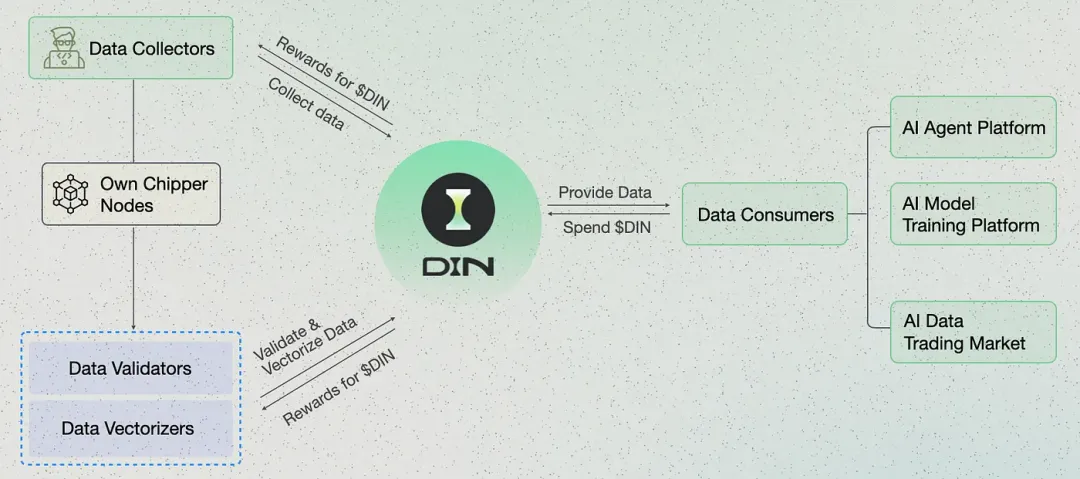
Against this backdrop, DIN (formerly Web3Go), the first modular AI-native data preprocessing layer, has emerged. DIN aims to create a decentralized data economy where anyone can contribute data for AI and earn rewards through decentralized data validation and vectorization. It pioneers a future where individuals monetize their personal data while enterprises access data more efficiently and affordably. To date, DIN has secured a $4 million seed round led by Binance Labs, followed by an additional $4 million in pre-listing funding from institutions, communities, and KOL networks, bringing its current valuation to $80 million—a strong endorsement of its potential. Its partners include Polkadot, BNB Chain, Moonbeam Network, and Manta Network.
DIN's Data Preprocessing Node – Chipper Node
DIN has a clear market positioning: building a decentralized data intelligence network at the intersection of AI and data. The Chipper Node plays a central role within the DIN ecosystem, responsible for data validation, vectorization, and reward calculation—it is the core component of DIN’s data preprocessing layer. To expand adoption of the data economy, DIN has opened public sales of Chipper Nodes, incentivizing more users to participate in network growth and maintenance with rewards, thereby creating a positive feedback loop that drives co-development of the DIN ecosystem and the broader data economy.
Node sale models have rapidly gained popularity in the crypto space as a novel token distribution mechanism due to their unique advantages. Compared to traditional public sales, node sales offer investors greater flexibility and higher potential returns. By selling nodes, projects can better incentivize early adopters while maximizing decentralization and long-term economic sustainability.
DIN’s node sale will roll out in phases: private sale, whitelist sale, and public sale—each with distinct participation criteria and reward structures. The allocation and unlocking schedule for node-generated tokens have been carefully designed to ensure price stability and sustainable investor returns. By purchasing and operating a DIN Chipper Node, users can actively participate in data validation and vectorization while earning generous $DIN token rewards.
As the AI and data markets continue to grow, DIN is well-positioned to emerge as a leader in this space. The following sections will explore DIN’s Chipper Node sale model and its unique market advantages, analyzing expected returns and payback periods to reveal its investment potential and future outlook.
Expected Return Rates and Payback Period Analysis
DIN’s node sale program will proceed in stages: private sale, whitelist sale, and public sale—each offering different pricing and incentives. The token reward distribution and vesting rules are meticulously structured to maintain market stability and secure long-term gains for investors. By purchasing and running a DIN Chipper Node, users gain access to data validation and vectorization workflows, along with mining rewards in $DIN tokens. Below is a detailed analysis of expected returns and payback timelines.
DIN's Node Sale Plan
-
Token Reward Allocation: Nodes account for 25% of the total $DIN supply, with 50% unlocked in the first year. In addition to node mining rewards, $xDIN holders receive a separate $DIN airdrop fully unlocked at TGE. Chipper Node holders will also receive a 13% token airdrop, linearly vested over six months post-TGE. This design helps stabilize the token price by preventing excessive sell pressure from sudden unlocks.
-
Sale Phases: DIN’s node sale consists of three stages—private sale, whitelist sale, and public sale—each tailored to different investor types. The private sale targets early product users and core community contributors; the whitelist sale is for select institutions, communities, and KOL partners; and the public sale is open to general retail investors.
-
Referral Mechanism: DIN introduces a referral system where existing users inviting new participants to buy nodes will both receive bonus token rewards. This mechanism effectively expands the user base while boosting community engagement and loyalty.
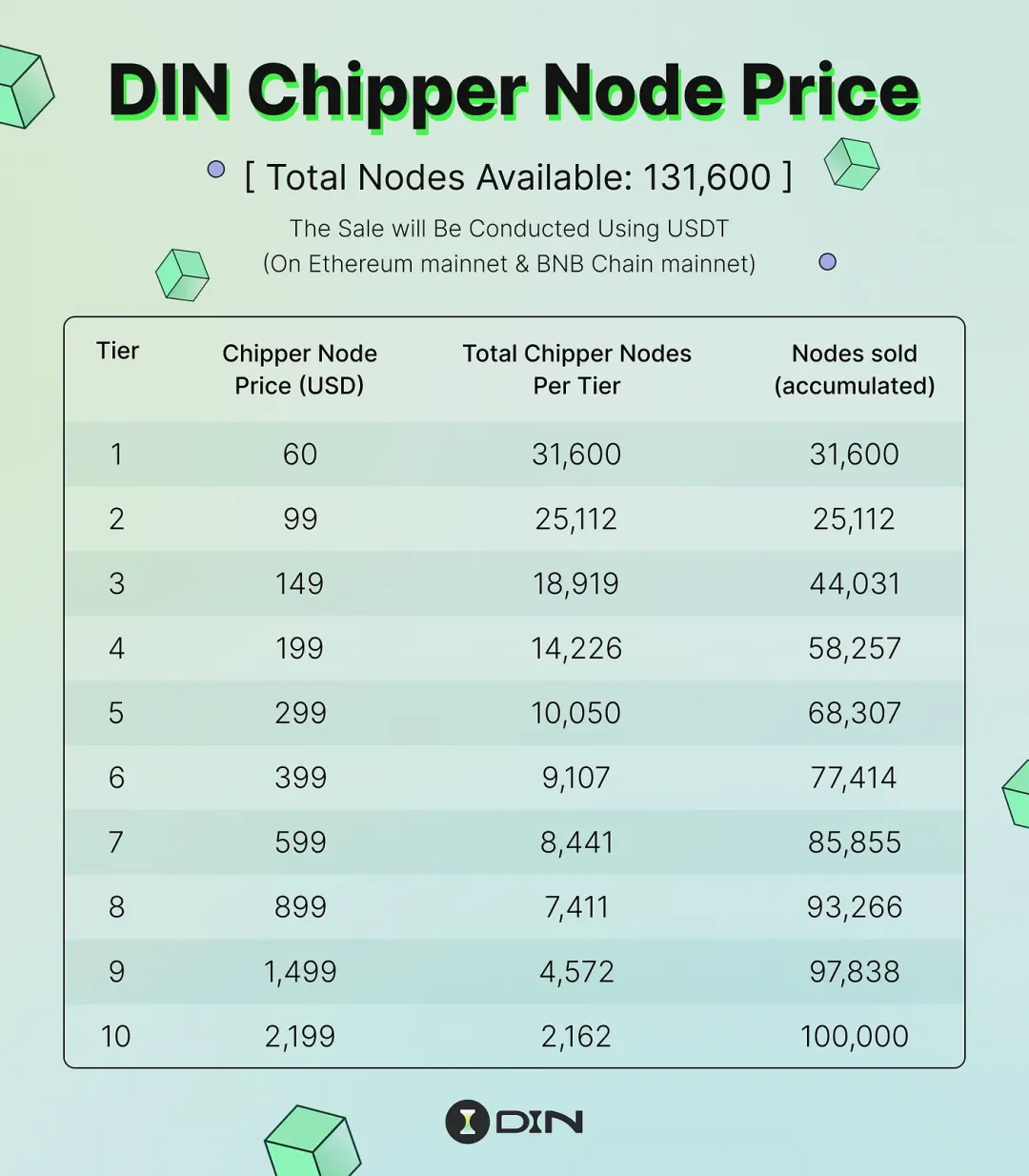
Node Pricing and Payback Periods Across Different Rounds
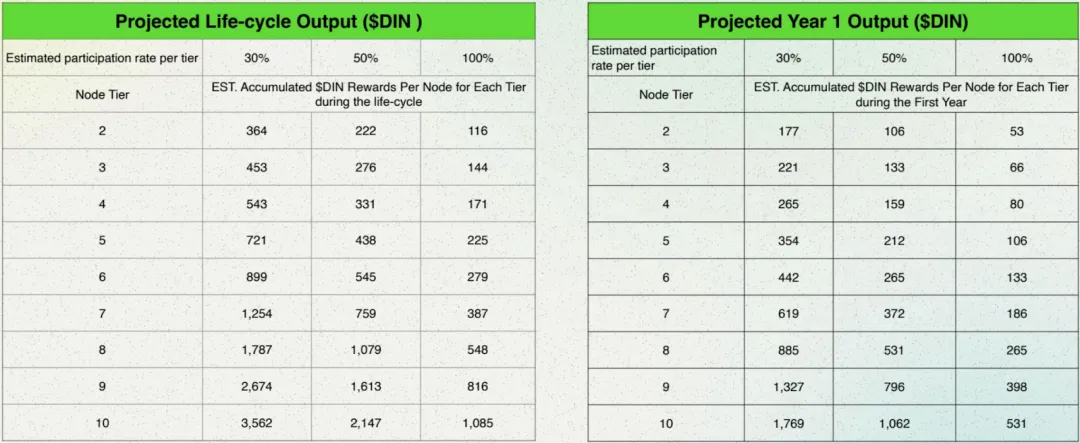
The total supply of $DIN is capped at 100 million tokens. When compared to other DePIN projects, io.net—which also conducted a node sale and raised $10 million before TGE—currently holds a FDV of $1.5 billion. Using this as a benchmark, assuming a post-TGE $DIN price of $15 and a 50% node operation rate, we can estimate annual returns and payback periods for each investment tier (excluding airdrop rewards).
Tier 1 nodes in the private sale are offered free of charge to eligible xData Chip NFT holders and select community contributors, eliminating any payback consideration. These participants can start mining early, converting their wafers into airdrop points ($xDIN) and securing their share of the $DIN airdrop.
Tier 2 nodes in the whitelist sale are priced at $99. They yield 106 $DIN in node rewards during the first year—equivalent to $1,590—resulting in a payback period of just 27 days.
The public sale is divided into two phases: Phase 1 (Tier 3–5) and Phase 2 (Tier 6–10). Tier 3 nodes are priced at $149, delivering 133 $DIN in first-year rewards worth $1,995, resulting in a 36-day payback. Tier 6 nodes are priced at $300, generating 265 $DIN in rewards valued at $3,975, still enabling full recovery within three months.
Compared to other recently launched node-based projects such as Aethir and CARV, DIN offers superior advantages in pricing, unlock speed, and reward structure. Aethir’s node tokens vest over four years, leading to longer payback cycles. While CARV employs a multi-tiered sale strategy, its overall return rates fall short of DIN’s. With faster vesting schedules and flexible incentives, DIN enables investors to achieve returns quickly while maintaining price stability—reducing investment risk and enhancing capital efficiency.
DIN’s Technical Strength and Market Potential
Technical Strength
As the first modular AI-native data preprocessing layer, DIN demonstrates exceptional innovation and technical differentiation. Its core technology leverages decentralized data validation and vectorization to deliver efficient and reliable preprocessing services. This approach not only improves data processing efficiency but also ensures data security and privacy. Moreover, DIN’s Chipper Nodes provide clear advantages in data verification and reward computation, allowing node operators to directly participate in network operations and maintenance—further strengthening decentralization and system resilience.
Market Potential
The immense potential of the AI and data markets serves as a key driver behind DIN’s growth. With rapid advancements in artificial intelligence and big data technologies, demand for high-quality data is surging. Through its innovative technology and business model, DIN delivers efficient data preprocessing services for AI models, significantly reducing the cost of data acquisition and processing. This positions DIN favorably in a highly competitive landscape, giving it substantial market potential and promising long-term prospects.
Funding and Backing
DIN’s robust financial backing and institutional support further strengthen its market position. The project has successfully completed a $4 million seed round and an additional $4 million in pre-listing financing, achieving a current valuation of $80 million. Notably, DIN is backed by top-tier investors including Binance Labs—providing not only solid financial resources but also strategic network access and operational support crucial for future expansion.
Conclusion
Although global capital markets recently suffered setbacks and the crypto market experienced sharp declines—with lingering fear still present in secondary markets—participating in node sales may offer a higher-risk-adjusted return during turbulent times, providing more predictable rewards than volatile spot trading. Through a well-structured token reward system and flexible sales model, DIN delivers attractive returns and short payback periods for investors. As macroeconomic conditions stabilize and rate-cut expectations materialize, a bull market could return in the second half of the year. As a project uniquely combining modularity, DePIN, and AI narratives, DIN is poised to lead the next wave of personal data economics in the era of rapid AI advancement. Its performance in the evolving market landscape is highly anticipated.
Join TechFlow official community to stay tuned
Telegram:https://t.me/TechFlowDaily
X (Twitter):https://x.com/TechFlowPost
X (Twitter) EN:https://x.com/BlockFlow_News
 Go2Mars Capital