








Inside Hong Kong Web3 (1): Licensed Exchanges Require Massive Investment
TechFlow Selected TechFlow Selected
Inside Hong Kong Web3 (1): Licensed Exchanges Require Massive Investment
What qualifies as a "compliant exchange"? What are its requirements regarding capital, asset custody, accounting, and auditing?
 Navigating Web3 tides with focused insights
The tension between regulation and innovation has always been the central theme in the evolution of emerging technologies.
For Hong Kong, 2022 was undoubtedly a turning point. With the new administration taking office, policy reforms were launched to aggressively position Hong Kong as a global hub for crypto finance and virtual assets—competing directly with cities like Singapore, London, and New York. The release of the Guidelines for Virtual Asset Trading Platform Operators on June 1, 2023, marked a globally leading step by providing clear and comprehensive regulatory guidance for licensed virtual asset exchanges.
OSL is launching a series titled “Approaching Web3 in Hong Kong,” beginning with a focus on the topic of “licensed vs. unlicensed exchanges.” This series aims to explore differences from multiple perspectives—the interplay between regulation and innovation, the application journey and experiences of licensed platforms, and the development of business operations under regulated environments. We will also delve into how licensed exchanges operate in practice, analyzing how they innovate services and expand markets under strict regulations, and how they strike a balance between compliance and innovation.
Defining "Licensed Exchanges" and Their Advantages
Since 2017, from ICOs and STOs to digital asset trading, and from tokenized bonds and digital Hong Kong dollars to central bank digital currencies (CBDCs) and stablecoins, Hong Kong has gradually established a licensing-based regulatory framework.
In today’s Hong Kong digital asset market, what kind of trading platform qualifies as a “regulated exchange”?
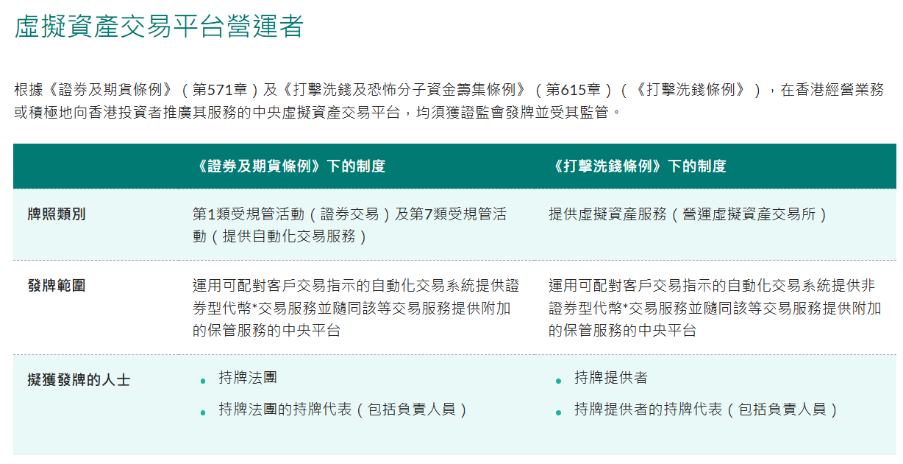
According to the Securities and Futures Commission (SFC) website, digital asset platforms must obtain three licenses to operate legally:
- Providing virtual asset services (operating a virtual asset exchange) under the Anti-Money Laundering Ordinance (AMLO); and
- Type 1 and Type 7 regulated activity licenses under the Securities and Futures Ordinance (SFO)
These three licenses now form the foundational entry barrier for participating in Hong Kong's compliant virtual asset industry. Only platforms holding all three—the AMLO license, Type 1, and Type 7 licenses—can be considered genuine “licensed exchanges” in Hong Kong’s digital asset space.
According to disclosures by the SFC, there are currently only two licensed digital asset trading platforms in Hong Kong, with OSL being one of them; other applicants listed are still awaiting formal approval at the time of writing.
The advantages of compliant exchanges like OSL are clear:
- High Security: Operating under comprehensive regulatory oversight ensures better protection of user assets, offering theoretically more secure and reliable services than non-compliant platforms;
- Scalability for Other Digital Asset Businesses: For instance, the SFC requires that authorized virtual asset ETFs use licensed exchanges as custodians and trading venues. Licensed compliant exchanges will thus become central players in the future virtual asset market;
Overall, the process of applying for a compliance license is complex and rigorous, involving the establishment of legal and compliance teams, investment in security and technology infrastructure, implementation of fund segregation and risk management mechanisms, setting up auditing and reporting systems, and conducting ongoing compliance training and education.
Licensing Fees and Operational Costs
While the SFC lists application fees for each license at several thousand HKD, the cumulative cost of meeting capital and operational compliance requirements can reach tens of millions of USD. What kind of investor protections do these high compliance costs actually deliver?
Firstly, licensed exchanges must adhere to anti-money laundering regulations including KYC, AML, and CFT policies. All transfers and transactions undergo scrutiny, ensuring investors’ legitimate assets are not exploited for criminal activities. Listing procedures also require strict rules and due diligence on project teams, liquidity, technical security, and regulatory status. As such, fraudulent projects cannot appear on compliant exchanges.
At OSL, a significant portion of operating expenses goes toward investor protection. Management of private keys, maintenance of cold wallets, and other measures effectively prevent hackers from stealing investor assets. Additionally, licensed exchanges are required to purchase third-party insurance for client custodial assets, providing multiple layers of protection and tangible value.
Accounting and Auditing
The SFC’s Guidelines for Virtual Asset Trading Platform Operators state that licensed virtual asset exchanges and their subsidiaries must regularly submit audited financial statements and related data to the SFC. Exchange operators must maintain sufficient liquid assets in their Hong Kong entity equivalent to at least 12 months of operating expenses. The SFC also reserves the right to conduct on-site inspections and investigations when necessary, issues circulars and FAQs irregularly, and in cases of inconsistency, the stricter requirement prevails.
OSL Exchange’s parent company is OSL Group (863.HK), listed on the Main Board of the Hong Kong Exchange. Beyond SFC requirements, OSL undergoes audits by one of the Big Four accounting firms. If accounting is a language, then auditing ensures it is “objectively and fairly represented.” Investors gain accurate insights into the company’s actual condition, enabling informed decision-making.
Conclusion
To innovate or to regulate? On June 1 this year, the transition period for Hong Kong’s virtual asset trading platform licensing regime officially ended. Hong Kong has taken a pioneering step in regulatory clarity on a global scale. However, it is worth noting that some trading platforms have announced their exit from the Hong Kong market in the first half of the year.
From this perspective, fostering innovation while maintaining effective regulation is inherently a delicate balance. History rhymes, but doesn’t always repeat. Looking ahead, the future of next-generation exchanges like OSL is unfolding—from early STO and OTC businesses to the recently launched virtual asset ETF offerings, OSL Exchange has played an indispensable role as a leader among compliant platforms.
We must afford sufficient patience to industry leaders building this ecosystem. We believe that product innovation within a regulated framework will grow increasingly significant in global competition. Though this trend may not yet be obvious, time will gradually amplify its impact.
End
The views and opinions expressed in this article are those of the author and do not necessarily reflect the views or positions of OSL Group Limited or its affiliates. Any forecasts or opinions contained herein are provided as general market commentary only and do not constitute securities or investment offers, nor should they be construed as solicitation, advice, investment recommendations, or guarantees of returns. Information, forecasts, and opinions are accurate as of the date of this article and are subject to change without notice. They should not be regarded as advice regarding any investment product or market.
Join TechFlow official community to stay tuned
Telegram:https://t.me/TechFlowDaily
X (Twitter):https://x.com/TechFlowPost
X (Twitter) EN:https://x.com/BlockFlow_News
 @osldotcom


