Is the "Ethereum killer" finally here?
TechFlow Selected TechFlow Selected
Is the "Ethereum killer" finally here?
Movement is the breakthrough solution to the current challenges in the Move ecosystem.
 Navigating Web3 tides with focused insights
Author: Willson Lee, Core Contributor at Biteye
Editor: Crush, Core Contributor at Biteye
01 Introduction
Faster and more secure blockchains have always been the core narrative driving technological advancement in the crypto industry. From a constant stream of L2 scaling solutions to high-performance public chains like Solana, efforts continue to push the boundaries of blockchain performance and security, aiming to deliver better experiences for users.
However, as L1s and L2s emerge in explosive numbers—many later becoming "zombie chains"—the market has shown that superior technology alone is not enough for success. L1s and L2s must exert significant effort to build their own ecosystems.
EVM compatibility is a key criterion we use to differentiate blockchains. High-performance public chains often sacrifice EVM compatibility to achieve greater speed, such as Solana, Aptos, and Sui.
In contrast, networks like Avalanche and Polygon prioritize EVM compatibility over peak performance, ensuring seamless migration of the thriving Ethereum ecosystem onto their platforms.
The trade-off between EVM compatibility and performance reflects whether a blockchain should sacrifice some of its ability to attract existing ecosystems for the sake of ultimate performance—a decision rooted fundamentally in the limitations of Solidity and the EVM itself.
Since its inception, Move has been highly anticipated as a new smart contract language designed by Facebook (now META) specifically for digital assets.
Compared to programming languages commonly used in the Ethereum ecosystem like Solidity, Move emphasizes “security” and “high performance” in its design philosophy.
Without relying on L2s, Move reduces blockchain transaction storage and computation costs through an optimization technique called “module packaging.” Module packaging bundles multiple smart contracts into a single module, reducing storage and indexing overhead while improving execution speed by minimizing bytecode execution steps.
This enables Move-based public chains to achieve TPS exceeding tens of thousands—and potentially scale up to 100,000.
Aptos and Sui, known as the Move twins, achieved strong initial market performance but still lag behind traditional EVM ecosystems in terms of developer adoption and ecosystem growth, causing momentum to stall.
Movement is emerging as the breakthrough solution for current challenges in the Move ecosystem. Movement aims to bridge Move’s advantages in security and high performance with the liquidity and vast user base of the EVM ecosystem, creating a powerful synergy.
Through the Movement SDK, developers can automatically convert Solidity scripts into opcodes understandable by Move—no need to write Move code. This delivers interoperability compatible with Ethereum and other EVM networks, seamlessly combining Move’s strengths with Ethereum’s vibrant ecosystem.
02 Product Architecture and Advantages
2.1 Core Components: M1 and M2
Movement consists of two core components—M1 and M2—which together form a secure, efficient, and decentralized blockchain ecosystem.
M1 serves as a universal Move-EVM blockchain, gradually evolving into a decentralized sequencer, while M2 functions as a zero-knowledge Layer 2 based on Move + EVM, delivering secure and high-efficiency smart contract execution, empowering users and developers to innovate on a unified platform.
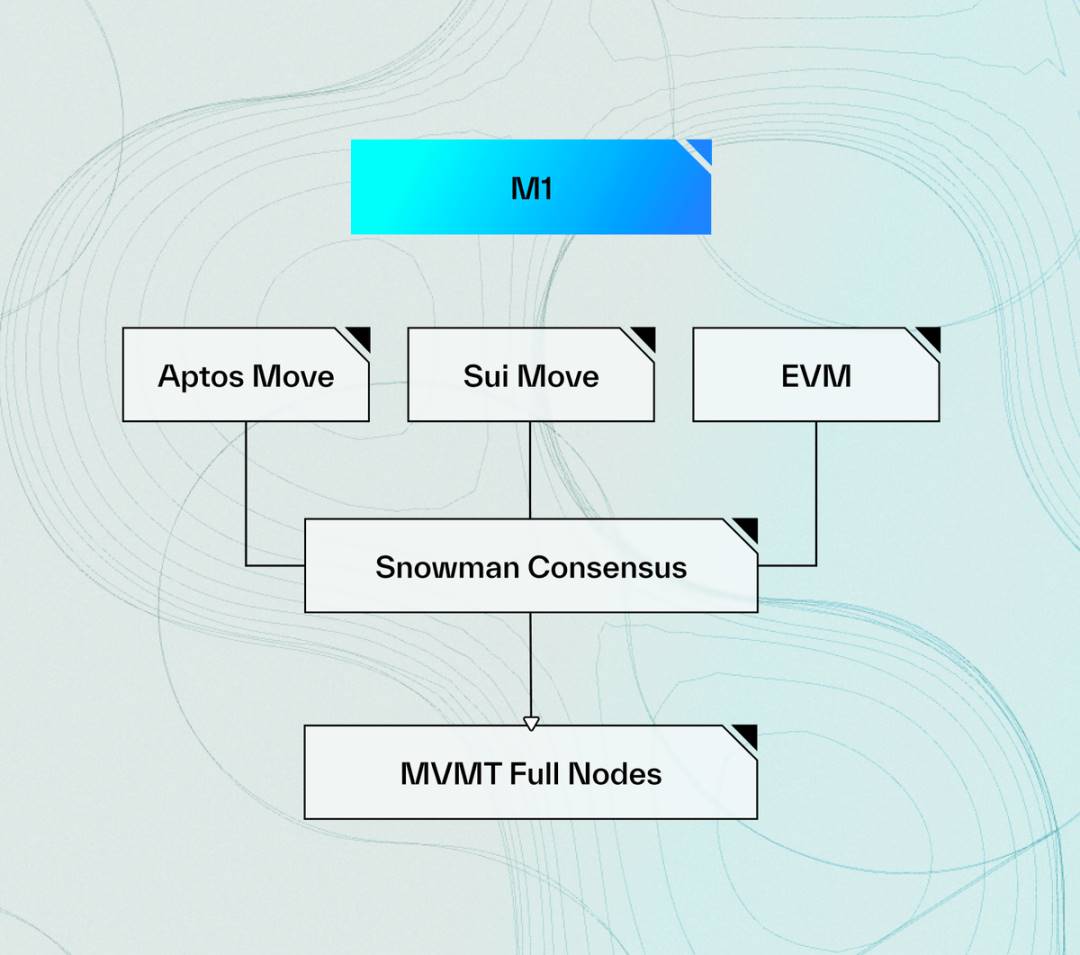
M1: M1 is a community-driven blockchain network built on the Move language, offering excellent compatibility and scalability.
High Compatibility
- Fragmentation exists within the Move ecosystem: Despite both originating from Facebook's blockchain initiative, Aptos and Sui—the so-called Move twins—differ significantly in technical implementation and goals. Aptos Move and Sui Move are effectively different languages, leading to confusion and division among developers. Aptos Move closely follows the original Move language from Facebook’s Diem project, while Sui evolved independently over six months with semantics and consensus mechanisms more akin to Solana. As a result, Aptos Move prioritizes security, whereas Sui Move emphasizes speed and compilation efficiency.
- Solution: Movement implements an RPC translation mechanism that compiles both Sui Move and Aptos Move into the same bytecode, achieving cross-Move compatibility. Additionally, they developed Fractal—an EVM interpreter—enabling deployment of EVM smart contracts on Movement. Thus, users gain access to EVM liquidity while experiencing a unique execution environment and a dynamic ecosystem.
Scalability: M1 is designed as the first general-purpose Move-EVM blockchain, initially driven by its own validator set and eventually transitioning into a decentralized sequencer supporting M2 and other Rollups built on the Move Stack.
- M1 was designed with decentralization in mind, enabling validators to launch quickly, inheriting security from existing Snowman validators with minimal hardware requirements. As the network matures during the Parthenon test phase, more community validators will be allowed to join, with the ultimate goal of permissionless decentralization. This will establish the first permissionless, decentralized shared sequencing layer supporting M2.
- Furthermore, M1 creates the most economically viable shared sequencing layer, as all transaction fees are distributed back to staked validator nodes, creating a flywheel effect that incentivizes more validators to join for higher returns. As sequencing fees decrease over time, M1 will become the hub for next-generation Rollups by serving as a staking center, ultimately encouraging Rollups to adopt decentralized shared sequencers.
Source: https://x.com/movementlabsxyz/status/1747746334797410811/photo/1
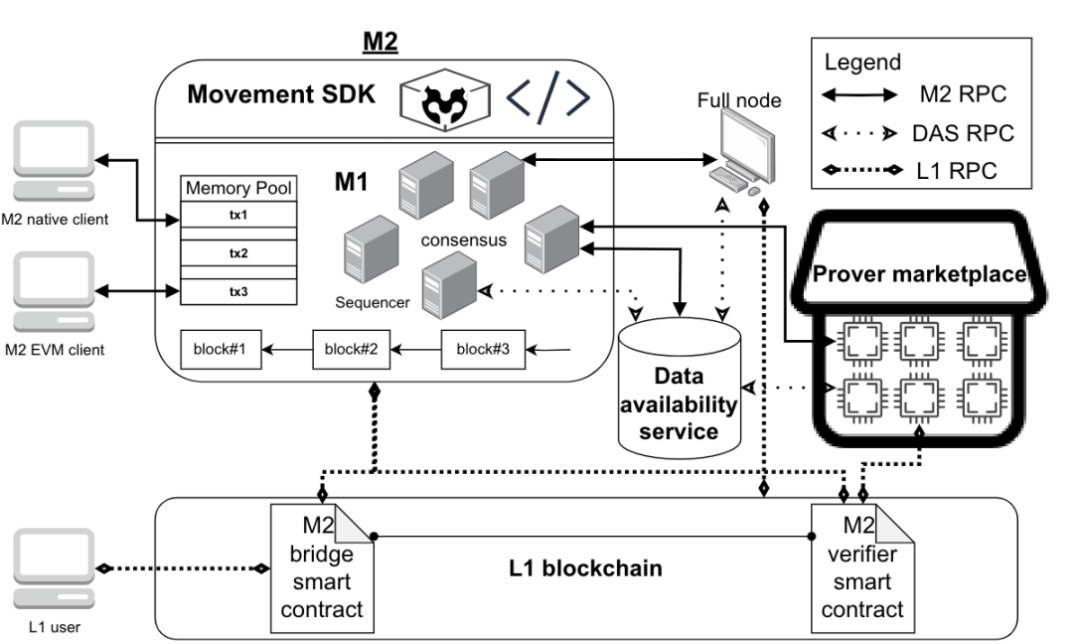
- M2: M2 is the first zero-knowledge Layer 2 (MEVM) based on Move + EVM, operating on Ethereum with data availability (DA) provided by Celestia, bringing MoveVM natively to Ethereum. M2 combines Move’s strong ownership model with EVM’s liquidity, offering a secure and efficient platform for smart contract development. It supports both Aptos Move and Sui Move, and embeds the MEVM EVM interpreter, enabling Sui, Aptos, and EVM users to operate on the same Layer 2. With high TPS and instant finality, M2 supports large-scale financial transactions and decentralized applications, while offering modular customization options to meet diverse project needs, delivering efficient and flexible blockchain solutions.
In summary, M1 establishes a scalable consensus layer compatible with both Move and EVM, building native Move consensus and ecosystem; M2 handles Solidity-to-Move conversion and transaction execution, directly integrating into the EVM ecosystem and acting as a bridge between Move and EVM.
Source: https://www.techflowpost.com/article/detail_18939.html
2.2 Developer On-Ramp: Movement SDK
The Movement SDK is an innovative development tool that allows developers to easily build modular and interoperable applications across Move and EVM environments.
By combining the security and resource management features of MoveVM with the flexibility and adaptability of Solidity, the Movement SDK enables developers to build and deploy Move-based infrastructure and applications in any distributed environment.
It primarily consists of three core components: MoveVM, Fractal, and custom adapters for sequencer networks and DA services.
- MoveVM: The core execution engine of the Movement SDK, providing a resource-oriented and strictly controlled environment for running smart contracts. Although both are based on Move, Sui Move and Aptos Move operate as independent blockchain systems with distinct virtual machines (VMs) and toolkits. Movement’s modular MoveVM is a versatile virtual machine engineered for full compatibility with the Ethereum Virtual Machine (EVM) and other Move ecosystems. It currently supports deploying Aptos and EVM code and will soon support the Sui ecosystem.
- Fractal: A compiler that allows developers to seamlessly deploy existing Solidity smart contracts onto MoveVM. This bridging capability provides Solidity developers with a more secure and efficient execution environment while preserving the original logic and functionality of their contracts.
- Custom Adapters: The final core component of the Movement SDK, designed to enable seamless integration with sequencer networks and data availability (DA) services, ensuring secure connectivity with various blockchain networks and services.
The Movement SDK not only equips developers with tools for perfect fusion between Move and EVM, but also works synergistically with M1 as part of the M2 framework, further enhancing Movement’s scalability.
03 Project Progress
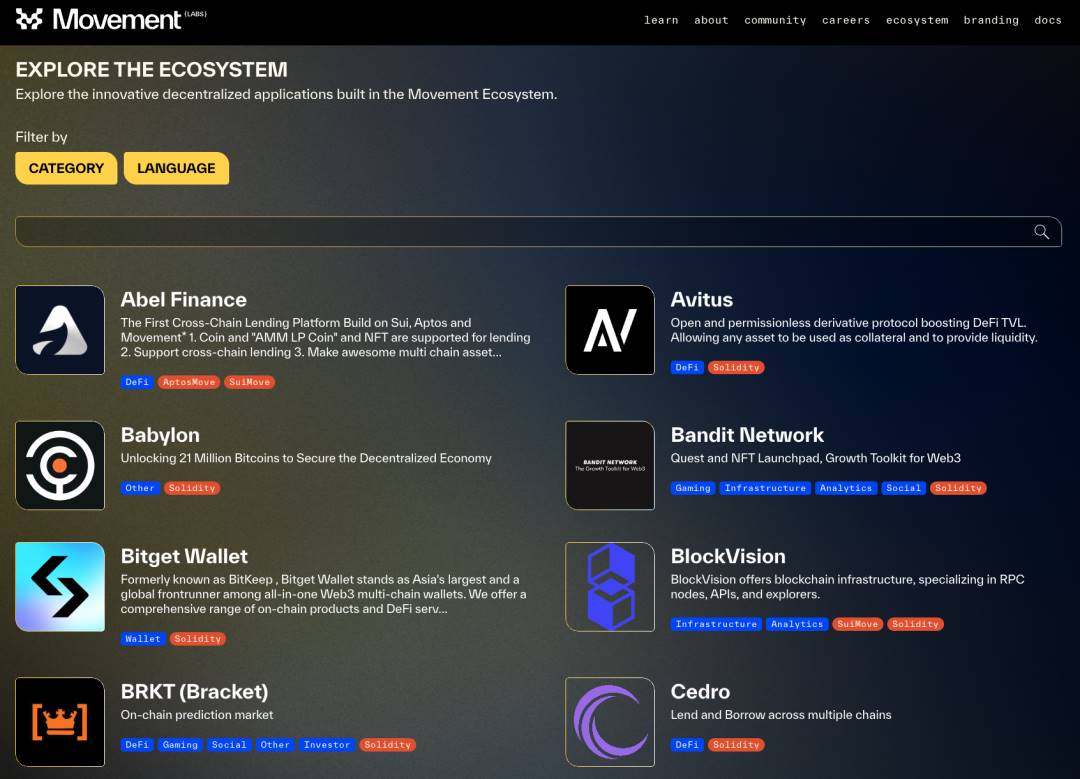
According to Movement’s official website, nearly 80 ecosystem projects have already been deployed on Movement, including prominent names such as Babylon and Ethena.
Looking at the tags beneath the projects, one can see initiatives built with various programming languages, showcasing Movement’s strong compatibility and ecosystem potential.
Source: https://movementlabs.xyz/ecosystem/page/1
Note: Movement has launched its testnet campaign. Follow the tutorial to participate and earn potential airdrop rewards.
https://twitter.com/BiteyeCN/status/1818523443203358919
04 Team Background
4.1 Core Members
Movement Labs was co-founded by Rushi Manche and Cooper Scanlon. Rushi is 21 years old, and Cooper is 24, both alumni of Vanderbilt University.

Source: https://www.techflowpost.com/article/detail_18939.html
Rushi Manche began programming at age 14, initially working at UnitedHealth Group, a major health insurance company, where he managed cloud infrastructure migration.
His career began in distributed systems and databases, and he became interested in cryptocurrency during college. This experience laid a solid technical foundation and paved the way for his entry into the crypto space.
Rushi’s interest in crypto started when he learned that Facebook was developing its own blockchain project during university.
He first heard about it through a New York Times article, which sparked intense curiosity.
At the time, Cosmos had only five users and Ethereum a few hundred, while Facebook had billions. This presented massive potential for widespread crypto adoption.
Rushi deeply studied the Move language, gaining extensive knowledge from the Move Book, and ultimately decided to pursue a career in this field.
Rushi’s entrepreneurial journey wasn’t easy. While at Vanderbilt University, despite limited resources, he persisted in developing his own projects.
He also shared his experience choosing between Avalanche and Cosmos, ultimately joining Avalanche as an early supporter.
During college, he founded Ensemble, an AI-powered exam prep platform offering free study materials to high school students.
In 2022, Rushi joined Aptos as a software engineer, directly contributing to Move-based smart contract development and making significant contributions to core DEXs in the ecosystem. This experience revealed Move’s immense potential and ignited his passion for entrepreneurship in this domain.
Cooper Scanlon is the other co-founder of Movement Labs. Before founding Movement Labs, he built and audited the first yield aggregator using the Move language.
In November 2022, Rushi and Cooper, both Vanderbilt alumni, made the bold decision to drop out of school and co-found Movement Labs.
The founding of Movement Labs marked a new beginning for Rushi and Cooper in the blockchain space. Their team is dedicated to bringing Move language to the EVM ecosystem and advancing blockchain technology.
Rushi and Cooper’s entrepreneurial journey highlights their deep technical expertise and courage in innovation. Despite numerous challenges, they remain steadfast in pursuing their vision, contributing to the development and application of blockchain technology through Movement Labs.
4.2 Funding Overview
According to Rootdata, Movement received investment from Binance Labs in May. In its Series A round, Movement secured funding from top-tier institutions including Polychain and Hack VC, raising a total of $38 million. This underscores Movement’s strong capabilities and market validation.
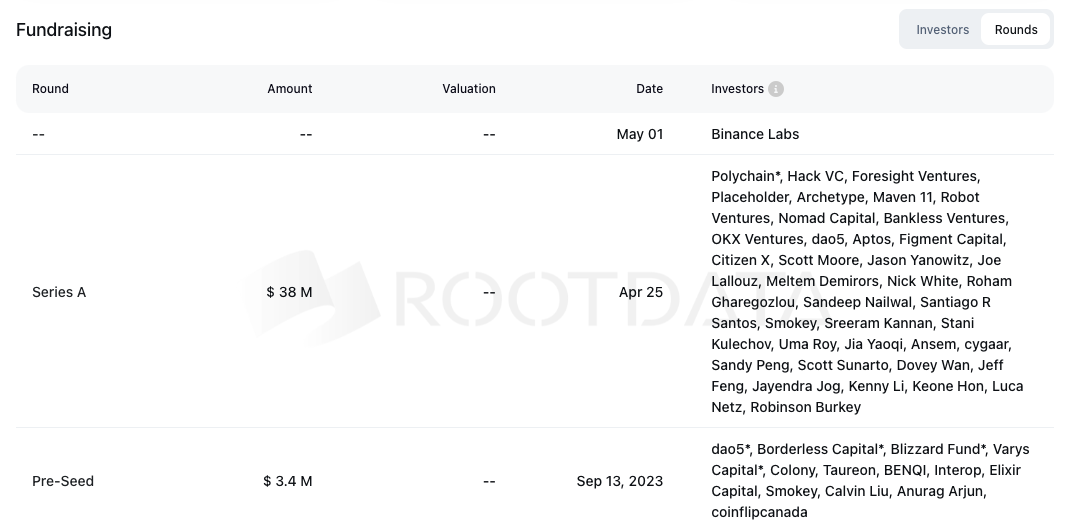
Source: https://www.rootdata.com/Projects/detail/Movement?k=OTMxMg%3D%3D
05 Summary and Outlook
In the fiercely competitive Ethereum L2 landscape and the emerging Move ecosystem, Movement Labs has carved out a unique path that balances performance and ecosystem growth, standing out and earning market recognition.
Movement not only achieves a seamless technical integration of Move and EVM but also continuously strengthens ecosystem development, striving to provide developers and users with a secure, efficient, and user-friendly blockchain platform.
As Movement’s infrastructure continues to mature and its ecosystem expands, we look forward to seeing Movement deliver further innovations and breakthroughs, driving progress across the entire blockchain industry.
Join TechFlow official community to stay tuned
Telegram:https://t.me/TechFlowDaily
X (Twitter):https://x.com/TechFlowPost
X (Twitter) EN:https://x.com/BlockFlow_News
 @BiteyeCN