Ethereum vs. Solana: Advantages and Challenges
TechFlow Selected TechFlow Selected
Ethereum vs. Solana: Advantages and Challenges
This article compares Ethereum and Solana, exploring their strengths and weaknesses to gain a clearer understanding of each platform's uniqueness.
 Navigating Web3 tides with focused insights
Author: 0xEdwardyw
Preface
Comparing Ethereum and Solana is one of the most debated topics in today’s cryptocurrency market. As two of the most influential Layer 1 blockchains, each possesses unique characteristics and serves distinct user groups within the crypto ecosystem.
Ethereum, often regarded as the pioneer of smart contracts, has become the platform of choice for decentralized applications (dApps) and decentralized finance (DeFi). Benefiting from first-mover advantage, its vast developer community and strong network effects have made it the leading Layer 1 blockchain in terms of adoption metrics and social influence. In contrast, Solana is known for its high-speed transactions and scalability. With the capacity to process tens of thousands of transactions per second, Solana emerges as a powerful option for high-frequency trading and real-time applications.
This article compares Ethereum and Solana, examining their respective strengths and weaknesses. We aim to help readers gain a clearer understanding of each platform's uniqueness.
Ethereum’s Advantages
Ethereum boasts the strongest network effect among all Layer 1 blockchains. As the first smart contract platform, it has attracted the largest user base and the most extensive, active developer community. Ethereum hosts a rich ecosystem of decentralized applications (dApps), tools, and resources, making it easier for new projects to build and grow. As more projects and developers choose to build on Ethereum, the network becomes increasingly valuable—creating a positive feedback loop that further attracts users and projects.
In terms of economic security, Ethereum also stands out among Layer 1 blockchains. As of July 2024, over one million validators have staked more than $110 billion worth of ETH. This massive amount of staked value creates strong economic incentives for validators to act honestly.

Source: stakingrewards.com/
As a Proof-of-Stake blockchain, the economic attack threshold for Ethereum can be categorized into three levels based on the percentage of total staked ETH an attacker would need to control:
-
Controlling 33% of total staked ETH is sufficient to disrupt finality and increase the likelihood of a successful attack
-
Controlling 50% of total staked ETH allows an attacker to dominate the fork choice algorithm, enabling transaction censorship and short-range reorganizations
-
An attacker needs to control 66% of total staked ETH to execute a double-spend
However, given that over $110 billion worth of ETH is already staked, the cost for an attacker to acquire enough ETH to carry out such attacks would be prohibitively high. This substantial economic barrier serves as a powerful deterrent against malicious behavior.
As the first smart contract platform, Ethereum demonstrates significant maturity and stability. Unlike some newer blockchains, Ethereum has not experienced any major network-wide outages that caused complete operational halts. This reliability is crucial for developers, users, and enterprises relying on the network for various applications and services.
Although Ethereum has faced challenges like network congestion during periods of high demand, these issues have not led to full network failures. Instead, they result in slower transaction times and higher gas fees—problems that Ethereum is actively addressing through various upgrades and Layer 2 scaling solutions.
Another major advantage Ethereum holds over other Layer 1 networks is regulatory recognition. Ethereum has gained legitimacy in the eyes of regulators, enhancing its appeal to institutional investors. Notably, spot Ethereum exchange-traded funds (ETFs) were approved in July 2024. These investment vehicles offer investors a regulated and user-friendly way to gain exposure to Ethereum without dealing with the complexities of directly purchasing and storing cryptocurrencies.

Source: marketwatch.com
Solana’s Advantages
Scalability is central to Solana’s design, enabling it to handle up to 65,000 transactions per second. This high scalability is achieved through a combination of innovative technologies, including Proof of History (PoH) and Turbine—a block propagation protocol. PoH provides a cryptographic timestamp to order transactions, achieving high throughput without compromising security. This scalability makes Solana ideal for applications requiring high transaction volumes, such as high-frequency trading and large-scale dApps.

Source: swaps.app/blog
Solana offers low transaction latency, with transactions processed and confirmed within seconds. The network achieves a block time of approximately 400 milliseconds, ensuring rapid transaction finality. For context: while Solana produces a block every 400 milliseconds, Ethereum’s block time is 12 seconds. Solana reaches finality within about 5 to 12 seconds per block, whereas Ethereum typically requires around 13 minutes for finality.
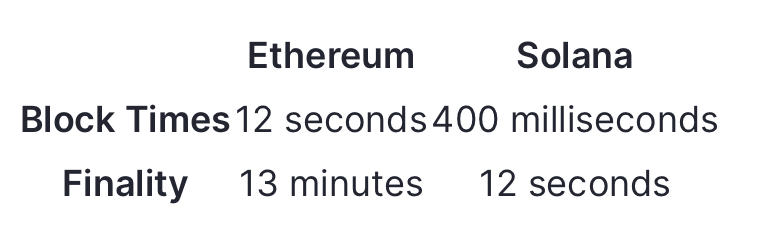
Solana’s low latency is critical for real-time applications and competitive trading environments where speed is paramount. Its ability to deliver near-instant transaction finality enhances user experience, positioning it as a strong competitor to centralized financial systems and exchanges.
Solana employs sophisticated block-building techniques that contribute to its efficiency and performance. The network’s architecture supports advanced mechanisms such as Gulf Stream—which forwards transactions to validators before the current block is finalized—and Sealevel, which enables parallel execution of smart contracts. These mechanisms reduce confirmation times and boost throughput.
Decentralization Efforts
Despite being more centralized than Ethereum currently, Solana is actively working to further decentralize its network. These efforts include decentralized pre-confirmation methods and improved validator distribution. The Solana Foundation provides grants and support to help new validators join the network, ensuring it isn’t dominated by a small number of large participants. Solana has also introduced the Firedancer client, making it the only network after Bitcoin and Ethereum to have a second independent client live on mainnet.
Ethereum’s Scalability Dilemma and Fragmentation Issues
Both Ethereum and Solana face significant technical challenges that impact their performance and adoption. Ethereum’s primary challenge has long been scalability. Despite ongoing efforts to implement sharding and Layer 2 solutions, Ethereum still experiences high transaction fees and slower processing times during peak usage periods.
Ethereum’s reliance on Layer 2 scaling solutions (L2s) has also introduced a new challenge—fragmentation. There are currently 64 Layer 2 protocols, 18 Layer 3 protocols, and 81 upcoming Layer 2 and Layer 3 projects entering the Ethereum ecosystem. Since different L2s operate in isolated environments, it becomes difficult for decentralized applications (dApps) and users to seamlessly interact across these networks.

The fragmented state of Layer 2s leads to several problems that undermine user experience and Ethereum’s network effects.
-
Interoperability Issues: As various L2 solutions develop independently, they create siloed ecosystems. This fragmentation hampers the ability of dApps to interact across different Layer 2s, reducing the overall composability of the Ethereum ecosystem. Users may find transferring assets or data between Layer 2s difficult, requiring additional complexity—such as using cross-chain bridges—which introduces extra security risks.
-
Liquidity Fragmentation: With numerous L2s emerging, liquidity is spread across different platforms. Diluted liquidity makes it harder for users to find sufficient trading depth, leading to inefficiencies and higher costs when trading assets.
-
User Experience Complexity: Each L2 may require users to set up new endpoints or wallets, complicating the user experience.
-
Centralization Risks: Many L2 solutions rely on a limited number of operators to validate transactions. This centralization poses risks—for example, if these operators fail or are compromised, it could lead to potential downtime or vulnerabilities. Greater decentralization is needed as L2s mature to ensure security and reliability.
-
Immaturity of Layer 2 Solutions: Major Ethereum Layer 2 scaling solutions remain in early stages of development, with most projects achieving only Stage 0 or Stage 1 in terms of security guarantees and decentralization. According to L2Beat’s classification system, for a Layer 2 rollup to reach Stage 1, it must deploy a “fully functional proof system” and an “escape hatch” allowing users to withdraw their assets back to the Ethereum mainnet permissionlessly. So far, only Arbitrum and Optimism have reached Stage 1, while other major rollups like Base and zkSync remain at Stage 0.
Solana’s Security Concerns
While excelling in scalability, Solana faces its own set of challenges, including potential time manipulation ("Time Game") issues and the complexity of maintaining high-speed performance without sacrificing security. The network’s reliance on Proof of History (PoH) and its hybrid consensus mechanism raises concerns about centralization and collusion risks among validators. Additionally, Solana has experienced several network outages and performance issues, raising questions about its long-term stability and reliability.
Solana’s unique consensus mechanism, combining Proof of History (PoH) and Proof of Stake (PoS), introduces potential for time manipulation. Validators might exploit timestamp features to manipulate transaction ordering, enabling front-running or transaction censorship. This risk raises concerns about fairness in transaction processing, especially in high-stakes environments like decentralized finance (DeFi).
Reliance on a hybrid consensus model also raises centralization concerns. While Solana’s architecture enables high throughput, it favors large validators with specialized expertise and financial resources, leading to concentration of validation power. This centralization could make the network more vulnerable to collusion among validators and reduce overall security.
Network Outages
Solana has experienced several network outage events, raising doubts about its reliability. For instance, a major outage occurred on February 6, 2024. Lasting nearly five hours, this incident highlighted vulnerabilities in the network’s infrastructure. Although Solana’s engineering team demonstrated quick response and recovery capabilities, the frequency and duration of such outages can erode user trust and deter developers from building applications on the platform.
Despite improvements in network performance metrics, Solana continues to face performance-related challenges under heavy load. Historical events show that surges in transaction volume can lead to congestion, causing delays and failed transactions. While the network is designed for high-speed operation, it may struggle during unexpected demand spikes, resulting in degraded user experience.
Coexistence of Ethereum and Solana
Given their distinct strengths, Ethereum and Solana cater to different needs and use cases, allowing them to complement rather than directly compete with each other.
Ethereum’s robust network effects, security, and maturity make it ideal for applications requiring high trust and composability. In contrast, Solana’s high throughput and low transaction costs suit applications needing fast transaction processing and low fees. The complementary strengths of Ethereum and Solana can foster a diverse and resilient blockchain ecosystem. By serving different market segments, both platforms can enhance the overall functionality and adoption of decentralized technologies, offering users a range of options tailored to their specific needs.
Join TechFlow official community to stay tuned
Telegram:https://t.me/TechFlowDaily
X (Twitter):https://x.com/TechFlowPost
X (Twitter) EN:https://x.com/BlockFlow_News
 @TokenInsight