








TAO sees strongest rebound yet,盘点 12 useful AI projects on the subnet
TechFlow Selected TechFlow Selected
TAO sees strongest rebound yet,盘点 12 useful AI projects on the subnet
12 new subnets have been added to Bittensor, each contributing to AI-related development to some extent.
 Navigating Web3 tides with focused insights
Author: TechFlow
After this week's "Black Monday," the crypto market was left bloodied, but within a day, tokens across different sectors began to rebound.
Among them, the standout performer is Bittensor (TAO).
According to Coinmarketcap data, among the top 100 cryptocurrencies by market cap yesterday, Bittensor (TAO) surged 23.08%, leading the rebound rankings.
Although the AI narrative isn't as hot as it was at the beginning of the year, capital flows still reflect confidence in leading projects within the sector.
However, Bittensor has previously faced some FUD (fear, uncertainty, doubt), with the community criticizing the project as overhyped and lacking practical applications within its subnets.
(Related reading: Amid FUD Rumors, Will Bittensor, the New AI King, Fall from Grace?)
While a crypto project’s utility may not directly correlate with its token price, is Bittensor truly just an empty shell?
Over the past few months, 12 new subnets have been added to Bittensor, each contributing to AI-related development to varying degrees—some of which might even spawn the next Alpha project.
We’ve reviewed these new subnets to examine fundamental developments behind Bittensor, even as attention remains focused on TAO’s price rebound.

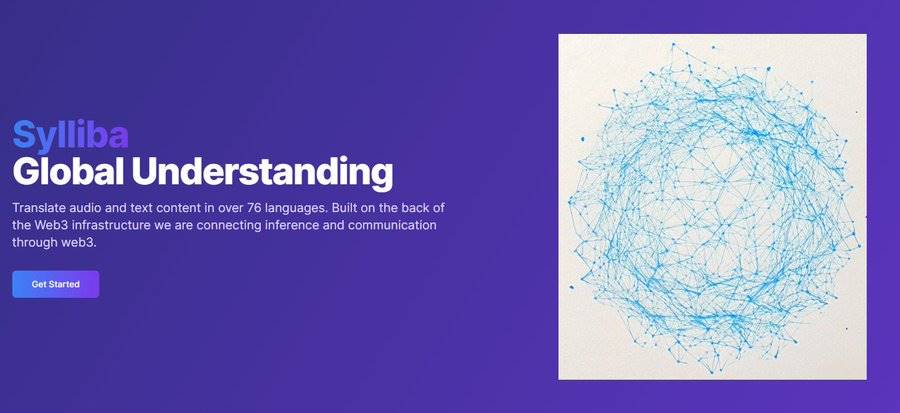
Subnet 38: Sylliba – Text and Speech Translation Tool Supporting 70+ Languages
Development Team: Agent Artificial
Overview:
Sylliba is a translation application supporting both text and speech translation across more than 70 languages.
Notably, this tool can be used by on-chain AI agents:
-
Automated translation workflows: AI agents can automatically invoke this service for cross-language information processing and communication.
-
Enhanced AI capabilities: Enables AI systems without native multilingual support to handle multilingual tasks.
-
Translation requests and results can be verified on-chain, increasing system trustworthiness.
-
Incentive mechanism: Token economics incentivize high-quality translation service providers.
Project URL: https://github.com/agent-artificial/sylliba-subnet
Subnet 34: Bitmind – Detecting and Distinguishing Real Content from Synthetic Forgeries
Development Team: @BitMindAI
Overview:
Bitmind focuses on developing decentralized deepfake detection technology. As generative AI models rapidly advance, distinguishing high-quality synthetic media from authentic content becomes increasingly difficult.
Bitmind addresses this via its Subnet deployed on the Bittensor network, using both generative and discriminative AI models to effectively identify deepfakes.
Additionally, the Bitmind API enables developers to build powerful consumer applications leveraging the subnet’s deepfake detection capabilities. The BitMind Web Application, featuring an image upload interface, uses the API to help users quickly assess whether an image is real or fake, providing an accessible and interpretable anti-deception tool.
Subnet 43: Graphite – Intelligent Path Planning Network
Development Team: @GraphiteSubnet
Overview:
Graphite is a subnet specifically designed to solve graph problems, with a focus on the Traveling Salesman Problem (TSP). TSP is a classic optimization challenge aiming to find the shortest possible route that visits a set of cities and returns to the origin.
Graphite leverages Bittensor’s decentralized machine learning network to efficiently connect miners handling computational demands for TSP and similar graph problems.
Currently, validators generate synthetic requests and send them to miners in the network. Miners use their own algorithms to solve TSP instances and return results to validators for evaluation.
Subnet 42: Gen42 – Open-Source AI Coding Assistant for GitHub
Development Team: @RizzoValidator, @FrankRizz07
Overview:
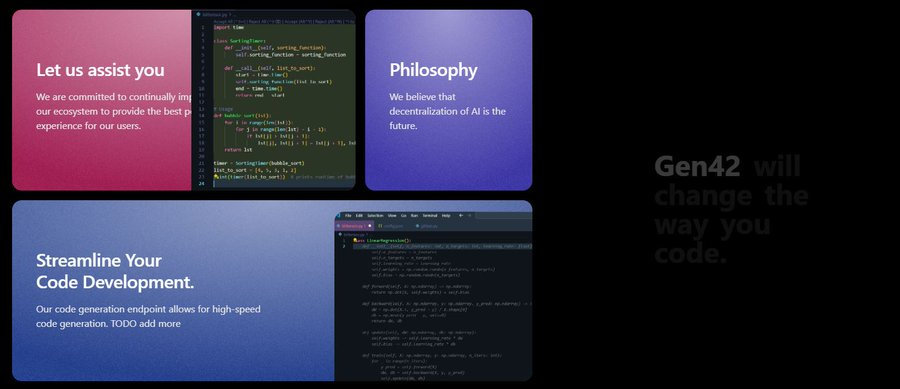
Gen42 leverages the Bittensor network to provide decentralized code generation services. Their focus is on building robust, scalable tools for code-based Q&A and code completion, powered by open-source large language models.
Main Products:
a. Chat Application: A chat frontend allowing users to interact with their subnet, primarily enabling code-based question answering.
b. Code Completion: Offers an OpenAI-compatible API compatible with continue.dev.
Details on miner and validator participation are available on the project’s GitHub.
Subnet 41: Sportstensor – Sports Prediction Model

Development Team: @sportstensor
Overview:
Sportstensor is a project dedicated to developing decentralized sports prediction algorithms, powered by the Bittensor network.
The project provides base models on open-source HuggingFace for miners to train and improve. It enables strategic planning and performance analysis based on historical and real-time data, rewarding comprehensive dataset collection and high-performance prediction model development.
Miner and Validator Roles:
-
Miners: Receive requests from validators, access relevant data, and use ML models for predictions.
-
Validators: Collect miners’ predictions, compare them with actual outcomes, and record verification results.
Subnet 29: coldint – Training Niche AI Models

Developer: Not publicly identified; official website here
Overview:
SN29 coldint stands for Collective Distributed Incentivized Training.
Objective: Focuses on pre-training niche models—those not as widely applicable as large general-purpose models but highly valuable in specific domains or tasks.
Roles and Contributions:
a) Miners primarily earn incentives by publicly sharing trained models.
b) Secondary rewards go to miners or contributors who share insights through code contributions.
c) Small improvements are rewarded to encourage regular sharing of incremental progress.
d) High rewards are given for code contributions that combine individual training efforts into superior ensemble models.
Subnet 40: Chunking – Optimizing Datasets for RAG (Retrieval-Augmented Generation) Applications
Development Team: @vectorchatai
Token: $CHAT
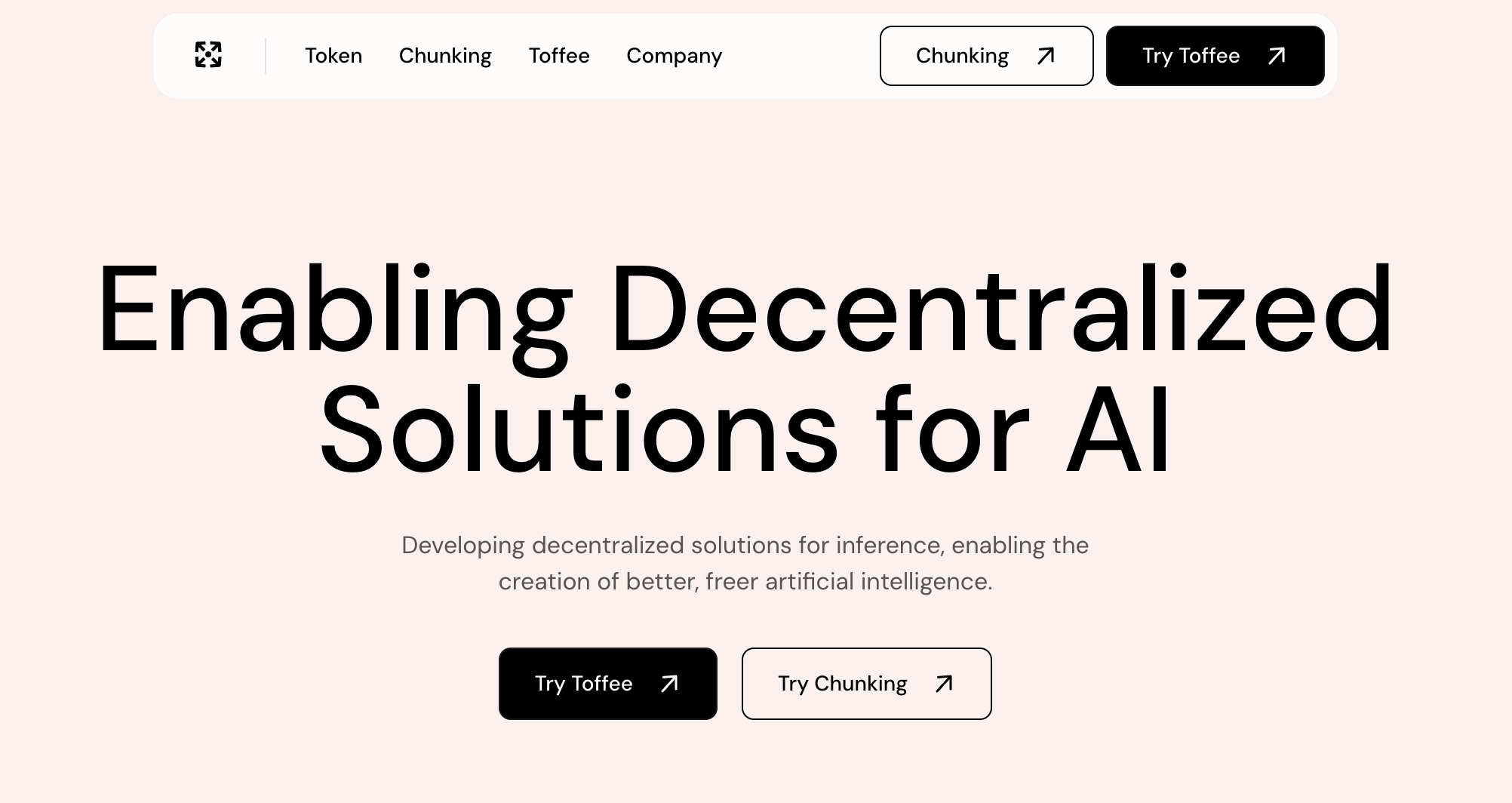
Overview:
SN40 Chunking acts like a highly intelligent librarian, breaking down vast amounts of information (text, images, audio, etc.) into smaller chunks so AI systems can better understand and use them—just as well-organized shelves make finding books faster.
SN40 Chunking helps AI “organize the bookshelf.”
Beyond text, SN40 Chunking also handles images, audio, and other data types—an all-in-one librarian managing books, photo albums, music CDs, and more.
Subnet 39: EdgeMaxxing – Optimizing AI Models to Run on Consumer Devices
Development Team: @WOMBO
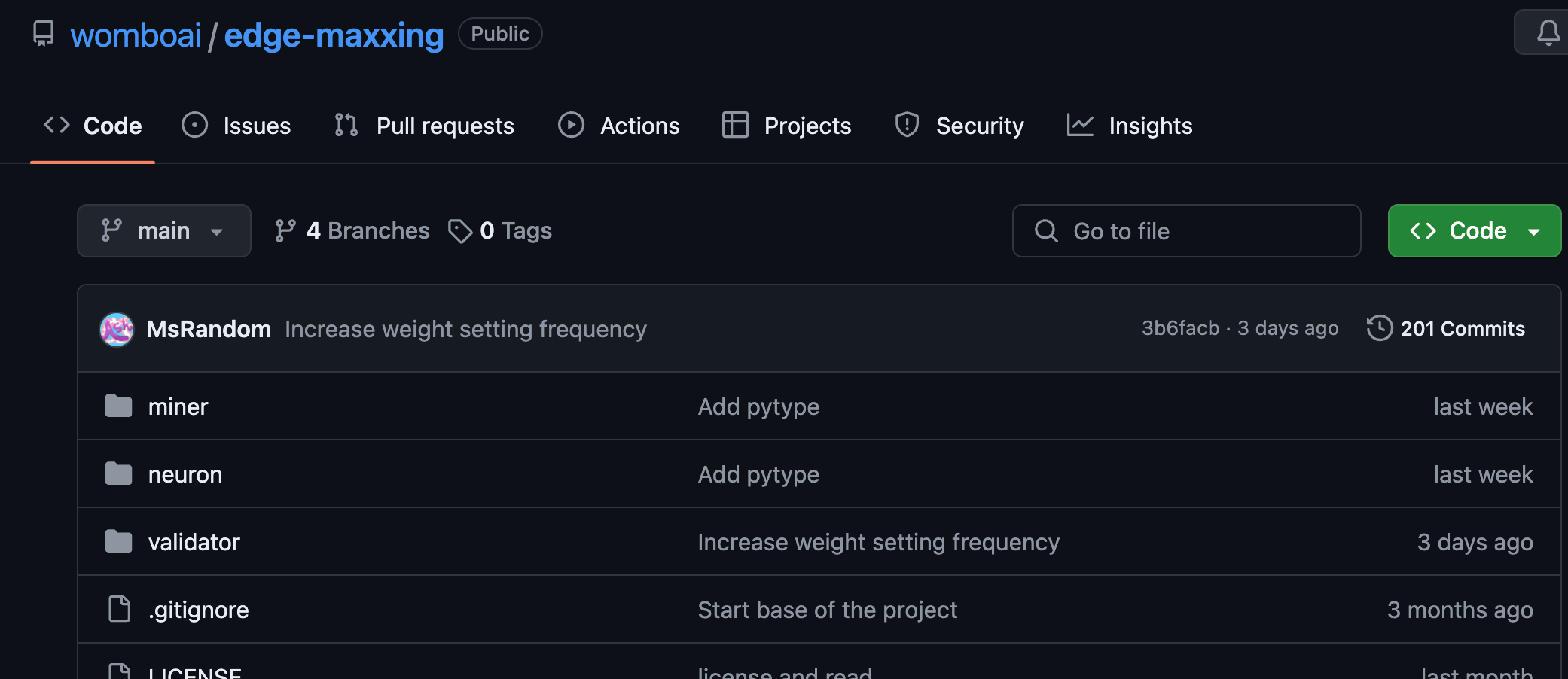
Overview: SN39 EdgeMaxxing is a subnet focused on optimizing AI models for consumer devices—from smartphones to laptops.
The EdgeMaxxing subnet employs a competitive reward system with daily competitions, encouraging participants to continuously optimize AI model performance on consumer hardware.
Participant Roles:
Miners:
Primary task: Submit optimized AI model checkpoints.
They use various algorithms and tools to enhance model performance.
Validators:
Must run on specified target hardware (e.g., NVIDIA GeForce RTX 4090), collect all submitted models daily, benchmark each submission against a baseline checkpoint, and score based on speed improvement, accuracy retention, and overall efficiency—selecting the best-performing model as the daily winner.
Open-source repository: https://github.com/womboai/edge-maxxing
Subnet 30: Bettensor – Decentralized Sports Prediction Market

Development Team: @Bettensor
Overview:
Bettensor allows sports fans to predict game outcomes, creating a blockchain-based decentralized sports prediction market.
Participant Roles:
Miner: Generates prediction outputs.
Validator: Verifies the accuracy of predictions.
Data Collector: Gathers sports event data from various sources.
Open-source Repository: https://github.com/Bettensor/bettensor (appears to still be under development)
Subnet 06: Infinite Games – General-Purpose Prediction Market
Development Team: @Playinfgames
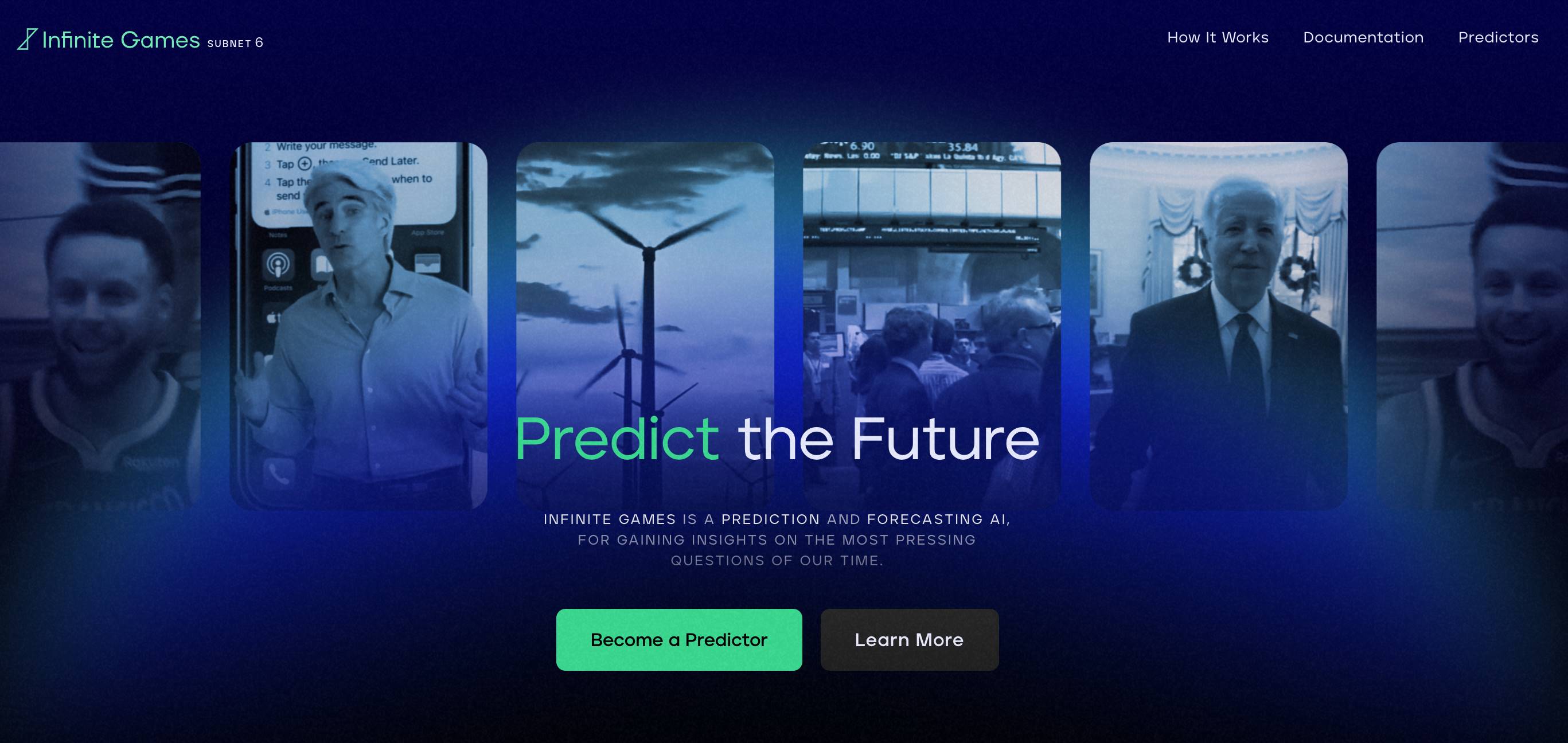
Overview:
Infinite Games develops real-time and predictive tools for prediction markets. The project also arbitrages and aggregates events from platforms such as @Polymarket and @azuroprotocol.
Incentive System:
Uses $TAO tokens as incentives.
Rewards accurate predictions and valuable information providers.
Overall, the project encourages user participation in predictions and information sharing, fostering an active prediction community.
Subnet 37: LLM Fine-tuning – Large Language Model Fine-Tuning
Development Team: Taoverse & @MacrocosmosAI
Overview:
This subnet focuses on fine-tuning large language models (LLMs), rewarding miners for fine-tuning LLMs and using a continuous synthetic data stream from Subnet 18 for model evaluation.
Workflow:
-
Miners train models and regularly publish them to the Hugging Face platform.
-
Validators download models from Hugging Face and conduct ongoing evaluations using synthetic data.
-
Evaluation results are recorded on the wandb platform.
-
TAO token rewards are distributed to miners and validators based on weights.
Repository URL: https://github.com/macrocosm-os/finetuning
Subnet 21: Any to Any – Building Advanced AI Multimodal Models
Development Team: @omegalabsai
Overview:
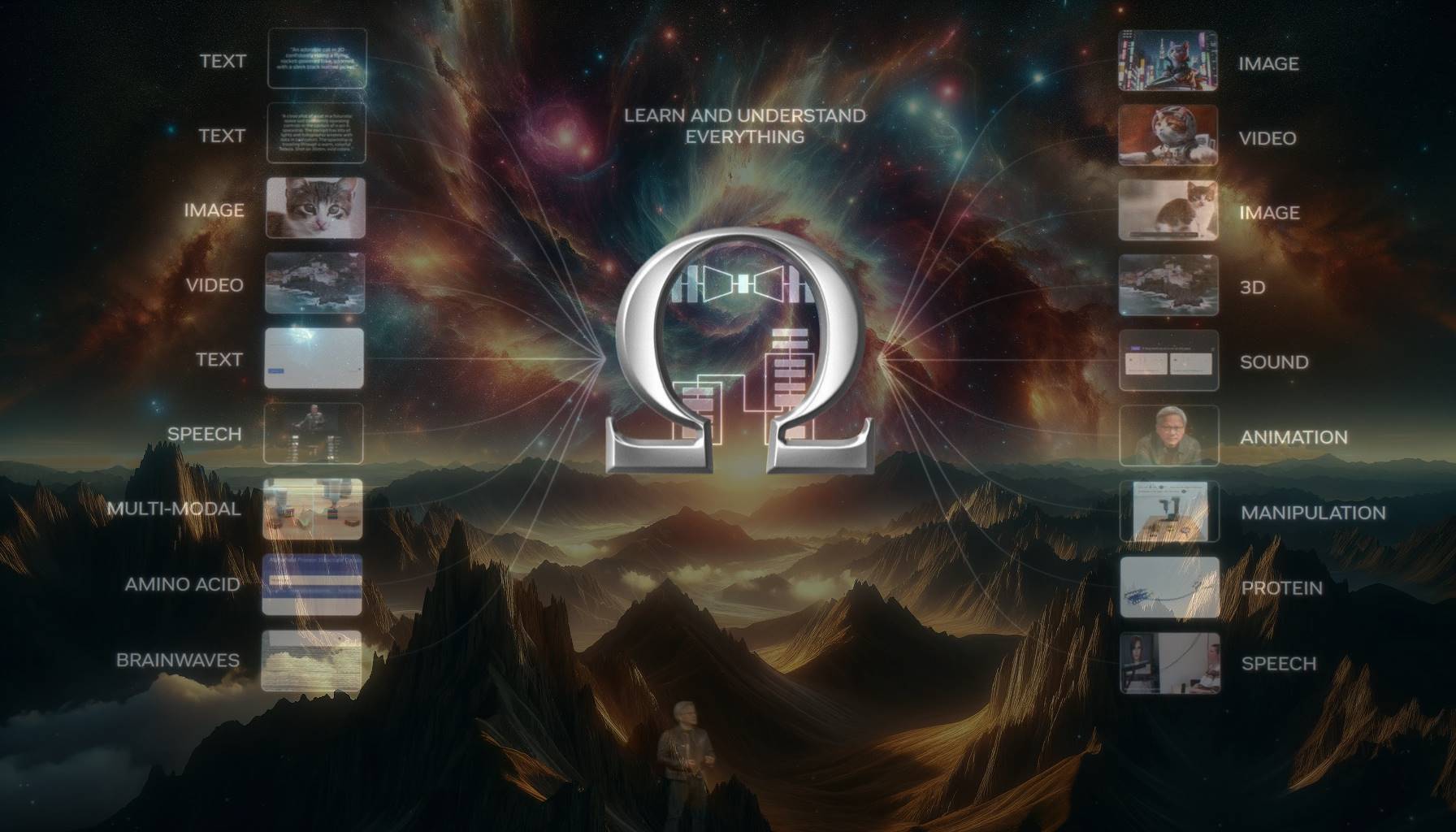
“Any to Any” refers to a multimodal AI system capable of converting and understanding between different data types—such as text to image, image to text, audio to video, and video to text.
The system not only performs conversions but also understands relationships across modalities—for example, linking textual descriptions to corresponding images or aligning videos with their audio tracks.
Within this subnet, incentive mechanisms encourage global AI researchers and developers to participate:
-
Contributors earn token rewards by providing valuable models, datasets, or computational resources.
-
This direct economic incentive makes high-quality AI research and development sustainable.
Repository URL: https://github.com/omegalabsinc/omegalabs-anytoany-bittensor
Supplementary Knowledge:
For readers unfamiliar with the significance of Bittensor subnets, a simple explanation is:
-
Subnets are specialized networks within the Bittensor ecosystem,
-
Each subnet focuses on a specific AI or machine learning task.
-
Subnets allow developers to create and deploy purpose-built AI models.
-
They use crypto-economic incentives to reward participants for contributing computational resources and improving models.
Join TechFlow official community to stay tuned
Telegram:https://t.me/TechFlowDaily
X (Twitter):https://x.com/TechFlowPost
X (Twitter) EN:https://x.com/BlockFlow_News
 深潮TechFlow


