









"Day of Reckoning"! When the U.S. economic recession comes knocking
TechFlow Selected TechFlow Selected
"Day of Reckoning"! When the U.S. economic recession comes knocking
The sharp decline in the cryptocurrency market may be influenced by concerns over a U.S. economic recession, global stock market losses, and a large-scale sell-off by Jump Trading.
 Navigating Web3 tides with focused insights
Author: 1912212.eth, Foresight News
The market's sharp decline has exceeded most people's expectations. After BTC lost the $60,000 mark at around 10 PM last night, it continued to plunge sharply below $53,000, reaching a low of $52,300—an over 10% drop in 24 hours and the lowest level for BTC since March this year. BTC has now stabilized above $54,000.
ETH also dropped below $3,000, hitting a low of $2,111, down more than 20% in 24 hours. It has since recovered to trade above $2,300—a level that nearly erased all of ETH’s gains for the year. Altcoins broadly declined around 20%.
According to Coinglass data, total liquidations across the market reached $808 million in the past 24 hours, with $705 million coming from long positions. U.S. crypto-related stocks extended their declines during overnight trading: CleanSpark fell over 20%, MicroStrategy and Marathon Digital dropped more than 16%, while Coinbase and Riot Platforms each declined over 13%.
After BTC broke above $70,000 at the end of July but failed to reach a new all-time high, investor sentiment weakened. Amid dwindling capital inflows, what factors accelerated this major crypto market crash?
Weak Jobs Data Fuels Recession Fears in the U.S.
Last Friday, the U.S. nonfarm payrolls report came in significantly below expectations, triggering a chain reaction on Wall Street. The weak reading not only caused a broad selloff in U.S. equities but also heightened concerns about the overall economic outlook. As a key barometer of economic health, the disappointing jobs data sent shockwaves through financial markets. The U.S. unemployment rate surged 0.6 percentage points from its low earlier this year. After several consecutive months of higher-than-expected unemployment, the so-called "Sahm Rule" has now been triggered.
The Sahm Rule states that a recession is likely underway when the three-month moving average of the national unemployment rate rises by more than 0.5 percentage points relative to its lowest point in the previous 12 months. This indicator has had a 100% accuracy rate since the 1970s. Following the release of July’s data, the threshold was met, suggesting the U.S. may already be in a recession. Since 1950, the Sahm indicator has issued 11 signals—only in 1960 did the actual recession begin five months after the signal; in the other 10 cases, the economy was already contracting when the signal appeared.
Jan Hatzius, Chief Economist at Goldman Sachs, raised the probability of a U.S. recession within the next 12 months from 15% to 25%. Goldman now expects the Federal Reserve to cut interest rates by 25 basis points at each of its September, November, and December meetings. Moreover, if August’s employment data proves similarly weak, a 50-basis-point cut in September becomes highly likely. In contrast, JPMorgan and Citigroup have adjusted their forecasts, now expecting a 50-basis-point rate cut as early as September.
Investors who believe in the recession narrative tend to sell risk assets preemptively, unwilling to bet against a potential downturn. As a result, capital has flowed out of the crypto market, exacerbating price declines.
Global Equities Plunge Amid Panic Selling
The day after the Fed's meeting, U.S. stocks began a steep decline. The immediate catalyst was the release of the ISM Manufacturing Index on August 1, which came in at 46.8%—below expectations. This index measures factory activity in the U.S. and is widely viewed as a leading indicator of economic contraction.
Then, Friday’s weaker-than-expected nonfarm payrolls report intensified investor anxiety. July data showed the U.S. unemployment rate rising to 4.3%, the highest since 2021. Combined with Thursday’s report showing initial jobless claims reaching their highest level since August 2023, signs are mounting that the labor market is cooling rapidly. U.S. equity futures tumbled: Nasdaq 100 futures dropped 2.21%, and S&P 500 futures fell 1.23%.
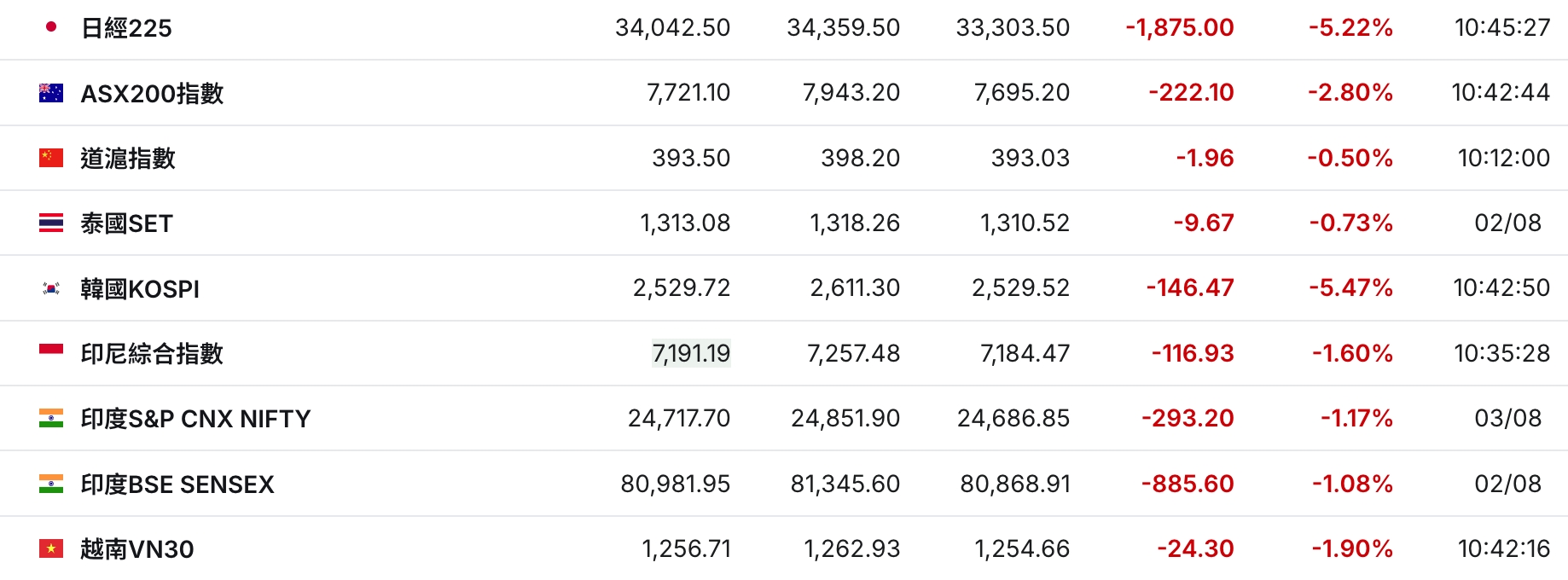
Asian markets followed suit today, dragged down by the U.S. selloff. Japan’s stock market plunged, with the Nikkei 225 dropping 6% and falling over 12% in just three days. The Tokyo Stock Price Index (TOPIX) hit its circuit breaker, and is now down 20% from its July peak—entering technical bear market territory. Bank, financial, and mining stocks led the losses. South Korea’s KOSPI index extended its decline to 5%, with Samsung shares tumbling 6%—their biggest drop since 2020. Singapore’s Straits Times Index fell 3%, Australia’s S&P/ASX 200 dropped 3%, and the Philippine index declined 2%.
Large-Scale Crypto Liquidations Accelerate Downward Spiral
On June 20, rumors spread that Jump Trading was under investigation by the U.S. Commodity Futures Trading Commission (CFTC). Just four days later, Kanav Kariya, President of Jump Crypto, announced his departure via social media without specifying the reason. Recently, Jump Trading began gradually redeeming a $410 million wstETH position (120,000 tokens) into ETH and transferring the funds to exchanges such as Binance and OKX. In the past 24 hours alone, Jump Trading moved another 17,576 ETH (worth approximately $46.78 million) to centralized exchanges. According to Scopescan, Jump’s current holdings are now dominated by USDC and USDT.
Arthur Hayes, co-founder of BitMEX, recently posted on social media that, through traditional finance sources, he learned that a “big player” collapsed and sold off all its crypto holdings. That “big player,” many speculate, could very well be Jump Trading.
Additionally, as selling pressure drove prices lower, multiple large-scale liquidations and on-chain deleveraging events occurred today. Early this morning, four whale wallets were forcibly liquidated due to the rapid price drop, resulting in the clearance of 14,653 ETH (valued at ~$33.54 million). According to Parsec data, DeFi protocol loan liquidations surpassed $320 million in the past 24 hours—the highest level this year.
Major liquidations also hit centralized exchanges. One Binance user suffered a single long position liquidation worth $10.91 million at 10:17 AM today when ETH was trading at $2,197, in the ETH/USDC futures pair.
As leveraged positions continue to be liquidated, additional selling pressure mounts, fueling further declines across the crypto market.
Join TechFlow official community to stay tuned
Telegram:https://t.me/TechFlowDaily
X (Twitter):https://x.com/TechFlowPost
X (Twitter) EN:https://x.com/BlockFlow_News
 Foresight News










