The Underrated "Ethereum Spot ETF"
TechFlow Selected TechFlow Selected
The Underrated "Ethereum Spot ETF"
Going beyond Bitcoin ETFs, Ethereum ETFs are gaining more favor from traditional institutions.
 Navigating Web3 tides with focused insights
Author: Zhou Zhou, Foresight News
Spot Ethereum ETFs are underestimated. During the first seven trading days, traditional institutions demonstrated strong demand for Ethereum ETFs.
On July 23, 2024, U.S. spot Ethereum ETFs officially began trading—just six months after the launch of U.S. spot Bitcoin ETFs. In those six months (through July 2024), net inflows into spot Bitcoin ETFs reached $17 billion. This means that, on average, over $100 million flowed into Bitcoin ETFs every single trading day after their approval. The market reacted swiftly—Bitcoin rose 50% within two months following the ETF approval.
No other factor has influenced Bitcoin’s price in this cycle more than spot Bitcoin ETFs. Yi He, co-founder of Binance, said in an interview with Foresight News: "From 2021 to 2024, this so-called bull market wasn’t driven by innovation—it was driven by standalone events like ETF approvals." This isn't an exaggeration. According to Caixin Weekly, daily trading volume for spot Bitcoin ETFs is approximately $4–5 billion, accounting for 15%–20% of total global cryptocurrency exchange volume. ETFs have brought massive liquidity to the Bitcoin market.
Spot Bitcoin ETFs have also made history in the broader U.S. ETF market. Within just six months of launch, two Bitcoin spot ETFs (IBIT and FBTC) ranked among the top 10 out of nearly 2,000 ETFs launched over the past five years in terms of capital inflows. BlackRock’s IBIT became the fastest ETF in U.S. history to reach $20 billion in assets, achieving it in only 137 days (the previous record holder was JPMorgan’s actively managed JEPI fund, which took 985 days). As of July 31, 2024, BlackRock’s IBIT had attracted $20.023 billion in net inflows, while Fidelity’s FBTC reached $9.952 billion.
As perhaps the single most influential variable currently affecting Bitcoin and the broader crypto market, the performance data of spot Bitcoin ETFs provides a rare and valuable template for evaluating future cryptocurrency ETFs such as Ethereum. Investors can now directly compare daily metrics like net inflows and trading volumes between spot Bitcoin and Ethereum ETFs.
So, will Ethereum replicate the success of spot Bitcoin ETFs? At what level of trading volume and net inflows would Ethereum ETFs be considered to outperform Bitcoin ETFs? And will Ethereum ETFs impact Ethereum’s liquidity and price as significantly as Bitcoin ETFs have impacted Bitcoin?
The Underestimated "Spot Ethereum ETF"
In the first seven trading days, traditional institutions showed strong buying interest in Ethereum ETFs. Relative to its market cap share (~30% of Bitcoin’s), the net inflow performance of spot Ethereum ETFs even surpassed that of Bitcoin ETFs.
As of August 1, Ethereum’s market cap stood at about 30% of Bitcoin’s. Against this benchmark, the initial-day and first-week figures for Ethereum ETFs exceeded those of Bitcoin ETFs.
On the first trading day, eight non-Grayscale Ethereum ETFs recorded $591 million in net inflows, compared to $750 million across nine non-Grayscale Bitcoin ETFs—meaning Ethereum achieved 78% of Bitcoin’s first-day inflow. Given Ethereum’s market cap is only 30% of Bitcoin’s, this debut performance was remarkably strong—outpacing Bitcoin ETFs on a relative basis.
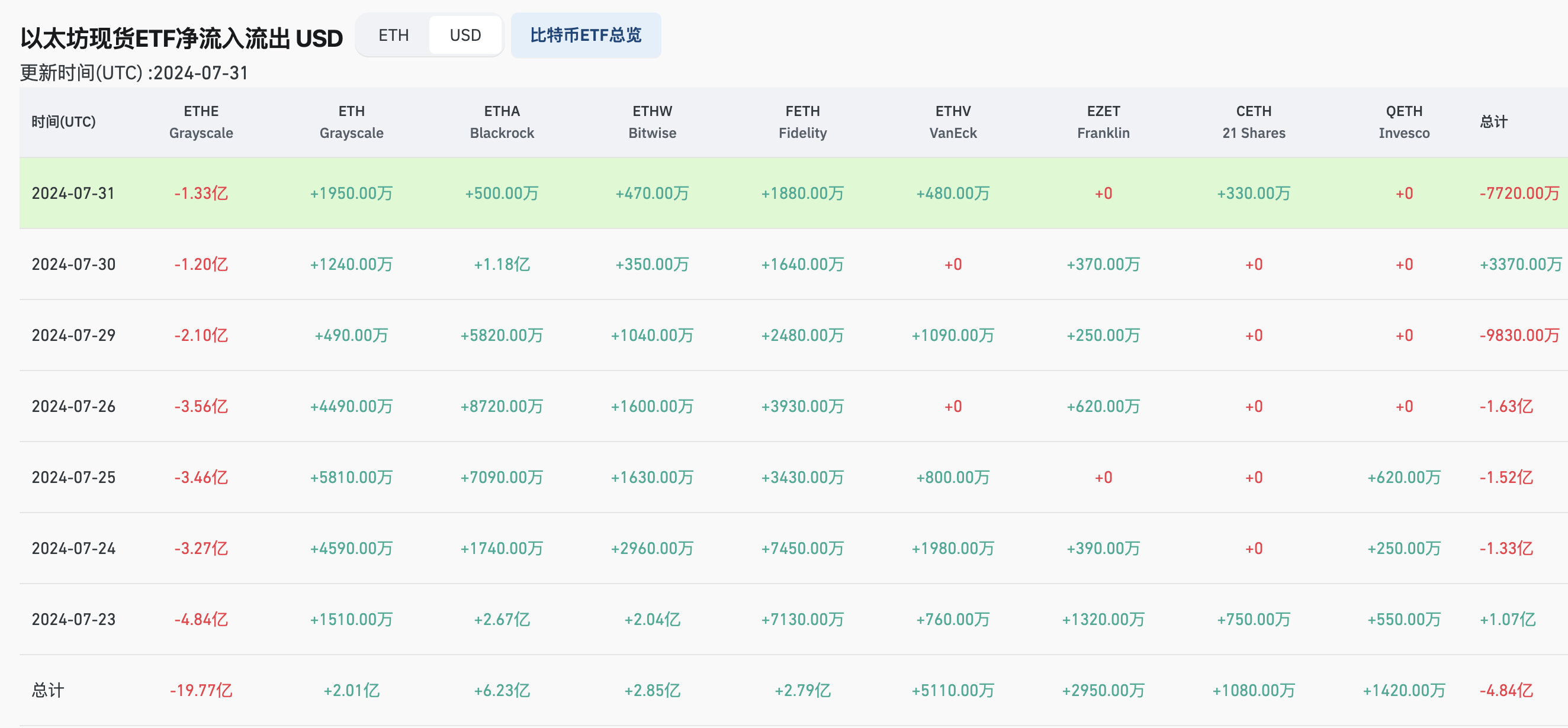
First 7 trading days of spot Ethereum ETFs (Data source: Coinglass)
Extending the timeframe to one week, Ethereum ETFs still hold up favorably against Bitcoin ETFs.
Over the first seven trading days, eight non-Grayscale Ethereum ETFs saw $1.494 billion in net inflows. By comparison, nine non-Grayscale Bitcoin ETFs recorded $4.536 billion in net inflows during their early days—Ethereum reaching 32% of that figure. Considering Ethereum’s market cap is ~30% of Bitcoin’s, Ethereum ETFs’ first-week performance matches or slightly exceeds that of Bitcoin ETFs.
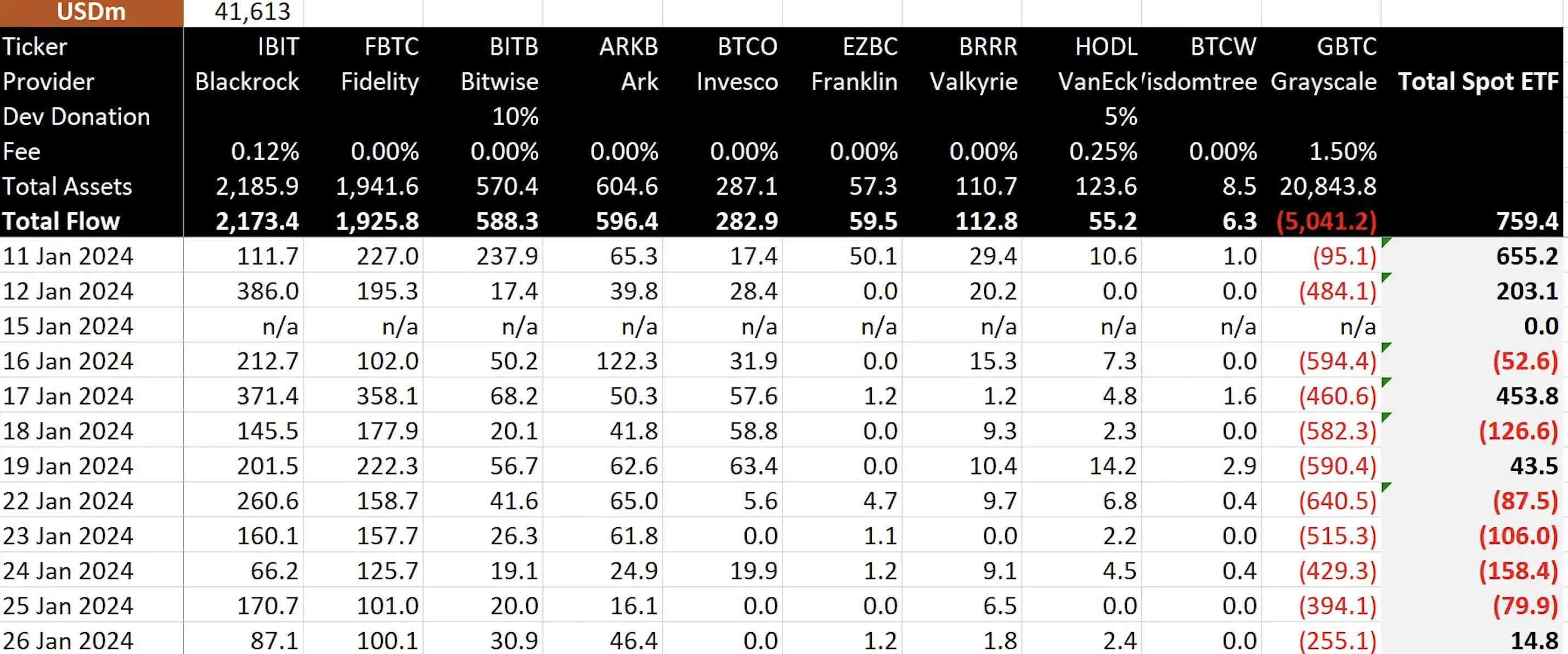
First 11 trading days of spot Bitcoin ETFs (Data source: BitMEX Research)
As shown in the two charts above, during the first 11 trading days, both spot Bitcoin ETFs (10 funds) and spot Ethereum ETFs (9 funds) saw selling pressure concentrated solely in Grayscale, while all others were buying. Moreover, Grayscale’s outflows far exceeded the combined inflows from the other eight firms.
This is due to Grayscale’s early entry, low-cost basis in both Bitcoin and Ethereum, and high post-conversion fees, leading to significant sell-offs in the early weeks for both assets. As a result, prices for both Bitcoin and Ethereum won’t rise immediately despite ETF launches.
According to Coinglass data, as of July 30, 2024, total assets under management (AUM) for U.S. Ethereum ETFs reached $9.009 billion, with Grayscale’s ETFE holding $6.896 billion—accounting for 76% of the entire U.S. spot Ethereum ETF market. Grayscale’s Ethereum-related sell pressure will persist for some time.
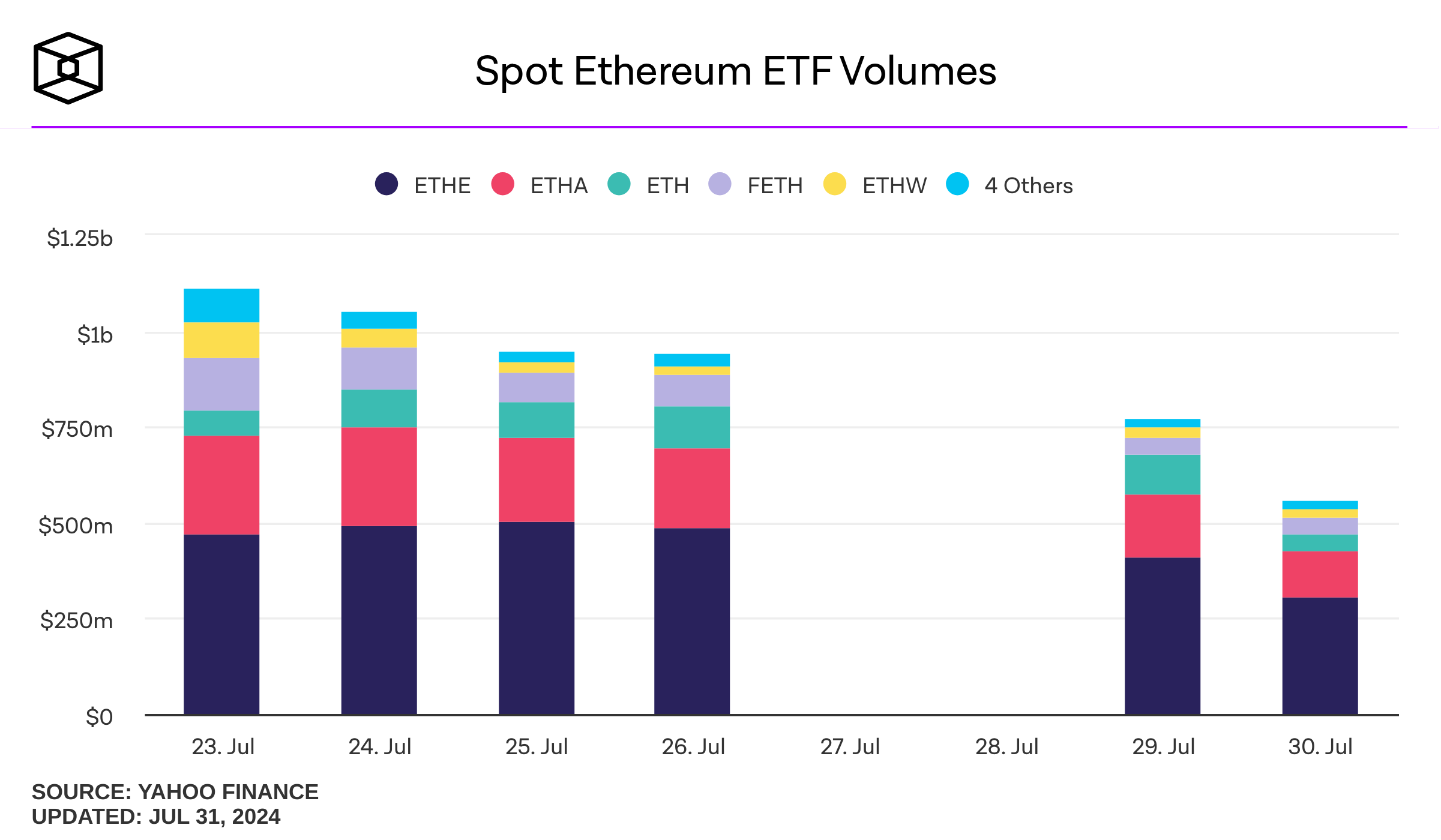
Grayscale’s ETFE holds $6.896 billion in AUM, representing 76% of the market (Source: The Block)
Over the first seven trading days, the nine Ethereum ETFs collectively recorded $484 million in net outflows. Of this, Grayscale’s ETHE accounted for $1.977 billion in outflows. Despite net buying from the other eight ETFs, Grayscale alone drove the entire Ethereum ETF complex into net outflows.
How long will Grayscale’s Ethereum sell-off pressure continue? When will Ethereum ETF capital flows accelerate, bringing sustained net inflows and liquidity to the Ethereum market—and eventually begin directly influencing Ethereum’s price?
Will Ethereum ETFs Outperform Bitcoin ETFs?
How do we assess the performance of spot Ethereum ETFs?
U.S. ETF analysts believe BlackRock’s ETF performance will serve as a key benchmark. (Indicator One)
Whether for Bitcoin or Ethereum spot ETFs, BlackRock is the largest buyer, and it's expected to absorb all of Grayscale’s sell-offs over time.
As the world’s largest asset manager overseeing $10 trillion, BlackRock’s Bitcoin ETF holdings alone exceed the combined total of the other nine Bitcoin ETFs. From January 11 to July 31, 2024, BlackRock attracted $20.023 billion in net Bitcoin inflows, while the other eight non-Grayscale Bitcoin ETFs combined for $16.6 billion. Meanwhile, Grayscale sold off $19 billion worth of Bitcoin. BlackRock fully absorbed Grayscale’s Bitcoin sell-offs.
According to Bitcoin ETF data, on the 12th trading day after launch (January 29), BlackRock’s spot Bitcoin ETF surpassed Grayscale’s Bitcoin Trust (GBTC) in daily trading volume. Some U.S. professional ETF analysts viewed this as a sign that Grayscale’s selling pressure had significantly weakened—potentially marking a bottom for Bitcoin.
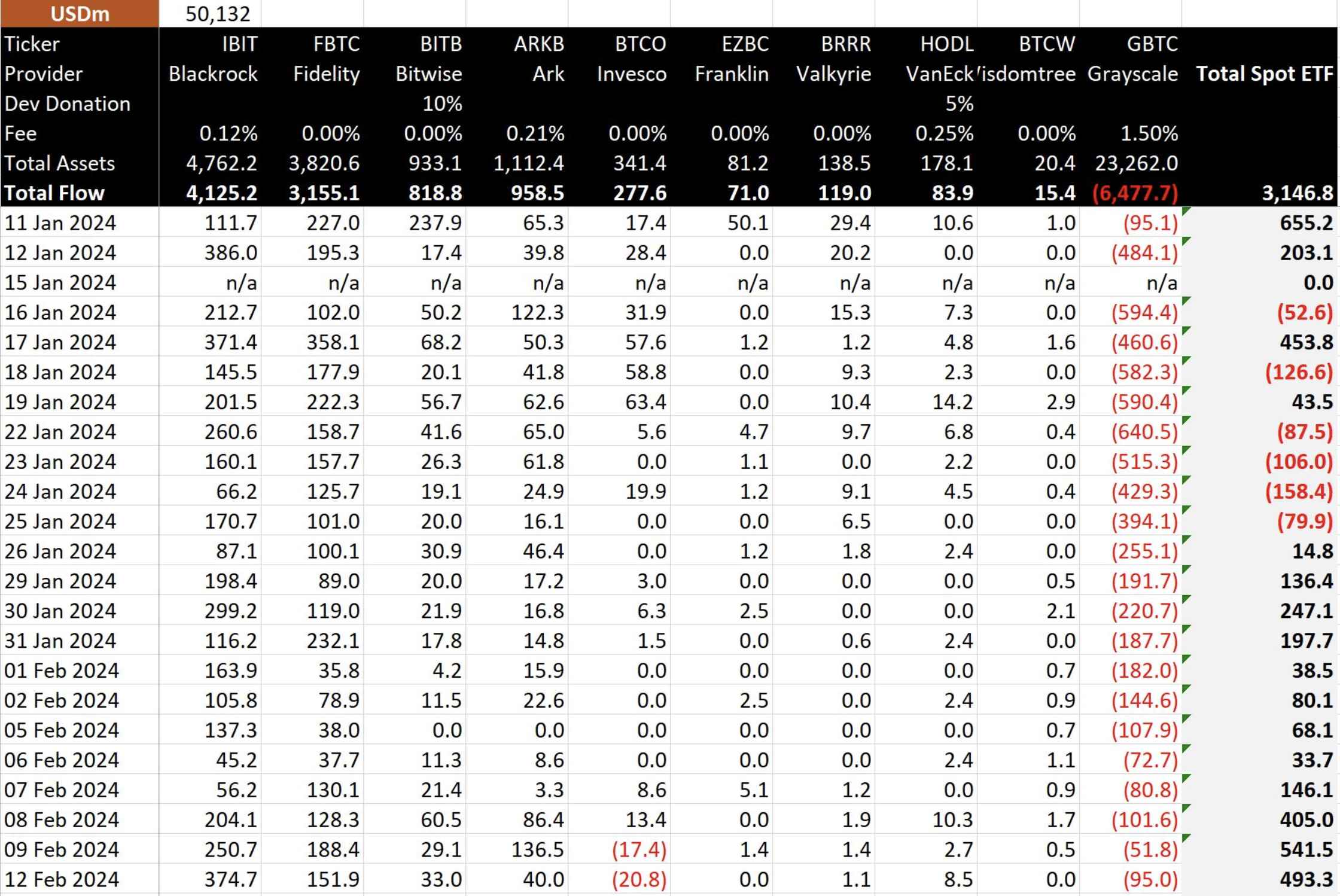
First 23 trading days of spot Bitcoin ETFs (Data source: BitMEX Research)
Indeed, from that day onward (the 12th trading day), Bitcoin ETFs began consistent net inflows.
As shown above, after the 12th trading day, Grayscale’s selling could no longer match prior levels, while buying from BlackRock and Fidelity remained strong. Bitcoin’s price began rising steadily from January 26, peaking around March 14—an uptrend fueled by nearly $10 billion in net inflows via ETFs over two months.
A second key metric: Will net inflows into Ethereum ETFs reach 30% of Bitcoin ETF inflows after launch? (Indicator Two)
Eugene, Head of Institutional Business at Bybit, told Foresight News: “Traditional financial institutions may take slightly longer to understand ETH compared to BTC. We expect net inflows into Ethereum ETFs to reach roughly 25%–30% of Bitcoin ETF inflows, aligning with Ethereum’s market cap ratio relative to Bitcoin.”
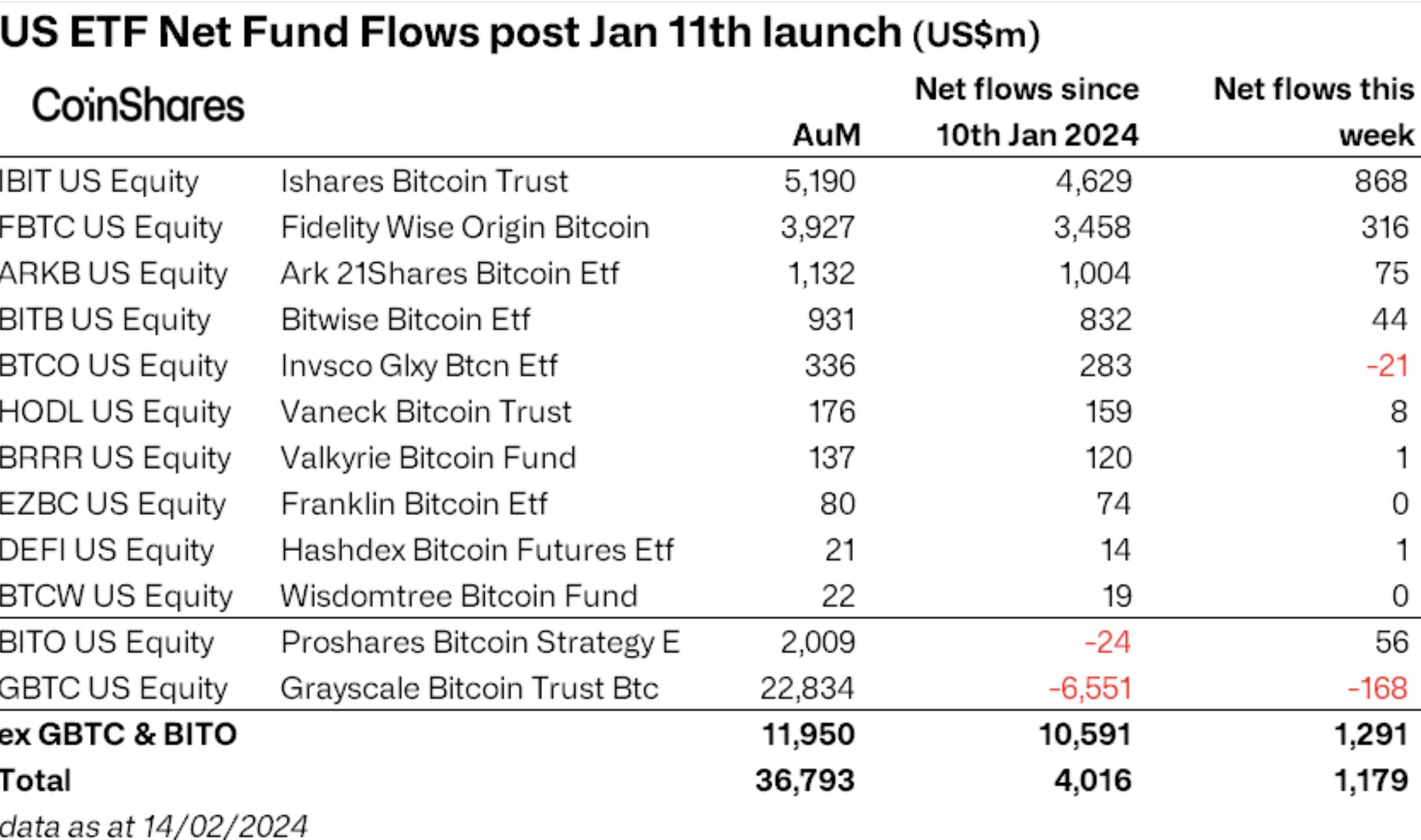
Source: James Butterfill, Research Director at CoinShares
Net inflows represent real new capital entering the Ethereum market through Ethereum ETFs—true incremental funding.
As shown above, around one month after the official launch of spot Bitcoin ETFs (February 14), total net inflows reached $4 billion—delivering tangible new capital to the Bitcoin market.
Quantifying Indicator Two further:
1) By the end of the first month (~August 23, 2024), will Ethereum ETF net inflows reach $1 billion?
2) After two months (~September 23), will net inflows reach $2.7 billion, with total AUM hitting $16.5 billion? (As of July 31, Ethereum ETF AUM totaled $9.119 billion.)
3) After six months (~January 23, 2025), will net inflows reach $4.6 billion? (After six months, Bitcoin ETFs had accumulated $15.2 billion in net inflows.)
The moment when all spot Ethereum ETFs together record their first net inflow will be another crucial signal. (Indicator Three)
As shown below, as of July 31, Ethereum ETFs recorded $484 million in net outflows—indicating Grayscale’s selling outweighed buying from the other eight Ethereum ETFs.
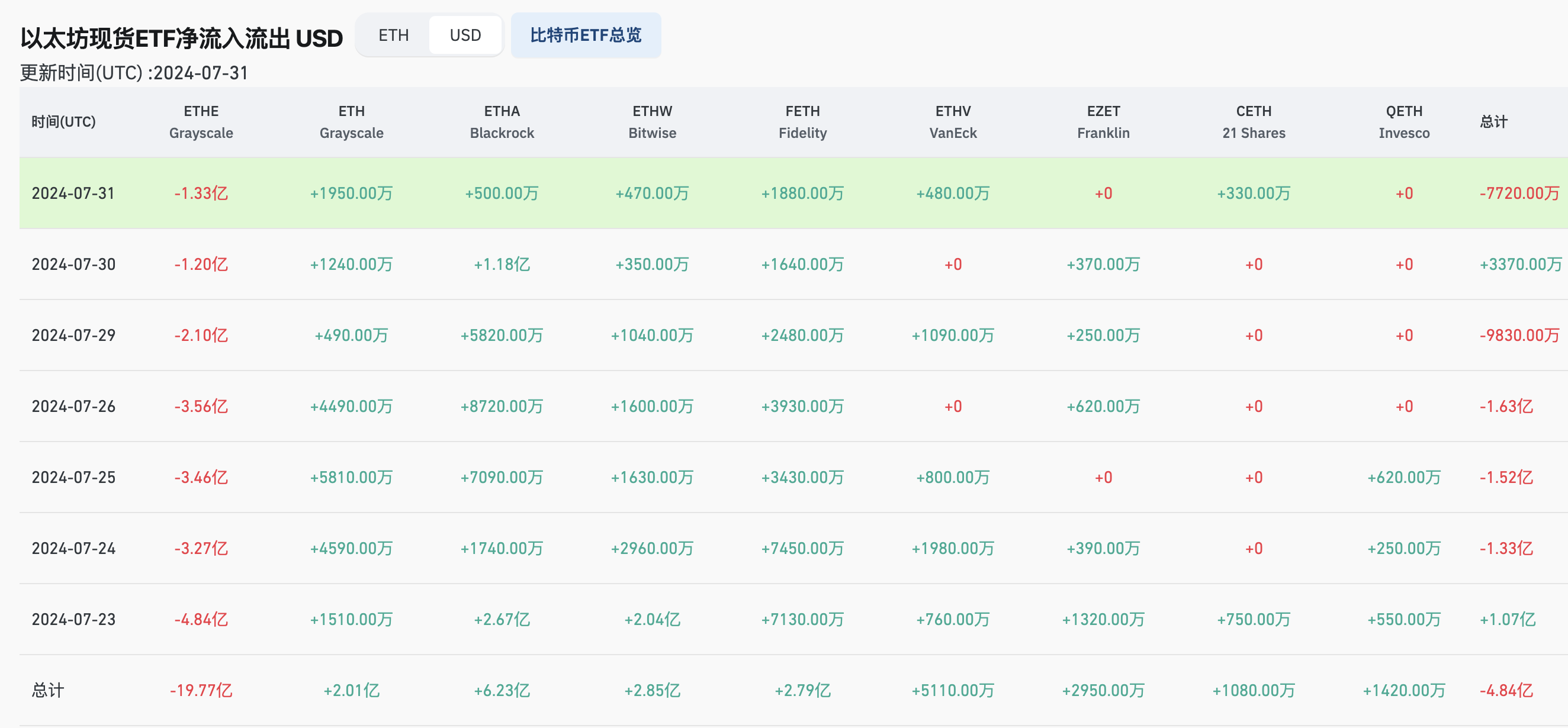
Data source: Coinglass
However, Grayscale’s ETFE currently holds $6.896 billion in AUM. At the current average daily outflow rate of $282 million, its AUM would halve in just 12 trading days—a pace clearly unsustainable and illogical. Looking at Grayscale’s Bitcoin ETF, despite selling nearly every day for six months, it only reduced its Bitcoin holdings by slightly more than half during that period.
Given the current pace and size of Grayscale’s Ethereum ETF holdings, it is unlikely they can maintain the same aggressive selling pressure beyond the initial weeks. Meanwhile, institutions like BlackRock are likely to sustain their buying momentum. If so, Ethereum ETFs could see a turning point toward net inflows within weeks.
ETFs: The Biggest Short-Term Variable Affecting Ethereum’s Price?
Bitcoin ETFs were the biggest variable affecting Bitcoin’s price in this cycle. Now that Ethereum ETFs have launched, will they become the dominant factor influencing Ethereum’s price?
As Eugene from Bybit told Foresight News, this depends on whether traditional institutions can quickly understand Ethereum’s value proposition and commit capital accordingly.
“Many see Bitcoin’s main appeal in its scarcity, but many others see Ethereum’s strength in its utility—you can think of Ethereum as a global platform for running applications without centralized intermediaries,” said Eric Balchunas, Bloomberg ETF analyst.
“Ethereum is a global application platform that operates without any central authority—the first truly decentralized platform in history,” added another industry participant. Regardless, over the next six months, Ethereum will face scrutiny from traditional institutions, who will vote with their capital on whether they believe in Ethereum’s technology, developers, business narrative, and future potential.
The good news is that, relative to its 30% market cap share, and excluding Grayscale’s influence, traditional institutions have shown strong demand for Ethereum ETFs in the first seven trading days. Ethereum ETFs have achieved 32% of Bitcoin ETFs’ net inflow volume—a figure suggesting that, so far, spot Ethereum ETFs are performing slightly better than spot Bitcoin ETFs on a relative basis.
Join TechFlow official community to stay tuned
Telegram:https://t.me/TechFlowDaily
X (Twitter):https://x.com/TechFlowPost
X (Twitter) EN:https://x.com/BlockFlow_News
 Foresight News