Forbes Investigates Polymarket: The 26-Year-Old Founder and the $1 Billion Prediction Market
TechFlow Selected TechFlow Selected
Forbes Investigates Polymarket: The 26-Year-Old Founder and the $1 Billion Prediction Market
Despite questions about its legality, hundreds of millions of dollars have been wagered on Polymarket.
 Navigating Web3 tides with focused insights
By Nina Bambysheva, Forbes
Translated by Luffy, Foresight News
How likely is Vice President Kamala Harris to defeat former President Trump in November? On Polymarket, a prediction platform, thousands of bets currently give Harris a 39% chance of winning, compared to Trump’s 59%, with Michelle Obama and Robert F. Kennedy each at 1%. Could J.D. Vance be replaced as Trump’s vice-presidential pick? A $100 bet would yield $1,000 if Vance steps down.
Welcome to the future of prediction markets, where almost anything can be wagered on—from Bitcoin’s peak price in 2024 and the stair-climbing speeds of Trump and Biden, to the gender of unborn children of Haley and Justin Bieber. On Polymarket, about $446 million has been bet so far on the outcome of the November presidential election. But betting on elections is banned in the U.S., as the Commodity Futures Trading Commission (CFTC) considers it contrary to public interest. Based in New York City, Polymarket has become a phenomenon—largely fueled by global attention on American politics.
Shayne Coplan, Founder and CEO of Polymarket
According to Dune Analytics, Polymarket launched in 2020 and has already seen over $650 million in trading volume this year, with nearly $300 million traded in July alone. The platform is expected to process $1 billion in prediction wagers by year-end. Campaign managers and political analysts are now turning to this unconventional oracle for signals hidden in volatile market prices. Even former President Donald Trump has boasted about his odds on Polymarket via his social media app, TruthSocial.
Polymarket operates on Polygon, a blockchain network that runs 24/7 with transaction fees just a fraction of Ethereum's. However, users must trade using USDC, a dollar-pegged stablecoin, rather than U.S. dollars. That’s changing: last Wednesday, Polymarket announced a partnership with Miami-based MoonPay, enabling users to place bets via bank transfers and credit cards.
The surging popularity of this prediction market has attracted top investors—including Peter Thiel’s Founders Fund and Ethereum co-founder Vitalik Buterin—who have collectively backed the startup with $74 million. Markets related to the U.S. election (over 100 of them) now account for most of Polymarket’s trading volume. According to web analytics platform Similarweb, while these markets are supposedly closed to U.S. residents, 25% of website traffic comes from the United States. Shayne Coplan, Polymarket’s 26-year-old founder, declines to discuss details about efforts to block American users from betting on elections, preferring instead to highlight the new platform’s advantages.
“Polymarket turns what used to be an internet argument into a market where those who predict correctly get rewarded. We want our predictions to become ubiquitous and mainstream,” said Coplan from a luxurious penthouse office in Manhattan’s SoHo district.
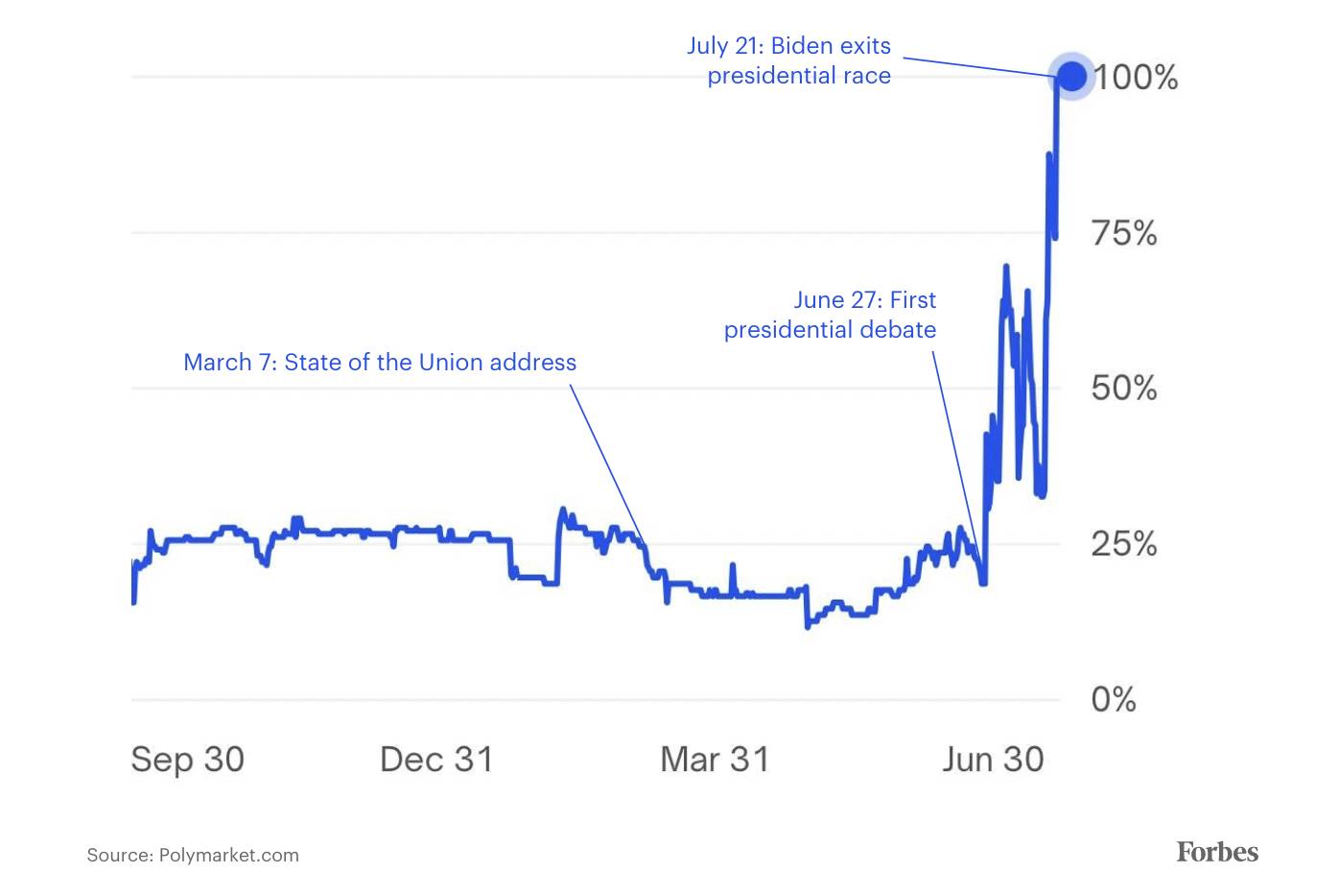
If you track real-time betting on whether President Biden will drop out of the race on Polymarket, you’ll see how odds dropped and rose around his public appearances and eventual withdrawal announcement
Coplan, whose mother is a film professor at New York University, grew up in Manhattan and describes himself as an internet obsessive. At 14, he built a cryptocurrency mining rig; in 2014, he participated in Ethereum’s presale when ETH was priced at about 30 cents. He studied computer science at NYU but dropped out during his second semester in 2017. Of the next three years, Coplan says: “I lived a hermetic life, obsessed with reading and trying new things.”
In 2020, amid global uncertainty during the pandemic, Coplan began exploring predecessors of Polymarket like Augur, an Ethereum-based prediction market. Augur had conducted an ICO in 2017 but never gained traction. Eventually, Coplan decided to build his own prediction platform. “I wanted to know the likelihood of New York City reopening—would vaccines be ready, would restaurants reopen? Finding signal through the noise was extremely hard, and that’s exactly where prediction markets excel,” he recalls. The first market on Polymarket asked when New York City would reopen.
A few months later, in October 2020, Coplan raised $4 million in seed funding led by Olaf Carlson-Wee, another crypto prodigy and founder of cryptocurrency hedge fund Polychain Capital. At the time, Carlson-Wee said: “We’ve always been fascinated by information markets, but many solutions in this space suffer from poor user experience and liquidity issues. Shayne and his team have deep expertise and have channeled it into a creative, user-centric product approach.” Carlson-Wee declined to comment for this article.
Prediction markets follow a fairly simple principle: you profit if your prediction is correct; you lose if it’s wrong. In these markets, the price of a “share” reflects the probability of an event occurring, ranging from $0.00 to $1.00. Currently, on Polymarket, a share for Donald Trump winning the presidency trades at 59 cents, meaning the market assigns a 59% chance of victory. If he wins in November, that bet pays out $1.00.
“Prediction markets are a powerful antidote to misinformation,” said Marc Bhargava, managing director at General Catalyst and a seed investor in Polymarket, in a statement to Forbes. “The incentive structure rewards people who back the most accurate views with their actions.”
Because Polymarket is built on a distributed ledger, it claims higher efficiency and transparency than centralized prediction markets like Kalshi and PredictIt, based in New York City and Wellington, New Zealand, respectively. Polymarket relies on a decentralized oracle called UMA (Universal Market Access), a blockchain-based system that resolves disputes via token-holder voting. Once an outcome is determined, smart contracts automatically distribute payouts to winners.
This blockchain-based application isn’t flawless. In June, Polymarket users bet over $1 million on whether Donald Trump’s 18-year-old son Barron was involved in launching the memecoin DJT (an acronym for the former president’s initials), which had a market cap of about $80 million. Initially, the odds favored his involvement at 60%, but they quickly dropped due to insufficient evidence. UMA’s vote concluded that Barron was not involved. Yet Polymarket later intervened, challenging the result and ultimately overturning UMA’s decision, stating Barron Trump had participated “in some way” in the launch of the DJT token. Polymarket then refunded bettors who had taken the “yes” side of the contract—but only after they had already lost their funds.
“Some people dismiss prediction markets because of incidents like this,” said Nick Tomaino, founder and general partner of crypto-focused investment firm 1Confirmation and an investor in Polymarket, on the Unchained podcast. “I think that’s foolish, because these systems are still being refined.”
Polymarket’s surge in trading volume isn’t just due to good timing. According to Art Malkov, Polymarket’s first CMO and co-founder of influencer marketing platform Lever.io, the company invested heavily in marketing, including promotions with the Reddit community WallStreetBets, helping attract a large base of retail investors.
Coplan leads a global team of about 30 people who curate user suggestions and scour the internet for trending topics that can be turned into prediction markets. Polymarket currently hosts over 300 markets across seven categories: politics, Olympics, crypto, pop culture, sports, business, and science. All employees are required to read Friedrich Hayek’s *The Use of Knowledge in Society* and works by George Mason University economics professor Robin Hanson, known for pioneering the concept of “futarchy.”
Polymarket doesn’t charge fees, and Coplan hasn’t disclosed its revenue model, though he hints that fees are coming. “We’re focused right now on growing markets and delivering the best user experience,” he said. “We’ll focus on monetization later.”
Despite lacking revenue and facing ongoing questions about the source of its trading volume, the young Coplan remains a darling of Silicon Valley. Billionaire venture capitalist Tim Draper effusively praised him in written comments to Forbes as “energetic and brilliant.” Tom Schmidt, general partner at crypto-focused Dragonfly Capital, added: “The word ‘tenacious’ feels overstated for most entrepreneurs, but for Shayne, it’s 100% accurate. Building Polymarket over years takes real courage, passion, and vision… qualities essential for building a once-in-a-generation company.” Ethereum co-founder Vitalik Buterin has also invested in Polymarket and promoted it publicly and on X.
“Shayne is an impatient young man, but he’s impatient to get things right,” said Chris Giancarlo, former CFTC chair and chairman of Polymarket’s advisory board, which recently welcomed election forecaster Nate Silver. “Polymarket’s success is generational,” he added. “I think older Americans didn’t grow up in environments like Europe, where prediction markets were popular, so they may not grasp the value proposition. But younger people won’t be deterred by their elders’ warnings.”
The origins of prediction markets date back to the 16th century, when Europeans occasionally bet on papal succession. In the late 19th century, “bucket shops” flourished as speculative venues where people wagered on stock prices. Over time, these evolved into more sophisticated platforms, especially with the rise of the internet. In the late 1990s, the Tippie College of Business at the University of Iowa began experimenting with so-called political stock markets via its Iowa Electronic Markets. The platform allowed small wagers on political outcomes, economic indicators, and cultural events for research purposes.
The U.S. government has long been cautious about gambling, leading to legal challenges for prediction markets. Because they resemble futures contracts, these markets fall under the jurisdiction of the Commodity Futures Trading Commission (CFTC).
In January 2022, the CFTC fined Polymarket $1.4 million for operating unregistered services in the U.S. As part of the settlement, the company agreed to phase out its U.S. operations while continuing internationally.
Technically, U.S. users are not permitted to bet on Polymarket, yet 25% of the site’s visitors come from the United States. According to Similarweb, the next largest visitor countries are Canada (6.3%), the Netherlands (6%), Vietnam (5.9%), and Mexico (5%). Prior to the CFTC settlement, U.S. traffic ranged between 34% and 54%. Coplan declined to comment on Polymarket’s geofencing measures, but a former employee who spoke to Forbes anonymously said the company “does everything it can to keep ineligible users off the platform.” Still, users can access Polymarket through workarounds like virtual private networks (VPNs).
Polymarket’s competitor PredictIt has operated in the U.S. since 2014. The CFTC issued a no-action letter allowing it to function as a “data collection tool for academic researchers” in collaboration with Victoria University of Wellington, New Zealand. PredictIt allows bets on U.S. elections and currently gives Trump a 52% chance and Kamala Harris a 49% chance. It charges a 10% fee on final profits and caps individual investments at $850 per contract, resulting in much lower trading volume: $31 million on election outcomes versus Polymarket’s $446 million. In August 2022, the CFTC withdrew its no-action letter and ordered PredictIt to cease operations; the company continues to operate while challenging the decision in court. PredictIt’s founder and CEO, John Aristotle Phillips, stated: “We’ve legally operated in the U.S. for 10 years under no-action relief and expect to continue for another decade or more.”
Another rival, CFTC-regulated Kalshi, cannot offer election betting but does allow wagers on government-related events such as Federal Reserve interest rate decisions. The platform charges a small fee based on a contract’s maximum potential payout and implied probability. “Kalshi is focused on building a legal, regulated prediction market in the U.S.,” CEO Tarek Mansour told Forbes.
More restrictions may be coming. In May, the CFTC proposed banning predictions tied to political campaigns, award shows, or sporting events, calling them “contrary to the public interest.” In response to Forbes’ request for comment, the CFTC referenced its settlement with Polymarket and noted that the rule proposal’s comment period ends on August 8.
However, on June 28, in Loper Bright Enterprises v. Raimondo, the Supreme Court invalidated a federal agency rule regarding fishing vessels, effectively overturning the so-called “Chevron deference” doctrine that allowed federal agencies to enforce regulations based on their interpretation of often ambiguous laws. As a result, agencies like the SEC and CFTC now face greater scrutiny. This could provide a reprieve for prediction markets like Polymarket that have faced pressure from the CFTC.
“I believe the long-term trend is toward acceptance of prediction markets,” said Giancarlo.
A major question hanging over Polymarket’s future is how it will sustain trading volume and momentum after the November 2024 election. Coplan and his supporters don’t seem concerned. “Yes, volume tends to spike around events like elections, but there will always be big events—and in an increasingly volatile world, their impact may be even greater. Another driver of sustained growth is the growing desire for people to participate in predictions and see what others truly believe; this challenges traditional social media and especially genAI, where generating massive inaccurate content faces no penalty,” said General Catalyst’s Bhargava.
Given low barriers to entry in crypto, competition will be another major challenge for Polymarket. Memecoins like DJT have already become proxies for prediction markets. The space has also drawn traditional financial players like billionaire Thomas Peterffy’s Interactive Brokers, which recently announced ForecastEx, a prediction market offering contracts based on key economic data releases such as the U.S. federal funds target rate and CPI. In April, Susquehanna International, the trading firm owned by billionaire Jeff Yass, formed a dedicated team to make markets for Kalshi, Polymarket’s competitor.
Despite competition from traditional finance, Dragonfly’s Schmidt remains bullish on Coplan’s chances in the race to build a lasting prediction market. “Ultimately, Polymarket’s secret weapon is its ability to empower a creator ecosystem to launch new markets—a feature traditional financial rivals can’t easily replicate,” he said. “Think YouTube, not TV.”
Join TechFlow official community to stay tuned
Telegram:https://t.me/TechFlowDaily
X (Twitter):https://x.com/TechFlowPost
X (Twitter) EN:https://x.com/BlockFlow_News
 Forbes