








Vitalik's Latest Speech: Ethereum's Next Decade
TechFlow Selected TechFlow Selected
Vitalik's Latest Speech: Ethereum's Next Decade
Ethereum's Decade of Transformation and Outlook for the Next Ten Years
 Navigating Web3 tides with focused insights
By Pzai, Foresight News
Today at EDCON 2024, an Ethereum developer conference held in Tokyo, Ethereum co-founder Vitalik Buterin delivered a keynote on "Ethereum's Next Decade," offering both a brief retrospective on the past ten years and a forward-looking vision of the boundless possibilities for Ethereum in the decade ahead.
Changes Over the Past Decade
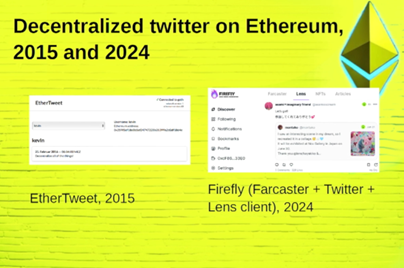
Vitalik first reviewed the evolution of social interfaces—from EtherTweet in 2015, which simply posted information on-chain, to today’s multi-client Firefly. This shift reflects improvements in both user experience and underlying architecture, resulting in greater efficiency, lower costs, and enhanced usability. Vitalik described Firefly as a “Farcaster + Twitter + Lens client,” where posts made via Firefly can simultaneously appear on both Farcaster and Lens.
Next, Vitalik discussed improvements in on-chain interactions. In 2019, using the mainnet was expensive, and ZK-SNARKs were even costlier. Today, transaction costs are typically less than one cent. Over the past decade, Ethereum has significantly reduced fees and increased transaction throughput through scaling solutions. Regarding confirmation times (transaction inclusion), users in 2019 often waited 1 to 5 minutes, sometimes up to 60 minutes under poor conditions. Now, thanks to EIP-1559, this has improved to 5–20 seconds, with Layer 2 solutions achieving sub-second confirmations.
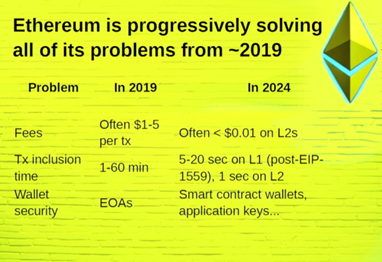
Additionally, proposals like EIP-4337 have enhanced the usability and security of smart contract wallets. Vitalik expects that within the next five years, nearly everyone will adopt smart contract wallets such as Safe.
Vitalik noted that blockchain use cases over the past decade have remained largely unchanged—centered around stablecoins, financial derivatives, decentralized exchanges, and prediction markets—highlighting the need to explore future applications. Back in 2014, he had envisioned decentralized exchanges and prediction markets (today, platforms like Polymarket operate at a fraction of earlier costs), but did not foresee the rise of NFTs.
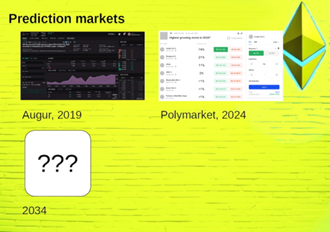
“I didn’t expect people would spend up to $2 million trading a digital monkey,” said Vitalik. “In 2020, I paid $1,000 in fees on Augur; today, trading on Polymarket costs almost nothing. The last ten years saw some very interesting developments—so what will happen in the next ten?”
Outlook for Ethereum’s Next Decade
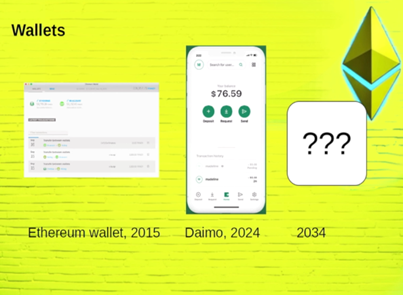
On wallets, Vitalik used wallet UI as an example: Ethereum wallets in 2015 closely resembled Bitcoin wallets in design, while by 2024, they began adopting more conventional app-like experiences. However, Vitalik believes neither represents the future paradigm, as Ethereum aims to create a new type of on-chain social system.
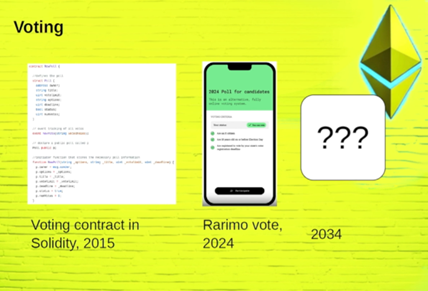
In 2024, an application developed by a Ukrainian company is building a zero-knowledge proof voting system. Such systems could even be applied to government elections. When combined with privacy-preserving technologies like ZKPs, they offer higher credibility. Looking ahead to 2034, making voting more transparent, efficient, and secure could expand the scope of “governance voting” in daily life—and potentially integrate with financial mechanisms.
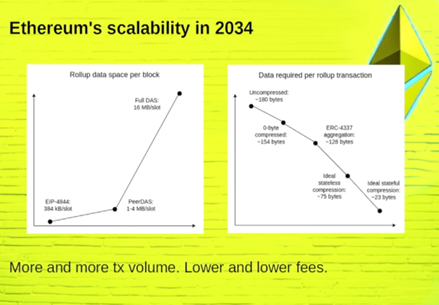
On scaling, Vitalik mentioned that blob space will initially expand from 1–4 MB, eventually reaching 16 MB per mainnet block. This expansion will be protected by Ethereum and its ecosystem, while leveraging techniques like transaction compression to benefit users in a scaled environment.
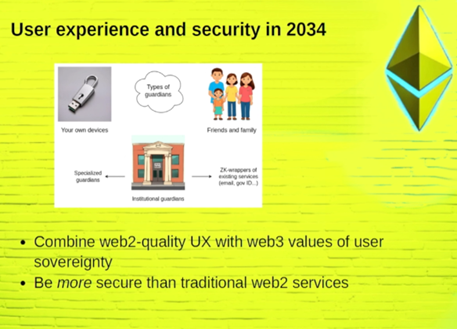
Regarding user experience, Vitalik hopes future wallet designs will blend traditional UX principles with stronger self-sovereignty and security. For instance, in wallet custody, hybrid on-chain/off-chain models—such as “guardian” setups—can enhance protection. By 2034, Web2-level user experience and Web3 values of user sovereignty will converge, offering greater security than traditional Web2 services. Moreover, using Ethereum L2s will feel as seamless as using the Ethereum mainnet directly.
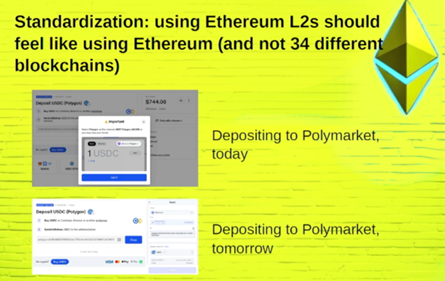
Additionally, Vitalik proposed standardized front-end interaction experiences: through frontend standards (such as ERC-3770 and ERC-7683), multi-chain experiences within the EVM ecosystem can be unified. He cited Polymarket as an example—where users once had to carefully avoid cross-chain transfer errors, in the future they’ll interact seamlessly across chains via a single interface.
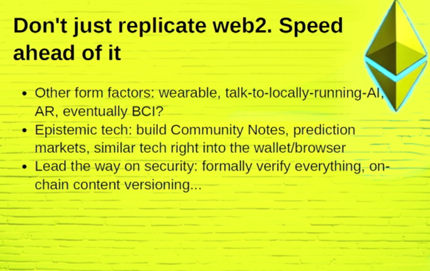
Moreover, Vitalik emphasized that builders should not merely replicate Web2, but instead lead the way through bold exploration. By 2034, devices will go beyond desktops and mobile phones to include wearables, locally-run AI, AR, and ultimately possibly brain-computer interfaces (BCIs). Practical tools may directly embed features like Community Notes, prediction markets, or similar technologies into wallets or browsers, with enhanced security allowing verification of everything or providing proofs of on-chain content versions. These innovations define the purpose of cryptocurrency: protecting people at the source amid ongoing security challenges.
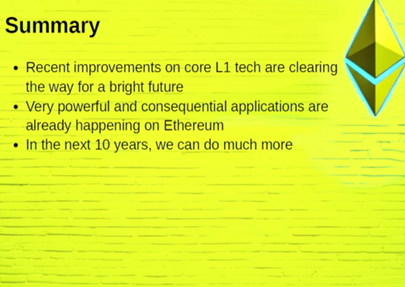
Finally, Vitalik summarized his thoughts, stating that the past decade focused heavily on theory. Now, as developers can deliver the quality of experience users demand, powerful and meaningful applications are already being built on Ethereum. The focus can now shift toward creating impactful applications for the world, while preserving the value of ownership for all.
“What kind of applications should we build? How do we build them while preserving our shared values? I don’t have the answers—but I believe each of us, every developer, every Buidler, and every indispensable member of the community, has the opportunity to help shape the future,” concluded Vitalik.
Join TechFlow official community to stay tuned
Telegram:https://t.me/TechFlowDaily
X (Twitter):https://x.com/TechFlowPost
X (Twitter) EN:https://x.com/BlockFlow_News
 Foresight News






