Understanding the cryptocurrency industry's upstream and downstream ecosystem, uncovering the value of downstream front-end applications
TechFlow Selected TechFlow Selected
Understanding the cryptocurrency industry's upstream and downstream ecosystem, uncovering the value of downstream front-end applications
Value flows downstream to midstream participants and ultimately to upstream players through monetization via a large network of paying customers.
 Navigating Web3 tides with focused insights
Author: Richard Yuen
Translation: TechFlow
Downstream frontend applications will become one of the largest components of the on-chain economy.
Many call for more applications, but for the wrong reasons—not because venture capital firms are trying to inflate their infrastructure assets or chase the next 100x speculative story.
Here are some thoughts.
1. Value Chain – Upstream, Midstream, and Downstream
To understand how the crypto/blockchain space might evolve, we can look at mature industries such as the internet.
In a mature internet industry, the value chain can be divided into upstream, midstream, and downstream segments.
-
Upstream: Foundational technologies and infrastructure enabling the internet—hardware, connectivity, networks, core software, protocols, etc.
-
Midstream: Platforms built on top of the underlying infrastructure—data storage, cloud computing, hosting services, search engines, etc.
-
Downstream: Platforms supported by midstream infrastructure that interact directly with end users and consumers—social media, streaming, e-commerce, blogs, forums, and other applications.
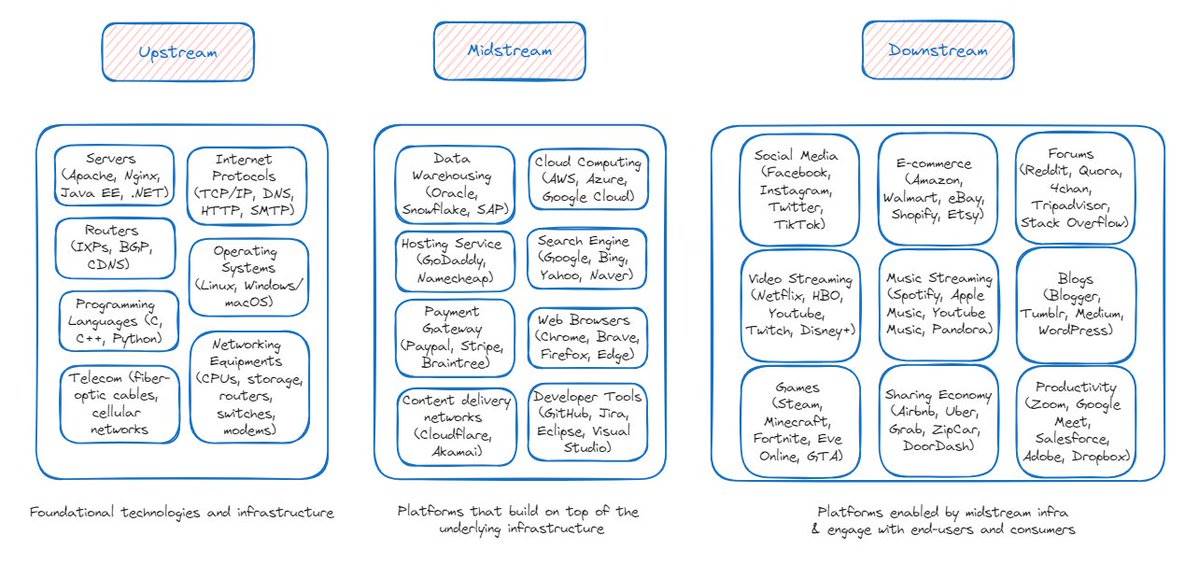
The upstream segment involves developing foundational technologies, including core protocols and software upon which midstream platforms rely. Midstream platforms act as critical intermediaries, ensuring compatibility, optimization, and seamless integration between upstream infrastructure and technology providers and downstream consumer-facing platforms. Downstream platforms serve as the primary interface and delivery channel for end users, where consumers access and use products and services.
Infrastructure provided by upstream and midstream platforms enables downstream applications to offer diverse products and infinite iterations to meet end-user needs.
Upstream and midstream infrastructure typically has strong technical moats, is highly standardized, offers limited differentiation, often becomes commoditized, yet still generates high profits (e.g., Amazon AWS), with some components evolving into public goods.
Downstream applications have lower technical moats but offer differentiated products with clear value propositions to attract users, focusing on user retention and building strong network effects as their competitive advantage. Many applications expand horizontally to offer broader product suites, and some even vertically integrate across the entire value chain as they scale.
-
Upstream and midstream platforms: B2B
-
Downstream applications: B2C
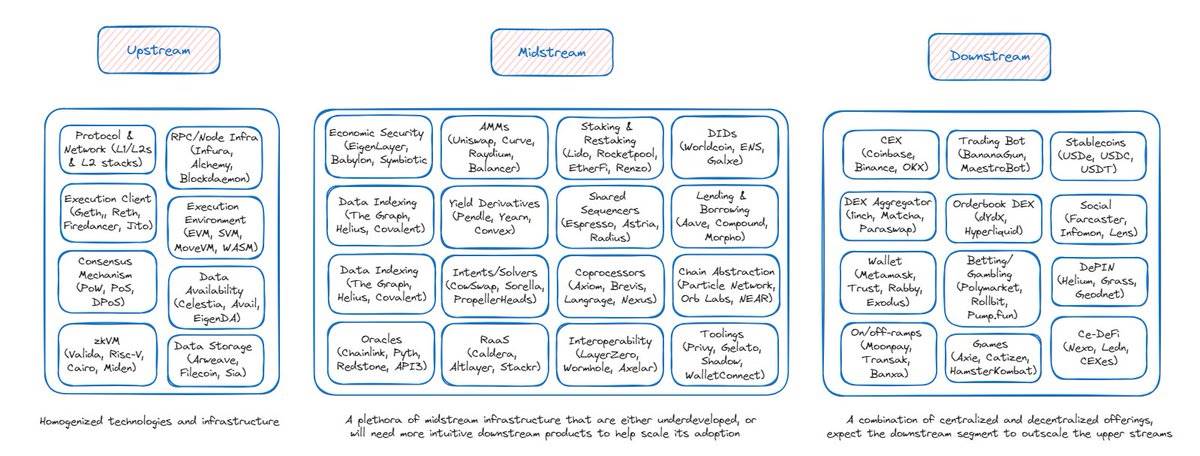
As the blockchain/crypto industry matures, I expect the value chain to eventually settle into three main streams:
-
Upstream: Foundational technologies and infrastructure enabling blockchain adoption—protocols and networks (L1/L2), RPC/node infrastructure, execution and consensus clients, execution environments, consensus mechanisms, data storage, zkVMs, data availability, etc.
-
Midstream: Platforms built on foundational blockchain infrastructure—economic security, automated market makers (AMMs), yield derivatives, intent solvers, oracles, rollups-as-a-service (RaaS), staking and restaking, shared sequencers, interoperability, decentralized identity (DID), lending markets, chain abstraction, data indexing, etc.
-
Downstream: Applications supported by upstream infrastructure—centralized exchanges (CEX), decentralized exchange aggregators, orderbook DEXs, trading bots, games, Ce-DeFi platforms, on/off-ramps, wallets, decentralized physical infrastructure (DePIN), social apps, gambling/betting, stablecoins, etc.
2. Key Observations and Thoughts:
Upstream crypto infrastructure is becoming homogenized. Infrastructure projects are almost all built using the same standardized mechanisms—e.g., Proof-of-Stake (PoS), EVM compatibility. While certain projects may offer niche specialization or unique features, the overall functionality provided by upstream participants is largely comparable.
The homogenization of upstream products will inevitably lead to price competition, forcing these projects to differentiate through pricing, performance, and developer relations. Building brand recognition and network effects has become more important than ever for upstream players to remain relevant in this competitive landscape.
It seems odd for upstream infrastructure (such as L1/L2) to shoulder most of the burden of customer acquisition since their business model is primarily B2B. Spending billions of dollars indiscriminately airdropping tokens to users across various downstream applications appears highly inefficient. Imagine Amazon AWS spending billions to help onboard end users of its downstream customers—say, Robinhood’s retail traders or Netflix viewers. Due to unfamiliarity with product specifics, user behavior/segmentation, engagement metrics, etc., designing effective user onboarding and retention incentives becomes extremely difficult. As a result, billions are wasted attracting short-term “airdrop farmers” and mercenary users who abandon the platform once incentives dry up.
Midstream crypto infrastructure may face a similar fate—homogenization and eventual commoditization.
DeFi applications like Uniswap, Aave, and Pendle—I deliberately classify them as midstream because differences among peers in the same sub-sector are limited, and they require more intuitive downstream applications (e.g., frontend aggregators, CeDeFi platforms) to deliver better user experience and achieve scale. Currently, their UX is often only accessible to crypto natives (let’s be honest: setting up and funding hot wallets, navigating to DeFi apps, selecting correct products/pairs, choosing the right chain, confirming transactions, etc., is truly a nightmare for most non-native users).
Many midstream infrastructure layers are still iterating (especially intent layers/solver networks, coprocessors, shared sequencing, chain abstraction). As these mature, they’ll enable downstream applications to offer better functionality—faster, cheaper, more precise execution and computation, improved interoperability, smoother UX, and so on.
The downstream crypto application space is far from maturity. I expect the downstream sector to grow larger than the upstream—a pattern consistent with market structures in mature industries.
Two main categories of downstream applications: centralized and decentralized. Centralized apps (CEXs, CeDeFi platforms, on/off-ramps) offer more intuitive UI/UX similar to Web2 platforms, lower onboarding friction, generally comply with regulations, and many have already found some form of product-market fit. Decentralized apps leverage and aggregate upstream infrastructure while offering smoother frontends to reduce user friction. This segment will be at the forefront of accelerating mass adoption of blockchain technology and cryptocurrencies.
Vertical integration—there’s a trend of downstream applications that have achieved product-market fit beginning to vertically integrate across the value chain and expand horizontally to offer broader services. This isn’t unusual—Amazon started as an online bookstore (downstream), then built its own logistics/fulfillment network (midstream) and cloud infrastructure (upstream) to support e-commerce and internal operations, expanding its product range across every consumer category. In crypto—we see centralized exchanges like Binance and Coinbase (downstream) launching BNB Chain and Base (upstream), incentivizing midstream infrastructure development on them, and expanding into wider offerings: wallets, staking, on/off-ramps, custody, etc. Or consider Axie Infinity (downstream) launching Ronin Chain (upstream) and all associated midstream apps/infrastructure—Ronin Wallet, Katana (DEX), Mavis Market (NFT marketplace), Ronin Launchpad, Mavis ID (decentralized identity), Ronin RPC, etc.
I anticipate the burden of customer acquisition will shift back from upstream infrastructure to downstream applications. This shift will be catalyzed by:
1) L1/L2 ecosystems directly airdropping to applications, allowing them to design incentive programs aligned with their roadmaps, product designs, and business models;
2) VCs, L1/L2 teams, and general capital re-evaluating downstream applications and funding growth in this segment.
3. Downstream Applications Will Accumulate the Most Value
On value creation: Upstream infrastructure creates value by pioneering technological innovation, improving the performance, efficiency, and reliability of base systems. Midstream platforms create value by packaging upstream technologies into developer-friendly applications, platforms, or ecosystems tailored to specific market needs. Downstream players create value by enhancing usability, accessibility, and personalization, relying on midstream and upstream infrastructure.
Current state: Upstream and midstream infrastructure have gone through 2–3 cycles of technological iteration; much of the value created by these innovations is already reflected in their market valuations. Innovation has plateaued, and technologies have become homogenized. Meanwhile, downstream applications are poised for unprecedented growth in the coming cycle as they begin leveraging increasingly mature upstream infrastructure to generate value.
In mature industries, downstream platforms and applications typically receive the most user attention because they are the sole interface for user interaction. Users often don’t know (and don’t care) about the backend tech stack powering these applications—their primary concern is the user experience.
With strong network effects (user base) and differentiated product offerings, downstream platforms command greater pricing power and higher valuations.
Take ByteDance (TikTok’s parent company): over 500 million daily active users, $120 billion in revenue, valued at $268 billion—compared to Akamai, the CDN network it relies on, which generates $3.8 billion in revenue and was acquired for $16 billion in 2023. The same applies to Meta, Netflix, Google, and others.
Value flows from downstream applications—monetizing large paying customer networks—to midstream, and ultimately to upstream participants. Growth in downstream applications drives demand for the upstream technologies they depend on, creating a symbiotic relationship.
We’ve already seen fee revenues from crypto applications exceed those of upstream infrastructure—midstream (Raydium, Uniswap, PancakeSwap, Aave, Lido, Jito); downstream (Ethena, Pump). Upstream infrastructures like Avalanche, Near, and Polygon are no longer in the spotlight, generating only $10,000 to $100,000 in fees per day.
Take Uniswap and Ethereum: a user trades $100,000 on Uniswap, pays $1 in network gas fees to Ethereum, but Uniswap earns over $300 from trading fees and MEV profits—clearly indicating which layer accumulates more value.
4. Proliferation of Profit Maximization
Downstream applications on L1/L2 are affected not only by user activity-driven gas fees (L1 security costs and/or L2 execution costs) but also by upstream L1/L2 block builders capturing MEV, leaving substantial revenue untapped.
Intuitively, to maximize revenue, many downstream applications are exploring ways to reclaim sovereignty over revenue generation.
We expect downstream applications to further privatize their order flow, build private mempools via vertical integration, or even become block builders themselves. Some may launch their own app-specific chains to capture more value.
Take Banana Gun TG bot, for example—it’s projected to pay over $100 million in priority fees and miner tips to Ethereum builders and validators. Already, 98% of its order flow goes through private mempools. I wouldn’t be surprised if Banana Gun expands vertically into block building to capture more value.
Others choose to build their own app chains to achieve more optimized blockchain architectures for specific use cases (throughput requirements, consensus algorithms, application-specific data structures, custom gas fees and economic incentives, sovereignty, etc.), enabling more efficient scaling than general-purpose blockchains. Value capture will also concentrate on the app chain rather than being “shared” with the base-layer blockchain.
As solver networks (Fastlane Atlas, Semantic Layer, Uniswap V4 hooks), interoperability, chain abstraction, RaaS, and rollup stacks (OP Stack, ZK Stack, Arbitrum Orbit, etc.) mature and become widespread, application profitability is expected to rise, enabling better value capture in the future.
5. The "Frontend Flip" Meta-Concept
Smooth, user-friendly downstream frontend applications will lead the onboarding of millions of non-crypto users. Midstream applications like Curve and Aave, along with upstream infrastructure, will serve as the backbone for execution and settlement.
I’m particularly bullish on frontend applications that offer: trading bots and wallet-integrated swaps providing chain-abstracted trading experiences with optimized execution and low fees; orderbook-based and centralized limit order book (CLOB) platforms delivering Web2-like trading experiences with fast, low-cost trades; payment super-apps with seamless on/off-ramp capabilities, enabling smooth P2P Venmo-like stablecoin transfers; and social apps and games that intelligently leverage financialization, asset ownership, and AI to deliver experiences competitive with Web2.
The “frontend flip” is already happening.
For example, downstream frontends like Jupiter and 1inch collect fees comparable to Uniswap and PancakeSwap.
Moreover, frontend applications such as Telegram bots, wallet swaps, and aggregators now generate approximately 50% of Ethereum transactions.
Downstream frontends are capturing market share from midstream backend applications. As these frontends become the de facto standard for interacting with DeFi, backend applications’ share is expected to decline further.
The flip toward fat frontend applications is inevitable.
Join TechFlow official community to stay tuned
Telegram:https://t.me/TechFlowDaily
X (Twitter):https://x.com/TechFlowPost
X (Twitter) EN:https://x.com/BlockFlow_News
 @Richard__Yuen