








LayerPixel: All in for TON, building an All-in-One DeFi solution for the TON ecosystem
TechFlow Selected TechFlow Selected
LayerPixel: All in for TON, building an All-in-One DeFi solution for the TON ecosystem
LayerPixel aims to provide Telegram Mini App developers with an all-in-one DeFi service, helping more outstanding applications overcome the technical barriers of building within the TON ecosystem.
 Navigating Web3 tides with focused insights
By: TechFlow
After weathering multiple bull and bear cycles, the TON ecosystem has finally arrived at its spring in this current bull market.
In September 2023, Telegram officially announced integration with the TON network, reconciling its relationship with TON. This move opened a Web3 gateway for Telegram’s 900 million monthly active users, bringing unprecedented opportunities to the TON ecosystem and transforming TON from a “neglected public chain backed by a giant” into a highly sought-after platform.
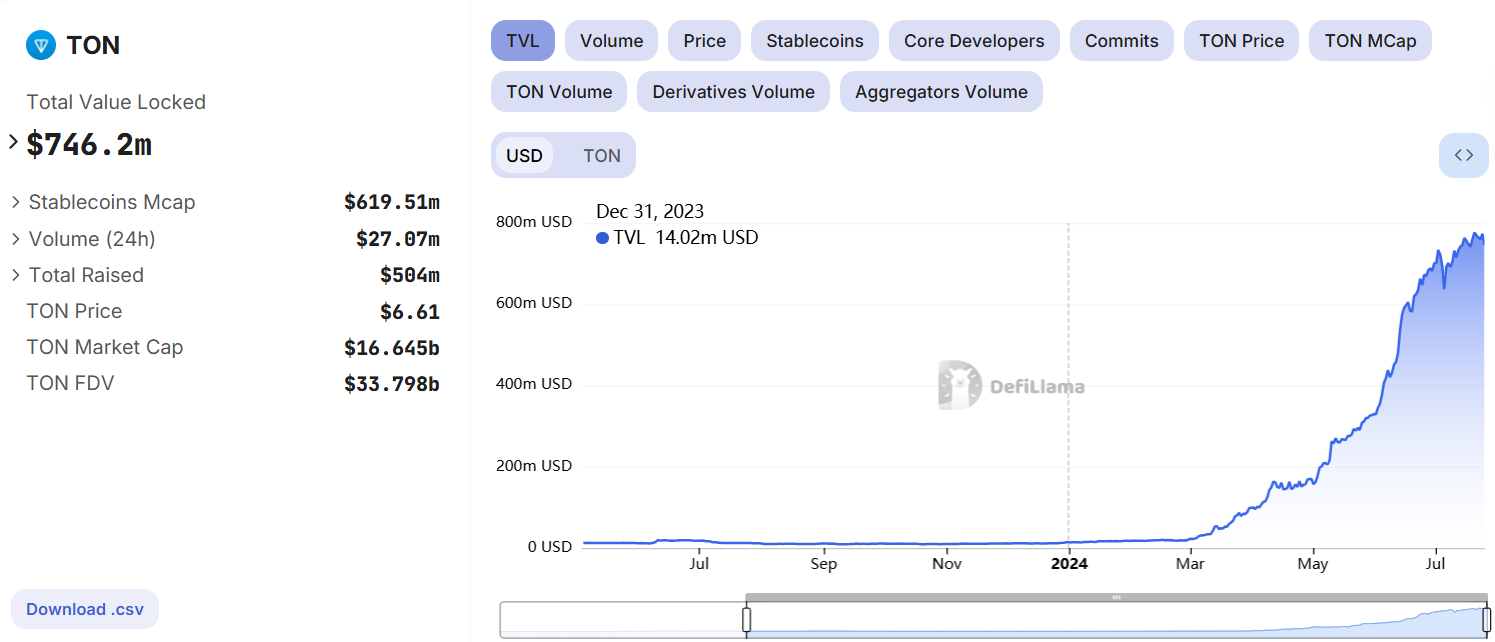
The crypto market has clearly recognized the massive wave that the TON ecosystem is about to unleash: the Total Value Locked (TVL) in the TON ecosystem has surpassed $740 million—an increase of 32x over just five months. Applications across various sectors within the ecosystem are thriving. TON-based GameFi projects on Telegram like Notcoin ($NOT) and the viral memecoin Dogwifhat ($Dogs) have broken into mainstream awareness, generating significant momentum for the Telegram×TON ecosystem and drawing intense market attention.
How Far Is Mass Adoption?
The Telegram×TON ecosystem appears to be getting closer to the ideal of mass adoption. However, the hype driven by memes alone is insufficient to sustain TON’s long-term value. A richer set of applications must emerge on this fertile ground. Yet, the unique technical architecture of TON makes development relatively complex, and the lack of foundational infrastructure means developers often lack the proper tools—clearly a setback for projects looking to join the TON ecosystem.
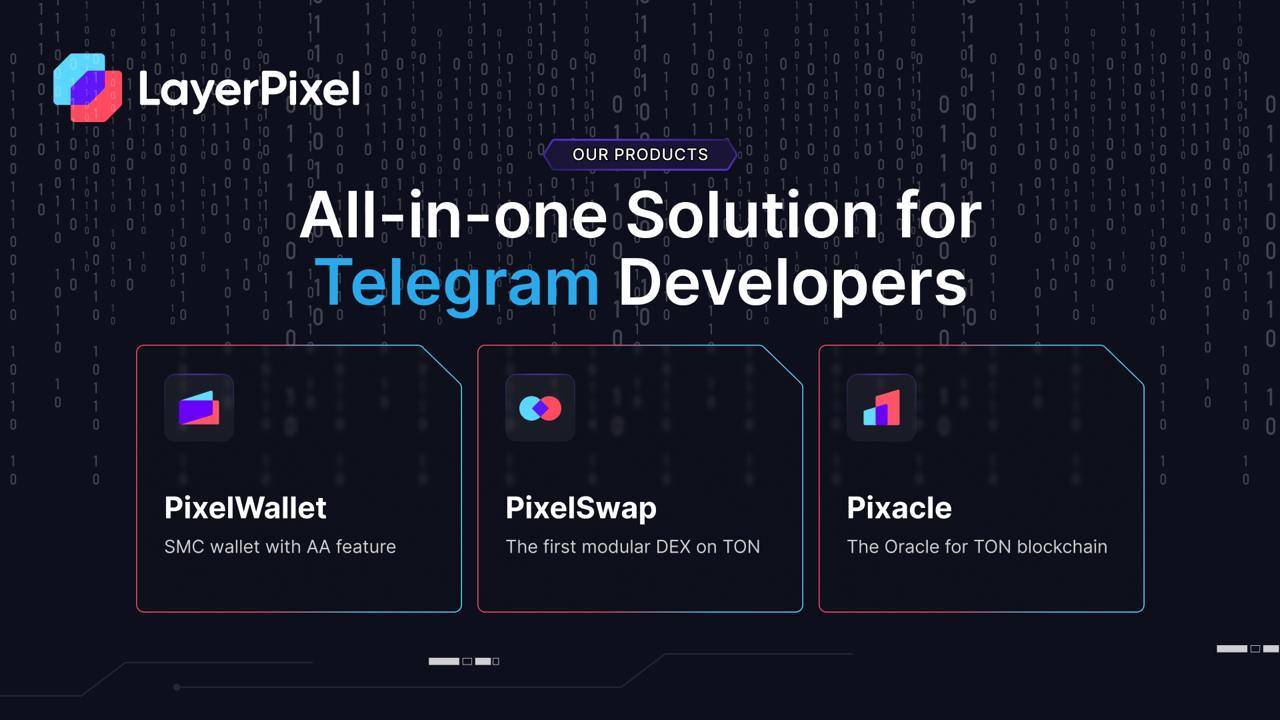
As the saying goes: “A craftsman must sharpen his tools before he can do his work well.” For the rapidly growing TON ecosystem, robust infrastructure is an indispensable foundation. LayerPixel, a Layer 1.5 solution built on TON for Telegram, fills this critical gap by offering one-stop DeFi services for Telegram Mini App developers, helping promising applications overcome the technical barriers of building on TON.
Recently, LayerPixel achieved a major milestone by announcing a $2 million seed round led by Kenetic Capital, with participation from Waterdrip Capital, Foresight Venture, VentureSouq, Web3 Port, Microcosm Research, TMM Club, and dozens of prominent individual investors. This funding not only reflects strong market confidence in LayerPixel but also provides solid backing for its ambitious roadmap.
Additionally, LayerPixel’s recently launched Game of Dawn initiative represents a novel attempt to seamlessly onboard Web2 users into the Web3 world, injecting fresh vitality and new possibilities into the TON ecosystem. It showcases the potential of the TON ecosystem to external audiences while offering innovative solutions to user acquisition and value creation challenges.
What enables LayerPixel to achieve such remarkable success in both fundraising and innovation? What unique strengths does it possess in terms of technological innovation, user strategy, and ecosystem development? Let’s dive deep into this project that is reshaping the TON ecosystem landscape.
From Pioneer to Foundation-Builder: The Evolution of LayerPixel
There are countless projects offering DeFi solutions—what sets LayerPixel apart?
Only after tracing LayerPixel team’s journey through the TON ecosystem do we realize that LayerPixel was born out of firsthand experience—the team had been caught in the rain, so they decided to hold up an umbrella for others.
Development Technical Challenges
During their exploration of the TON ecosystem, the team realized that for projects entering TON, relying solely on external capital isn’t always the best solution. The real challenge lies in technical development within the TON ecosystem.
From the early stages of development, the team identified several significant hurdles in building on TON:
Heterogeneous Asynchronous Sharding Increases Development Complexity
Unlike Ethereum’s synchronous transaction execution, TON’s heterogeneous asynchronous sharding means transactions aren’t executed synchronously. In such an environment, individual transactions may succeed or fail independently. This uncertainty, combined with complex inter-shard mechanisms, significantly increases the difficulty and cost of building DeFi applications that require fast and deterministic transaction confirmations.
Absence of Token Approval Mechanism
Ethereum uses a centralized ledger similar to Alipay, allowing users to easily transfer funds internally. In contrast, TON uses a decentralized ledger where assets cannot be transferred on behalf of users. Developers must design more complex contract logic to manage token transfers and authorizations, increasing smart contract complexity, development costs, and the risk of vulnerabilities and bugs.
Commitment to Building Native DeFi Infrastructure
Faced with these inherent development challenges on TON, the team realized that a high-quality, ecosystem-specific infrastructure and toolkit are crucial for the current state of the TON ecosystem.
They decided to shift their identity from “pioneers” to “foundation-builders,” taking it upon themselves to construct DeFi infrastructure tailored for the TON ecosystem.
Thus, LayerPixel emerged, ready to tackle the series of development challenges facing the TON ecosystem.
LayerPixel: The "Cheat Code" for TON Development
As an all-in-one DeFi solution, LayerPixel’s unique layered architecture—combined with integrated wallets and PixelSwap—enables development teams to effortlessly build DeFi projects on TON. It’s like activating a “cheat code” in a video game, turning what was once a grueling process into a smooth and enjoyable experience.
Layered Architecture: LayerPixel's Magical LEGO
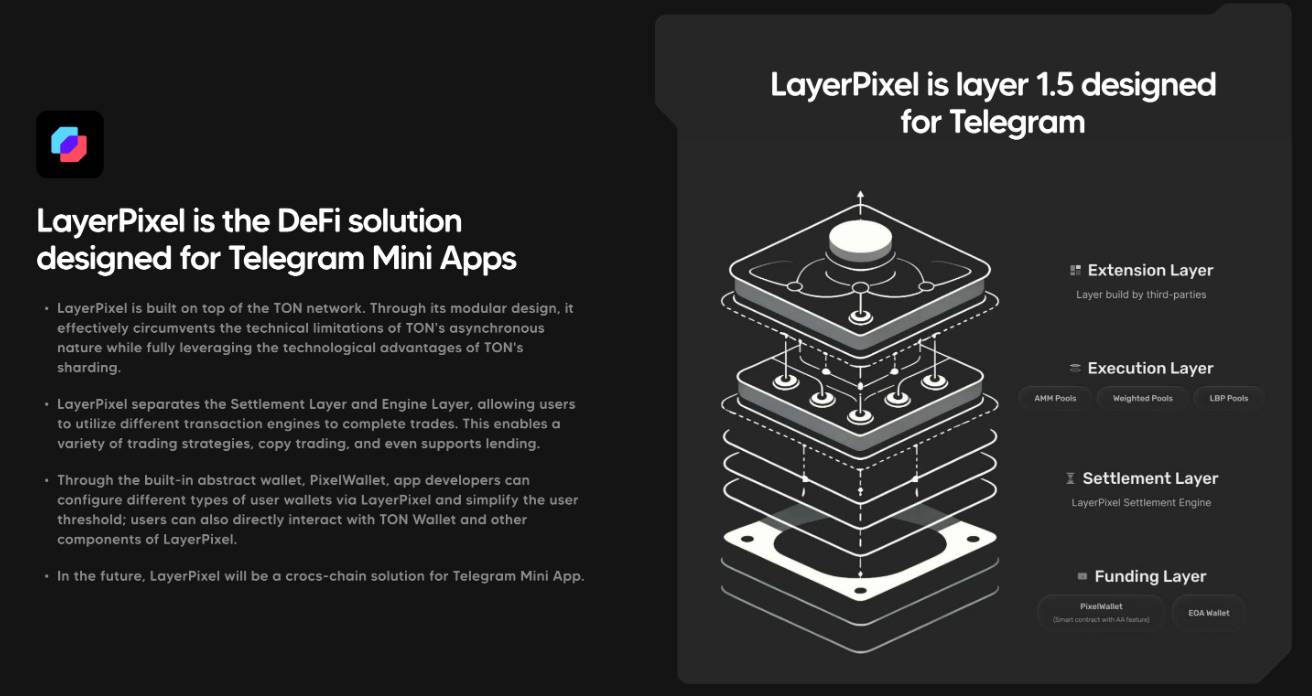
LayerPixel features a uniquely designed multi-layered architecture, with each layer serving distinct functions:
Funding Layer (Fund Management Layer)
A virtual asset storage layer that implements token approval functionality. The Funding Layer supports both the built-in abstract wallet PixelWallet and external EOA wallets, providing basic fund management as well as support for smart contracts and automation.
Settlement Layer
Analogous to a bank vault, this layer securely stores all funds and relies on the LayerPixel Settlement Engine—the core transaction settlement engine—to ensure accurate execution and recording of every transaction.
Execution Layer
Serving as the transaction matching engine, this layer includes the AMM Engine, Weighted Pool Engine, and LBP Engine.
These three engines work synergistically to deliver high-quality liquidity solutions for DeFi.
Extension Layer
A third-party-built extension layer that allows developers to add custom features and modules, enhancing system flexibility and scalability.
For example, developers can plug in anti-money laundering (AML) modules via the Extension Layer to enable functionalities like asset freezing.
Through this multi-tiered architectural design, LayerPixel delivers a flexible, efficient, and scalable DeFi solution capable of meeting diverse needs of users and developers alike.
PixelWallet: The Art and Science of Asset Management
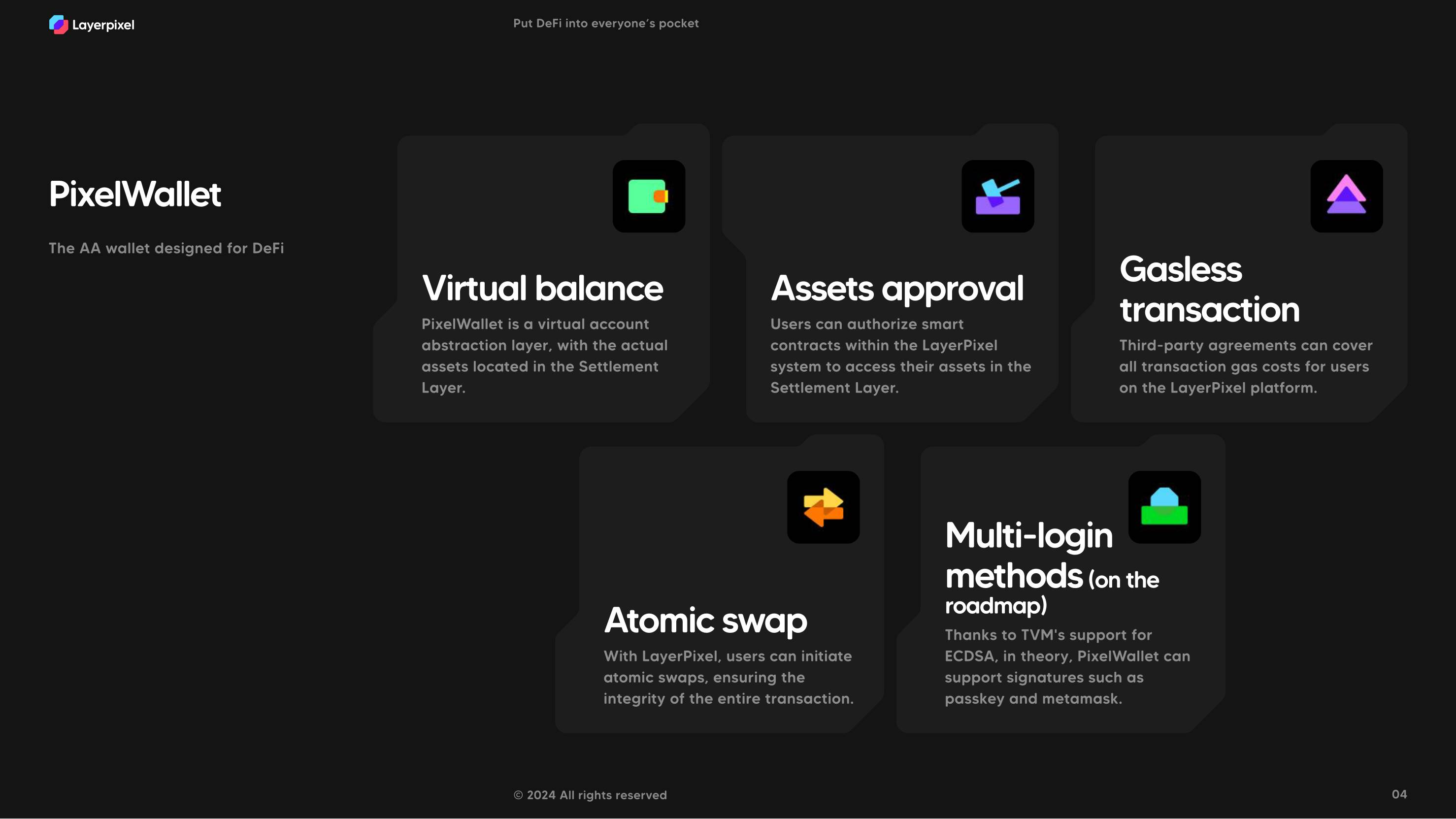
LayerPixel’s account abstraction wallet, PixelWallet, designed specifically for DeFi, offers developers and users a comprehensive suite of functional modules. It allows users to authorize LayerPixel’s internal smart contracts to access and manage virtual assets:
-
Supports gasless transactions, allowing third-party protocols to cover all gas fees.
-
Supports atomic swaps, enabling multiple transactions to be completed in a single operation, avoiding partial failures or data inconsistencies caused by asynchronous communication.
-
Plans to support multiple login methods, including passkeys and signature schemes like Metamask.
-
Allows app developers to configure different types of user wallets, simplifying onboarding, while supporting direct interaction between users and TON Wallet or other LayerPixel components—enhancing user experience and operational convenience.
PixelSwap: A Multidimensional Trading Engine for the TON Ecosystem
As LayerPixel’s core trading layer, PixelSwap plays a pivotal role.
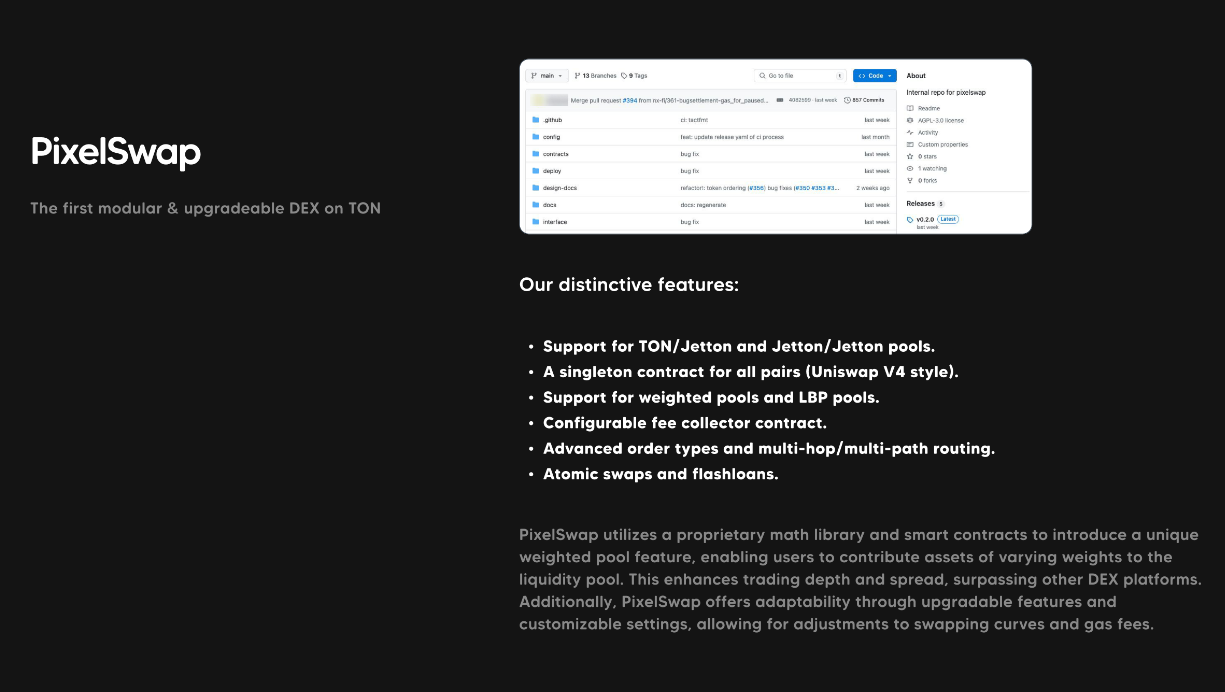
PixelSwap is the first modular and upgradeable decentralized exchange on TON, introducing innovative trading mechanisms and injecting fresh energy into the entire ecosystem.
Technically, PixelSwap’s uniquely designed weighted pool protocol significantly enhances liquidity efficiency and trading flexibility. By supporting TON/Jetton and Jetton/Jetton pools, it greatly expands the range of tradable pairs, giving users more options. Notably, PixelSwap adopts a singleton contract model similar to Uniswap V4 to manage all trading pairs, effectively improving platform efficiency and gas optimization.
Another standout feature of PixelSwap is its support for diverse trading algorithms. Beyond standard pools, the platform supports weighted pools and Liquidity Bootstrapping Pools (LBP), offering users greater flexibility in liquidity management and enabling more efficient capital utilization. Additionally, support for advanced order types and multi-hop/multi-path routing further optimizes trade execution speed and precision.
In terms of DeFi support, PixelSwap is equally impressive. The platform supports atomic swaps and flash loans, greatly enhancing functionality and enabling more sophisticated financial strategies. PixelSwap’s proprietary math library and smart contracts enable unique weighted pool functionality, allowing users to contribute assets with varying weights—increasing trading depth and improving price spread performance.
Upgradeability and customizability are another key advantages. The platform supports adjustable swap curves and gas fees, offering the flexibility to continuously optimize operations in response to market changes and user demands. Moreover, configurable fee collector contracts enhance operational flexibility, opening doors for future growth.
The modular design makes the entire system highly extensible and customizable. An asset authorization mechanism ensures transaction reliability. Gasless transactions reduce user costs. Atomic swap functionality guarantees transaction integrity and mitigates default risks. Multiple login methods enhance accessibility and security. Through this “magical LEGO” of foundational components, LayerPixel has built a flexible and efficient DeFi solution for Telegram-based applications on TON.
Joining LayerPixel’s Future
Earn Tokens via Points: Game of Dawn Helps You Mine LayerPixel
With the rapid development of the TON ecosystem, especially the emergence of numerous homogeneous applications centered around TapTap-style mini games, two major issues have surfaced: tokens lacking real utility, and large user bases consisting largely of “freebie hunters” rather than genuine participants.
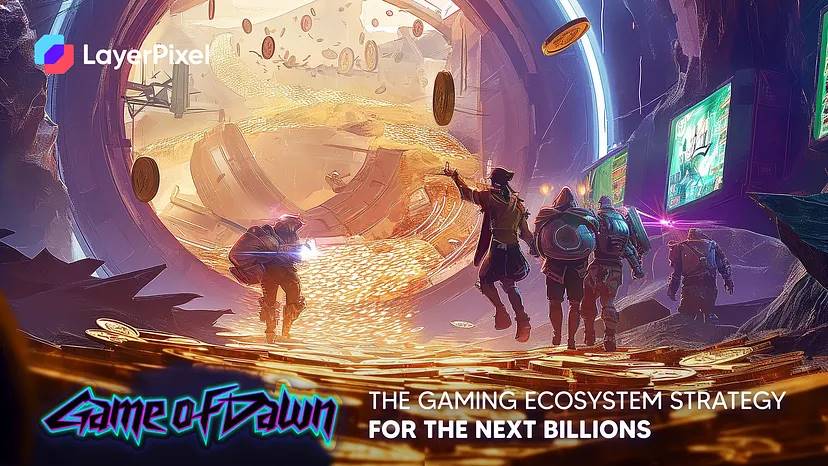
LayerPixel’s recently launched Game of Dawn aims to change this status quo.
Game of Dawn seeks to attract and reward authentic gamers through innovative mechanics while establishing a solid value foundation for LayerPixel’s token $PIX. The event cleverly bridges high-quality Web2 users into the Web3 world, breathing new life into the TON ecosystem.
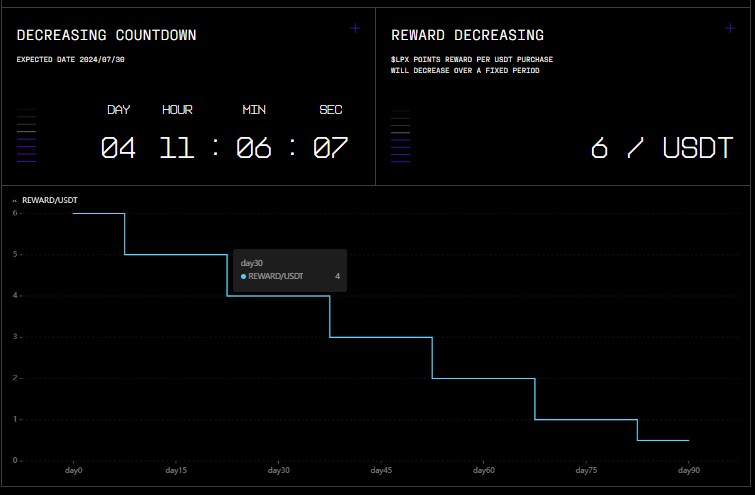
Through a paid participation model, Game of Dawn ensures it attracts genuinely engaged, high-quality users with spending power. By playing games on the platform, users earn activity points that will ultimately translate into allocations of the LayerPixel token $PIX. Game of Dawn employs a tiered point distribution structure based on when users join—early participants receive higher weightings and more rewards.
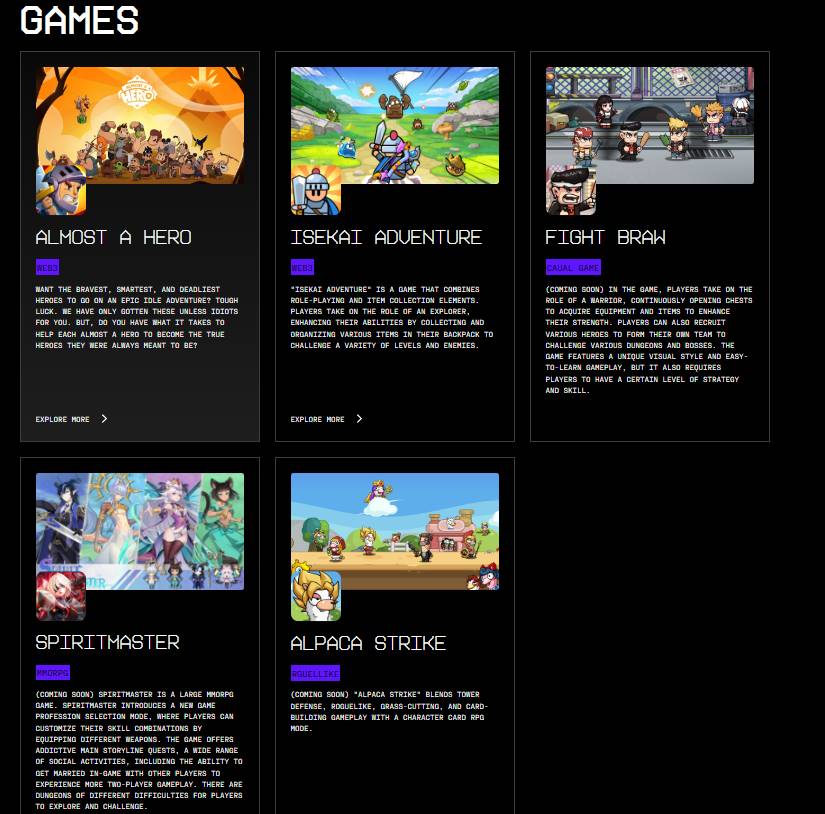
Going forward, the number of games available on the platform will continue to grow, offering users more ways to participate and earn points.
Through Game of Dawn, LayerPixel not only demonstrates its innovation in user acquisition and community building but also sets a new benchmark for the TON ecosystem—skillfully balancing user engagement, token value, and ecosystem growth, laying a solid foundation for long-term success.
To learn more about Game of Dawn, visit the official article: Introducing Game of Dawn
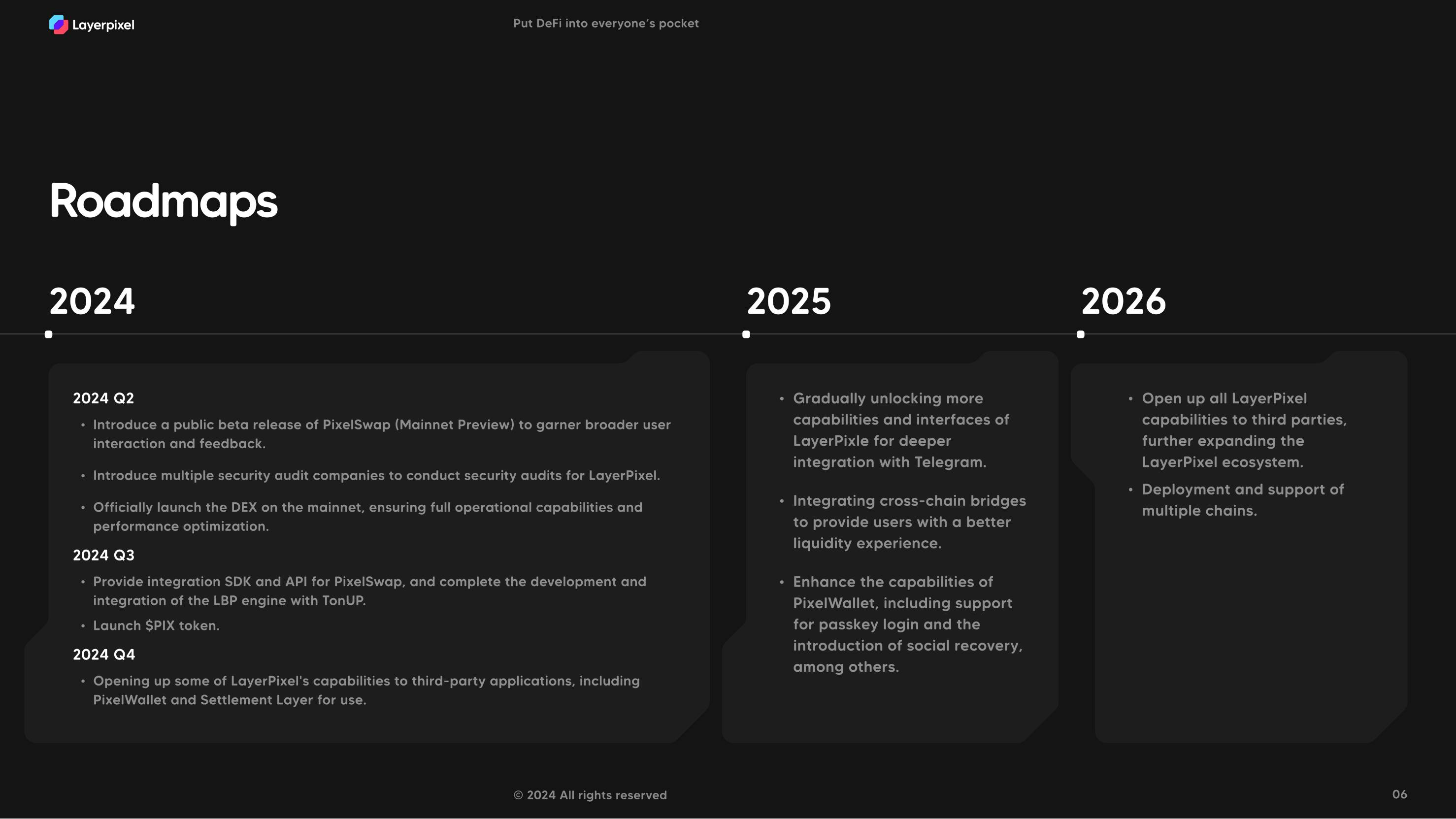
Looking ahead, LayerPixel will gradually unlock additional features and interfaces to deepen integration with Telegram and introduce cross-chain bridges to improve user liquidity experiences. Additionally, PixelWallet will be enhanced with features such as key-based login and social recovery.
By 2026, LayerPixel plans to open all functionalities to third parties, further expanding its ecosystem. Developers will be able to leverage LayerPixel’s technology to build diverse dApps, enriching the application scenarios within the TON ecosystem.
LayerPixel also plans to deploy and support multiple chains, evolving into a multi-chain platform. This will further enhance its flexibility and compatibility, enabling it to meet the needs of various blockchain environments.
Conclusion
From exploration to foundation-building, LayerPixel has steadily delivered results for the TON ecosystem.
As the market gradually recognizes TON’s value and the ecosystem continues to mature, demand for infrastructure will inevitably rise. LayerPixel’s timely arrival provides strong support for the still-developing Telegram×TON ecosystem.
From the all-in-one DeFi infrastructure component LayerPixel, to the full-service asset launchpad TonUP, to the liquidity-enabling PixelSwap—pioneering the development of the TON ecosystem, the team has provided a complete stack of foundational infrastructure, unlocking new possibilities for TON-based applications.
Perhaps true mass adoption is now closer than ever.
Join TechFlow official community to stay tuned
Telegram:https://t.me/TechFlowDaily
X (Twitter):https://x.com/TechFlowPost
X (Twitter) EN:https://x.com/BlockFlow_News
 深潮TechFlow


