"Pudgy Penguins" Enters L2 Arena Amid Skepticism: Tech Acquirer Saw Months of Stagnation, CEO Hopes for NFT Revival
TechFlow Selected TechFlow Selected
"Pudgy Penguins" Enters L2 Arena Amid Skepticism: Tech Acquirer Saw Months of Stagnation, CEO Hopes for NFT Revival
To better achieve technological development, Pudgy Penguins recently acquired the on-chain creator economy platform Frame.
 Navigating Web3 tides with focused insights
By Weilin, PANews

The well-known NFT project "Pudgy Penguins" has recently been making headlines—so much so that it even appeared in VanEck’s promotional video for its ETH ETF. In May, Pudgy Penguins announced a collaboration with game studio Mythical Games to develop an immersive mobile game set for release in 2025. Then in June, the project revealed it had co-founded a parent company named Igloo alongside its NFT licensing platform, OverpassIP.
Then came even bigger news: on July 23, Pudgy Penguins announced plans to launch "Abstract," a new Ethereum Layer 2 blockchain. This consumer-focused L2 secured $11 million in funding led by Peter Thiel’s Founders Fund. Prior to this announcement, Pudgy Penguins had already acquired Frame, a Web3 creator platform, aiming to leverage its technical expertise in blockchain development along with Pudgy Penguins’ own community and user base.
Building a Consumer-Centric L2—and Possibly Launching an Airdrop
The new L2, Abstract, is built using Matter Labs’ ZK Stack and EigenLayer’s data availability layer, EigenDA, making it easier, cheaper, and more secure to develop decentralized applications. Beyond building the chain itself, Pudgy Penguins also plans to establish a developer incubator designed to help apps go from 0 to 1.
This strategic funding round for Abstract was led by Peter Thiel’s Founders Fund, with participation from Fenbushi Capital, 1kx, Everest Ventures Group, and Selini Capital. Pudgy Penguins will use these funds to establish a new company called Cube Labs, which will oversee the development of the Abstract chain and provide ongoing support. Michael Lee, former Senior Vice President at Matter Labs—the developer behind Ethereum L2 ZKsync—will serve as CEO of Cube Labs.
Abstract is currently running on testnet, with the mainnet expected to launch around the end of this year, though the token launch timeline remains unclear. The Abstract team currently consists of about 30 members globally, and Cube Labs has an office in Miami.
Pudgy Penguins CEO Luca Netz aims to disrupt the space with Abstract. His ambitions are grand—he hopes to bring 100 million users on-chain. In a recent interview on the YouTube show Milk Road, Netz stated that the “consumer crypto revolution” will happen on one chain: Abstract. He believes the three pillars enabling this vision are “community, culture, and distribution.” Given its track record, Pudgy Penguins may indeed be well-positioned to deliver. He even emphasized, “Abstract will become synonymous with Layer 2—it will be *the* largest Layer 2, not just one among many or one of thousands.”
Pudgy Penguins entering the L2 space isn’t surprising; other NFT projects have done the same, such as Bored Ape Yacht Club’s Apechain and Azuki’s AnimeChain.
In fact, from a technical standpoint, launching a Layer 2 has become significantly easier and less expensive. Lugui Tillier, Chief Commercial Officer at Web3 infrastructure firm Lumx Studios, recently wrote that setting up and maintaining an L2 today can be fast and relatively cheap. Rollup-as-a-Service (RaaS) providers can spin up and maintain a rollup in under six minutes, for less than $1,000 per month. However, he also pointed out several challenges facing current L2 development. First, market liquidity is fragmented, requiring users to constantly switch wallets and bridge assets. Second, transaction costs on L2s remain unstable and unpredictable, which hampers app development. Additionally, these new chains risk further fragmenting the ecosystem. That said, some of these issues are being addressed by shared L2 solutions like CDKs. Polygon, Optimism, and ZkSync are working on liquidity aggregation layers that could make thousands of app-specific and industry-specific chains function seamlessly as one unified network. “Thousands of application and industry chains are coming—they’ll be essential for financially sustainable on-chain development,” Tillier noted.
To strengthen its technical foundation, Pudgy Penguins recently acquired Frame, a platform for on-chain creator economies. Last December, Frame announced on X that it had completed a new funding round, though the amount wasn’t disclosed. In January, it released an airdrop claim link but then went silent for months. Previously, Frame’s chain featured enforced royalties and native support for ERC-6551, allowing every ERC721 NFT to be linked to a smart contract wallet with full Ethereum account functionality—enabling true composability for NFTs.
According to the latest official tweet, Frame stated that users who were eligible for its previous airdrop will have their rewards recognized within Abstract’s incentive system.
L2 Move Sparks Debate—CEO Still Bullish on NFTs
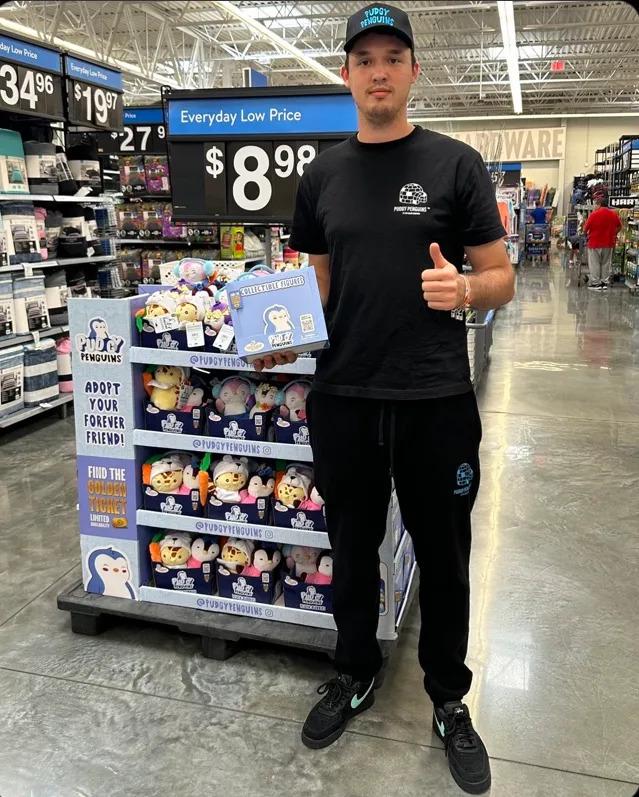
Pudgy Penguins’ current strength lies in its deep understanding of community and users, coupled with strong commercial execution. For example, its NFT-based physical plush toys have seen remarkable success in offline retail channels like Walmart. As of early July, these plush toys generated $13–14 million in retail sales, with 1.2 million units sold—an important pillar supporting the company’s financial health.
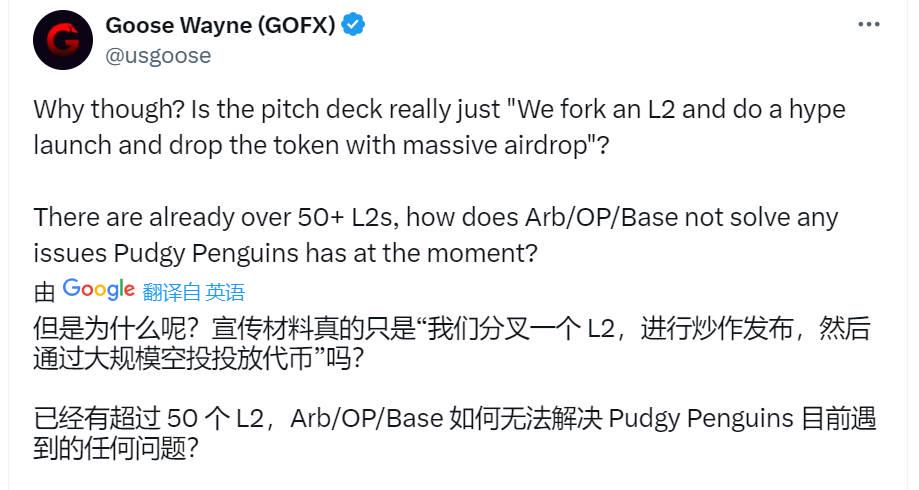
However, amid broader market struggles in the NFT space, Pudgy Penguins’ L2 initiative has drawn skepticism. Goose Wayne (GOFX) @usgoose commented, “But why? Is the pitch really just ‘we fork an L2, do a hype launch, and dump tokens via massive airdrops’? There are already over 50 L2s—why can’t Arb/OP/Base solve whatever problems Pudgy Penguins is facing?”
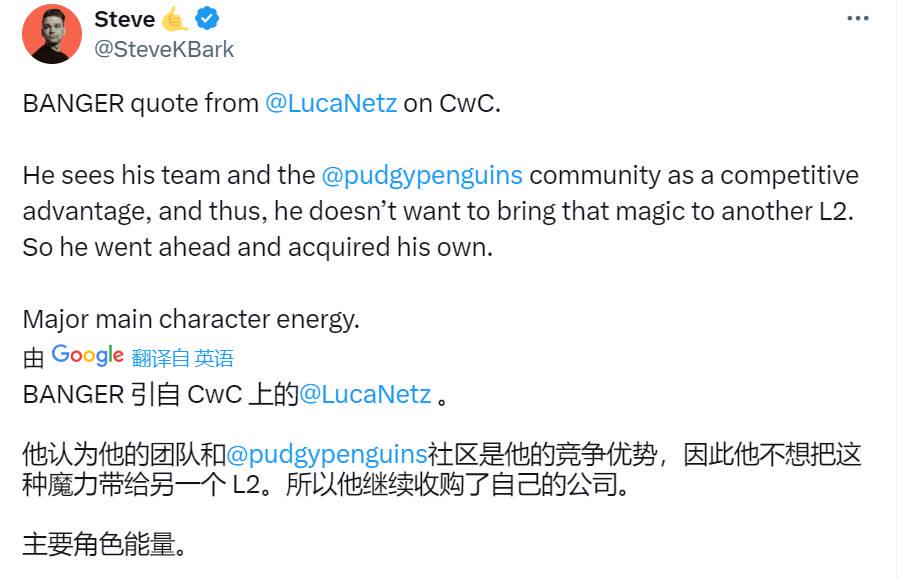
Still, there are supporters too. Steve@SteveKBark praised Luca Netz for showing “main character energy,” arguing that his team and the Pudgy Penguins community represent a unique competitive advantage—one he doesn’t want diluted across another L2. Hence, he chose to build his own.
Regarding recent NFT market performance, CEO Luca Netz offered his reflections and outlook: “I actually believe that if you look at the top NFT projects today, they’re executing at a pace never seen before in NFT history. The mechanism still works… Crypto markets are financially driven—anything offering massive returns will go through cycles. Despite volatility, it won’t disappear completely. So I think NFTs will come back.”
He added another bullish argument when comparing digital collectibles to physical ones. The current collectibles market is valued at around $450 billion, while the NFT (digital collectibles) market represents only 1% of that—meaning the ratio between physical and digital is 99 to 1. Yet digital collectibles offer numerous advantages over physical ones. “Clearly, the current 99-to-1 market cap split doesn’t reflect the real strengths of digital collectibles. I believe it should move closer to 50/50, indicating huge growth potential ahead.”
He further noted that in Asia and China especially, digital collectibles are gaining immense popularity, signaling strong growth potential from a consumer product perspective. “It’s clear NFTs are here to stay. The world is moving toward digitalization, and digital ownership is obvious to anyone who understands the internet and societal trends. NFTs sit at the core of this transformation. People want to collect, desire valuable items, and seek status symbols. I think the worst is behind us.”
For now, despite some mockery around Pudgy Penguins’ L2 move, the new developments have injected fresh momentum into both the NFT space and the broader market. How things unfold from here will be worth watching closely.
Join TechFlow official community to stay tuned
Telegram:https://t.me/TechFlowDaily
X (Twitter):https://x.com/TechFlowPost
X (Twitter) EN:https://x.com/BlockFlow_News
 PANews