








Building Solana City: Summary of the Interview with Solar, Chair of the Solana Foundation, by the Community
TechFlow Selected TechFlow Selected
Building Solana City: Summary of the Interview with Solar, Chair of the Solana Foundation, by the Community
Solar is a new decentralized Chinese-language community organization for Solana, dedicated to promoting the thriving development of the Solana ecosystem in Chinese-speaking regions and bringing Chinese-speaking influence into the Solana ecosystem.
 Navigating Web3 tides with focused insights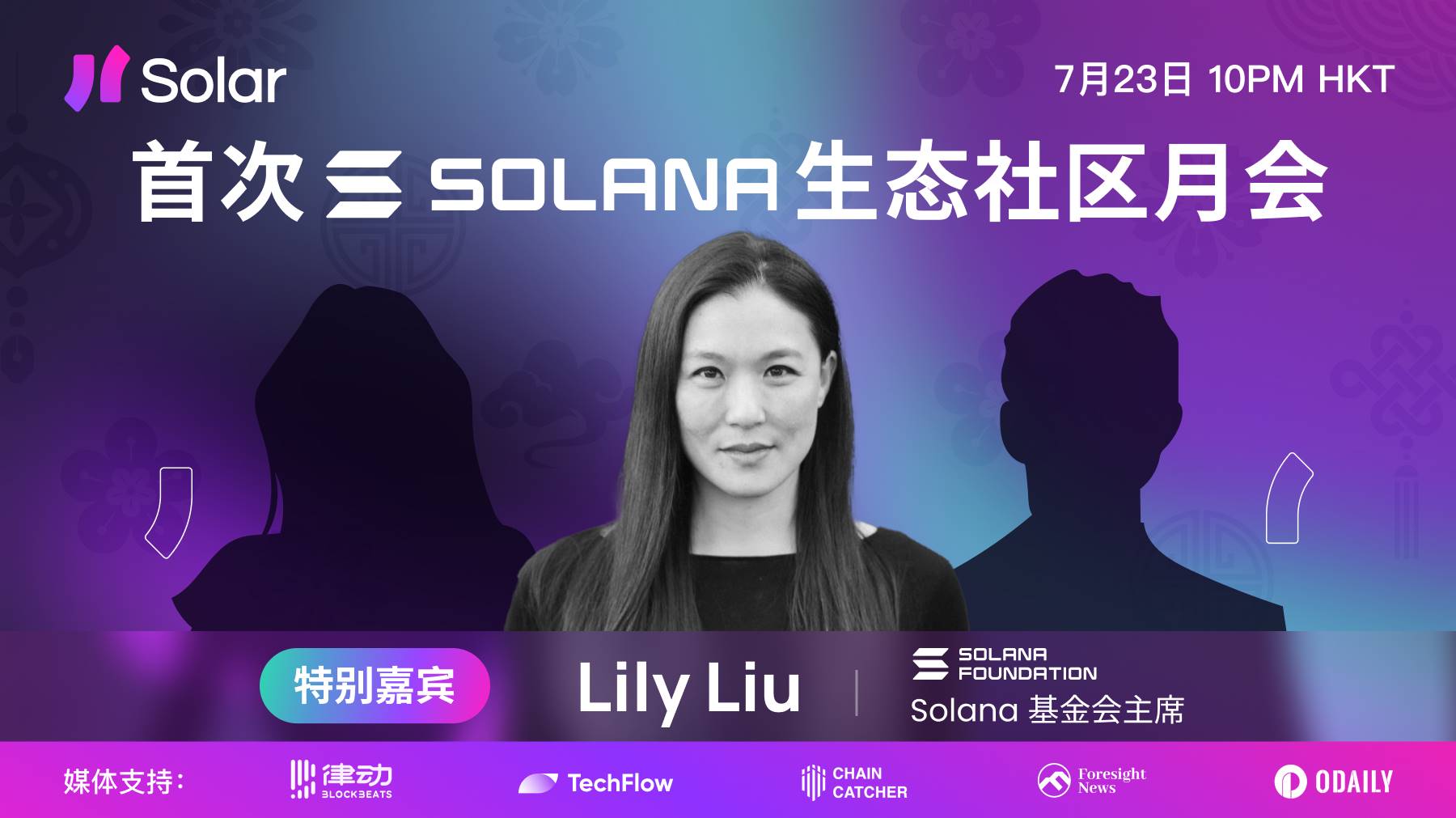
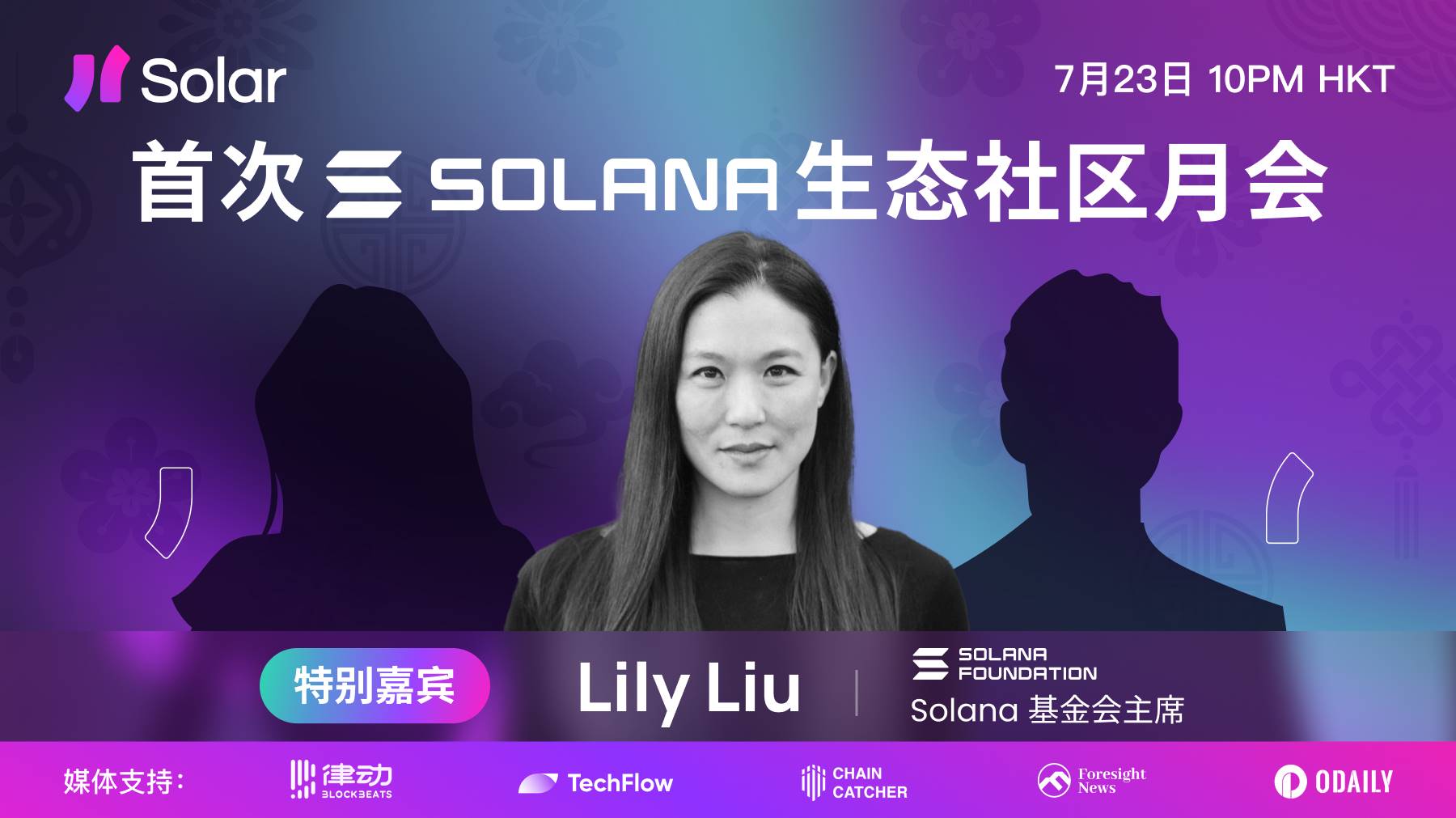
On the evening of July 23, Solar—the newly launched Chinese-language community brand for Solana—held its first monthly Solana ecosystem meetup. Lily Liu, Chair of the Solana Foundation, attended the event and engaged in an in-depth live conversation in Chinese with the entire Chinese-speaking community for the first time.
Through this interaction, it became evident that the Solana Foundation places significant importance on the Chinese-speaking ecosystem, community, and developers. During the livestream, Lily also repeatedly emphasized Solana’s vision as a value chain and the directions she hopes to advance.
Below is a summary of the event:
QA Summary
Q1
Please introduce yourself to partners in the Chinese-speaking region, Lily:
A1
Hello everyone, I'm Lily, Chair of the Solana Foundation. I currently live in Europe. I first discovered Bitcoin while in Shanghai ten years ago—back when blockchain was just Bitcoin. Before entering the blockchain space, I worked in traditional finance. I was born and raised in California; my family roots are in Hunan. I studied at Stanford and Harvard for both undergraduate and graduate school, then worked in investment banking at Morgan Stanley in Hong Kong, followed by McKinsey and later the private equity firm KKR. Over about five years, I worked in Shanghai, Beijing, and Hong Kong, so I have considerable familiarity with the region—and it's where my crypto journey began.
I first heard about Bitcoin ten years ago at a university alumni event. At first, I thought it was merely a tool for money laundering—until I read the Bitcoin whitepaper. It took me reading it seven or eight times to truly understand the industry and realize this was a profound transformation. This year marks my 10th anniversary in this space. My first blockchain project was in 2018 when we sold earn.com to Coinbase. After that, I moved on to other projects.
Three years ago, I learned about Solana and realized it was the only technology capable of matching Web2 user experience. At the time, I was in San Francisco and arranged a meeting with Solana’s founders. I never imagined that just months later I’d join the community and begin collaborating with the Solana Foundation. In recent years, one of our key focuses has been helping Solana build developer communities globally. I’m especially excited to have the opportunity to work with Adam, Daniel, and Yaoyao to build a strong Chinese-speaking community.
Q2
Unique community culture has always been a proud hallmark of the Solana ecosystem. Builders worldwide have established multiple decentralized communities—including Superteam—that have collectively driven Solana’s rapid growth. The recently launched Chinese-language community brand, Solar, aims to cultivate a distinct Solana community culture within the Chinese-speaking world. Lily, as Foundation Chair, how do you view Solana’s community culture, and why is decentralized community building so important?
A2
One of the biggest reasons Solana attracted me is its culture. Over the past decade, there have been many blockchain projects with strong technologies, innovations, and infrastructure. But I believe blockchain is more than just technology—it is itself a culture and a community.
What’s the core of building a large, successful community? I believe it’s value. Building practical, usable technology and a strong technical platform enables developers to create applications that deliver real value—value that Web2 cannot achieve.
Moreover, a community isn’t just a place to chat—it’s more like building a small city. From the start, we’ve viewed Solana not just as a blockchain or a tech platform, but as a city—with its own culture, infrastructure, economy, and internal values. This is how we aim to build our community.
Another key point: every community member should embrace the mindset “ask not what the chain can do for you, but what you can do for your chain.” We hope that regional communities contribute to our Solana city, and in return, the Solana city offers great opportunities to our builders. Over the past few years, many builders who consistently contributed to building this city have also achieved their own success.
A blockchain’s success doesn’t rely solely on the foundation—the foundation only does part of the work. What truly attracts investors, developers, and users is the effort of our builders.
Q3
Superteam, as one of the flagship community brands, has achieved outstanding results globally. Now, Solar is beginning its journey to build a community in the Chinese-speaking region. Lily, how do you see the potential of the Chinese-speaking community, and what are your expectations for Solar’s future?
A3
I believe the Chinese-speaking community is a vital force in the global blockchain industry and an essential market.
I've long believed there are two major markets in blockchain: the English-speaking world and the Chinese-speaking world. While the English-speaking market is led by the U.S.—the largest developer community—the second-largest is the Chinese-speaking region.
There are some differences between them. The English-speaking world tends to focus heavily on infrastructure, which has driven valuable innovation over the past 10–15 years. However, this cycle—where Ethereum continuously innovates on L2s and L3s—has outpaced actual user demand. I think it’s overheated. Applications that truly reach end consumers will be the ones to succeed in this bull market and drive mass adoption.
The strength of the Chinese-speaking region lies in building strong applications and application-layer products. Solana provides a ready-to-use, practical blockchain infrastructure that supports such applications. I hope to shift developer focus from infrastructure to applications. In terms of application development, the largest global developer community is likely in the Chinese-speaking world.
Q4
What key directions or events on Solana should we watch in the second half of the year?
A4
Each cycle has different focal points. The last cycle focused on NFTs and creators, but this bull market is centered on financial applications.
In fact, blockchain’s core is financial products. Its original value lies in financial relationships. Every cycle—2015, 2019—has brought innovation and progress in this area. I believe this cycle will see significant advancements in several domains:
First, payments. I believe payments are now feasible thanks to Solana. With Solana achieving significant scale, stablecoins become central. Stablecoins are booming globally—originally dominated by USDT, but now USDC is growing rapidly. There’s tremendous innovation in the stablecoin space—not just USD-pegged ones.
Recently, new regulations emerged in Europe, officially recognizing stablecoins as cash-related payment methods. This is a major boost for the stablecoin and broader blockchain industry. In Asia, several stablecoin pilots are underway. For example, last week in Hong Kong, news broke that 3–4 companies had begun formal trials for Hong Kong-issued stablecoins. I expect a HKD-pegged stablecoin next year.
We’re already seeing new FinTech products emerge, such as stablecoin credit cards, with several companies developing consumer finance applications. I entered the blockchain industry because I believe deeply in this global vision.
For the past 15 years, this vision was unattainable—Bitcoin was too expensive and slow, taking an hour to complete a transaction. Ethereum improved performance, but still requires two minutes and $2 per average transaction—insufficient for any payment-related product.
Now, in this cycle, we can finally combine payment platforms with project capabilities to enable unique applications that only exist on blockchains. Solana aims to build an integrated value chain across payments, stablecoins, asset management, and all financial products.
Q5
Recently, you’ve mentioned the concept of PayFi at several major industry conferences. Could you introduce PayFi to partners in the Chinese-speaking region?
A5
I believe Solana is the true inheritor of Bitcoin’s original vision. Until now, no other blockchain has fulfilled the promise Bitcoin initially offered.
When I first discovered Bitcoin, I read the whitepaper. Bitcoin’s original vision was “programmable money,” micro-payments, and a global financial system.
What applications could stem from that vision? That’s a massive mission and opportunity—one that Bitcoin, Solana, Ethereum, and the entire industry should collaborate on. Yet to date, no other community, chain, or technology has delivered it.
PayFi, in my view, embodies Bitcoin’s original vision.
We’ve discussed specific examples of PayFi at previous conferences. I see PayFi starting with payments and stablecoins, enabling complex financial products on-chain—a huge existing market. Of course, these concepts already exist in traditional finance.
I believe blockchain, as a new industry, doesn’t need to invent entirely new markets. Instead, it can bring more valuable products and solutions to existing markets by leveraging blockchain’s advantages.
About Solar:
Solar is a new decentralized organization for the Solana Chinese-speaking community, dedicated to advancing Solana’s ecosystem in the Chinese-speaking world and bringing Chinese-speaking talent into the Solana ecosystem.
Over the past year, the Solana Chinese community has organized over 100 online and offline events across cities in mainland China, Hong Kong, Taiwan, and Singapore, gathering more than 1,500 high-quality Chinese-speaking developers and supporting over 250 Chinese-language projects in Solana hackathons. Solar will continue this mission, empowering the community through diverse ecosystem events and localized developer education programs, offering comprehensive support to developers and entrepreneurs in the Chinese-speaking world.
Solar is currently recruiting early community contributors, including technical experts, opinion leaders, community ambassadors, and student ambassadors. Contributors will have opportunities to deeply engage in Solana ecosystem development and access top-tier resources from the Solana Foundation and global partners.
For more information, follow Solar’s official X account: https://x.com/Solana_zh
Join TechFlow official community to stay tuned
Telegram:https://t.me/TechFlowDaily
X (Twitter):https://x.com/TechFlowPost
X (Twitter) EN:https://x.com/BlockFlow_News
 @Solana_zh


