Why is Solana's market performance holding strong? Robust fundamentals and ETF expectations attract capital inflows
TechFlow Selected TechFlow Selected
Why is Solana's market performance holding strong? Robust fundamentals and ETF expectations attract capital inflows
After the expectations around spot Bitcoin and Ethereum ETFs settled, Solana has become the next target for investor enthusiasm and speculative hype regarding ETFs.
 Navigating Web3 tides with focused insights
Author: Nancy, PANews
Following the resolution of expectations around spot Bitcoin and Ethereum ETFs, Solana has emerged as the next favored and heavily speculated-upon candidate for an ETF, especially as multiple issuers have successively filed applications for Solana ETFs, boosting market confidence. Strong fundamentals, significant institutional accumulation, and the U.S. election landscape have further elevated optimistic sentiment toward Solana. This article analyzes the main reasons behind Solana’s recent outperformance relative to the broader market.
Outperforming Ethereum Across Key Metrics, Attracting Institutional Accumulation
In recent months, Solana has demonstrated strong market performance and gained increasing favor from institutions.
Price movements often significantly influence user confidence and market expectations. According to CoinGecko data, SOL recently reached a nearly three-month high and delivered a 31.1% gain over the past 30 days—outpacing major crypto assets including Bitcoin and Ethereum.
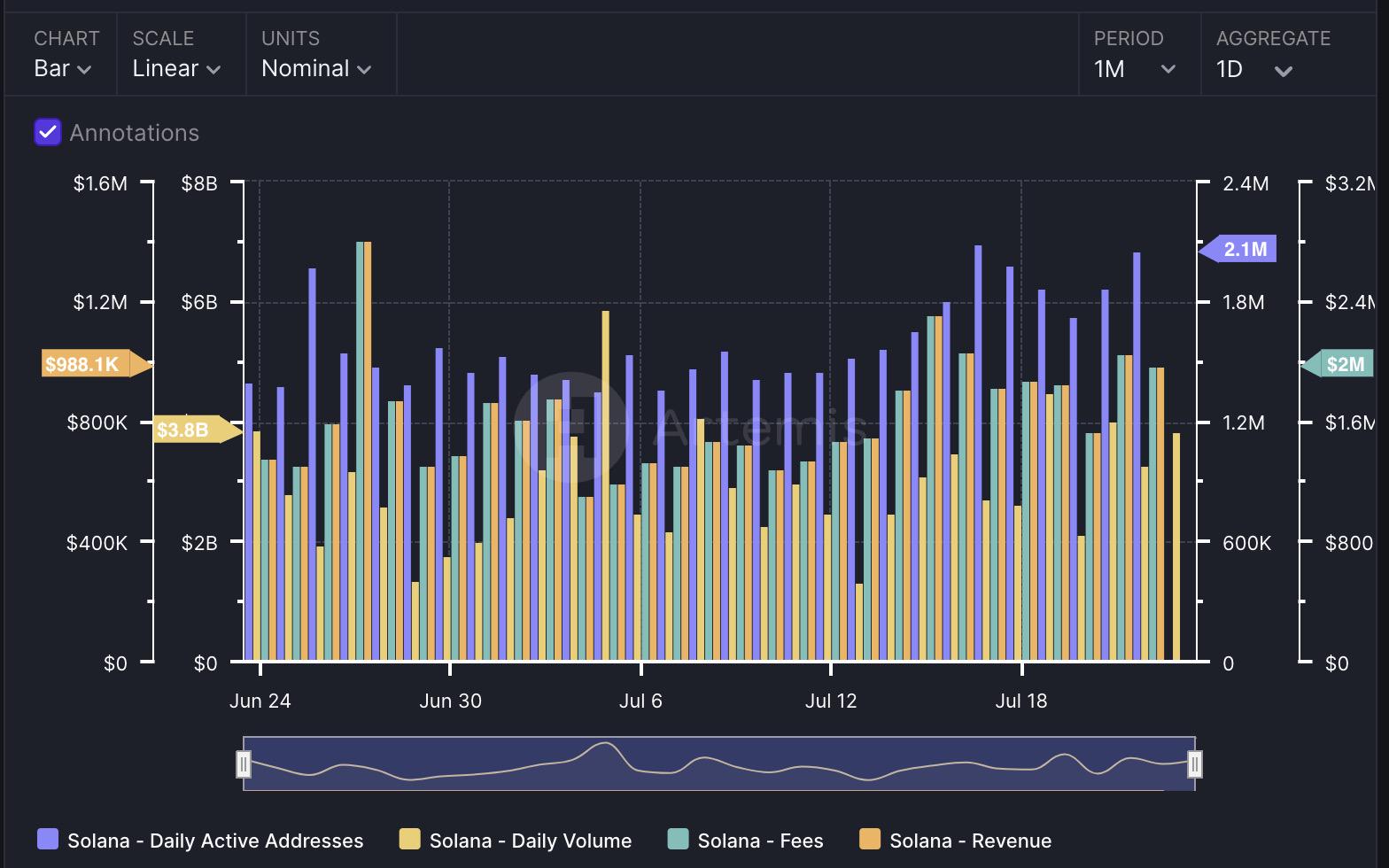
Meanwhile, Artemis数据显示 that over the past month, Solana’s daily trading volume rose 40.5% to $43.7 million; daily active addresses surged 75% to 2.1 million, driven primarily by wallets, meme coins, and cross-chain bridges—with new user addresses accounting for a higher proportion. Total value locked (TVL) increased by approximately 26.9% to $5.2 billion, while daily transaction fees climbed over 33.3% to $2 million, with daily revenue also rising over 33.1%. Wallets, DeFi, and MEV were the primary contributing sectors.
Additionally, Ryan Connor, a researcher at Blockworks Research, recently stated on X that Solana surpassed Ethereum in decentralized exchange (DEX) trading volume over the past 30 days—the first time Solana has ranked as the most-used chain by this metric.

According to a report by Coin98 Analytics, Solana’s fees and revenue saw substantial growth in Q2 2024, generating over $26 million in revenue—a year-on-year increase of more than 42x. SOL’s total transaction volume reached $292 billion, nearly seven times higher than the same period last year. Dune data also shows that Solana’s liquid staking ratio rose to 6.58%, up 1.76% quarter-on-quarter, while the market share of the top three providers declined from 93% to 68.7%, indicating a healthier and more diversified ecosystem.
Amid Solana’s robust fundamentals, several institutions have recently begun publicly accumulating SOL. For example, Canadian fintech firm DeFi Technologies announced it added Solana to its digital asset reserves, currently holding 12,775 SOL (worth approximately $2.03 million). Canadian-listed investment company Cypherpunk significantly increased its SOL holdings to over 63,000 tokens and also announced plans to operate its own Solana validator, pledging 49,917 tokens (valued at around $11 million) through its own node.
“This isn’t something you see every day. We’re now responding to growing investor interest in Solana—one of the most actively traded cryptocurrencies after Bitcoin and Ethereum,” commented Cboe’s global head of ETP listings in remarks on the Solana ETF 19b-4 filing. Rennick Palley, founding partner at crypto venture fund Stratos, also noted, “Loosening U.S. regulatory policies are increasing SOL’s appeal among professional investors.”
Multiple Issuers File for Solana ETF, Political Shifts Introduce Uncertainty
Solana’s strong market performance has made a spot ETF application a key catalyst, positioning it as one of the most anticipated and likely candidates for approval.
On June 27, VanEck announced it had submitted an application for the “VanEck Solana Trust” to the U.S. SEC—the first Solana ETF application filed in the United States. If approved, the ETF would list on the Cboe BZX Exchange. 21Shares quickly followed, submitting an S-1 form for a spot Solana ETF, planning for the 21Shares Core Solana ETF to trade on Cboe BZX. Digital asset management firm 3iQ also recently filed an application for a Solana ETF in Canada, intending to list under the ticker $QSOL—marking the first Solana ETF application in North America.
Franklin Templeton has also expressed optimism about Solana: “Beyond Bitcoin and Ethereum, we believe other exciting developments are driving innovation in crypto. Solana has demonstrated broad use cases and is maturing rapidly, overcoming early technical hurdles and showcasing the potential of a high-throughput monolithic architecture.” Nate Geraci, president of The ETF Store, recently revealed that within the coming months, an ETF issuer plans to file for a combined spot ETF featuring Bitcoin, Ethereum, and SOL.
VanEck, 21Shares, and Franklin Templeton are all established issuers of spot Bitcoin and Ethereum ETFs in the U.S., and their involvement strengthens market expectations for a Solana ETF. Currently, Cboe has submitted the 19b-4 forms for VanEck and 21Shares’ Solana ETFs to the SEC. “Once the SEC acknowledges these filings, the decision clock starts ticking,” commented Nate Geraci.
With market sentiment rising, shifting political dynamics surrounding the U.S. election have further boosted the likelihood of a Solana ETF approval. As former President Donald Trump’s chances of winning the Republican nomination increase, speculation has grown that SEC Chair Gary Gensler—an outspoken regulator—may step down. Markus Thielen, founder of 10x Research, even predicted that although Gensler’s term officially ends on June 5, 2026, he may resign when President Biden’s term concludes in January or February 2025. Prior to this, the SEC repeatedly classified SOL as an unregistered security, making approval challenging.
“If SEC Chair Gary Gensler does not remain in his position following the 2024 presidential election, the chances of a Solana ETF approval will increase,” said Matt Sigel. Crypto voters could play a decisive role in the election, and the regulatory environment in Washington appears to be shifting toward greater support for cryptocurrencies. Moreover, the path from futures to spot funds for Bitcoin and Ethereum was arguably just part of Gensler’s psychological strategy. Bloomberg ETF analyst James Seyffart noted that the final deadline for a Solana ETF decision is mid-March 2025. However, the most critical date during this period is November. Only with new leadership in the White House and at the SEC would there be a realistic chance of launching such a product sometime in 2025.
However, political uncertainty remains due to the close association between Solana and FTX founder Sam Bankman-Fried (SBF), who was a major Democratic donor and one of President Biden’s largest contributors. The impact of political shifts on Solana is therefore still unclear. Notably, Solana co-founder toly (Anatoly Yakovenko) has not publicly disclosed his political stance.
Looking at capital inflows following the approval of spot Bitcoin ETFs, if Solana officially joins the ETF wave, it could provide direct price momentum. According to a forecast by leading crypto market maker GSR Markets, if the U.S. launches a spot Solana ETF, under bearish, baseline, and ideal scenarios, capital inflows could reach 2%, 5%, and 14% of Bitcoin ETF inflows respectively. Given that Solana’s market cap averaged 4% of Bitcoin’s over the past year, SOL could rise 1.4x in a bear market, 3.4x under baseline conditions, and 8.9x in an ideal scenario.
Join TechFlow official community to stay tuned
Telegram:https://t.me/TechFlowDaily
X (Twitter):https://x.com/TechFlowPost
X (Twitter) EN:https://x.com/BlockFlow_News
 PANews