








Life of Rollups After the Post-Cancun Upgrade Era
TechFlow Selected TechFlow Selected
Life of Rollups After the Post-Cancun Upgrade Era
The Cancun upgrade significantly reduced the operating costs of Dapp Rollups, encouraging more Dapps to adopt the Rollup paradigm for re-architecture.
 Navigating Web3 tides with focused insights
Author: NingNing
The core upgrade of Cancun, EIP-4844, moves L2 batch data posted to Ethereum's mainnet into newly added Blob storage space.
As we know, the architectural design of Rollups essentially involves reselling Ethereum mainnet blockspace to developers and end users.
There are two core business models for Rollups:
-
Building a truly thriving Rollup ecosystem and profiting from the gas price spread between L1 and L2 transactions, as well as Sequencer MEV revenue. Examples using this model include Arbitrum, Optimism (via the Superchain ecosystem), Base, etc.
-
Leveraging airdrop expectations to continuously run user engagement campaigns (Odyssey-style PUA), while earning revenue from the L1<>L2 gas spread and Sequencer MEV. Examples using this model include ZkSync, Scroll, Linea, etc.
The Cancun upgrade drastically reduces data availability costs for L2→L1 transactions, causing average gas fees on upgraded L2s to drop by an order of magnitude.
Ethereum aims to strengthen L1's dominance over its current Rollup-centric ecosystem through the Cancun upgrade, promoting explosive growth in the number of Rollups by reducing costs and improving efficiency.
However, it has inadvertently undermined the economic foundation of Rollups relying on the second business model.
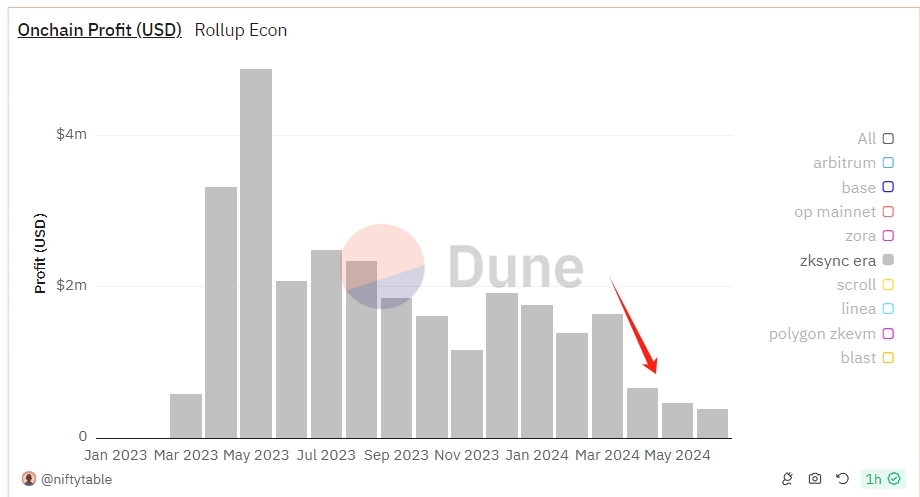
ZkSync is hit hardest. Immediately after the Cancun upgrade, ZkSync was among the first to adopt the new feature—but with poor results. Despite geometric reductions in gas fees, there was no corresponding surge in user growth or ecosystem activity. Instead, their revenue from L1-L2 gas spreads was halved.
Given ZkSync’s historically underdeveloped ecosystem, rising MEV revenue could not offset the sharp decline in gas spread income. With no other options, ZkSync chose to conduct its airdrop during June’s market rebound, effectively enabling partial exit via token sales in secondary markets.
In contrast, competitors like Scroll and Linea have resisted community and market pressure—first, by delaying deployment of the Cancun upgrade as long as possible to maintain high L2 gas fees and profit from the spread; second, by holding firm on their no-airdrop, no-token launch policy to continue user engagement (PUA).
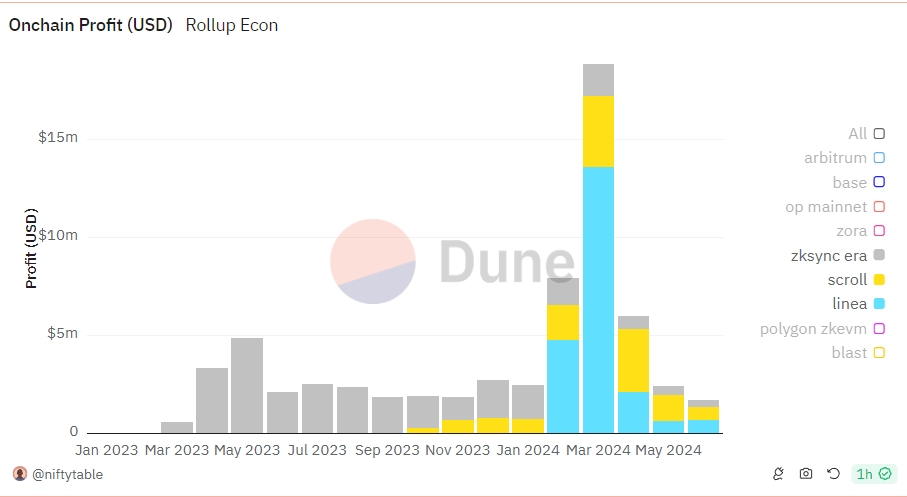
On-chain data shows that since February, Scroll and Linea have significantly outperformed ZkSync in Rollup revenue.
I believe that until Ethereum’s next Pectra upgrade changes the rules again, teams like Scroll and Linea will have zero intention of launching tokens or conducting airdrops—so “digital beggars,” manage your expectations accordingly.
Rollups following the first business model face different challenges, primarily the capital and user drain caused by Solana’s Meme coin frenzy siphoning attention away from the Ethereum ecosystem.
Fortunately, Base chain’s sudden rise in SocialFi and Meme sectors has become a shield protecting Ethereum’s ecosystem against Solana’s aggressive expansion, driving Rollup revenues upward—maintaining the top spot for four consecutive months.
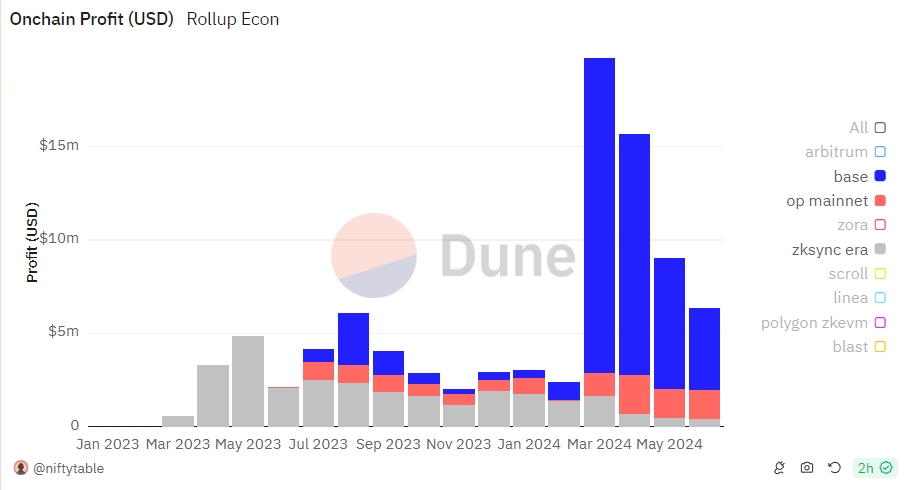
Since Base is built using the OP Stack and is part of Optimism’s Superchain, Optimism benefits from Base’s ecosystem success through positive externalities, seeing its Rollup revenue grow post-Cancun upgrade.
Meanwhile, former leader Arbitrum saw a dip in Rollup revenue in April and May due to overexposure to Web3 gaming and slow progress on its Rollup Stack strategy, but quickly recovered in July.
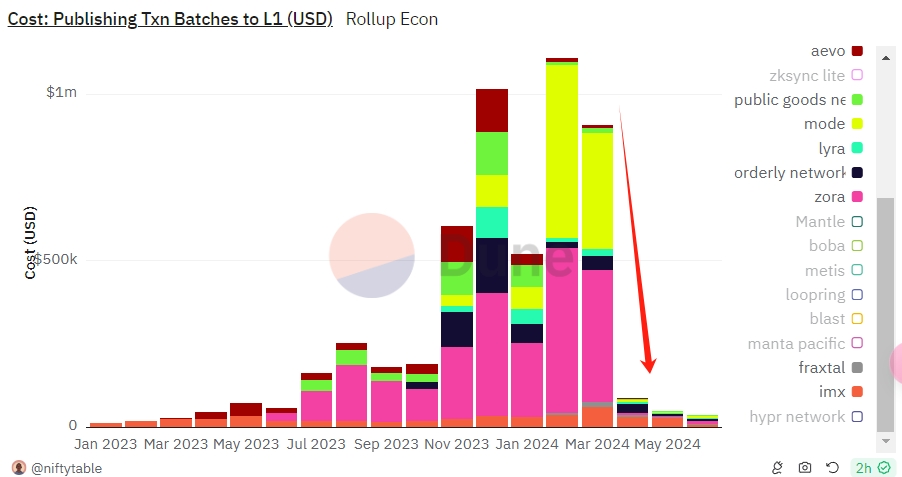
Finally, the Cancun upgrade has greatly reduced operating costs for Dapp-specific Rollups, encouraging more dApps (such as Frax, Uniswap, AAVE, etc.) to restructure using the Rollup paradigm.
Join TechFlow official community to stay tuned
Telegram:https://t.me/TechFlowDaily
X (Twitter):https://x.com/TechFlowPost
X (Twitter) EN:https://x.com/BlockFlow_News
 @0xNing0x










