








Biden stepped down, who will take over?
TechFlow Selected TechFlow Selected
Biden stepped down, who will take over?
Vice President Harris is the frontrunner, followed by California Governor Newsom, Michigan Governor Whitmer, and Pennsylvania Governor Shapiro.
 Navigating Web3 tides with focused insights
Author: Huang Yu
Source: Wall Street Insight
U.S. President Biden announced on Sunday that he would withdraw from the race. Who will now take over for the Democrats to face off against Trump?
Vice President Kamala Harris is the front-runner, followed by Gavin Newsom, California's governor who strongly promotes renewable energy, as well as Gretchen Whitmer and Josh Shapiro, who lead two key swing states.
Kamala Harris
Harris’s biggest advantage is Biden’s endorsement. On the 22nd, Biden stated on social media that he would fully support Harris as the Democratic nominee this year.
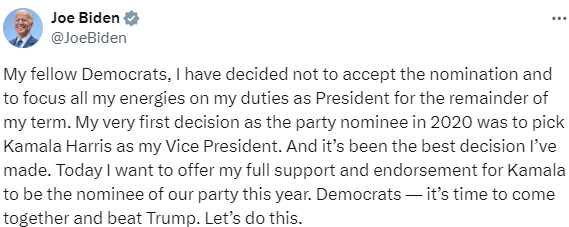
This means Harris will likely gain support more easily than other candidates, as she essentially continues Biden’s policies. Campaign funds that previously backed Biden are highly likely to shift toward her.
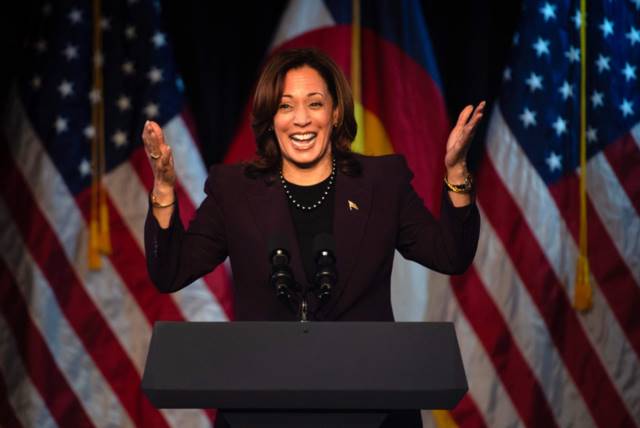
Image source: Visual China
Isaac Boltansky, BTIG's policy research director, pointed out that there is little policy divergence between Biden and Harris on major issues. Harris would largely continue Biden’s agenda, with perhaps only slight shifts in emphasis. For example, Harris is a strong advocate for climate action and has repeatedly expressed concern about climate change, emphasizing its impact on the global economy and society, and proposing various response strategies.
She also advocates a $6,000 tax credit for middle- and low-income households. Increasingly, top Democratic leaders, including the Clintons, have voiced their support.
Gavin Newsom
If Harris fails to secure the nomination, California Governor Gavin Newsom would be considered the strongest alternative. One reason is that California is a Democratic stronghold—regardless of who the nominee is, Democrats are almost certain to win the state.
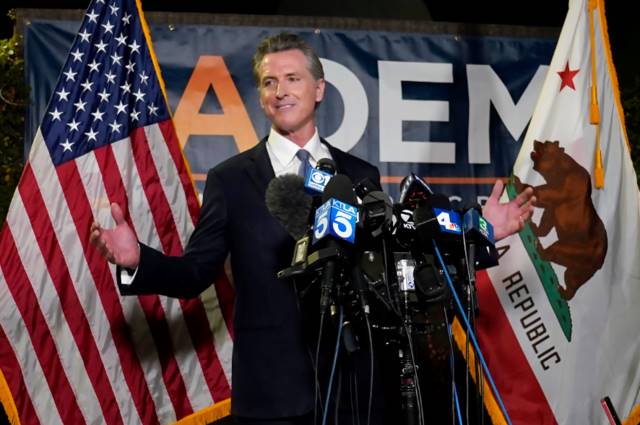
Image source: Visual China
On the other hand, Newsom has experience running large-scale campaigns—he even participated in a debate during this election cycle, going head-to-head last December with then-Republican presidential candidate Ron DeSantis.
In terms of policy, Newsom firmly defends Biden’s economic agenda. In California, he actively promotes renewable energy policies, aiming for the state to run entirely on clean energy within twenty years.
More importantly, Newsom stated last week that he would not challenge Harris if she seeks the presidency.
Gretchen Whitmer
Besides Newsom, Michigan Governor Gretchen Whitmer is another leading contender, partly because she has spent over five years building influence in Michigan, a pivotal swing state whose role in the general election is crucial.
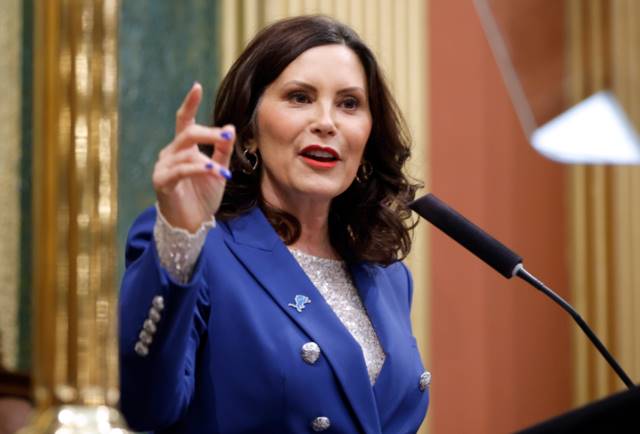
Image source: Visual China
In the 2022 U.S. midterm elections, Whitmer defeated her Republican challenger by a 10-point margin. Democrats believe that as a presidential or vice-presidential nominee, Whitmer could bring support not only in Michigan but also in other "Rust Belt" states like Pennsylvania and Wisconsin.
On policy, Whitmer is more moderate than some other contenders. She supports economic development incentives for large corporations like Ford, encouraging them to expand operations in the state. This has drawn criticism from some local lawmakers, who argue these funds should instead go toward public infrastructure. As a candidate, she has won support from affluent suburban voters in Michigan—many of whom were alienated by Trump.
Josh Shapiro
Pennsylvania Governor Josh Shapiro, like Whitmer, benefits from leading a key swing state. Shapiro has served as Pennsylvania’s governor for only a year and a half, but he built national recognition earlier during his tenure as state attorney general.
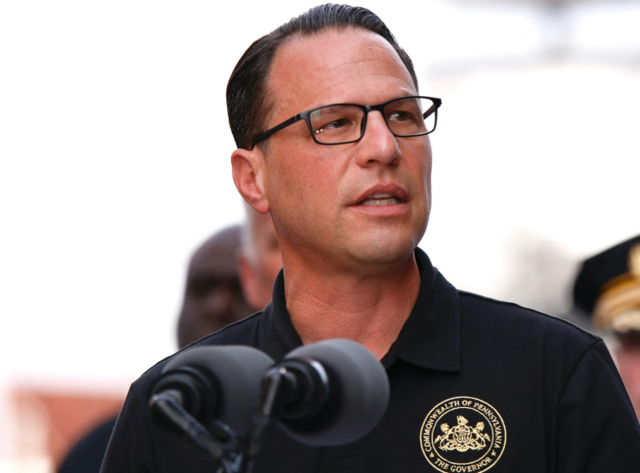
Image source: Visual China
As governor, Shapiro has tried to balance advancing the clean energy transition while supporting regions in Pennsylvania that still rely on traditional fossil fuel industries. He proposed a carbon emissions plan under which Pennsylvania would establish its own independent carbon pricing program, with most of the costs borne by traditional power plants and used to lower electricity bills for consumers.
In hypothetical matchups against Trump, his polling numbers are significantly better than Biden’s. A recent poll by BlueLabs Analytics showed that candidates like Shapiro and Whitmer lead Biden by “about 5 percentage points” in swing states. Even if Shapiro does not secure the presidential nomination, this polling data could position him as a potential vice-presidential candidate.
Like Newsom, however, Shapiro also expressed support for Harris on Sunday, stating in a declaration that uniting behind the vice president is “the best path forward for the Democratic Party.”
Therefore, judging from public statements, if Harris continues her campaign, Whitmer, Newsom, and Shapiro are all likely to step aside for her.
Join TechFlow official community to stay tuned
Telegram:https://t.me/TechFlowDaily
X (Twitter):https://x.com/TechFlowPost
X (Twitter) EN:https://x.com/BlockFlow_News











